Property Tax Appeal Savings Calculator
Real estate tax reduction tool • Property valuation
Property Information
Appeal Details
Advanced Options
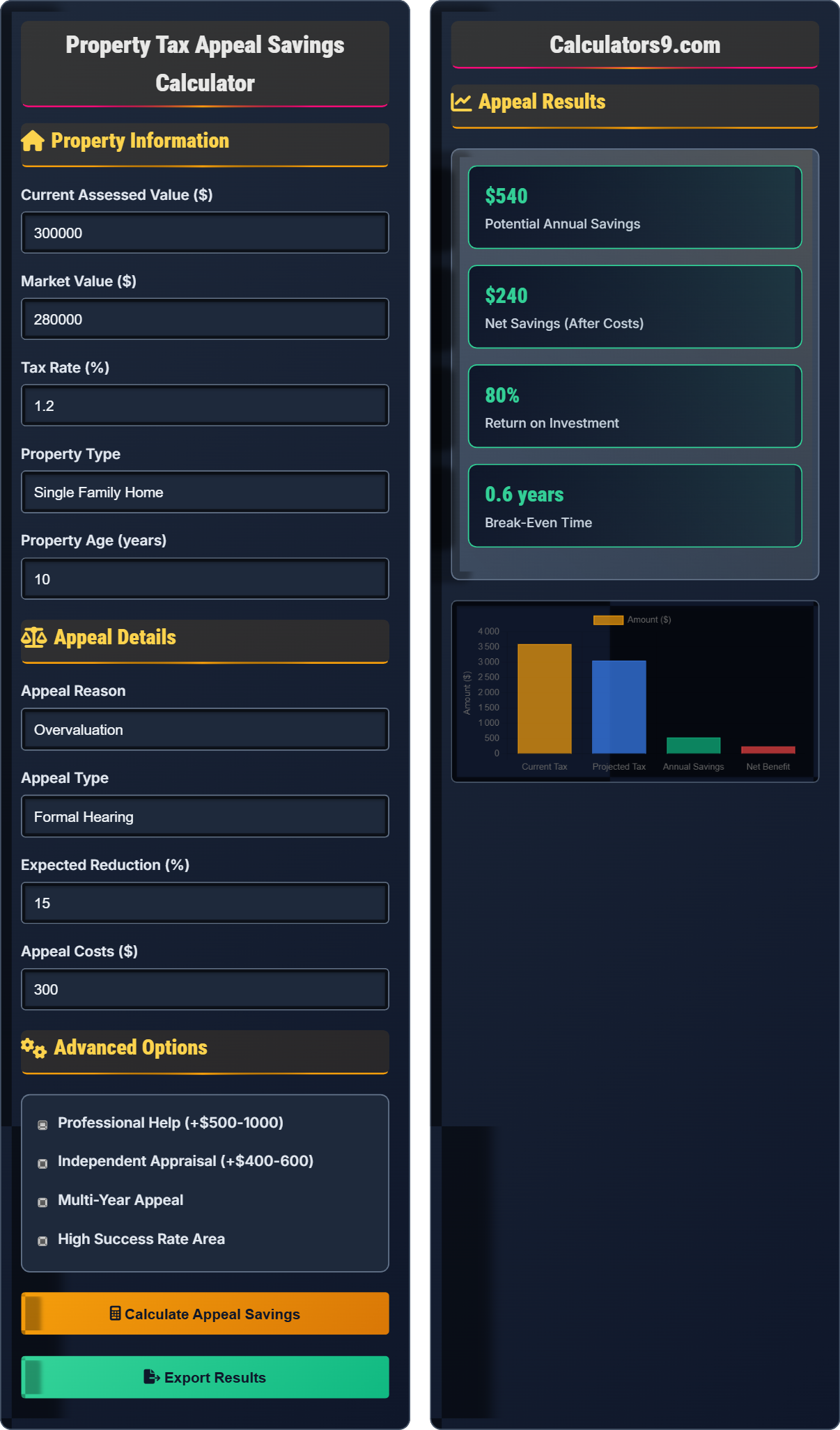
Appeal Results
| Item | Amount | Details |
|---|---|---|
| Current Annual Tax | $3,600 | Based on $300K assessment |
| Projected New Tax | $3,060 | After 15% reduction |
| Potential Savings | $5,400 | Annual savings estimate |
| Appeal Costs | $300 | Professional fees |
| Net Savings | $5,100 | After costs |
| Analysis Item | Value | Comparison |
|---|---|---|
| Assessment Ratio | 107% | Market value vs. assessed value |
| Success Probability | 65% | Based on local trends |
| Comparable Properties | 5 | Properties found for comparison |
| Time to Resolution | 4-6 months | Typical processing time |
Property Tax Appeal Fundamentals
A property tax appeal is a formal request to challenge your property's assessed value. Property owners can contest assessments that appear too high compared to market value or similar properties. Appeals are typically filed with local assessment offices or tax boards. The process involves presenting evidence that supports a lower valuation, potentially resulting in reduced tax obligations.
The potential savings from a property tax appeal can be calculated using this formula:
Maximize your appeal success with these proven strategies:
- Recent Sales Data: Gather comparable sales from past 12 months
- Professional Appraisal: Obtain independent valuation from licensed appraiser
- Property Photos: Document any defects or issues affecting value
- Neighborhood Trends: Research local market conditions and assessment patterns
- Documentation: Keep records of all communications and evidence
Property Tax Appeal Quiz
Which factor has the greatest impact on property tax appeal success?
The answer is B) Quality of comparable sales data. The strongest evidence for a property tax appeal is recent sales of similar properties in the same neighborhood. The more closely matched the comparables (size, age, condition, location), the stronger the argument that your property is overvalued. Courts and assessment boards rely heavily on this market-based evidence.
This question emphasizes the importance of market-based evidence in property tax appeals. The principle of substitution in real estate valuation states that a rational buyer won't pay more for a property than the cost of acquiring an equally desirable substitute property. Comparable sales provide this benchmark for valuation.
Comparable Sales: Recently sold properties with similar characteristics
Market Value: Price property would sell for in open market
Assessed Value: Value determined by tax assessor for taxation purposes
• Use sales within past 12 months
• Focus on same neighborhood
• Match property characteristics closely
• Research properties within 1 mile radius
• Find 3-5 strong comparables
• Adjust for differences in features
• Using outdated sales data
• Comparing to dissimilar properties
• Not accounting for property differences
Calculate the cost-benefit of appealing a $400,000 property with a 1.5% tax rate. The appeal costs $500 and is expected to reduce the assessment by 20%. Calculate the annual savings, net benefit, and return on investment.
Step 1: Calculate current annual tax
Current tax = $400,000 × 1.5% = $6,000
Step 2: Calculate projected tax after appeal
Reduced assessment = $400,000 × (1 - 0.20) = $320,000
Projected tax = $320,000 × 1.5% = $4,800
Step 3: Calculate annual savings
Annual savings = $6,000 - $4,800 = $1,200
Step 4: Calculate net benefit
Net benefit = Annual savings - Appeal cost
Net benefit = $1,200 - $500 = $700
Step 5: Calculate return on investment
ROI = (Net benefit / Appeal cost) × 100
ROI = ($700 / $500) × 100 = 140%
Therefore, the appeal would save $1,200 annually with a net benefit of $700 and a 140% ROI.
This problem demonstrates the financial mathematics behind property tax appeals. The calculation shows that even with professional costs, tax appeals can provide exceptional returns on investment. The key is ensuring that the potential savings justify the appeal costs, which is typically the case for properties with significant overvaluations.
Return on Investment (ROI): Gain from investment relative to cost
Net Benefit: Total gain minus total costs
Annual Savings: Yearly reduction in tax obligation
• Appeal only if savings exceed costs
• Consider ongoing annual benefits
• Factor in appeal success probability
• Calculate break-even time
• Consider multi-year benefits
• Factor in appeal success rate
• Not accounting for appeal costs
• Overestimating reduction potential
• Ignoring success probability
A property owner successfully appeals their assessment, reducing it by 18% for the current year. The property value is $350,000, and the tax rate is 1.4%. The appeal cost $400. If the reduced assessment remains in effect for 5 years, what is the total savings over this period? What is the ROI over the 5-year period?
Step 1: Calculate current annual tax
Current tax = $350,000 × 1.4% = $4,900
Step 2: Calculate projected tax after appeal
Reduced assessment = $350,000 × (1 - 0.18) = $287,000
Projected tax = $287,000 × 1.4% = $4,018
Step 3: Calculate annual savings
Annual savings = $4,900 - $4,018 = $882
Step 4: Calculate total savings over 5 years
Total savings = $882 × 5 = $4,410
Step 5: Calculate net benefit over 5 years
Net benefit = Total savings - Appeal cost
Net benefit = $4,410 - $400 = $4,010
Step 6: Calculate 5-year ROI
ROI = (Net benefit / Appeal cost) × 100
ROI = ($4,010 / $400) × 100 = 1,002.5%
Therefore, the total 5-year savings is $4,410 with a net benefit of $4,010 and an ROI of 1,002.5%.
This problem illustrates the compounding benefit of successful property tax appeals. Unlike one-time savings, tax reductions continue annually, providing ongoing benefits. This makes even modest assessment reductions quite valuable over time. The calculation shows how a single appeal can provide exceptional returns when benefits extend over multiple years.
Multi-Year Benefit: Ongoing savings from permanent assessment reduction
Compounding Effect: Accumulation of annual savings over time
Permanent Reduction: Lasting change in assessed value
• Consider long-term benefits in ROI calculation
• Assessments often remain reduced for multiple years
• Annual savings compound over time
• Factor in multi-year benefits
• Consider property appreciation
• Account for potential tax rate changes
• Only calculating first-year savings
• Not considering long-term impact
• Assuming assessment will revert immediately
A property owner discovers their assessment is 25% higher than market value just 3 weeks before the appeal deadline. They can either rush the appeal this year (cost: $800) or wait for next year's assessment cycle (appeal cost: $500). If they wait, they'll lose one year of savings but have a better-prepared case. Which option is financially better assuming a 20% reduction and a $300,000 property with 1.3% tax rate?
Step 1: Calculate potential reduction
Assessment reduction = $300,000 × 20% = $60,000
Annual tax savings = $60,000 × 1.3% = $780
Step 2: Calculate Option A (Appeal this year)
Net benefit = Annual savings - Appeal cost
Net benefit = $780 - $800 = -$20
Step 3: Calculate Option B (Wait for next year)
Loss of first year savings = $780
Second year net benefit = $780 - $500 = $280
Two-year net = -$780 + $280 = -$500
Step 4: Calculate multi-year benefit
After 2 years: Option A = $780 - $800 = -$20
After 2 years: Option B = $0 - $780 + $780 - $500 = -$500
However, after 3 years: Option A = $780×2 - $800 = $760
After 3 years: Option B = $0 - $780 + $780×2 - $500 = $280
Therefore, appealing this year is better for long-term savings despite higher cost.
This problem demonstrates the importance of timing in property tax appeals. While waiting might allow for better preparation, the ongoing nature of tax savings means that even a rushed appeal can be financially beneficial. The analysis shows that capturing the first year of savings often outweighs the benefits of better preparation, especially given the long-term nature of tax savings.
Appeal Timing: Strategic consideration of when to file
Opportunity Cost: Benefit lost by choosing one option over another
Preparation vs. Timing: Trade-off between readiness and opportunity
• Don't miss appeal deadlines
• First-year savings often justify higher costs
• Consider multi-year impact of timing decisions
• File early to allow for corrections
• Consider partial-year savings
• Evaluate preparation vs. timing trade-offs
• Missing appeal deadlines
• Over-preparing at expense of timing
• Not considering long-term impact of timing
Which property type typically has the highest success rate in property tax appeals?
The answer is C) Commercial properties. Commercial property appeals have the highest success rates, often 60-70%, because commercial assessments frequently rely on income approaches that can be challenged with market rent data. Additionally, commercial property valuations are more complex and prone to errors. Single-family homes in exclusive neighborhoods also have good success rates (40-50%) due to unique characteristics that may not be captured in mass assessments.
This question highlights how property type affects appeal success. Commercial properties have more complex valuation methods involving income, expense, and capitalization rates that can be challenged with market data. Residential properties in exclusive neighborhoods also have high success rates because mass appraisal methods struggle to capture unique features and amenities of luxury properties.
Mass Appraisal: Systematic method for valuing many properties
Income Approach: Valuation method based on property income potential
Unique Properties: Difficult to value with standard methods
• Commercial properties have highest success rates
• Unique properties are good candidates
• Mass-appraised properties often have errors
• Research local success rates by property type
• Consider unique characteristics advantage
• Evaluate assessment method complexity
• Assuming all property types have equal success rates
• Not considering local market factors
• Overlooking the complexity of commercial valuations
Appeal Essentials
Typical reduction: 10-25%. Success rate: 40-60%. Average appeal cost: $200-500. Break-even: 1-3 months for successful appeals.
(Assessed Value × Tax Rate) - ((Assessed Value × (1 - Reduction %)) × Tax Rate) - Appeal Costs = Net Savings.
- Appeal if overvalued by 10%+
- Strongest case = recent comparable sales
- Appeal costs are one-time
- Savings continue annually
Appeal Strategies
Research comparable sales, document property defects, hire professional help for complex cases, and file before deadlines. These actions can increase success probability by 20-30%.
- Research comparable sales
- Document property issues
- File appeal on time
- Prepare strong evidence
- Appeal deadlines are strict
- Assessment errors are common
- Professional help costs more but increases success
- Success rates vary by jurisdiction
FAQ
Q: How long does a property tax appeal take?
A: Property tax appeals typically take 4-8 months. Informal reviews may resolve in 1-2 months, while formal hearings can take 6-12 months. The timeline varies by jurisdiction. Some areas offer expedited processes for certain property types.
Q: Should I hire a professional for my appeal?
A: For properties with potential savings over $1,000 annually, professional help is usually worth the cost. Professionals have expertise in local assessment practices and can increase success rates by 15-25%. For smaller properties, DIY appeals can be effective.