Moving Cost Calculator
Moving expense estimator • 2026 rates
Moving Cost Formula:
Show the calculator\( MC = L \times T + (D \times R) + E \)
Where:
- \( MC \) = Moving Cost
- \( L \) = Labor Rate per Hour
- \( T \) = Time Required (Hours)
- \( D \) = Distance (Miles)
- \( R \) = Rate per Mile
- \( E \) = Additional Expenses (Packing, Insurance, etc.)
This formula calculates the total moving cost based on labor time, distance traveled, and additional expenses. For local moves, labor and time dominate the cost, while long-distance moves include mileage charges.
Example: For a local move with 2 movers for 6 hours at $75/hour each, plus $200 for packing supplies:
Labor Cost = 2 movers × 6 hours × $75/hour = $900
Additional Expenses = $200
Total Cost = $900 + $200 = $1,100
For a long-distance move of 1,000 miles at $3.50 per mile plus $800 for labor:
Distance Cost = 1,000 miles × $3.50/mile = $3,500
Labor Cost = $800
Total Cost = $3,500 + $800 = $4,300
Thus, the moving cost would be approximately $1,100 for local or $4,300 for long-distance.
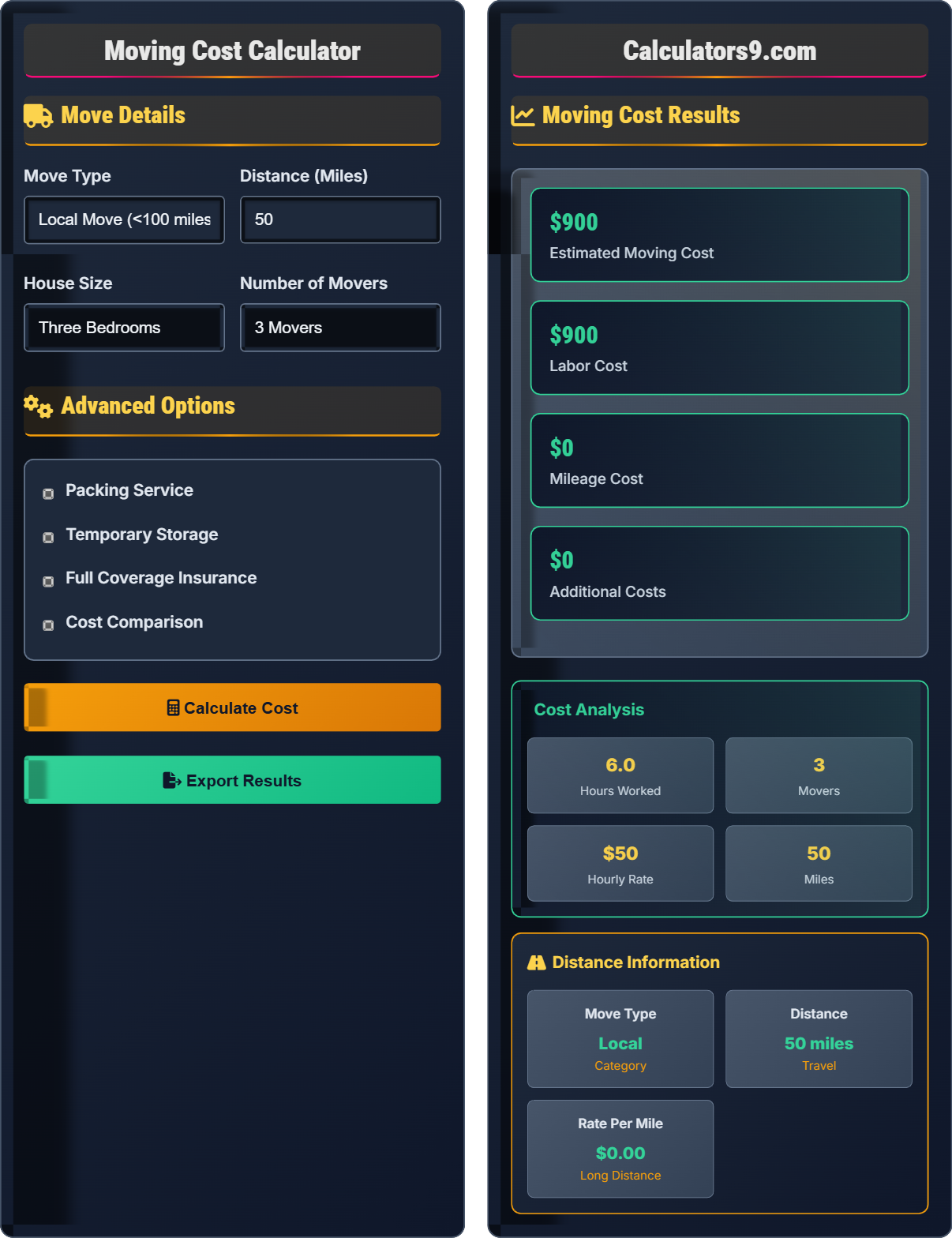
Move Details
Advanced Options
Moving Cost Results
Moving Cost Analysis Guide
Moving costs encompass all expenses associated with relocating from one home to another. These costs vary significantly based on distance, size of the move, services required, and timing. Understanding these costs helps with budgeting and comparing moving service providers. Typical moving costs include labor, transportation, packing materials, insurance, and additional services.
The standard moving cost calculation uses the following formula:
Where:
- \(MC\) = Moving Cost
- \(L\) = Labor Rate per Hour
- \(T\) = Time Required (Hours)
- \(D\) = Distance (Miles)
- \(R\) = Rate per Mile
- \(E\) = Additional Expenses (Packing, Insurance, etc.)
Moving cost structures typically follow industry best practices:
- Local Moves: $800-$2,500 average for 2-3 bedroom home
- Long Distance: $2,500-$7,000+ for cross-country move
- Labor Rate: $25-$50 per hour per mover
- Distance Rate: $2-$5 per mile for long-distance moves
- Peak Season: 30-50% higher rates during summer months
- Timing: Move mid-month, mid-week to avoid peak pricing
- Declutter: Donate unwanted items to reduce volume
- DIY Packing: Pack non-fragile items yourself
- Compare Quotes: Get multiple estimates from licensed movers
- Book Early: Secure dates during busy season in advance
Moving Cost Calculation
Moving cost is the total expense of relocating household goods from one location to another.
\(MC = L \times T + (D \times R) + E\)
Where MC=total cost, L=labor rate, T=time, D=distance, R=rate per mile, E=extras.
- Local moves charged by time
- Long-distance charged by weight/distance
- Additional fees apply for stairs/special items
Moving Planning
Summer months (May-August) when demand is highest and rates are elevated.
- Move during off-peak times
- Pack your own items
- Donate unwanted goods
- Get multiple quotes
- Weekend moves cost more
- Holiday weekends are premium
- Same-day booking increases cost
- Special items require extra fees
Moving Cost Learning Quiz
A family is moving from San Francisco to Los Angeles (380 miles) with a 3-bedroom home. They need 3 professional movers for 10 hours each at $45/hour. The moving company charges $3.25 per mile for the distance. They also want full-coverage insurance at 1.8% of their declared value of $50,000. Calculate the total moving cost including all components. Show all calculations and explain each component's significance.
Step 1: Calculate Labor Cost
Labor Cost = Number of Movers × Hours Worked × Hourly Rate
Labor Cost = 3 movers × 10 hours × $45/hour = $1,350
Step 2: Calculate Mileage Cost
Mileage Cost = Distance × Rate per Mile
Mileage Cost = 380 miles × $3.25/mile = $1,235
Step 3: Calculate Insurance Cost
Insurance Cost = Declared Value × Insurance Rate
Insurance Cost = $50,000 × 0.018 = $900
Step 4: Calculate Total Moving Cost
Total Cost = Labor Cost + Mileage Cost + Insurance Cost
Total Cost = $1,350 + $1,235 + $900 = $3,485
The total moving cost is $3,485. The labor cost ($1,350) compensates the movers for their time and effort. The mileage cost ($1,235) covers transportation expenses for the long-distance move. The insurance cost ($900) provides protection for valuable belongings during transit.
Long-distance moving costs involve multiple components that each serve a specific purpose. The labor cost represents the human resources needed to pack, load, transport, and unload belongings. The mileage cost covers fuel, vehicle wear and tear, and transportation logistics. Insurance provides financial protection against damage or loss during transit. Understanding these components helps in budgeting and comparing moving services effectively.
Long-Distance Move: Move greater than 100 miles, typically charged by distance and weight
Full Coverage Insurance: Comprehensive protection for belongings during transit
Declared Value: The estimated worth of belongings for insurance purposes
• Long-distance moves include both labor and mileage costs
• Insurance rates are typically 1-2% of declared value
• Additional fees may apply for stairs or special items
• Book moves well in advance to secure better rates
• Declutter before moving to reduce volume and cost
• Compare detailed quotes from multiple movers
• Underestimating time required for large moves
• Not accounting for distance charges in long-distance moves
• Forgetting to include insurance in cost estimates
A couple needs to move a 2-bedroom apartment locally. They can either hire professional packers for $400 or pack themselves for $75 in supplies. Professional movers cost $35/hour per person, and they estimate needing 6 hours with 2 movers. The moving company offers free storage for 30 days, but if they pack themselves, they need to rent a storage unit for $120/month for 2 months. Calculate both options and determine which is more cost-effective. Also consider the time value of the couple's work (valued at $25/hour).
Option 1: Professional Packing
Mover Cost = 2 movers × 6 hours × $35/hour = $420
Packing Service = $400
Storage = $0 (included free)
Time Cost = $0 (their time)
Total Cost = $420 + $400 + $0 = $820
Option 2: Self-Packing
Mover Cost = 2 movers × 6 hours × $35/hour = $420
Packing Supplies = $75
Storage = $120/month × 2 months = $240
Time Cost = 10 hours packing × $25/hour × 2 people = $500
Total Cost = $420 + $75 + $240 + $500 = $1,235
Option 1 (professional packing) costs $820, while Option 2 (self-packing) costs $1,235. Professional packing is more cost-effective by $415. However, this analysis doesn't account for the convenience factor, stress reduction, and potential for damage when packing fragile items personally.
This problem demonstrates the importance of considering all costs, including opportunity costs (time value), when making financial decisions. The couple's time has monetary value based on their earning potential. When self-packing, they sacrifice time that could be spent working, effectively increasing the cost of that option. This illustrates how non-obvious costs can significantly impact financial decisions and why comprehensive analysis is important for optimal decision-making.
Opportunity Cost: The value of the next best alternative foregone
Time Value: Monetary value assigned to time based on earning potential
Cost-Benefit Analysis: Evaluation of all costs versus benefits of different options
• Include opportunity costs in financial analysis
• Consider convenience and stress in cost comparisons
• Factor in potential damages from self-service options
• Calculate time value using hourly wage rate
• Consider intangible costs like stress and inconvenience
• Factor in potential damage costs for self-service options
• Ignoring time value in cost calculations
• Focusing only on direct monetary costs
• Not accounting for potential damages in DIY options
FAQ
Q: What are the hidden fees I should watch out for when getting moving quotes, and how can I ensure I'm getting an accurate estimate?
A: Hidden fees are unfortunately common in the moving industry. Here are the most important ones to watch for:
Accessorial Charges: These include fees for stairs, long carries (carrying items more than 100 feet from truck to home), elevator use, and narrow hallways. A "long carry" fee can be $100-$200 per occurrence.
Weight-Based Charges: For long-distance moves, if your shipment weighs more than estimated, you'll be charged extra. This is why accurate inventory is crucial.
Shuttle Service: If the moving truck can't reach your home due to narrow streets or parking restrictions, a smaller vehicle may be used to transport items to/from the main truck. This typically costs $100-$300.
Storage Fees: If your new home isn't ready, your belongings may be stored temporarily. These fees can accumulate quickly, often $50-$100 per day.
Peak Season Surcharges: Moving during May-August can increase costs by 30-50% due to high demand.
To ensure accurate estimates:
- Get in-home estimates: Virtual estimates are less accurate than physical walkthroughs
- Request detailed quotes: Ask for itemized breakdowns of all potential charges
- Verify licensing: Ensure the company is licensed by the FMCSA (Federal Motor Carrier Safety Administration)
- Read the fine print: Understand cancellation policies and additional fees
- Check reviews: Look for mentions of hidden fees in customer feedback
Always ask for a binding estimate if possible, which guarantees the price won't change unless you add items or services after the estimate.
Q: What's the difference between full-value protection and released value protection, and which should I choose for my move?
A: Moving insurance options differ significantly in coverage and cost:
Released Value Protection (Free): This is the minimum coverage required by law. It provides $0.60 per pound per item. For example, if your 10-pound TV is damaged, you'd receive only $6. This is insufficient for valuable electronics and furniture.
Full-Value Protection (Paid): This is comprehensive coverage where the mover replaces damaged items with new items of similar kind and quality or reimburses you for the replacement cost. The cost is typically 1-2% of your declared value.
Third-Party Insurance: Independent insurance companies offer policies that may be more comprehensive than carrier insurance and can cover items during temporary storage.
Recommendation: For most people, full-value protection is advisable. Here's why:
- True Value Coverage: Compensates based on current replacement value, not depreciated value
- Convenience: Dealing with the moving company is often easier than third-party claims
- Peace of Mind: Protects your valuable belongings during transit
How to choose: Calculate 1-2% of your belongings' value. If your items are worth $50,000, insurance would cost $500-$1,000. If you couldn't afford to replace those items, the insurance is worthwhile. For less valuable items or if you're comfortable accepting risk, released value might suffice.
Always declare accurate values for your belongings. Under-declaring limits your compensation if items are lost or damaged.