Party Cost Calculator
Fast budget calculator • 2026 trends
Party Cost Formula:
Show the calculator\( \text{Total Cost} = \text{Food} + \text{Drinks} + \text{Venue} + \text{Entertainment} + \text{Decorations} + \text{Other Expenses} \)
Where:
- \( \text{Food} = \text{Guests} \times \text{Cost Per Person} \)
- \( \text{Drinks} = \text{Guests} \times \text{Drink Cost Per Person} \)
- \( \text{Venue} = \text{Rental Fee} + \text{Service Charges} \)
- \( \text{Entertainment} = \text{Activities, Music, etc.} \)
- \( \text{Decorations} = \text{Theme & Decor Items} \)
- \( \text{Other Expenses} = \text{Gifts, Favors, etc.} \)
This formula calculates the total cost of a party by summing all individual expense categories. The calculator provides accurate estimates for each category based on industry averages and current market prices.
Example: For a party of 30 guests:
Food: 30 × $15 = $450
Drinks: 30 × $8 = $240
Venue: $200
Entertainment: $150
Decorations: $100
Other: $50
Total: $450 + $240 + $200 + $150 + $100 + $50 = $1,190
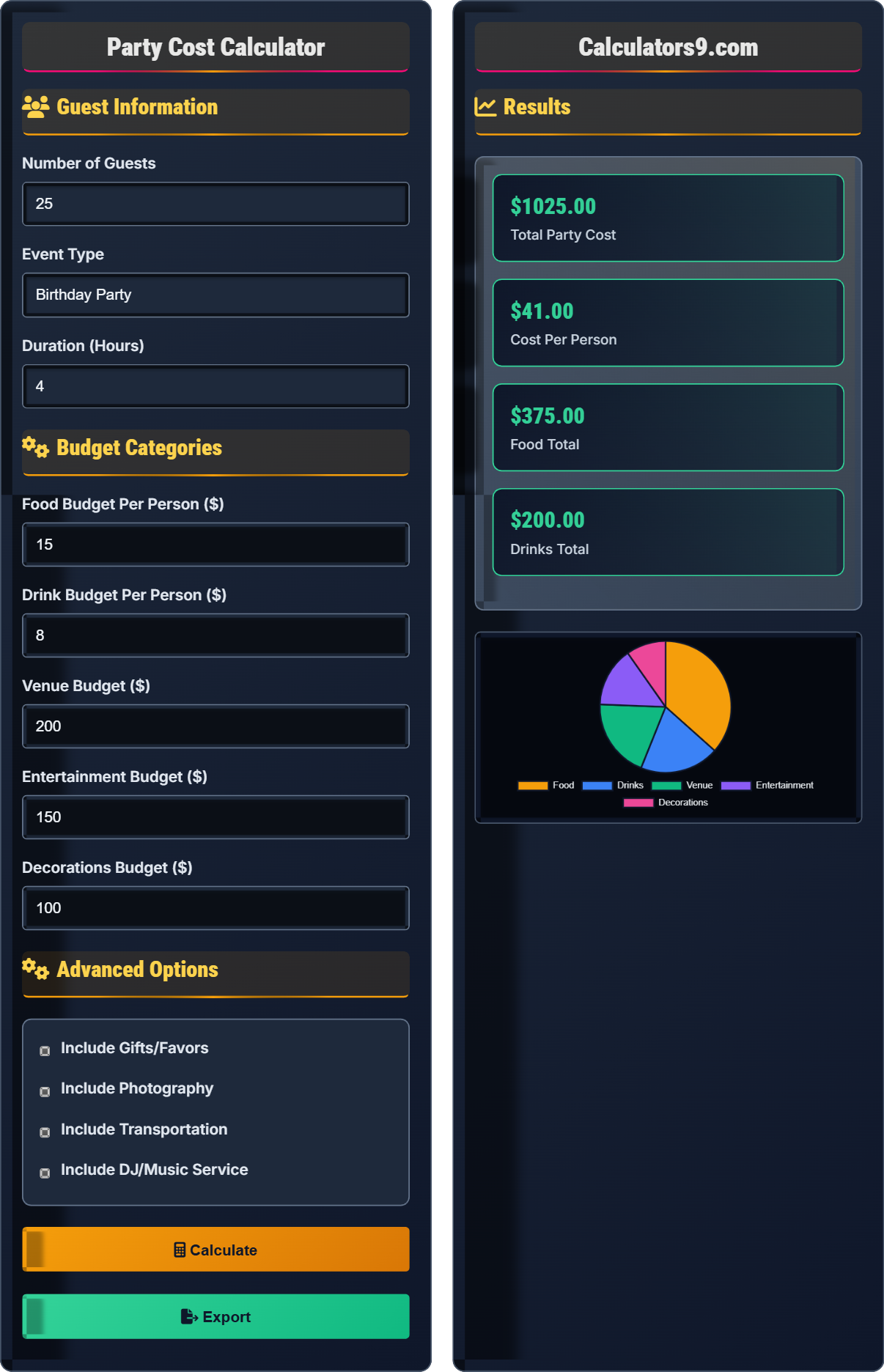
Guest Information
Budget Categories
Advanced Options
Results
| Category | Budget | Actual | Difference |
|---|
| Category | Savings Potential | Tips |
|---|
Comprehensive Party Planning Guide
A party budget is a financial plan that outlines all expected expenses for hosting an event. It helps ensure you don't overspend while still creating an enjoyable experience for your guests. The budget should account for all major categories including food, drinks, venue, entertainment, decorations, and miscellaneous items.
The ideal party budget allocation follows the 50-30-20 rule adapted for events:
Where:
- Food: Main expense category, typically 40% of total budget
- Drinks: Beverages for guests, usually 20% of budget
- Venue: Location rental or setup costs, about 15%
- Entertainment: Music, games, activities, approximately 15%
- Decorations: Theme items, ambiance, around 7%
- Other: Miscellaneous items like gifts, favors, 3%
Effective budget tracking involves:
- Set a realistic total budget: Based on your income and event importance
- Allocate funds by category: Use percentage guidelines to distribute funds
- Track spending in real-time: Record purchases as they occur
- Plan for contingencies: Set aside 10-15% for unexpected expenses
- Look for deals: Compare prices and consider bulk purchasing
- DIY decorations: Create custom items for less than store-bought
- Themed potluck: Ask guests to contribute specific items
- Off-peak timing: Host during weekdays or off-season for venue discounts
- Simple menu: Focus on crowd-pleasing dishes rather than elaborate spreads
- Free entertainment: Use streaming services or playlist instead of hiring DJs
Party Budget Basics
A financial plan for all event expenses with category breakdowns.
\( \text{Total Cost} = \sum(\text{All Expense Categories}) \)
Where each category is calculated individually then summed.
- Food typically represents 40% of budget
- Drinks account for 20% of total
- Always budget 10-15% contingency
Planning Strategies
Proper distribution across expense categories ensures balanced spending.
- Calculate total available budget
- Assign percentages to each category
- Monitor spending against allocations
- Adjust as needed without exceeding total
- Guest count directly affects food/drink costs
- Venue costs may have minimums
- Seasonal factors impact pricing
- Location affects availability and cost
Party Budget Learning Quiz
In a typical party budget, what percentage should be allocated to food costs?
The answer is B) 40%. In a typical party budget, food costs represent approximately 40% of the total budget. This is the largest expense category in most party budgets because it's essential for guest satisfaction and enjoyment. Food needs to accommodate all dietary preferences and provide enough variety to satisfy everyone.
Understanding budget allocation is crucial for effective party planning. The 40% allocation to food reflects its importance as the primary sustenance for guests. This percentage allows for adequate catering or food preparation that satisfies all attendees while maintaining budget control. Students should remember that food costs include not just the ingredients but also serving supplies, cooking time, and potentially catering fees.
Budget Allocation: The process of distributing total funds across different expense categories
Food Cost Percentage: The portion of total budget dedicated to food and beverages
Expense Category: A distinct area of spending within the overall budget
• Food typically represents 40% of party budget
• Drinks account for 20% of total budget
• Venue costs are usually 15% of budget
• Remember the 40-20-15-15-7-3 rule for budget allocation
• Use the acronym F-D-V-E-D-O (Food, Drinks, Venue, Entertainment, Decorations, Other)
• Underestimating food costs and allocating too little budget
• Forgetting to account for dietary restrictions and special requests
You're planning a birthday party for 30 guests with a total budget of $1,500. Calculate the recommended allocation for each category using the standard percentages (Food: 40%, Drinks: 20%, Venue: 15%, Entertainment: 15%, Decorations: 7%, Other: 3%). Then determine how much you can spend per person on food and drinks combined.
Step 1: Calculate allocation for each category:
Food: $1,500 × 40% = $600
Drinks: $1,500 × 20% = $300
Venue: $1,500 × 15% = $225
Entertainment: $1,500 × 15% = $225
Decorations: $1,500 × 7% = $105
Other: $1,500 × 3% = $45
Step 2: Calculate combined food and drink budget:
$600 + $300 = $900
Step 3: Calculate per-person spending on food and drinks:
$900 ÷ 30 guests = $30 per person
Therefore, you can spend $30 per person on food and drinks combined.
This problem demonstrates how to apply percentage-based budget allocation to real-world scenarios. Students learn to convert percentages to actual dollar amounts and then further divide to find per-person costs. This skill is essential for practical party planning and helps ensure budgets are realistic and achievable. The per-person calculation helps determine if your budget aligns with your expectations for the event quality.
Percentage Allocation: Distributing budget based on predetermined percentage ratios
Per-Person Calculation: Dividing total costs by number of guests to find individual cost
Budget Distribution: The strategic allocation of funds across expense categories
• Always verify that all percentages total 100%
• Calculate category totals before determining per-person costs
• Ensure per-person amounts are realistic for your event type
• Use the formula: Category Amount = Total Budget × Category Percentage
• Double-check calculations by ensuring all categories sum to total budget
• Forgetting to convert percentages to decimals when calculating
• Adding percentages incorrectly, leading to wrong allocations
FAQ
Q: How do I adjust my party budget if I have dietary restrictions in my guest list?
A: Dietary restrictions can significantly impact your food budget. Specialized diets like gluten-free, vegan, or allergen-free options typically cost 20-40% more than standard fare.
For example, if your standard food budget is $450 for 30 guests ($15 per person), accommodating special dietary needs might increase costs to $540-630. To manage this:
1. Survey guests about restrictions in advance
2. Plan separate dishes for special needs (more cost-effective than making everything special)
3. Consider a buffet setup allowing everyone to choose suitable options
4. Factor in an extra 15-25% for dietary accommodations
Mathematically, if \( C_s \) is the standard cost per person and \( R \) is the dietary restriction multiplier (1.2-1.4), then the adjusted food cost is:
\( \text{Adjusted Cost} = G \times C_s \times R \)
Where \( G \) is the number of guests with restrictions.
Q: What's the best way to save money on drinks without compromising guest experience?
A: Smart drink budgeting focuses on providing variety without overspending. Here are proven strategies:
• Offer a signature cocktail instead of a full bar (saves 40-60% on alcohol costs)
• Provide wine and beer options rather than extensive spirits
• Serve drinks during specific hours rather than all night
• Buy alcohol in bulk from warehouse stores
• Mix expensive liquors with affordable mixers
For a party of 30 guests, a full open bar might cost $600-900, while a limited selection with signature cocktails costs $200-350. The key is offering quality options that match your event's formality without going overboard on unnecessary variety.