IRA Contribution Calculator
Retirement planning tool • 2026 edition
IRA Contribution Formulas:
- Annual Contribution Limit: $6,500 ($7,500 if 50+)
- Traditional IRA: Tax-deductible contributions, taxed at withdrawal
- Roth IRA: After-tax contributions, tax-free growth and withdrawals
- Future Value: Present Value × (1 + r)^n
For example: Contributing $6,500 annually for 30 years at 7% return yields $663,000. With Roth IRA, this grows tax-free.
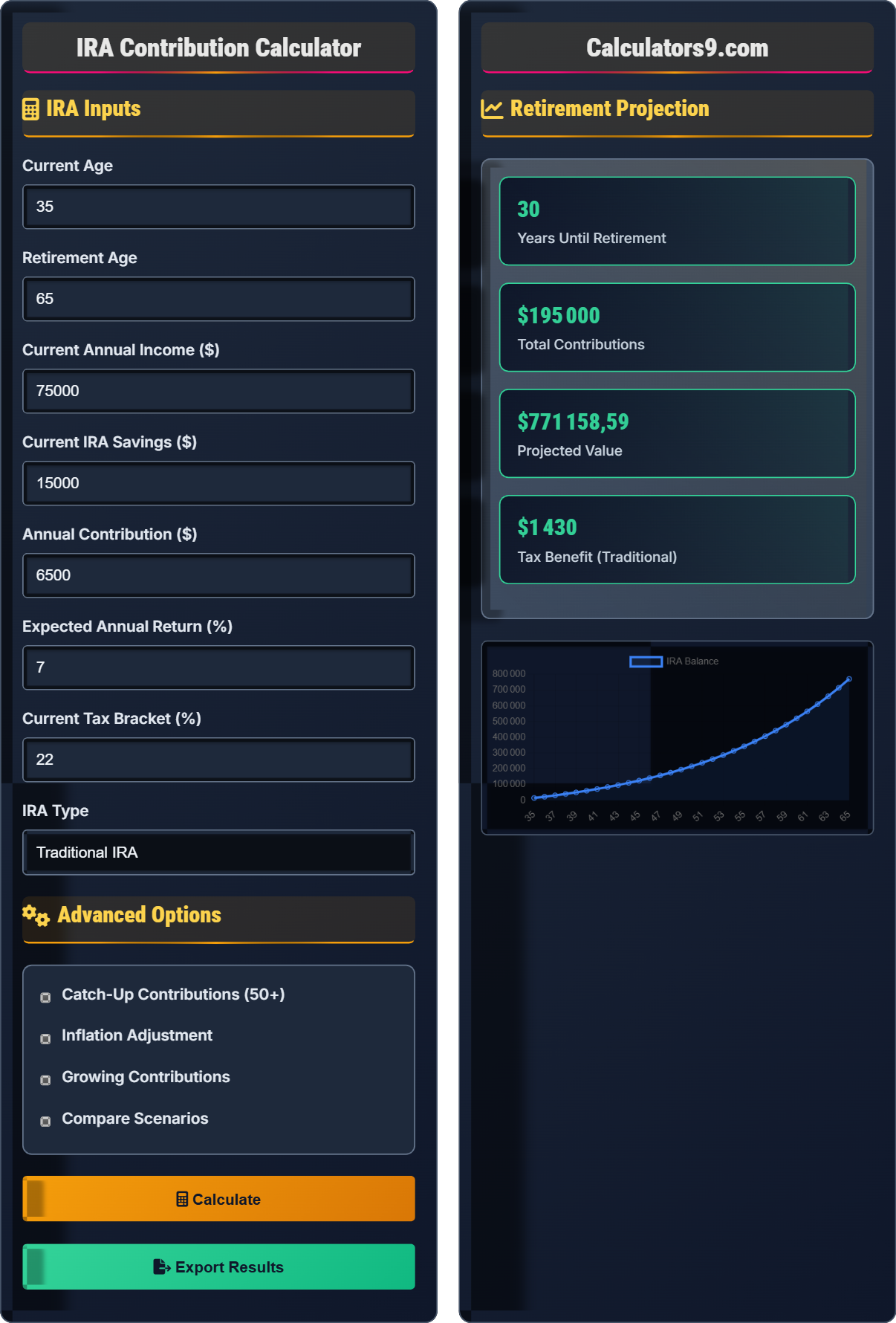
IRA Inputs
Advanced Options
Retirement Projection
| Year | Age | Contribution | Balance | Growth |
|---|
| Strategy | Benefits | Requirements | Best For |
|---|
IRA Contribution Planning
Individual Retirement Accounts (IRAs) offer tax-advantaged savings for retirement. Understanding the differences between Traditional and Roth IRAs is crucial for making informed decisions that align with your financial situation and retirement goals.
Annual contribution limits for IRAs:
- Traditional & Roth IRAs: $6,500 per year
- Catch-up contributions: Additional $1,000 if age 50+
- Maximum for 50+: $7,500 per year
- Income limits: Roth IRA has income restrictions
Key differences between Traditional and Roth IRAs:
- Traditional IRA: Tax-deductible contributions, taxed withdrawals
- Roth IRA: After-tax contributions, tax-free withdrawals
- Traditional: Reduces current taxable income
- Roth: Provides tax-free income in retirement
- Traditional: Subject to Required Minimum Distributions
- Roth: No RMDs during owner's lifetime
- Early Contribution: Contribute at beginning of year for maximum growth
- Automatic Transfers: Set up recurring contributions for consistency
- Backdoor Roth: Convert Traditional to Roth if income limits apply
- Spousal IRA: Non-working spouse can contribute to IRA
- Asset Location: Hold tax-inefficient investments in tax-advantaged accounts
IRA Planning Learning Quiz
What is the maximum annual contribution to an IRA for someone under 50 in 2023?
The answer is C) $6,500. For 2023, the annual contribution limit for IRAs is $6,500 for individuals under age 50. For those 50 and older, there's an additional $1,000 catch-up contribution, bringing the total to $7,500.
This question tests knowledge of current IRA contribution limits. These limits are set by the IRS and can change annually for inflation adjustments. It's important for savers to know these limits to maximize their tax-advantaged retirement savings without exceeding the limits, which could result in penalties.
IRA: Individual Retirement Account with tax advantages
Contribution Limit: Maximum amount allowed per year
Catch-up Contribution: Additional amount for those 50+
• Annual limit: $6,500 for under 50
• Catch-up: Additional $1,000 for 50+
• Limits may change annually
• Contribute early in the year for maximum growth
• Check IRS announcements for updated limits
• Consider catch-up contributions if eligible
• Confusing old limits with current limits
• Not knowing about catch-up contributions
• Exceeding contribution limits
If someone in the 24% tax bracket contributes $6,500 to a Traditional IRA, how much in tax savings do they receive this year?
Step 1: Calculate tax savings = Contribution amount × Tax bracket
Tax savings = $6,500 × 0.24 = $1,560
Therefore: The contributor saves $1,560 in federal taxes this year.
This problem demonstrates the immediate tax benefit of Traditional IRA contributions. The contribution is deducted from taxable income, reducing the tax liability for the year of contribution. The higher your tax bracket, the greater the immediate tax savings. However, withdrawals in retirement will be taxed as ordinary income.
Tax Deduction: Reduces taxable income
Tax Bracket: Percentage of income paid in taxes
Immediate Benefit: Tax savings in contribution year
• Traditional IRA contributions are tax-deductible
• Tax savings = Contribution × Marginal tax rate
• Withdrawals are taxed as ordinary income
• Higher tax bracket = greater immediate benefit
• Consider timing of contributions for tax benefits
• Remember withdrawals will be taxed
• Using effective tax rate instead of marginal rate
• Forgetting that withdrawals will be taxed
• Not considering state tax benefits
Sarah is 30 years old and wants to retire at 65. She opens a Roth IRA and contributes $6,500 annually. If she earns an average annual return of 7%, how much will she have at retirement? What will be the total amount contributed?
Step 1: Calculate years until retirement = 65 - 30 = 35 years
Step 2: Calculate total contributions = $6,500 × 35 = $227,500
Step 3: Calculate future value using annuity formula
FV = PMT × [((1 + r)^n - 1) / r]
FV = $6,500 × [((1.07)^35 - 1) / 0.07]
FV = $6,500 × [(10.68 - 1) / 0.07]
FV = $6,500 × (9.68 / 0.07)
FV = $6,500 × 138.29 = $898,885
Therefore: Sarah will have $898,885 at retirement with total contributions of $227,500.
This problem demonstrates the power of compound growth over long periods. The future value of an annuity formula accounts for regular contributions growing over time. In this example, Sarah's contributions of $227,500 grow to nearly $900,000 due to compound interest. With a Roth IRA, all growth and withdrawals in retirement are tax-free.
Future Value of Annuity: Value of regular payments at future date
Compound Growth: Growth on previous growthRoth IRA: After-tax contributions, tax-free growth and withdrawals
• FV of annuity = PMT × [((1+r)^n - 1) / r]
• Compound growth accelerates over time
• Roth withdrawals are tax-free if requirements met
• Start early to maximize compound growth
• Consistent contributions build wealth over time
• Roth IRA is especially beneficial for young investors
• Forgetting to account for all years of contributions
• Using simple interest instead of compound interest
• Not understanding Roth IRA tax treatment
Mark is 45 years old, currently in the 24% tax bracket, and expects to be in the 22% tax bracket during retirement. He has $50,000 in a Traditional IRA and is considering opening a Roth IRA. What are the advantages of each option, and which would likely be more beneficial for him?
Traditional IRA Advantages:
- Immediate tax deduction (24% bracket) = $1,560 tax savings for $6,500 contribution
- Reduces current taxable income
- Tax-deferred growth
Roth IRA Advantages:
- Tax-free growth and withdrawals
- No Required Minimum Distributions
- Tax-free income in retirement
- Estate planning benefits
Recommendation: Since Mark expects to be in a lower tax bracket (22%) in retirement, the Traditional IRA is likely more beneficial. He gets the higher tax deduction now (24%) and will pay lower tax (22%) upon withdrawal.
This problem demonstrates the importance of considering current vs. future tax brackets when choosing between Traditional and Roth IRAs. The general rule is: if current tax bracket is higher than expected retirement bracket, choose Traditional; if current bracket is lower, choose Roth. However, other factors like estate planning and tax diversification should also be considered.
Marginal Tax Bracket: Tax rate on next dollar of income
Tax Diversification: Having both taxable and tax-advantaged accounts
Required Minimum Distributions: Mandatory withdrawals from Traditional IRA
• Traditional: Deduct now, tax later
• Roth: Pay tax now, tax-free later
• Choose based on current vs. future tax brackets
• Consider a mix of both Traditional and Roth
• Think about future tax law changes
• Factor in estate planning goals
• Not considering future tax bracket changes
• Forgetting about RMDs with Traditional IRA
• Not understanding Roth conversion strategies
For 2023, what is the Modified Adjusted Gross Income (MAGI) limit for full Roth IRA contributions for a married couple filing jointly?
The answer is B) $218,000. For 2023, the MAGI limit for full Roth IRA contributions for married couples filing jointly is $218,000. The phase-out range is $218,000 to $228,000, after which no contributions are allowed.
This question tests knowledge of Roth IRA income limits, which restrict who can contribute directly to a Roth IRA. These limits are adjusted annually for inflation. High earners can still benefit from Roth through a "backdoor" conversion strategy, where they contribute to a Traditional IRA and then convert to Roth.
MAGI: Modified Adjusted Gross Income
Income Limits: Restrictions based on income level
Backdoor Roth: Conversion strategy for high earners
• Roth IRA has income limits for contributions
• Traditional IRA has no income limits for contributions
• Backdoor Roth is available for high earners
• Check annual limits as they change
• Consider backdoor Roth for high earners
• Track MAGI carefully as it affects eligibility
• Not knowing current income limits
• Confusing limits for different filing statuses
• Forgetting about backdoor Roth option
IRA Planning Basics
Contribution limits, tax benefits, and retirement planning fundamentals.
Future Value: PV × (1 + r)^n
Future Value of Annuity: PMT × [((1+r)^n - 1) / r]
Tax Savings: Contribution × Marginal Tax Rate
- Maximize contributions early in year
- Consider tax brackets for IRA type
- Take advantage of catch-up if 50+
Planning Strategies
Choose the right IRA type and contribution strategy for your situation.
- Assess current tax bracket
- Estimate future tax bracket
- Choose appropriate IRA type
- Maximize annual contributions
- Time horizon affects strategy
- Consider tax diversification
- Factor in estate planning goals
- Review annually and adjust
FAQ
Q: I'm young and in a low tax bracket. Should I choose a Traditional or Roth IRA?
A: For young professionals in low tax brackets, a Roth IRA is typically the better choice:
Reasons for Roth IRA:
- You're paying taxes now at a low rate
- Money grows tax-free for decades
- Withdrawals in retirement are tax-free
- No Required Minimum Distributions
- More valuable tax-free income in retirement
Example Calculation: If you contribute $6,500 at age 25 in the 12% bracket, you pay $780 in taxes now. If you earn 7% annually for 40 years, that grows to $101,000 tax-free. If you had used a Traditional IRA, you'd owe ~$22,200 in taxes at 22% in retirement.
However, if your employer offers a 401(k) match, prioritize getting the full match before maxing out your Roth IRA.
Q: Can I contribute to both a Traditional and Roth IRA in the same year?
A: Yes, you can contribute to both Traditional and Roth IRAs in the same year, but with an important limitation:
Combined Limitation:
- The total contributions to both accounts cannot exceed the annual limit
- For 2023: Maximum $6,500 ($7,500 if 50+)
- Example: You could contribute $3,000 to Traditional and $3,500 to Roth
Benefits of Splitting:
- Tax diversification in retirement
- Flexibility in managing retirement taxes
- Access to both Traditional and Roth benefits
Strategy: Many advisors recommend splitting contributions between Traditional and Roth, especially for those in middle tax brackets. This provides tax diversification, allowing you to withdraw from different account types depending on your tax situation in retirement.
Note: Income limits still apply to Roth contributions, so not everyone can contribute directly to a Roth IRA.