Acceleration Calculator
Motion Analysis • Kinematics • Force Relationships
Acceleration Formula:
Show the calculator\( a = \frac{v_f - v_i}{t} \)
Where:
- \( a \) = Acceleration (m/s²)
- \( v_f \) = Final velocity (m/s)
- \( v_i \) = Initial velocity (m/s)
- \( t \) = Time (s)
This fundamental equation describes how velocity changes over time.
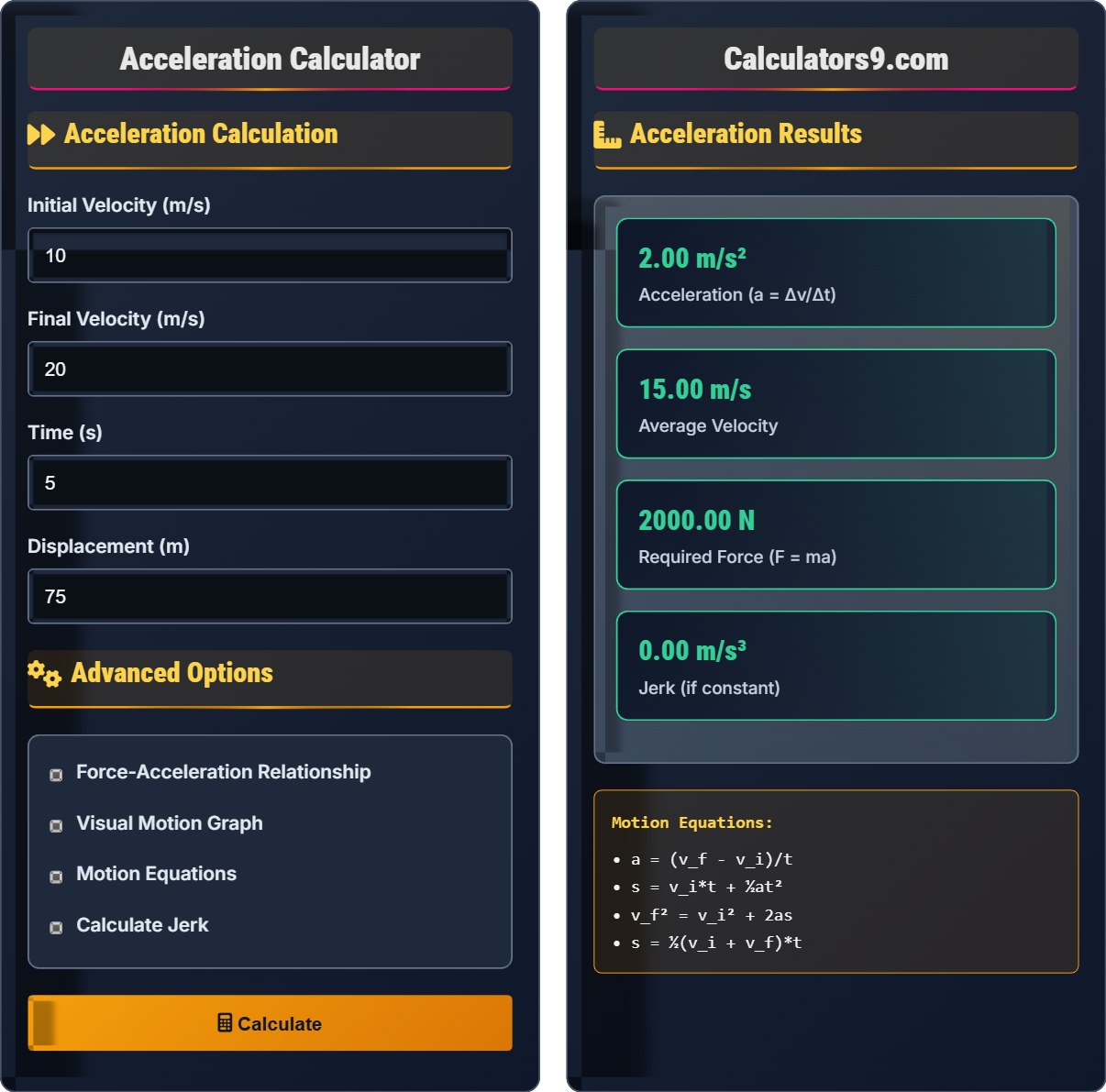
Example: Car accelerates from 10m/s to 20m/s in 5s:
\( a = \frac{20 - 10}{5} = 2 \text{ m/s}^2 \)
Thus, the acceleration is 2 m/s².
Acceleration Calculation
Advanced Options
Acceleration Results
Comprehensive Acceleration Physics Guide
Acceleration is a vector quantity that describes the rate of change of velocity with respect to time. It is measured in meters per second squared (m/s²) and indicates how quickly an object's velocity changes. Acceleration can be positive (speeding up) or negative (slowing down, also called deceleration). The relationship between acceleration, velocity, and time is fundamental to understanding motion in physics.
The fundamental acceleration equation and related formulas:
Acceleration calculations are essential in various fields:
- Automotive: Vehicle performance and safety systems
- Aerospace: Rocket propulsion and flight dynamics
- Sports: Athletic performance analysis
- Engineering: Structural design and vibration analysis
- Identify Motion Type: Uniform or accelerated
- Select Appropriate Formula: Based on known variables
- Consider Direction: Acceleration is a vector
- Check Units: Ensure consistency throughout
Acceleration Concepts
Rate of change of velocity: a = Δv/Δt
F = ma, where F is net force, m is mass, a is acceleration.
- Positive: Object speeds up
- Negative: Object slows down
- Zero: Constant velocity
Motion Calculations
Change in velocity divided by time interval.
- Find initial and final velocities
- Calculate velocity change (Δv)
- Measure time interval (Δt)
- Calculate a = Δv/Δt
- Same direction as velocity change
- Can differ from motion direction
- Vector addition for components
Physics Acceleration Learning Quiz
A car increases its speed from 15 m/s to 25 m/s in 4 seconds. What is its average acceleration?
The answer is A) 2.5 m/s². Using the acceleration formula: a = (v_f - v_i)/t = (25 - 15)/4 = 10/4 = 2.5 m/s². This represents the average rate at which the car's velocity changed during the time interval.
Acceleration is defined as the rate of change of velocity. In this problem, we calculate average acceleration by finding the change in velocity (final velocity minus initial velocity) and dividing by the time interval. The result tells us that the car's velocity increased by 2.5 m/s every second during the 4-second period.
Acceleration: Rate of change of velocity
Average Acceleration: Total change in velocity divided by time
Velocity Change: Difference between final and initial velocities
• Acceleration = (Final velocity - Initial velocity) / Time
• Positive acceleration means speeding up
• Units must be consistent (m/s²)
• Remember: a = Δv/Δt
• The sign indicates direction of acceleration
• Forgetting to subtract initial velocity from final velocity
• Dividing velocity by time instead of change in velocity
• Using incorrect units
A 1200kg car accelerates from 10 m/s to 30 m/s in 8 seconds. Calculate: a) the acceleration, b) the net force required, c) the distance traveled during acceleration, and d) the average velocity during this period.
a) Acceleration: Using a = (v_f - v_i)/t = (30 - 10)/8 = 20/8 = 2.5 m/s²
b) Net force: Using Newton's second law: F = ma = 1200kg × 2.5m/s² = 3000 N
c) Distance traveled: Using s = v_i*t + ½at² = 10×8 + ½×2.5×8² = 80 + ½×2.5×64 = 80 + 80 = 160 m
d) Average velocity: v_avg = (v_i + v_f)/2 = (10 + 30)/2 = 20 m/s
This problem demonstrates the connection between kinematics and dynamics. We start with the basic acceleration formula, then connect it to Newton's second law to find the required force. The distance calculation uses one of the kinematic equations, showing how acceleration affects displacement over time. The average velocity formula is particularly useful because for uniform acceleration, the average velocity is always the arithmetic mean of initial and final velocities.
Newton's Second Law: F = ma
Uniform Acceleration: Constant rate of velocity changeKinematic Equations: Mathematical relationships for motion
• F = ma connects force and acceleration
• For uniform acceleration: v_avg = (v_i + v_f)/2
• Kinematic equations require constant acceleration
• Always check that units are consistent
• Use the equation that has the fewest unknowns
• Verify that acceleration direction matches force direction
• Forgetting to convert units properly
• Using wrong kinematic equation for given variables
• Confusing average velocity with instantaneous velocity
FAQ
Q: Can acceleration be negative? I thought acceleration meant going faster.
A: Yes, acceleration can definitely be negative! Acceleration is a vector quantity that describes the rate of change of velocity, including direction. When acceleration is negative, it means the velocity is changing in the negative direction.
If an object is moving in the positive direction and has negative acceleration, it's slowing down (decelerating). If an object is moving in the negative direction and has negative acceleration, it's actually speeding up in the negative direction!
For example, if a car is moving forward (positive velocity) and brakes (negative acceleration), it slows down. The negative acceleration opposes the positive velocity.
Q: What's the difference between acceleration and jerk? When would I need to consider jerk in engineering applications?
A: Acceleration is the rate of change of velocity (second derivative of position), while jerk is the rate of change of acceleration (third derivative of position).
Jerk = da/dt = d²v/dt² = d³s/dt³
Jerk is important in engineering applications where smooth motion is critical. High jerk can cause vibrations, wear, and discomfort. Examples include:
• Passenger comfort in vehicles and elevators
• Precision machinery positioning
• Robotics and automated systems
• Roller coaster design for rider safety and comfort
Modern engineering often limits jerk to ensure smooth operation.