Force Calculator
Newton's Laws • F=ma • Gravitational Force
Newton's Second Law:
Show the calculator\( F = ma \)
Where:
- \( F \) = Net force (Newtons, N)
- \( m \) = Mass (kilograms, kg)
- \( a \) = Acceleration (m/s²)
This fundamental equation describes the relationship between force, mass, and acceleration.
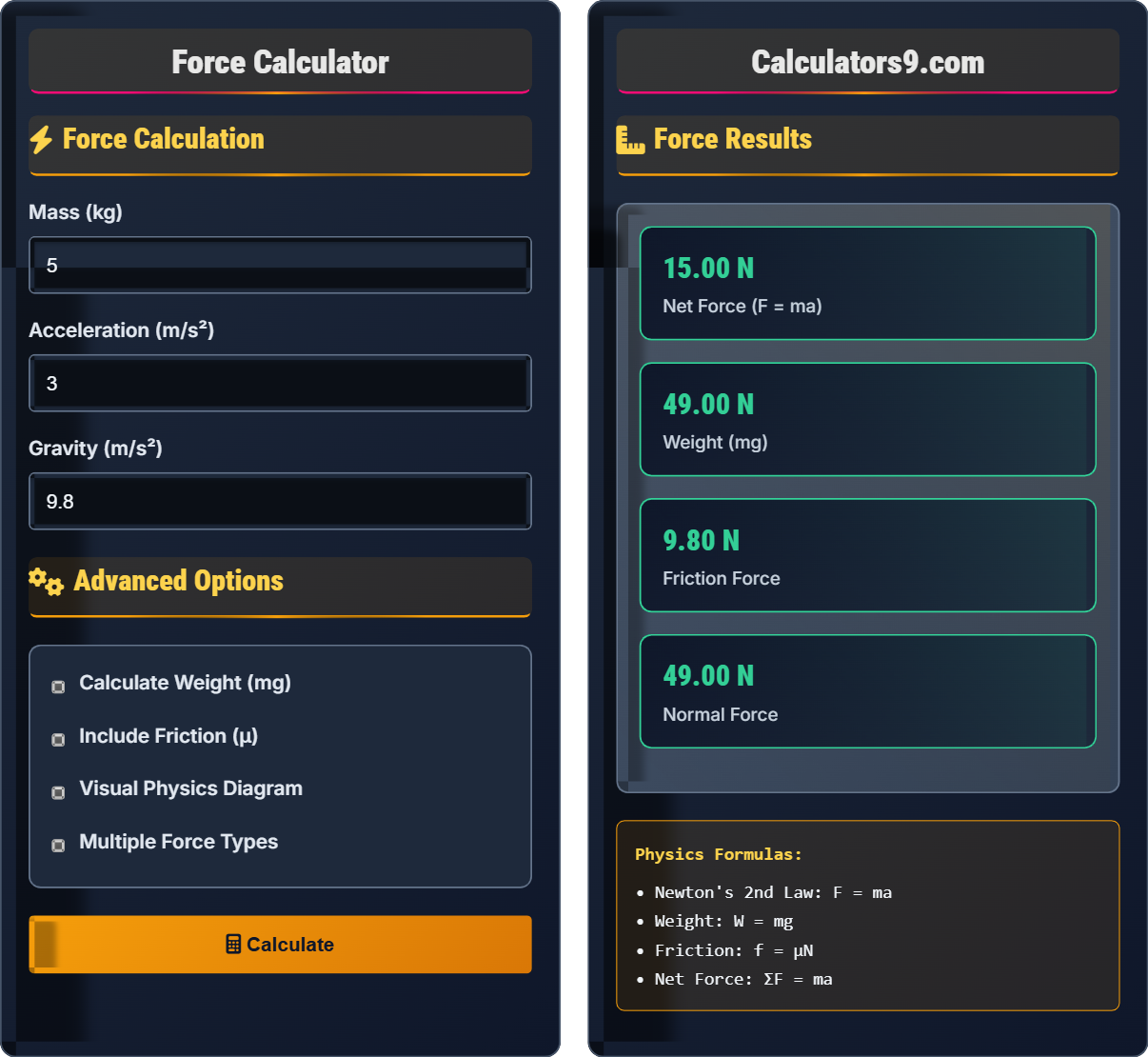
Example: For a 5kg object accelerating at 3m/s²:
\( F = 5 \times 3 = 15N \)
Thus, a net force of 15 Newtons is required.
Force Calculation
Advanced Options
Force Results
Comprehensive Force Physics Guide
Force is a vector quantity that causes an object with mass to accelerate. It is measured in Newtons (N) and is described by Newton's laws of motion. Forces can cause objects to start moving, stop moving, or change direction. The relationship between force, mass, and acceleration is defined by Newton's second law: F = ma.
Newton's three laws form the foundation of classical mechanics:
Force calculations are essential in various fields:
- Engineering: Structural analysis and design
- Automotive: Braking systems and safety
- Aerospace: Thrust and drag calculations
- Biomechanics: Human motion analysis
- Draw Free Body Diagram: Show all forces acting
- Choose Coordinate System: Define positive directions
- Apply Newton's Second Law: ΣF = ma
- Solve Equations: Calculate unknowns
Newton's Laws
An object at rest stays at rest, object in motion stays in motion.
Net force equals mass times acceleration.
- Every action has equal opposite reaction
- Forces come in pairs
- Act on different objects
Force Calculations
W = mg, where g is gravitational acceleration.
- Determine normal force (N)
- Identify coefficient (μ)
- Calculate f = μN
- Weight always acts downward
- Normal force perpendicular to surface
- Friction opposes motion
Physics Force Learning Quiz
If a 10kg object accelerates at 2m/s², what is the net force acting on it?
The answer is D) 20 N. Using Newton's second law: F = ma = 10kg × 2m/s² = 20 N. This is the net force required to produce the given acceleration.
Newton's second law states that the net force acting on an object equals the product of its mass and acceleration. The law is fundamental because it quantifies how much force is needed to achieve a certain acceleration for a given mass. In this problem, we simply substitute the given values into the formula F = ma to find the required net force.
Newton's Second Law: F = ma
Net Force: Sum of all forces acting on object
Acceleration: Rate of change of velocity
• Force and acceleration are vectors (direction matters)
• Mass is scalar (no direction)
• Units: 1 N = 1 kg·m/s²
• Always check units: kg × m/s² = N
• Remember: greater mass requires greater force for same acceleration
• Confusing mass with weight
• Forgetting to include units in final answer
• Mixing up force and acceleration
A 15kg box sits on a horizontal surface with a coefficient of friction μ = 0.3. If a horizontal force of 50N is applied to the box, calculate: a) the weight of the box, b) the normal force, c) the friction force, and d) the acceleration of the box.
a) Weight of the box: W = mg = 15kg × 9.8m/s² = 147N (downward)
b) Normal force: On a horizontal surface, N = W = 147N (upward)
c) Friction force: f = μN = 0.3 × 147N = 44.1N (opposite to motion)
d) Acceleration: Net force = Applied force - Friction = 50N - 44.1N = 5.9N
Using F = ma: a = F/m = 5.9N/15kg = 0.39 m/s²
This problem combines multiple concepts: weight calculation (W = mg), normal force (equal to weight on horizontal surface), friction calculation (f = μN), and finally Newton's second law (F = ma). The key is to identify all forces acting on the object and then determine the net force to find acceleration. The friction force opposes the applied force, reducing the net force available for acceleration.
Weight: Gravitational force W = mg
Normal Force: Perpendicular contact force N
Friction: Surface resistance f = μN
• On horizontal surface: N = W = mg
• Friction opposes motion: f = μN
• Net force determines acceleration
• Draw free body diagram first
• Identify all forces acting on object
• Apply Newton's laws systematically
• Forgetting to account for friction
• Using incorrect normal force value
• Not considering net force for acceleration
FAQ
Q: I'm confused about the difference between mass and weight. Aren't they the same thing since they both describe how heavy something is?
A: Mass and weight are fundamentally different quantities! Mass is a scalar quantity that measures the amount of matter in an object, measured in kilograms (kg). Weight is a vector quantity that measures the gravitational force acting on an object, measured in Newtons (N).
Mass is constant regardless of location - your mass is the same on Earth, Moon, or in space. However, your weight changes depending on the gravitational field strength. On Earth: W = mg = m × 9.8 m/s². On the Moon: W = mg = m × 1.6 m/s² (about 1/6 of Earth's gravity).
So a 10kg object always has a mass of 10kg, but its weight on Earth is 98N, while on the Moon it's only 16N.
Q: How does the coefficient of friction affect the force needed to move an object? Is there a relationship between the coefficient and the actual force?
A: Yes, there's a direct linear relationship! The friction force is calculated as f = μN, where μ is the coefficient of friction and N is the normal force. The coefficient of friction is dimensionless and depends on the materials in contact.
For example, if μ = 0.3 and N = 100N, then f = 0.3 × 100 = 30N. If you increase μ to 0.6, the friction force doubles to 60N. This means you'd need twice the applied force to overcome static friction and initiate motion.
The coefficient of static friction (μₛ) is typically higher than kinetic friction (μₖ), which explains why it's harder to start moving an object than to keep it moving.