Kinetic Energy Calculator
Motion Energy • Energy Conservation • Work-Energy
Kinetic Energy Formula:
Show the calculator\( KE = \frac{1}{2}mv^2 \)
Where:
- \( KE \) = Kinetic Energy (Joules)
- \( m \) = Mass (kg)
- \( v \) = Velocity (m/s)
This fundamental equation shows how motion energy depends on mass and velocity.
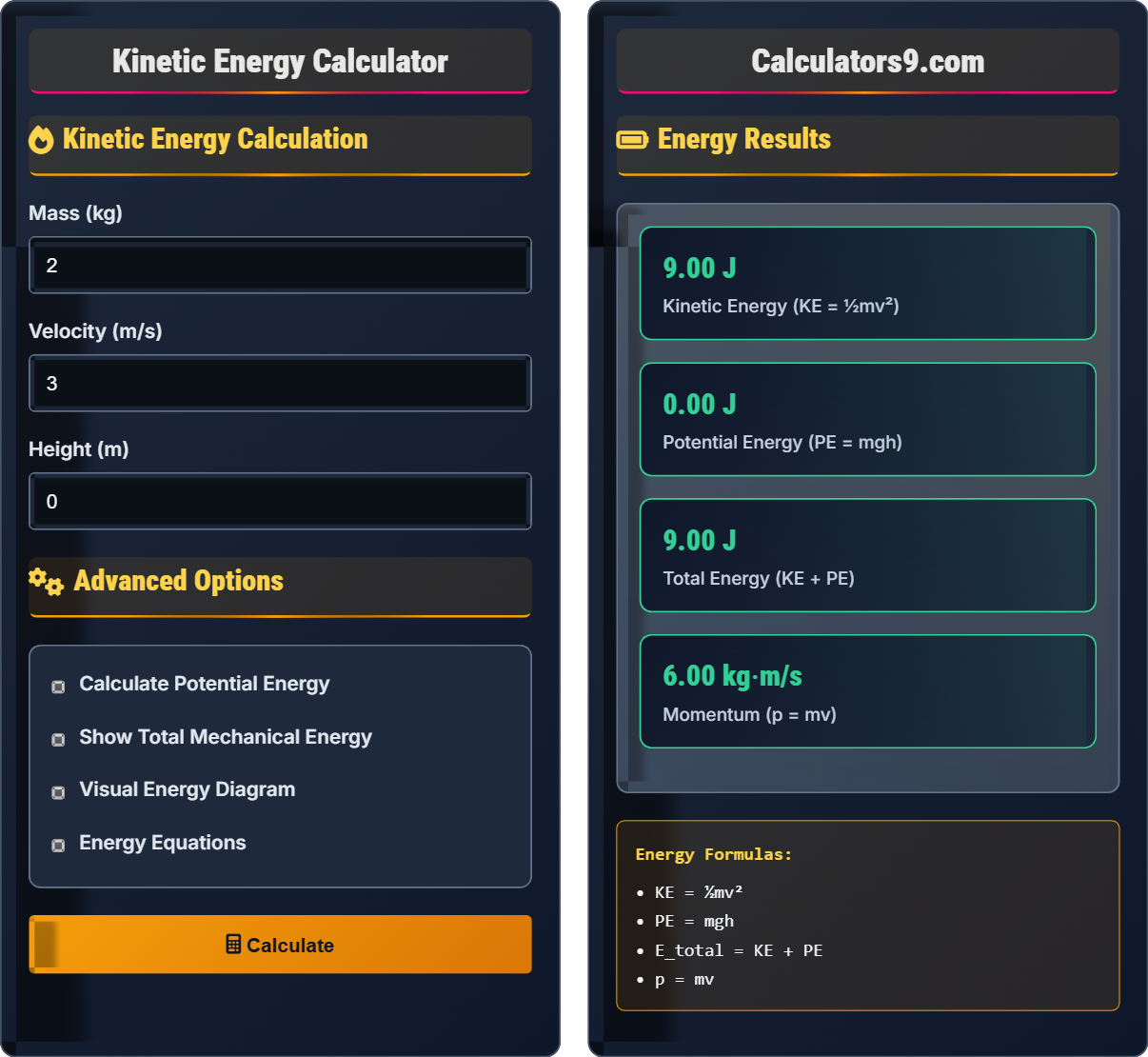
Example: 2kg object moving at 3m/s:
\( KE = \frac{1}{2} \times 2 \times 3^2 = 9 \text{ J} \)
Thus, the kinetic energy is 9 Joules.
Kinetic Energy Calculation
Advanced Options
Energy Results
Comprehensive Energy Physics Guide
Kinetic energy is the energy possessed by an object due to its motion. It is a scalar quantity measured in Joules (J) and depends on both the mass and velocity of the object. The kinetic energy formula KE = ½mv² shows that energy increases with the square of velocity, making velocity a more significant factor than mass in determining kinetic energy.
The fundamental energy equations:
Energy calculations are essential in various fields:
- Transportation: Vehicle safety and efficiency
- Sports: Performance analysis and equipment design
- Engineering: Structural impact and collision analysis
- Renewable Energy: Wind and hydroelectric power
- Conservation: Total mechanical energy remains constant
- Transformation: KE converts to PE and vice versa
- Isolated Systems: No external work done
- Real World: Some energy lost to friction
Energy Concepts
Energy due to motion: KE = ½mv²
KE + PE = constant in isolated systems
- KE ∝ v² (quadratic relationship)
- KE ∝ m (linear relationship)
- Velocity has greater impact than mass
Energy Calculations
Conversion between kinetic and potential energy.
- Identify mass and velocity
- Square the velocity
- Multiply by mass
- Divide by 2
- Double velocity = quadruple KE
- Double mass = double KE
- Energy is always positive
Physics Energy Learning Quiz
If the velocity of an object doubles while its mass remains constant, what happens to its kinetic energy?
The answer is C) Quadruples. Since KE = ½mv², kinetic energy is proportional to the square of velocity. If velocity doubles (v → 2v), then KE becomes ½m(2v)² = ½m(4v²) = 4(½mv²), which is 4 times the original kinetic energy.
This question highlights the quadratic relationship between kinetic energy and velocity. Because velocity is squared in the kinetic energy formula, any change in velocity has a squared effect on kinetic energy. This is why even small increases in speed can result in large increases in energy, which is critical in vehicle safety considerations.
Kinetic Energy: Energy due to motion
Quadratic Relationship: Proportional to the square of a variable
Proportionality: How one quantity changes with another
• KE ∝ v² (velocity has quadratic effect)
• KE ∝ m (mass has linear effect)
• Small velocity changes = large energy changes
• Remember: v² means velocity is squared
• Double velocity = 4x energy
• Triple velocity = 9x energy
• Forgetting that velocity is squared in the formula
• Missing the ½ factor in the formula
A 5kg ball is thrown upward with an initial velocity of 10 m/s. Calculate: a) its initial kinetic energy, b) the maximum height it reaches, c) its potential energy at maximum height, and d) verify energy conservation by comparing initial KE and final PE.
a) Initial kinetic energy: KE = ½mv² = ½ × 5kg × (10m/s)² = ½ × 5 × 100 = 250 J
b) Maximum height: At maximum height, all KE converts to PE. Using conservation: KE_initial = PE_max, so 250 J = mgh. Solving for h: h = 250/(5 × 9.8) = 250/49 = 5.1 m
c) Potential energy at max height: PE = mgh = 5 × 9.8 × 5.1 = 250 J
d) Energy conservation verification: Initial KE (250 J) = Final PE (250 J) ✓ Energy is conserved!
This problem demonstrates the principle of energy conservation in action. Initially, the ball has only kinetic energy due to its motion. As it rises, kinetic energy converts to potential energy until, at maximum height, all kinetic energy has transformed into potential energy. The total mechanical energy (KE + PE) remains constant throughout the motion, assuming no air resistance.
Energy Conservation: Total energy remains constant
Energy Transformation: Conversion from one form to another
Mechanical Energy: Sum of kinetic and potential energy
• KE + PE = constant (conservation)
• At max height: KE = 0, PE = maximum
• Energy can transform but not be destroyed
• Use conservation to find maximum height
• At turning points, KE = 0 (all PE)
• Always verify your calculations with energy conservation
• Forgetting to square the velocity in KE calculation
• Not accounting for the ½ factor in KE formula
• Mixing up KE and PE at different points
FAQ
Q: Why is kinetic energy proportional to the square of velocity? That seems like a very strong relationship.
A: The quadratic relationship comes from the fundamental work-energy theorem. When a force acts on an object to accelerate it, the work done (W = Fd) becomes kinetic energy. Through integration of the equations of motion, it turns out that KE = ½mv².
Intuitively, as velocity increases, the object covers more distance in the same time period, and the force acts over a longer distance, doing more work. This results in the squared relationship. This is why driving at 60 mph instead of 30 mph requires 4 times the stopping distance under the same braking force.
Q: How does kinetic energy relate to momentum? Are they the same thing?
A: Kinetic energy and momentum are related but distinct concepts. Momentum (p = mv) is a vector quantity that depends linearly on velocity, while kinetic energy (KE = ½mv²) is a scalar quantity that depends quadratically on velocity.
The relationship between them is: KE = p²/2m. So if you know momentum, you can find kinetic energy without knowing velocity directly. In collisions, momentum is always conserved (in closed systems), but kinetic energy is only conserved in elastic collisions. In inelastic collisions, some KE converts to other forms like heat or deformation.