Potential Energy Calculator
Gravitational Energy • Height-Energy • Energy Conservation
Potential Energy Formula:
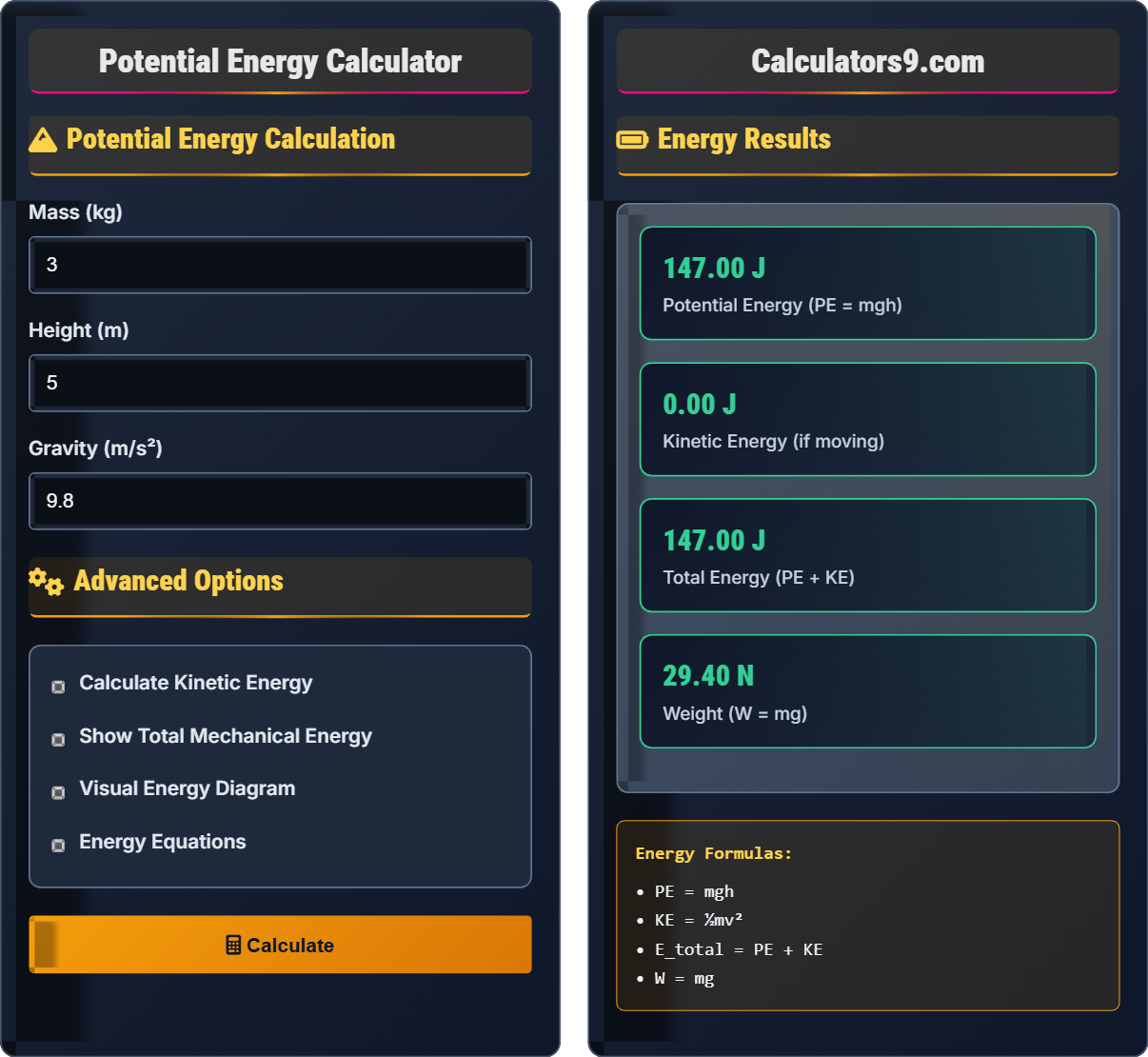
Show the calculator\( PE = mgh \)
Where:
- \( PE \) = Potential Energy (Joules)
- \( m \) = Mass (kg)
- \( g \) = Gravity (9.8 m/s²)
- \( h \) = Height (m)
This fundamental equation shows how stored energy depends on mass, gravity, and height.
Example: 3kg object at 5m height:
\( PE = 3 \times 9.8 \times 5 = 147 \text{ J} \)
Thus, the potential energy is 147 Joules.
Potential Energy Calculation
Advanced Options
Energy Results
Comprehensive Energy Physics Guide
Potential energy is the energy possessed by an object due to its position relative to other objects. Gravitational potential energy is the most common form, depending on an object's mass, the gravitational field strength, and its height above a reference point. The formula PE = mgh shows that energy increases linearly with mass, gravity, and height.
The fundamental energy equations:
Energy calculations are essential in various fields:
- Hydropower: Water stored at height
- Roller Coasters: Height-speed transformations
- Archery: Bow potential energy transfer
- Space Missions: Escape velocity calculations
- Conservation: Total mechanical energy remains constant
- Transformation: PE converts to KE and vice versa
- Isolated Systems: No external work done
- Real World: Some energy lost to friction
Energy Concepts
Stored energy due to position: PE = mgh
PE + KE = constant in isolated systems
- PE ∝ h (linear relationship)
- PE ∝ m (linear relationship)
- PE ∝ g (linear relationship)
Energy Calculations
Conversion between kinetic and potential energy.
- Identify mass and height
- Use standard gravity (9.8 m/s²)
- Multiply m × g × h
- Result in Joules
- Double height = double PE
- Double mass = double PE
- Energy is always positive
Physics Energy Learning Quiz
If the height of an object above ground is doubled while its mass remains constant, what happens to its gravitational potential energy?
The answer is B) Doubles. Since PE = mgh, gravitational potential energy is directly proportional to height. If height doubles (h → 2h), then PE becomes mg(2h) = 2(mgh), which is 2 times the original potential energy.
This question highlights the linear relationship between potential energy and height. Unlike kinetic energy (which has a quadratic relationship with velocity), potential energy changes proportionally with height. This means that if you double the height, you double the potential energy. This is why raising an object to twice the height requires twice the work against gravity.
Potential Energy: Stored energy due to position
Linear Relationship: Proportional to the variable
Gravitational Field: Force per unit mass
• PE ∝ h (height has linear effect)
• PE ∝ m (mass has linear effect)
• PE ∝ g (gravity has linear effect)
• Remember: PE = mgh
• Linear relationship: double one factor = double PE
• Always specify reference point for height
• Confusing linear relationship with quadratic relationship
• Forgetting that PE depends on reference point
• Using incorrect units for calculations
A 2kg rock is dropped from a height of 10m. Calculate: a) its initial potential energy, b) its kinetic energy just before hitting the ground, c) its velocity just before impact, and d) verify energy conservation by comparing initial PE and final KE.
a) Initial potential energy: PE = mgh = 2kg × 9.8m/s² × 10m = 196 J
b) Kinetic energy before impact: By conservation of energy, all PE converts to KE at ground level, so KE = 196 J
c) Velocity before impact: Using KE = ½mv², we solve for v: 196 = ½ × 2 × v² → 196 = v² → v = √196 = 14 m/s
d) Energy conservation verification: Initial PE (196 J) = Final KE (196 J) ✓ Energy is conserved!
This problem demonstrates the principle of energy conservation perfectly. Initially, the rock has only potential energy due to its height. As it falls, potential energy converts to kinetic energy until, just before impact, all potential energy has transformed into kinetic energy. The total mechanical energy (PE + KE) remains constant throughout the fall, assuming no air resistance. This conversion is why objects gain speed as they fall.
Energy Conservation: Total energy remains constant
Energy Transformation: Conversion from one form to another
Free Fall: Motion under gravity alone
• PE + KE = constant (conservation)
• At ground level: PE = 0, KE = maximum
• Energy can transform but not be destroyed
• Use conservation to find final velocity
• At release: KE = 0 (all PE)
• At impact: PE = 0 (all KE)
• Forgetting to account for the ½ factor in KE formula
• Not specifying the reference point for PE
• Mixing up PE and KE at different points
FAQ
Q: What is the reference point for potential energy? Does it matter where I measure height from?
A: The reference point for potential energy is arbitrary, but it's important to be consistent. You can choose any point as zero potential energy - typically ground level, sea level, or the lowest point in your problem. What matters is the change in potential energy (ΔPE), not the absolute value. For example, if you calculate PE as 100J at one point and 60J at another, the change is 40J regardless of your reference point. This is why energy conservation works with potential energy differences.
Q: How does potential energy relate to work done against gravity? Are they the same thing?
A: Potential energy and work done against gravity are directly related. When you lift an object, you do work against the gravitational force. This work is stored as gravitational potential energy. Specifically, W = Fd = mgd, where d is the height change. This work becomes the potential energy: PE = mgh. So the work done lifting an object equals the increase in its potential energy. This is a manifestation of the work-energy theorem: W = ΔPE.