Power Calculator
Energy Rate • Work-Time • Efficiency
Power Formula:
Show the calculator\( P = \frac{W}{t} \)
Where:
- \( P \) = Power (Watts)
- \( W \) = Work (Joules)
- \( t \) = Time (seconds)
This fundamental equation shows how power depends on work done and time taken.
Alternative forms:
\( P = Fv \) (Force × Velocity)
\( P = VI \) (Electrical Power)
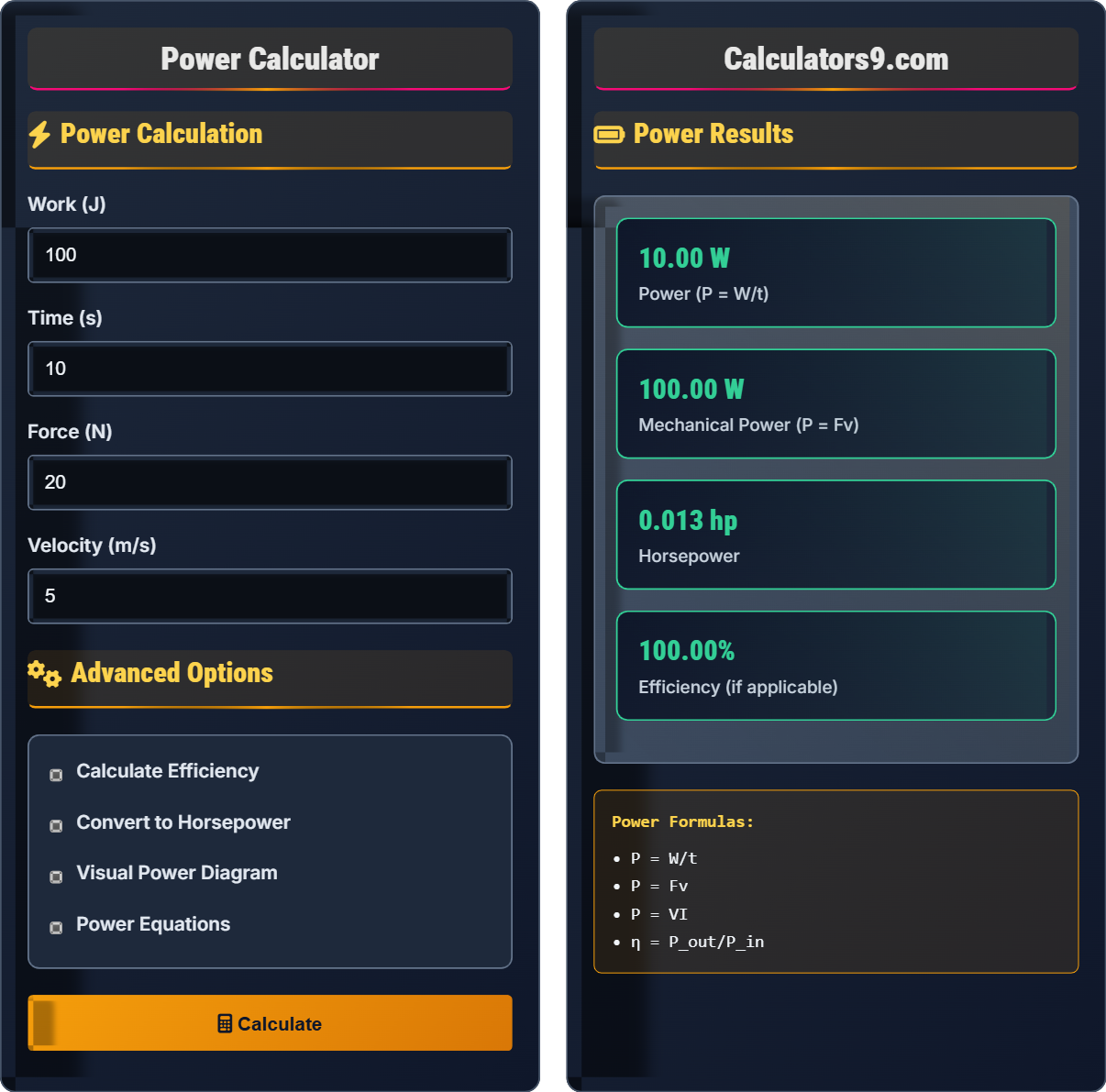
Example: 100J of work done in 10s:
\( P = \frac{100}{10} = 10 \text{ W} \)
Thus, the power is 10 Watts.
Power Calculation
Advanced Options
Power Results
Comprehensive Power Physics Guide
Power is the rate at which work is done or energy is transferred. It is a scalar quantity measured in Watts (Joules per second) and indicates how quickly energy is converted from one form to another. Power is crucial in engineering applications, as it determines the capability of machines and systems to perform work efficiently within specific time constraints.
The fundamental power equations:
Power calculations are essential in various fields:
- Automotive: Engine power ratings and performance
- Electrical: Circuit design and appliance ratings
- Industrial: Machinery selection and optimization
- Renewable Energy: Solar panel and wind turbine output
- Power: Rate of energy transfer (Watts)
- Energy: Total work done (Joules)
- Relationship: Energy = Power × Time
- Efficiency: Useful power output vs input
Power Concepts
Rate of doing work: P = W/t
P = Fv (Force × Velocity)
- Higher power = faster energy transfer
- Power is scalar (no direction)
- 1 Watt = 1 Joule per second
Power Calculations
Useful output vs total input: η = P_out/P_in
- Determine work done or energy transferred
- Measure time interval
- Calculate P = W/t
- Convert units if necessary
- Power ∝ Work (at constant time)
- Power ∝ 1/Time (at constant work)
- Efficiency never exceeds 100%
Physics Power Learning Quiz
If two machines perform the same amount of work, but machine A takes 5 minutes while machine B takes 10 minutes, how does the power of machine A compare to machine B?
The answer is C) Machine A has twice the power of B. Using P = W/t, if both machines do the same work (W), then P_A = W/5 and P_B = W/10. Therefore, P_A/P_B = (W/5)/(W/10) = (W/5) × (10/W) = 2. So P_A = 2P_B.
This question tests the inverse relationship between power and time when work is constant. Since power is work divided by time, if time decreases while work remains constant, power increases proportionally. Machine A completes the same work in half the time, so it must operate at twice the power. This is why more powerful engines can accomplish the same task faster.
Power: Rate of doing work
Inverse Relationship: When one quantity increases, the other decreases
Proportional: Changing at the same rate
• P = W/t (power is inversely proportional to time)
• More power = faster work completion
• Same work, less time = more power
• Remember: P = W/t
• Less time = more power (inverse relationship)
• Same work means W_A = W_B
• Thinking power is directly proportional to time
• Forgetting the inverse relationship between P and t
• Confusing work and power concepts
A motor lifts a 200kg crate 10m vertically in 25 seconds. The motor draws 1000W from the electrical supply. Calculate: a) the work done by the motor, b) the power output of the motor, c) the efficiency of the motor, and d) the energy wasted as heat.
a) Work done: W = mgh = 200kg × 9.8m/s² × 10m = 19,600 J
b) Power output: P_output = W/t = 19,600J / 25s = 784 W
c) Efficiency: η = P_out/P_in × 100% = 784W / 1000W × 100% = 78.4%
d) Energy wasted: P_wasted = P_in - P_out = 1000W - 784W = 216W. Energy wasted = P_wasted × t = 216W × 25s = 5,400 J
This problem combines multiple power concepts. The motor does work against gravity (potential energy increase), which represents the useful output power. The input power is what the motor draws from the electrical supply. Efficiency is the ratio of useful output to total input. The difference between input and output power represents energy lost to heat, friction, and other inefficiencies. This illustrates real-world applications where no system is 100% efficient.
Power Output: Useful power delivered by device
Power Input: Total power consumed by device
Efficiency: Ratio of useful output to input
• Efficiency = Output/Input × 100%
• P_input = P_output + P_loss
• Energy is conserved but transformed
• Always identify input vs output in efficiency problems
• Work done against gravity: W = mgh
• Power loss = Input - Output
• Confusing input and output power
• Forgetting to account for all energy losses
• Using wrong formula for efficiency calculation
FAQ
Q: What's the difference between power and energy? They seem like similar concepts.
A: Power and energy are related but distinct concepts. Energy is the capacity to do work and is measured in Joules (J). Power is the rate at which energy is transferred or work is done, measured in Watts (W), which is Joules per second.
Think of it this way: energy is like the amount of fuel in a tank, while power is how quickly you burn that fuel. A 60W light bulb uses 60 Joules of energy every second. A 100W bulb uses 100 Joules per second, so it burns through energy faster.
Mathematically: Energy = Power × Time, or P = E/t.
Q: How do I convert between mechanical power and horsepower? What's the significance of horsepower?
A: Horsepower is a traditional unit of power that originated from James Watt's measurements of a horse's ability to do work. The conversion is: 1 horsepower (hp) = 746 watts.
To convert mechanical power to horsepower: hp = P(watts) / 746
Horsepower is still widely used in automotive and industrial applications, especially in the US. While watts are the SI unit, horsepower gives a more intuitive sense of engine capability for many people. For example, a 150 hp engine produces about 111,900 watts of power.
Other common conversions: 1 kW = 1.34 hp, 1 MW = 1,341 hp.