Velocity Calculator
Speed • Acceleration • Kinematic Equations
Kinematic Equation:
Show the calculator\( v = u + at \)
Where:
- \( v \) = Final velocity (m/s)
- \( u \) = Initial velocity (m/s)
- \( a \) = Acceleration (m/s²)
- \( t \) = Time (s)
This fundamental equation describes how velocity changes with constant acceleration.
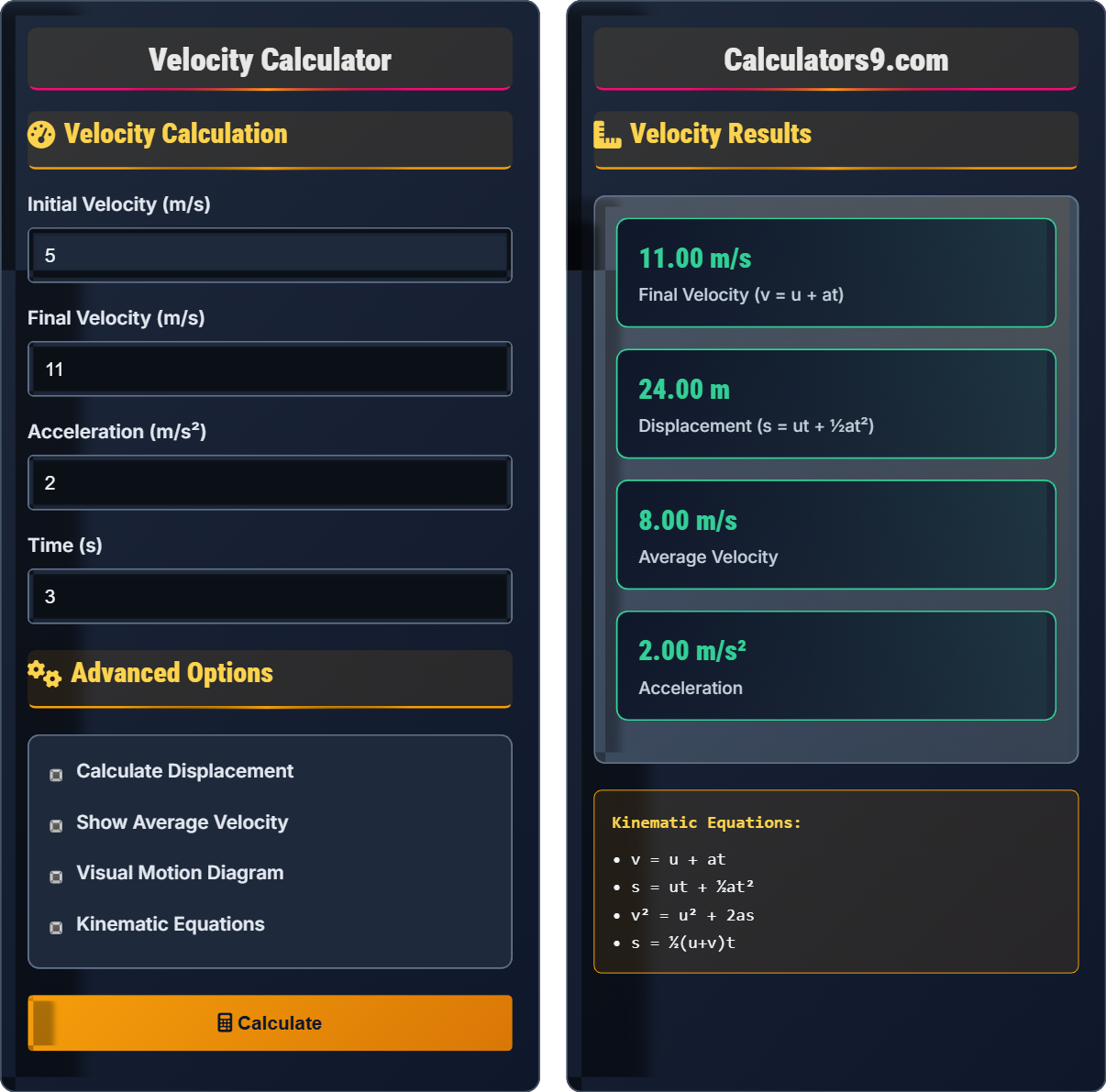
Example: Object starts at 5m/s, accelerates at 2m/s² for 3s:
\( v = 5 + (2 \times 3) = 11 \text{ m/s} \)
Thus, the final velocity is 11 m/s.
Velocity Calculation
Advanced Options
Velocity Results
Comprehensive Velocity Physics Guide
Velocity is a vector quantity that describes the rate of change of displacement with respect to time. Unlike speed (a scalar), velocity includes both magnitude and direction. It is measured in meters per second (m/s) and is fundamental to understanding motion in physics. The relationship between velocity, acceleration, and time is described by kinematic equations.
The four fundamental kinematic equations describe motion with constant acceleration:
Velocity calculations are essential in various fields:
- Transportation: Vehicle dynamics and safety
- Sports: Performance analysis and training
- Engineering: Machine design and robotics
- Astronomy: Orbital mechanics and celestial motion
- Identify Knowns: List all given variables
- Identify Unknowns: Determine what to find
- Select Equation: Choose appropriate kinematic equation
- Solve: Substitute values and calculate
Kinematic Equations
v = u + at (velocity-time relationship)
s = ut + ½at² (displacement-time relationship)
- Constant acceleration required
- Linear motion only
- Units must be consistent
Motion Calculations
Δs/Δt, where Δs is displacement and Δt is time interval.
- Find change in velocity (Δv)
- Measure time interval (Δt)
- Calculate a = Δv/Δt
- Positive velocity: forward motion
- Negative velocity: backward motion
- Zero velocity: object at rest
Physics Velocity Learning Quiz
A car traveling at 10 m/s accelerates uniformly at 2 m/s² for 5 seconds. What is its final velocity?
The answer is B) 20 m/s. Using the first kinematic equation: v = u + at, where u = 10 m/s, a = 2 m/s², and t = 5 s. So v = 10 + (2 × 5) = 10 + 10 = 20 m/s.
This problem uses the fundamental kinematic equation that relates final velocity to initial velocity, acceleration, and time. The equation v = u + at is derived from the definition of acceleration (rate of change of velocity). Since acceleration is constant, the change in velocity is simply acceleration multiplied by time. We add this change to the initial velocity to get the final velocity.
Initial Velocity (u): Velocity at start of motion
Final Velocity (v): Velocity at end of motion
Acceleration (a): Rate of change of velocity
• Always use consistent units (m/s, m/s², s)
• Acceleration can be positive or negative
• Time must be positive
• Write down known values before solving
• Check if answer is physically reasonable
• Forgetting to include initial velocity in calculation
• Using wrong kinematic equation
• Mixing up units (km/h vs m/s)
A train starts from rest and accelerates at 1.5 m/s² for 10 seconds. Calculate: a) its final velocity, b) the distance traveled during acceleration, and c) its average velocity during this time.
a) Final velocity: Using v = u + at, where u = 0 (starts from rest), a = 1.5 m/s², t = 10 s.
v = 0 + (1.5 × 10) = 15 m/s
b) Distance traveled: Using s = ut + ½at², where u = 0, a = 1.5 m/s², t = 10 s.
s = 0×10 + ½×1.5×10² = 0 + ½×1.5×100 = 75 m
c) Average velocity: Average velocity = total displacement / total time = 75 m / 10 s = 7.5 m/s
This multi-step problem demonstrates how to apply different kinematic equations sequentially. First, we use the velocity equation since we know initial velocity, acceleration, and time. Next, we use the displacement equation to find distance traveled. Finally, average velocity is simply total displacement divided by total time. Notice that the average velocity (7.5 m/s) is exactly halfway between initial (0 m/s) and final (15 m/s) velocities, which is always true for uniform acceleration.
Uniform Acceleration: Constant rate of change of velocity
Displacement: Change in position (vector quantity)
Average Velocity: Total displacement divided by total time
• For uniform acceleration: v_avg = (u + v)/2
• Start with what you know and what you need
• Check units throughout calculation
• Draw a simple sketch to visualize motion
• Use the equation that requires the fewest unknowns
• Verify that final velocity is greater than initial (for positive acceleration)
• Forgetting that "from rest" means u = 0
• Squaring time incorrectly (t² vs 2t)
• Confusing average velocity with instantaneous velocity
FAQ
Q: What's the difference between speed and velocity? I thought they were the same thing.
A: Speed and velocity are similar but fundamentally different! Speed is a scalar quantity that measures how fast an object is moving, regardless of direction. Velocity is a vector quantity that includes both speed AND direction.
For example, if a car travels 60 km/h in a circular track, its speed remains constant at 60 km/h, but its velocity is constantly changing because the direction is changing. If the car completes a full circle and returns to its starting point, its average velocity over the trip is zero (since displacement is zero), but its average speed is still 60 km/h.
Mathematically: Speed = |velocity|, where the absolute value bars indicate we only consider magnitude, not direction.
Q: How do I know which kinematic equation to use for a particular problem? There are four equations, and I'm not sure when to use each one.
A: The key is to look at what information you're given and what you're trying to find. Each kinematic equation omits one variable:
• v = u + at (omits displacement s)
• s = ut + ½at² (omits final velocity v)
• v² = u² + 2as (omits time t)
• s = ½(u+v)t (omits acceleration a)
Always choose the equation that doesn't include the variable you don't know and don't need to find. For example, if time isn't given and isn't asked for, use v² = u² + 2as. If acceleration isn't given and isn't asked for, use s = ½(u+v)t.