Work Calculator
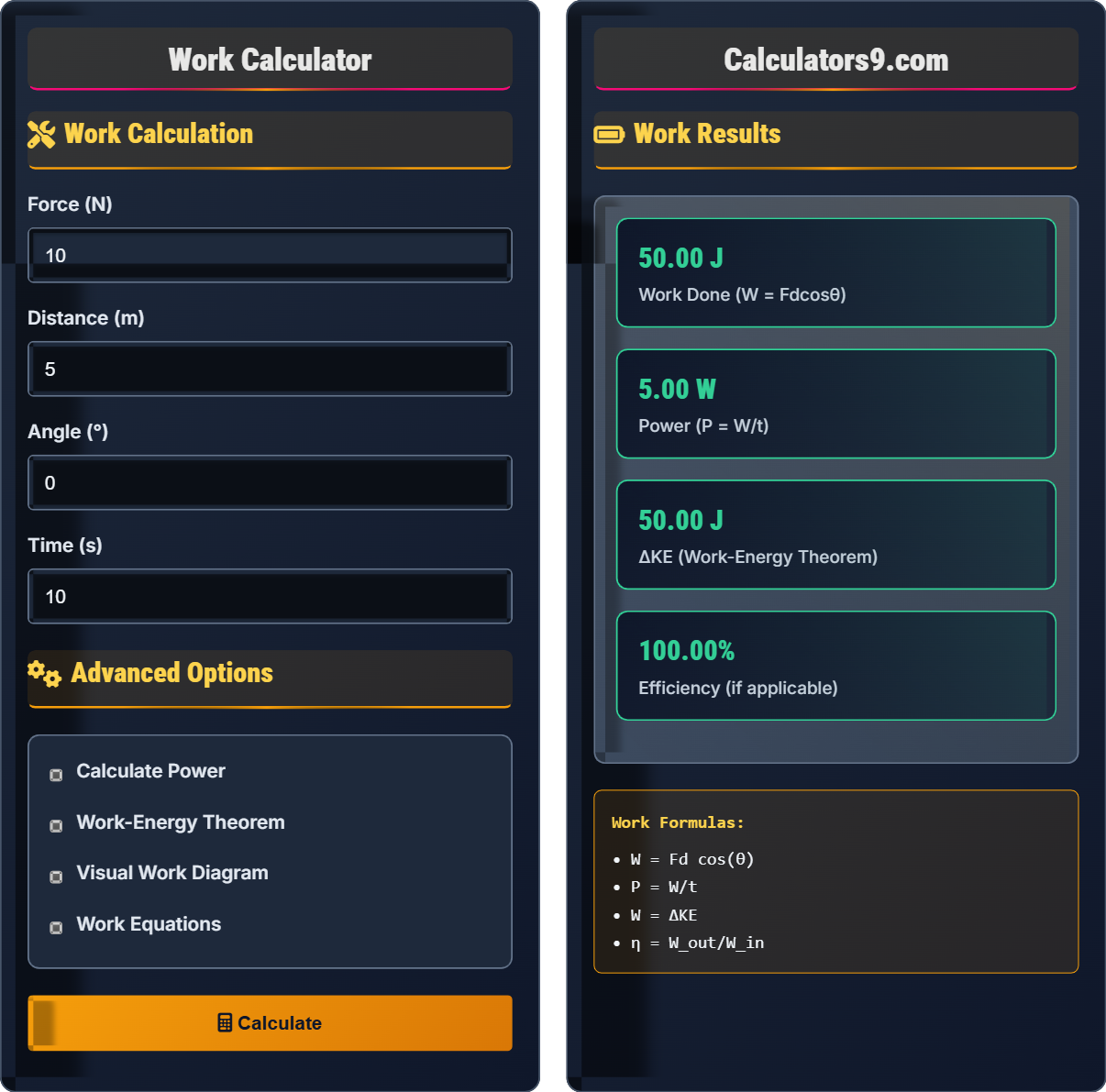
Force-Distance • Energy Conversion • Power
Work Formula:
Show the calculator\( W = Fd \cos(\theta) \)
Where:
- \( W \) = Work (Joules)
- \( F \) = Force (Newtons)
- \( d \) = Displacement (meters)
- \( \theta \) = Angle between force and displacement
This fundamental equation shows how work depends on force, displacement, and direction.
Example: 10N force applied over 5m at 0° angle:
\( W = 10 \times 5 \times \cos(0°) = 50 \text{ J} \)
Thus, the work done is 50 Joules.
Work Calculation
Advanced Options
Work Results
Comprehensive Work Physics Guide
Work is defined as the energy transferred when a force acts on an object causing it to move. It is a scalar quantity measured in Joules (J) and depends on the magnitude of the force, the displacement of the object, and the angle between the force and displacement vectors. The work formula W = Fd cos(θ) shows that work is maximized when force and displacement are parallel (θ = 0°).
The fundamental work equations:
Work calculations are essential in various fields:
- Mechanical Engineering: Machine efficiency analysis
- Construction: Lifting and moving materials
- Transportation: Vehicle performance and fuel efficiency
- Renewable Energy: Turbine and pump work calculations
- Work-Energy Theorem: Work equals change in kinetic energy
- Conservative Forces: Path-independent work
- Non-conservative Forces: Path-dependent work
- Energy Conservation: Work transforms energy forms
Work Concepts
Energy transfer through force and displacement: W = Fd cos(θ)
W_net = ΔKE = KE_final - KE_initial
- W = 0 when θ = 90° (perpendicular)
- W > 0 when 0° ≤ θ < 90° (positive)
- W < 0 when 90° < θ ≤ 180° (negative)
Work Calculations
Rate of doing work: P = W/t
- Identify force magnitude and direction
- Measure displacement magnitude and direction
- Determine angle between them
- Calculate W = Fd cos(θ)
- Maximum work when θ = 0°
- No work when θ = 90°
- Work is negative when θ > 90°
Physics Work Learning Quiz
If a force is applied perpendicular to the direction of displacement, what is the work done?
The answer is C) Zero work. When the force is perpendicular to displacement, the angle θ = 90°. Using the work formula: W = Fd cos(90°) = Fd × 0 = 0. This means no work is done by the force since cos(90°) = 0.
This question tests understanding of the angle dependence in the work formula. The cosine function determines how much of the force contributes to displacement in the same direction. When force and displacement are perpendicular, the force doesn't contribute to motion in the displacement direction, so no work is done. This is why centripetal force does no work on an object in circular motion.
Work: Energy transfer through force and displacement
Perpendicular: At 90° angle to each other
Cosine Function: cos(90°) = 0
• W = 0 when θ = 90° (force ⊥ displacement)
• W = Fd when θ = 0° (force ∥ displacement)
• W = -Fd when θ = 180° (opposite directions)
• Remember: Only force component parallel to displacement does work
• cos(0°) = 1, cos(90°) = 0, cos(180°) = -1
• Think about whether force moves object in its direction
• Forgetting the angle in the work formula
• Thinking all forces do work regardless of direction
• Misunderstanding perpendicular relationships
A 5kg box is pushed across a horizontal surface with a 20N force applied at an angle of 30° to the horizontal. If the box moves 8m, calculate: a) the work done by the applied force, b) the work done by friction if μ = 0.2, and c) the final velocity of the box starting from rest.
a) Work done by applied force: Only the horizontal component of force does work. W = F_horizontal × d = F cos(θ) × d = 20N × cos(30°) × 8m = 20 × 0.866 × 8 = 138.6 J
b) Work done by friction: First find normal force: N = mg - F sin(θ) = 5kg × 9.8m/s² - 20N × sin(30°) = 49 - 10 = 39N. Friction force: f = μN = 0.2 × 39 = 7.8N. Work by friction: W_friction = -f × d = -7.8N × 8m = -62.4J (negative because friction opposes motion)
c) Final velocity: Using Work-Energy Theorem: W_net = ΔKE = ½mv² - 0. W_net = W_applied + W_friction = 138.6 - 62.4 = 76.2J. So 76.2 = ½ × 5kg × v² → v² = 30.48 → v = 5.52 m/s
This problem combines multiple concepts: work calculation with angles, friction forces, and the work-energy theorem. The key insight is that only the component of force parallel to displacement does work. The vertical component of the applied force reduces the normal force, which in turn reduces friction. The net work (work by all forces) equals the change in kinetic energy.
Work-Energy Theorem: Net work equals change in KE
Friction Force: f = μN opposing motion
Normal Force: Perpendicular contact force
• Only parallel force component does work
• Friction always opposes motion (negative work)
• W_net = ΔKE applies to all forces
• Break angled forces into components
• Always consider all forces when calculating net work
• Draw free-body diagrams for complex problems
• Using total force magnitude instead of parallel component
• Forgetting to account for angle in work calculation
• Not considering all forces affecting motion
FAQ
Q: If I carry a heavy backpack horizontally at constant speed, am I doing work on the backpack?
A: No, you are doing zero work on the backpack in the ideal physics sense! Although you might feel tired, the work done on the backpack is zero because the force you apply (upward to counteract gravity) is perpendicular to the displacement (horizontal motion). Using W = Fd cos(θ), where θ = 90°, we get W = Fd cos(90°) = 0.
You might feel fatigued because your muscles are doing internal work (contractions and relaxations), but no external work is done on the backpack. This is a classic example of how work in physics differs from our everyday understanding of physical effort.
Q: How does the work-energy theorem relate to conservation of energy? Are they the same thing?
A: The work-energy theorem and conservation of energy are related but distinct concepts. The work-energy theorem specifically states that the net work done on an object equals its change in kinetic energy: W_net = ΔKE.
Conservation of energy is broader: it states that total energy in an isolated system remains constant. The work-energy theorem is a specific application when considering kinetic energy changes due to external forces.
When only conservative forces act, the work-energy theorem leads to conservation of mechanical energy (KE + PE = constant). When non-conservative forces (like friction) are present, the work done by these forces equals the loss in mechanical energy.