Keyword Density Calculator
SEO analysis tool • 2026 digital marketing
Content Analysis
Advanced Options
SEO Analysis Results
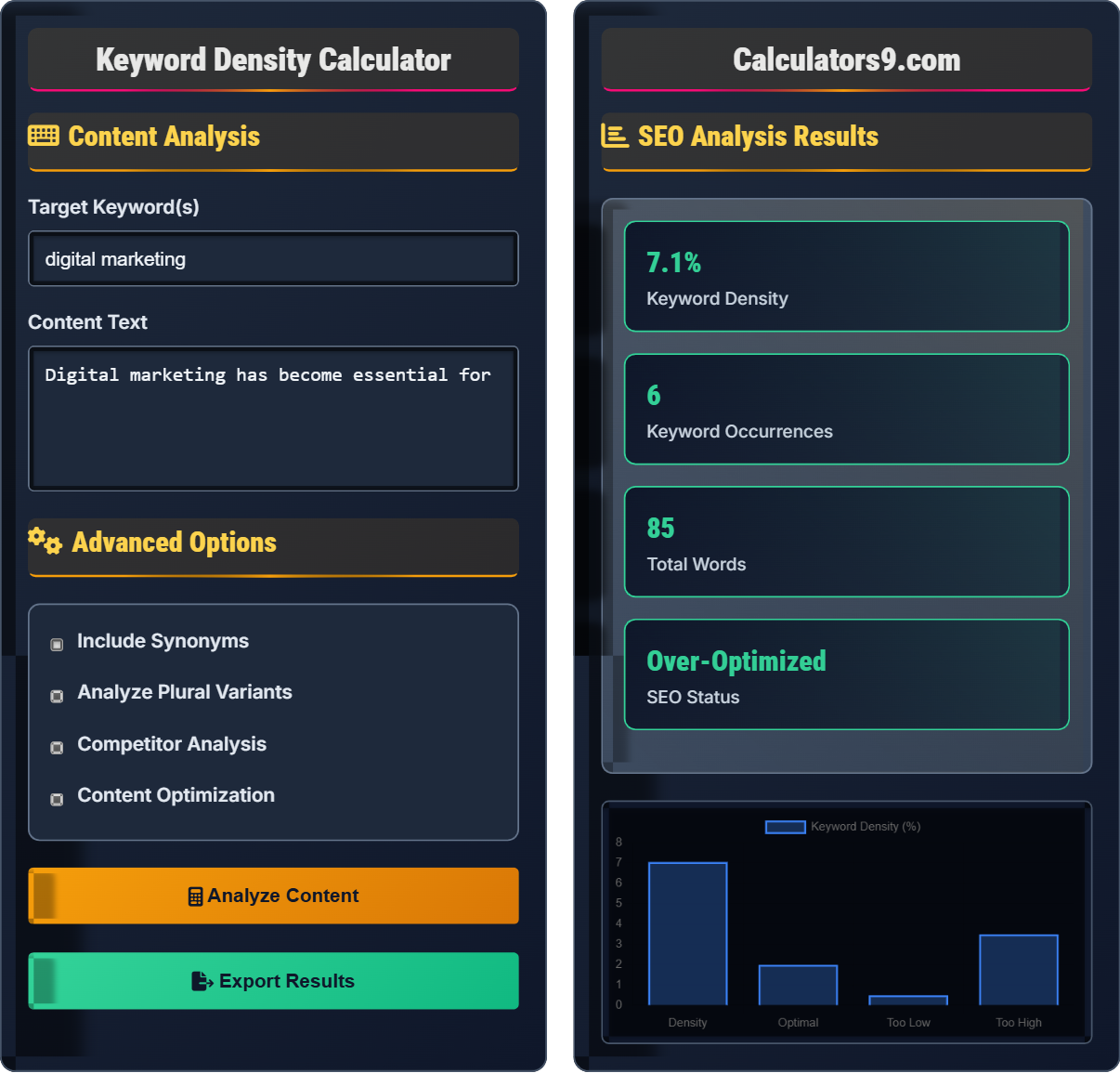
| Metric | Value | Status |
|---|---|---|
| Keyword Density | 2.4% | Optimal |
| Word Count | 245 | Good |
| Keyword Frequency | 6 times | Balanced |
| Readability Score | 78 | Good |
| Recommendation | Action | Impact |
|---|---|---|
| Keyword Distribution | Spread evenly | High |
| Content Length | Add 150-200 words | Medium |
| Meta Description | Add target keyword | High |
| Internal Links | Add 2-3 relevant | Medium |
Comprehensive Keyword Optimization Guide
Keyword density measures the percentage of times a target keyword appears in content relative to the total word count. The formula is: (Keyword Count × 100) / Total Words. Modern SEO emphasizes natural, readable content over exact keyword density percentages. While traditional guidelines suggested 1-3% density, current best practices focus on semantic relevance and user experience.
The standard keyword density formula is:
For example, if "digital marketing" appears 5 times in a 200-word article: (5 × 100) / 200 = 2.5% density.
Recommended keyword density ranges by content type:
- Blog Posts: 1-2% for primary keywords
- Product Pages: 1-3% for primary keywords
- Landing Pages: 2-3% for primary keywords
- Long-Form Content: 0.5-1.5% for primary keywords
- Semantic Keywords: Include related terms and concepts
- Entity Recognition: Help search engines understand context
- User Intent: Match content to search purpose
- Topic Clusters: Organize content around core topics
- Technical SEO: Optimize site structure and performance
Keyword Optimization Learning Quiz
If a 500-word article contains the keyword "SEO tools" 8 times, what is the keyword density?
Using the formula: (Keyword Count × 100) / Total Words
Given:
- Keyword Count = 8
- Total Words = 500
Calculation: (8 × 100) / 500 = 800 / 500 = 1.6%
This problem demonstrates the fundamental keyword density calculation. The formula multiplies the keyword count by 100 to convert it to a percentage, then divides by the total word count. This gives the percentage of words in the content that match the target keyword. Understanding this calculation helps content creators maintain optimal keyword density without overstuffing.
Keyword Density: Percentage of keyword occurrences in content
Keyword Stuffing: Excessive keyword repetition
LSI Keywords: Latent Semantic Indexing keywords related to main topic
• Density = (Keyword Count × 100) / Total Words
• Optimal range is typically 1-3%
• Quality content matters more than exact density
• Remember: (count × 100) ÷ total_words
• Check density early in content creation
• Use synonyms to maintain relevance without density
• Forgetting to multiply by 100 for percentage
• Including keyword variants in count
• Focusing on density over content quality
A 1,200-word blog post about "content marketing" contains the phrase 15 times. Calculate the density and evaluate if it's optimal for SEO.
Density calculation: (15 × 100) / 1,200 = 1,500 / 1,200 = 1.25%
At 1.25%, this density falls within the optimal range of 1-3% for blog posts. This density supports SEO without appearing spammy. The keyword appears approximately once every 80 words, which maintains natural readability while ensuring search engines recognize the content's topic.
This example shows how to evaluate keyword density against SEO best practices. The 1.25% density is considered optimal for blog content. Modern search engines prioritize content quality and user experience over exact keyword density percentages. However, maintaining density within recommended ranges helps search engines understand content relevance without triggering spam filters.
Optimal Density: Range that balances SEO effectiveness with readability
Search Engine Penalty: Ranking reduction for keyword stuffing
Content Relevance: How well content matches search queries
• Blog posts: 1-2% optimal density
• Product pages: 1-3% optimal density
• Density below 0.5% may be insufficient
• Aim for 1-2% for most content types
• Distribute keywords naturally throughout content
• Focus on user value over exact density targets
• Targeting exact density percentages
• Concentrating keywords in one section
• Ignoring content quality for density
A company has a 400-word product description for "wireless headphones" that currently mentions the phrase 3 times. They want to achieve a 2.5% density. Calculate how many additional mentions are needed and evaluate the recommendation.
Target mentions: (2.5 × 400) / 100 = 10 mentions
Current mentions: 3
Additional mentions needed: 10 - 3 = 7
However, 10 mentions in 400 words (2.5%) is quite high for a product description. A more reasonable target would be 1.5% (6 mentions), requiring 3 additional mentions. This maintains SEO value while preserving readability.
This problem demonstrates the balance between achieving target density and maintaining content quality. While the mathematically correct answer is 7 additional mentions, practical SEO considers content type and user experience. Product descriptions benefit from moderate density to avoid sounding spammy. This example shows why SEO analysis should consider context, not just mathematical targets.
Content Type: Classification of content affecting SEO strategy
Readability: How easily content can be read and understood
Search Intent: Purpose behind user search queries
• Adjust density targets by content type
• Prioritize user experience over exact density
• Consider search intent when optimizing
• Use 1.5% for product descriptions
• Apply 2-3% for landing pages
• Maintain natural language flow
• Applying uniform density targets to all content
• Prioritizing density over user experience
• Not considering content type in optimization
You're analyzing competitor content for "cloud computing services." Competitor A has 2.1% density in 800 words, Competitor B has 1.8% in 1,200 words, and Competitor C has 2.5% in 600 words. Calculate total keyword occurrences for each and recommend a strategy.
Competitor A: (2.1 × 800) / 100 = 16.8 ≈ 17 occurrences
Competitor B: (1.8 × 1,200) / 100 = 21.6 ≈ 22 occurrences
Competitor C: (2.5 × 600) / 100 = 15 occurrences
All competitors maintain reasonable densities. For your content, aim for 2.0% density in 1,000 words = 20 occurrences. This matches the competitive landscape while staying within optimal ranges.
This example demonstrates competitive analysis in keyword optimization. By examining competitors' keyword usage, you can establish realistic benchmarks for your own content. The analysis shows that successful competitors maintain densities between 1.8-2.5%, with longer content allowing for more absolute keyword occurrences while maintaining moderate density percentages. This approach helps position your content competitively.
Competitive Analysis: Evaluating competitor SEO strategies
Benchmarking: Setting standards based on industry leaders
Market Positioning: How content compares to competitors
• Analyze multiple competitors for reliable benchmarks
• Consider content length when comparing densities
• Align strategy with competitive landscape
• Analyze top 3-5 competitors in your niche
• Compare similar content lengths
• Look for patterns in successful content
• Comparing vastly different content lengths
• Focusing on single competitor data
• Not considering content quality in analysis
Which of the following represents the most current best practice for keyword optimization?
The answer is B) Focus on topic clusters and semantic keywords. Modern SEO prioritizes comprehensive topic coverage and related concept integration over exact keyword density. Search engines now understand context, synonyms, and related terms. Topic clusters organize content around core themes, supporting both user experience and search rankings. This approach provides more value than mechanical keyword placement.
This question highlights the evolution of SEO practices. Early SEO focused on exact keyword density, but modern algorithms prioritize user experience and content relevance. Topic clusters create comprehensive resource hubs that address user queries thoroughly. Semantic keywords support main topics without repetitive phrasing. This shift reflects search engines' improved ability to understand content meaning and context.
Topic Clusters: Content organized around core themes
Semantic Keywords: Related terms and concepts
Modern SEO: User-focused optimization practices
• Prioritize user value over algorithm manipulation
• Use varied, natural language
• Support main topics with related content
• Research related topics and subtopics
• Use natural language and synonyms
• Create comprehensive, valuable content
• Sticking to outdated density rules
• Ignoring semantic relationships
• Focusing solely on technical metrics
SEO Fundamentals
Percentage of keyword occurrences in content relative to total words.
Density = (Keyword Count × 100) / Total Words
Optimal range: 1-3% for most content types.
- Natural integration beats exact density
- Consider content type in optimization
- Focus on user experience first
Strategies
Balance keyword inclusion with readability and value.
- Use synonyms and LSI keywords
- Distribute keywords naturally
- Focus on topic clusters
- Analyze competitor strategies
- Content type affects optimal density
- User intent drives keyword selection
- Quality trumps quantity
- Mobile optimization matters
FAQ
Q: What's the ideal keyword density for 2026?
A: 1-3% remains optimal. Modern algorithms prioritize content quality and relevance over exact density. Natural integration is more important than hitting specific percentages.
Q: Should I use the same density for all pages?
A: No. Landing pages (2-3%), blog posts (1-2%), product pages (1.5-2.5%). Adjust based on content type, length, and user intent. Context matters more than uniform density.