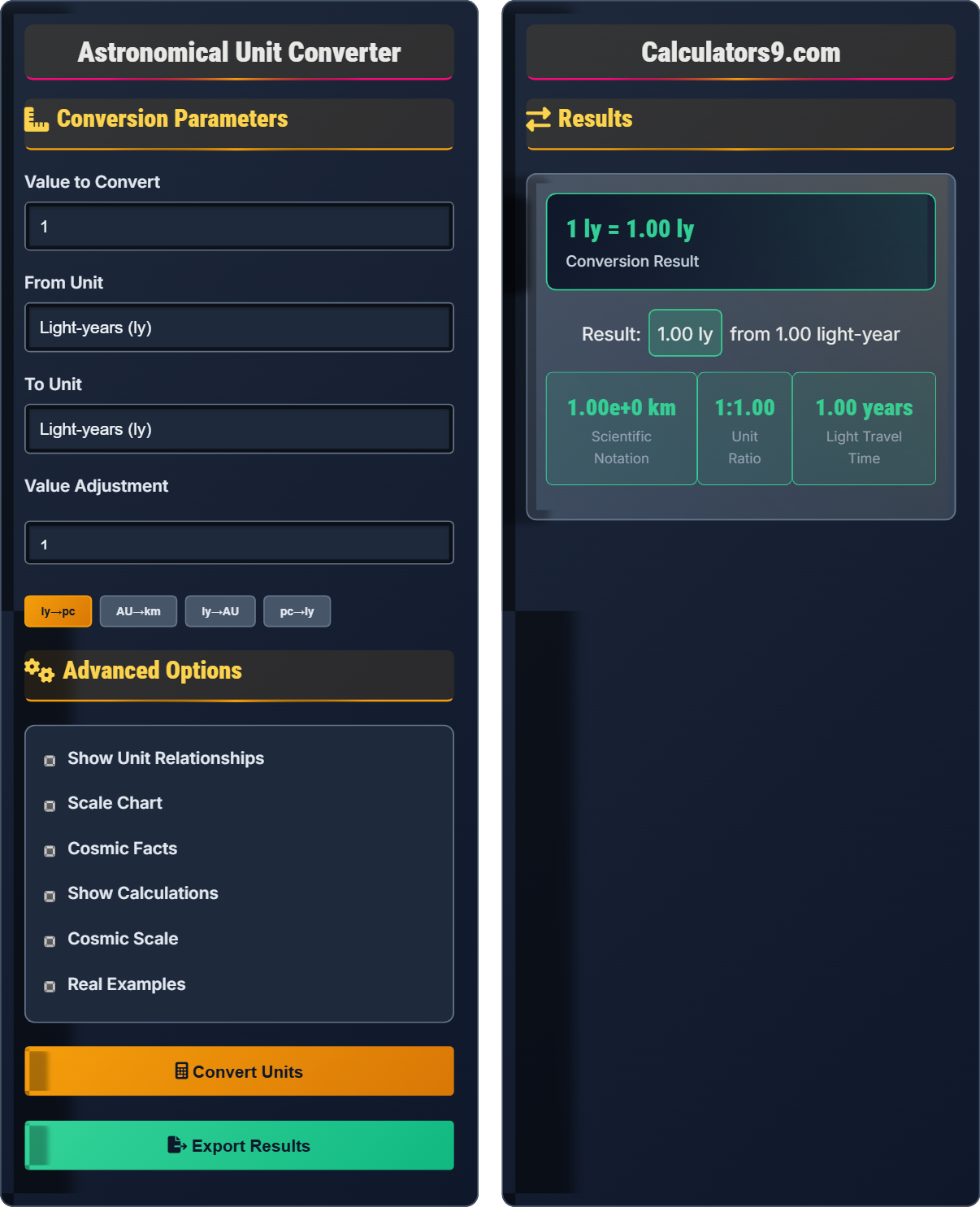
Astronomical Unit Converter
Cosmic distances • Space science tool
Unit Conversion Formulas:
Show the calculator\( 1 \text{ AU} = 149,597,870.7 \text{ km} \)
\( 1 \text{ light-year} = 9.461 \times 10^{12} \text{ km} = 63,241 \text{ AU} \)
\( 1 \text{ parsec} = 3.086 \times 10^{13} \text{ km} = 3.26 \text{ light-years} = 206,265 \text{ AU} \)
\( 1 \text{ light-minute} = 17,987,547.48 \text{ km} \)
These fundamental relationships define the cosmic distance ladder. The astronomical unit (AU) is based on Earth's average distance from the Sun, while the light-year is the distance light travels in one year. The parsec is defined by parallax measurements.
Example: Converting 4.2 light-years to parsecs:
\( 4.2 \text{ ly} \times \frac{1 \text{ pc}}{3.26 \text{ ly}} = 1.29 \text{ pc} \)
Therefore, 4.2 light-years equals 1.29 parsecs.
Conversion Parameters
Advanced Options
Results
Astronomical Unit Guide
Astronomical units are standardized measurements used to express distances in space. The astronomical unit (AU) is based on Earth's average distance from the Sun, while the light-year is the distance light travels in one year, and the parsec is defined by parallax measurements.
Key conversion relationships:
| Unit | Symbol | Kilometers | Miles | Relation to AU |
|---|---|---|---|---|
| Millimeter | mm | 0.000001 | 6.214×10⁻¹⁰ | 6.685×10⁻¹⁵ |
| Meter | m | 0.001 | 6.214×10⁻⁷ | 6.685×10⁻¹² |
| Kilometer | km | 1 | 0.6214 | 6.685×10⁻⁹ |
| Astronomical Unit | AU | 149,597,870.7 | 92,955,807 | 1 |
| Light-minute | lm | 17,987,547.48 | 11,176,943.8 | 0.1202 |
| Light-hour | lh | 1,079,252,848.8 | 670,616,629.4 | 7.214 |
| Light-day | ld | 25,902,068,371.2 | 16,094,799,105.6 | 173.14 |
| Light-year | ly | 9,460,730,472,580.8 | 5,878,625,373,183.6 | 63,241.1 |
| Parsec | pc | 30,856,775,814,913.7 | 19,173,513,058,736.7 | 206,264.8 |
Cosmic Measurements
Earth's average distance from the Sun (149,597,870.7 km).
\( \text{Distance} = \text{Speed of light} \times \text{Time} \)
Distance light travels in one year.
- 1 AU = 149.6 million km
- 1 light-year = 9.46 trillion km
- 1 parsec = 3.26 light-years
Space Science
Distance where 1 AU subtends 1 arcsecond.
\( d = \frac{1}{p} \)
Distance in parsecs from parallax angle.
- Light travels at 299,792 km/s
- 1 year = 31,557,600 seconds
- 1 parsec = 206,265 AU
Astronomical Unit Quiz
Which of the following represents the correct order of astronomical distance units from smallest to largest?
The answer is A) Meter, AU, Light-year, Parsec. The correct order from smallest to largest is: Meter (1 meter), Astronomical Unit (149,597,870.7 km), Light-year (9.461×10¹² km), and Parsec (3.086×10¹³ km). This sequence represents the increasing scale of distances used in astronomy, from terrestrial measurements to cosmic distances.
This question tests the understanding of the relative scales of astronomical distance units. It's important to remember that while a meter is a familiar terrestrial unit, astronomical units represent increasingly larger scales needed to measure distances in space. The AU is based on Earth-Sun distance, light-years measure cosmic distances, and parsecs are based on parallax measurements.
Astronomical Unit (AU): Earth's average distance from the Sun
Light-year: Distance light travels in one year
Parsec: Distance where 1 AU subtends 1 arcsecond
• 1 AU = 149.6 million km
• 1 light-year = 63,241 AU
• 1 parsec = 3.26 light-years
• Remember: AU is Earth-Sun distance
• Light-year is larger than AU
• Parsec is larger than light-year
• Confusing the relative sizes of units
• Forgetting the definition of astronomical units
Convert 2.5 parsecs to light-years. Show your work using the conversion factor 1 parsec = 3.26 light-years.
Using the conversion factor: 1 pc = 3.26 ly
Step 1: Set up the conversion: 2.5 pc × (3.26 ly/1 pc)
Step 2: Calculate: 2.5 × 3.26 = 8.15 ly
Step 3: Cancel units: pc cancels out, leaving ly
Therefore, 2.5 parsecs equals 8.15 light-years.
This problem demonstrates the use of dimensional analysis for unit conversions. The conversion factor is arranged as a fraction where the unit we want to cancel (pc) appears in the denominator, and the unit we want to keep (ly) appears in the numerator. This ensures proper unit cancellation.
Dimensional Analysis: Technique for unit conversion using conversion factors
Conversion Factor: Ratio expressing relationship between units
• Place unwanted unit in denominator
• Place desired unit in numerator
• Units cancel algebraically
• Always arrange conversion factors to cancel units
• Check that final units match what's expected
• Placing conversion factors incorrectly
• Forgetting to cancel units properly
Jupiter is approximately 5.2 AU from the Sun. Convert this distance to kilometers and then to light-minutes. (Use: 1 AU = 149,597,870.7 km, speed of light = 299,792 km/s)
Step 1: Convert AU to kilometers:
5.2 AU × 149,597,870.7 km/AU = 777,908,927.6 km
Step 2: Convert kilometers to light-minutes:
Light travels 299,792 km per second
Light travels 299,792 × 60 = 17,987,520 km per minute
777,908,927.6 km ÷ 17,987,520 km/min = 43.2 minutes
Therefore, Jupiter is approximately 778 million km or 43.2 light-minutes from the Sun.
This problem demonstrates multi-step conversions and the practical significance of light-minutes. The 43.2-minute light travel time means that when we observe Jupiter, we're seeing it as it was 43.2 minutes ago. This illustrates the concept of "look-back time" in astronomy.
Light-minute: Distance light travels in one minute
Look-back Time: Time it takes light to travel from object to observer
• 1 light-minute = 17,987,520 km
• Speed of light = 299,792 km/s
• Distance = Speed × Time
• Break complex conversions into steps
• Remember speed of light is constant
• Confusing time units (seconds vs minutes)
• Forgetting to convert intermediate units
Proxima Centauri, the nearest star to our solar system, is 4.24 light-years away. Convert this distance to parsecs and astronomical units. Then calculate how long it would take light to travel this distance in seconds. (Use: 1 pc = 3.26 ly, 1 ly = 63,241 AU, 1 year = 31,557,600 seconds)
Step 1: Convert light-years to parsecs:
4.24 ly × (1 pc/3.26 ly) = 1.30 pc
Step 2: Convert light-years to astronomical units:
4.24 ly × 63,241 AU/ly = 268,141 AU
Step 3: Calculate light travel time in seconds:
4.24 years × 31,557,600 s/year = 133,804,224 s
Therefore, Proxima Centauri is 1.30 pc or 268,141 AU away, and light takes about 134 million seconds to reach it.
This problem connects multiple astronomical units and demonstrates the vast scale of interstellar distances. The 4.24-year light travel time means we see Proxima Centauri as it was 4.24 years ago. The conversion to 1.30 parsecs connects with the parallax measurement method used to determine stellar distances.
Proxima Centauri: Nearest star to our solar system
Light Travel Time: Time for light to travel between two points
• 1 pc = 3.26 ly
• 1 ly = 63,241 AU
• 1 year = 31,557,600 s
• Use conversion factors systematically
• Remember the relationship between parsecs and parallax
• Mixing up conversion factors
• Incorrectly calculating time conversions
Which of the following statements about astronomical units is FALSE?
The answer is C) A light-year is shorter than an astronomical unit. This statement is false because a light-year is much larger than an astronomical unit. Specifically, 1 light-year equals approximately 63,241 astronomical units. The other statements are true: 1 parsec does equal approximately 3.26 light-years, the AU is based on Earth's distance from the Sun, and the parsec is indeed defined using parallax measurements.
This question tests the understanding of the relative scales of astronomical units. The light-year is significantly larger than the AU - it encompasses the distance light travels in an entire year, while the AU is based on Earth's orbital distance. This misconception often arises from the names of the units seeming similar in magnitude.
Parallax: Apparent shift in position due to viewing angle change
Scale Comparison: Relative sizes of measurement units
• 1 ly = 63,241 AU (light-year is much larger)
• AU is Earth-Sun distance
• Parsec based on parallax method
• Remember: Light-year is much larger than AU
• Think of light-year as annual distance traveled
• Underestimating the scale difference between units
• Confusing the relative sizes of astronomical units
FAQ
Q: Why do astronomers use different units for different distance scales?
A: Astronomers use different units to keep numbers manageable and meaningful:
- Meters/Kilometers: For terrestrial and solar system distances (e.g., Earth's diameter: 12,742 km)
- Astronomical Units (AU): For solar system distances (e.g., Earth-Sun: 1 AU)
- Light-years/Parsecs: For stellar and galactic distances (e.g., nearest star: 4.24 ly)
- Megaparsecs: For cosmological distances (e.g., galaxy clusters)
Using appropriate units prevents having to write extremely large or small numbers, making calculations and comprehension easier. For instance, saying Jupiter is 5.2 AU from the Sun is more intuitive than 778 million kilometers.
Q: What is the difference between a light-year and a parsec?
A: Both are units of distance used in astronomy, but they're based on different concepts:
Light-year: The distance light travels in one year in a vacuum (about 9.46 trillion km). It's based on time and the speed of light.
Parsec: The distance at which 1 astronomical unit subtends an angle of 1 arcsecond (about 3.26 light-years). It's based on the parallax method of distance measurement.
Relationship: 1 parsec = 3.26 light-years. Astronomers often prefer parsecs for stellar distances because they relate directly to the parallax measurement technique, while light-years are more intuitive for the general public.