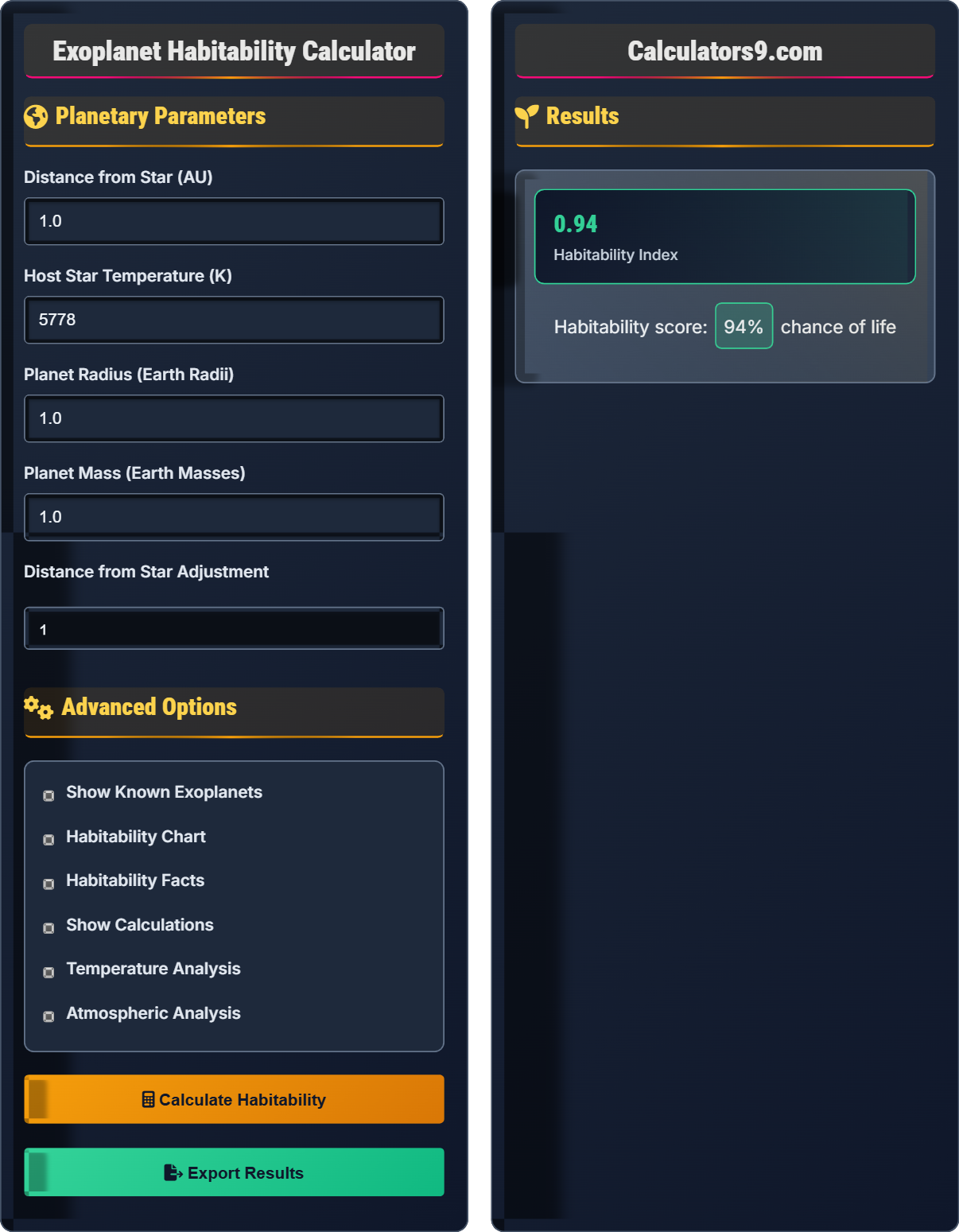
Exoplanet Habitability Calculator
Planetary conditions • Astrobiology tool
Habitability Index Formula:
Show the calculator\( H = \prod_{i=1}^{n} w_i \cdot f(x_i) \)
Where:
- \( H \) = habitability index (0 to 1)
- \( w_i \) = weight of factor i
- \( f(x_i) \) = normalized value of factor i
This composite index evaluates exoplanet habitability by combining multiple factors including temperature, atmospheric composition, magnetic field strength, and distance from host star. Each factor is weighted based on its importance for sustaining life.
Example: For an exoplanet with optimal conditions (all factors = 1.0):
\( H = 0.3 \times 1.0 \times 0.25 \times 1.0 \times 0.25 \times 1.0 \times 0.2 \times 1.0 = 1.0 \)
Where weights are: Temperature (0.3), Atmospheric Pressure (0.25), Magnetic Field (0.25), Water Availability (0.2).
Planetary Parameters
Advanced Options
Results
Exoplanet Habitability Guide
Exoplanet habitability depends on multiple factors including distance from host star, planetary mass, atmospheric composition, and magnetic field strength. The habitable zone represents the range of distances where liquid water could exist on a planet's surface.
Mathematically expressed as:
Where H is the habitability index, wi are weights assigned to each factor, and f(xi) are normalized values of each habitability factor. This composite index combines multiple parameters to assess potential for life.
| Planet | Distance (AU) | Mass (M⊕) | Radius (R⊕) | Habitability |
|---|---|---|---|---|
| Kepler-442b | 0.41 | 2.3 | 1.34 | 0.84 |
| Proxima Centauri b | 0.05 | 1.17 | 1.07 | 0.75 |
| TRAPPIST-1e | 0.029 | 0.87 | 0.92 | 0.82 |
| K2-18b | 0.15 | 8.6 | 2.61 | 0.68 |
| TOI-715b | 0.17 | 6.7 | 1.55 | 0.72 |
Habitability Factors
Range of distances where liquid water could exist on planetary surface.
\(T = \exp(-|T_{eff} - 288|/50)\)
Effectiveness based on Earth-like temperature.
- Liquid water requires 0-100°C range
- Atmospheric retention needs sufficient mass
- Magnetic field protects from radiation
Planetary Science
Mass required to retain atmosphere and maintain geological activity.
\(f_{atm} = 1 - \exp(-M/M_{min})\)
Retention factor based on minimum mass.
- 0.3-10 Earth masses ideal for habitability
- Stellar radiation affects atmospheric loss
- Planetary composition influences habitability
Exoplanet Habitability Quiz
What defines the habitable zone around a star?
The answer is A) Region where liquid water can exist on a planet's surface. The habitable zone, also known as the "Goldilocks zone," is defined as the region around a star where conditions are just right for liquid water to exist on a planet's surface. Liquid water is considered essential for life as we know it, making this the primary criterion for defining the habitable zone.
The habitable zone is a critical concept in astrobiology because liquid water is essential for the chemical reactions that sustain life. The boundaries of this zone depend on the star's luminosity - cooler stars have closer-in habitable zones, while hotter stars have habitable zones farther out. It's important to note that being in the habitable zone doesn't guarantee life exists, but it's a necessary condition.
Habitable Zone: Region around a star where liquid water can exist on planetary surfaces
Goldilocks Zone: Another name for the habitable zone
Liquid Water: Essential for known life processes
• Liquid water requires temperatures between 0-100°C
• Habitable zone varies with stellar luminosity
• Being in zone doesn't guarantee life exists
• Remember: Liquid water is key requirement
• Cooler stars have closer habitable zones
• Hotter stars have farther habitable zones
• Thinking habitable zone guarantees life exists
• Confusing habitable zone with atmospheric composition
Calculate the approximate distance of a planet from a star if the star has a temperature of 4000K and the planet is located at the inner boundary of the habitable zone. Use the relationship: R_inner = 0.95 × (L/L_sun)^0.5, where L is the star's luminosity relative to the Sun.
First, we need to calculate the star's luminosity relative to the Sun using the Stefan-Boltzmann law:
L/L_sun = (T_star/T_sun)^4
Given: T_star = 4000K, T_sun = 5778K
Step 1: L/L_sun = (4000/5778)^4 = (0.692)^4 = 0.232
Step 2: R_inner = 0.95 × √(L/L_sun) = 0.95 × √0.232 = 0.95 × 0.482 = 0.458 AU
Therefore, the inner boundary of the habitable zone is approximately 0.458 AU from the star.
This problem demonstrates how stellar properties affect the location of the habitable zone. Cooler stars have lower luminosity, which shifts the habitable zone closer to the star. The relationship between stellar temperature and luminosity follows the fourth power law, meaning small changes in temperature result in significant changes in luminosity and habitable zone location.
Stefan-Boltzmann Law: L ∝ T⁴, relating luminosity to temperature
Habitable Zone Boundaries: Inner and outer limits of liquid water stability
• Luminosity ∝ Temperature⁴
• Habitable zone ∝ √Luminosity
• Cooler stars have closer habitable zones
• Remember: L ∝ T⁴ for stellar luminosity
• Habitable zone distance ∝ √Luminosity
• Forgetting the fourth power relationship for luminosity
• Using the wrong exponent in the habitable zone calculation
An exoplanet has a mass of 0.5 Earth masses and a radius of 0.8 Earth radii. Calculate whether this planet can retain an atmosphere suitable for life. Use the relationship that a planet needs at least 0.3 Earth masses to retain a substantial atmosphere. Based on this, evaluate the planet's potential habitability regarding atmospheric retention.
Given: Planet mass = 0.5 Earth masses, Required minimum = 0.3 Earth masses
Step 1: Compare planet mass to minimum requirement: 0.5 M⊕ > 0.3 M⊕
Step 2: Since 0.5 > 0.3, the planet has sufficient mass to retain an atmosphere
Step 3: Calculate atmospheric retention factor using: f_atm = 1 - exp(-M/M_min)
f_atm = 1 - exp(-0.5/0.3) = 1 - exp(-1.67) = 1 - 0.189 = 0.811
Therefore, the planet can retain approximately 81% of its atmosphere, making it potentially habitable in terms of atmospheric retention.
This problem highlights the importance of planetary mass in atmospheric retention. A planet needs sufficient gravity to hold onto its atmosphere against thermal escape. The exponential relationship shows that planets just above the minimum mass threshold have significantly better atmospheric retention than those near the threshold. This is why Mars, with only 0.11 Earth masses, lost most of its atmosphere.
Atmospheric Retention: Ability to maintain atmospheric gases against escape
Thermal Escape: Process by which atmospheric molecules gain enough energy to escape
• Minimum mass ≈ 0.3 Earth masses for substantial atmosphere
• Higher mass = better atmospheric retention
• Atmosphere essential for liquid water stability
• Remember: 0.3 M⊕ is minimum for substantial atmosphere
• Exponential relationship favors higher mass planets
• Underestimating the importance of planetary mass for habitability
• Forgetting that atmosphere is necessary for liquid water
A K-type main sequence star has a temperature of 4500K and a luminosity of 0.4 times that of the Sun. Calculate the inner and outer boundaries of its habitable zone using the relationships: R_inner = 0.95 × (L/L_sun)^0.5 and R_outer = 1.67 × (L/L_sun)^0.5. If a planet orbits at 0.7 AU from this star, is it within the habitable zone? What are the implications for habitability?
Given: L/L_sun = 0.4
Step 1: Calculate inner boundary: R_inner = 0.95 × √0.4 = 0.95 × 0.632 = 0.601 AU
Step 2: Calculate outer boundary: R_outer = 1.67 × √0.4 = 1.67 × 0.632 = 1.055 AU
Step 3: Check if planet at 0.7 AU is in habitable zone: 0.601 < 0.7 < 1.055
Step 4: Since 0.601 < 0.7 < 1.055, the planet IS within the habitable zone.
Therefore, the habitable zone extends from 0.601 to 1.055 AU, and the planet at 0.7 AU falls within this range, making it potentially habitable.
This problem demonstrates how different stellar types have different habitable zones. K-type stars are cooler and less luminous than the Sun, so their habitable zones are closer in. The planet at 0.7 AU is well-positioned within the habitable zone of this K-type star, suggesting it could potentially support liquid water and life. This shows why stellar classification is crucial for identifying potentially habitable worlds.
K-Type Star: Orange dwarf star, cooler than Sun
Habitable Zone Boundaries: Limits of liquid water stability
• Cooler stars have closer habitable zones
• Habitable zone width depends on stellar luminosity
• Position within zone affects habitability
• Remember: R_inner and R_outer formulas
• Always check if planet distance is between boundaries
• Forgetting to use luminosity in habitable zone calculations
• Not checking if planet is between both boundaries
Which of the following factors is NOT typically considered when evaluating exoplanet habitability?
The answer is D) Planet's color in visible light. While distance from the host star, planetary mass and radius, and host star's metallicity all significantly affect habitability, the planet's color in visible light does not directly impact its potential to support life. The other factors are crucial: distance determines temperature, mass affects atmospheric retention, and stellar metallicity influences planet formation and composition. Color in visible light is not a determinant of habitability.
When evaluating exoplanet habitability, scientists focus on physical and chemical properties that affect the potential for liquid water and stable atmospheric conditions. Planetary color in visible light is primarily determined by atmospheric composition and surface materials, but it's not a direct indicator of habitability. Instead, scientists look at factors like temperature, atmospheric pressure, magnetic field strength, and chemical composition.
Stellar Metallicity: Abundance of elements heavier than hydrogen and helium
Physical Properties: Mass, radius, distance that affect habitability
• Focus on physical properties affecting life
• Distance affects temperature
• Mass affects atmospheric retention
• Think about what affects liquid water stability
• Consider what affects atmospheric retention
• Confusing appearance with actual habitability factors
• Thinking visual characteristics affect habitability
FAQ
Q: What is the difference between the habitable zone and the continuously habitable zone?
A: The terms are sometimes used interchangeably, but there is a subtle distinction:
Habitable Zone: The region around a star where liquid water could exist on a planet's surface at a given moment in time, based on the star's current luminosity.
Continuously Habitable Zone: The region that remains habitable over extended periods of time as the star evolves and its luminosity changes. For example, as stars age and become more luminous, the habitable zone moves outward, so the continuously habitable zone is the region that stays within the habitable zone boundaries over billions of years.
Most studies focus on the current habitable zone, but the continuously habitable zone is more restrictive since it requires the planet to remain in the zone for long enough for life to develop and evolve.
Q: How does tidal locking affect exoplanet habitability?
A: Tidal locking occurs when a planet's rotation period matches its orbital period, causing one side to always face its star. This has significant implications for habitability:
- Temperature Extremes: The day side becomes extremely hot while the night side becomes extremely cold, creating harsh temperature gradients.
- Atmospheric Circulation: Strong winds may develop between the hot and cold sides, potentially redistributing heat.
- Terminator Zone: The boundary between day and night sides might have moderate temperatures suitable for life.
- Water Distribution: Ice may accumulate on the night side while water vaporizes on the day side.
Recent climate models suggest that thick atmospheres and oceans could help redistribute heat, potentially making tidally locked planets habitable in certain regions, particularly the terminator zone.