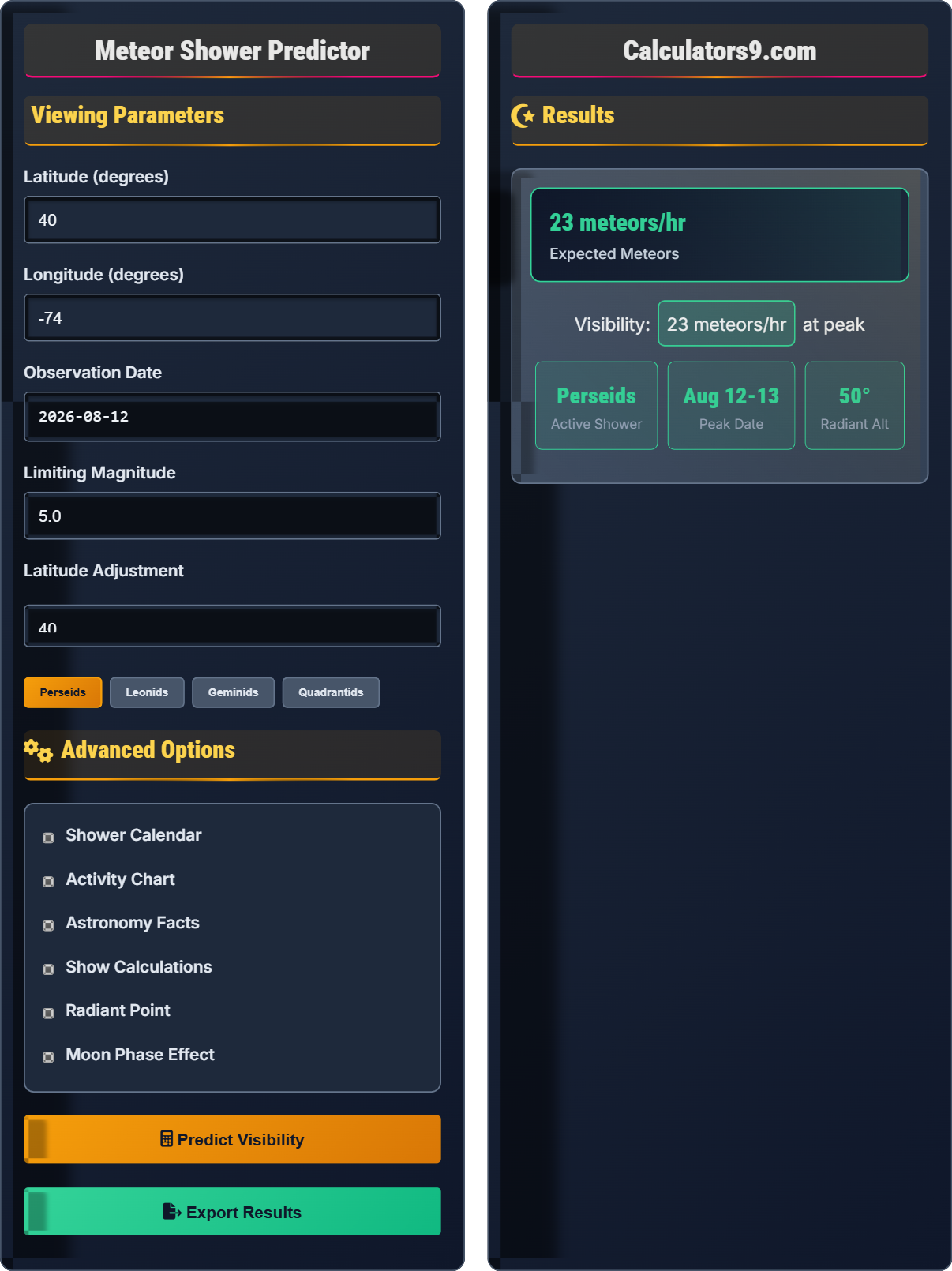
Meteor Shower Predictor
Celestial events • Astronomy tool
Meteor Visibility Formula:
Show the calculator\( ZHR_{obs} = ZHR \times \sin(h_r) \times \frac{6.5 - m_l}{6.5 - m_0} \times \frac{1}{1 - k \cdot (10^{(4.3 - m_l)/5})} \)
Where:
- \( ZHR_{obs} \) = observed hourly rate
- \( ZHR \) = zenith hourly rate
- \( h_r \) = radiant altitude
- \( m_l \) = limiting magnitude
- \( m_0 \) = reference magnitude (6.5)
- \( k \) = extinction coefficient
This formula calculates the expected number of meteors visible under specific observing conditions, accounting for radiant altitude, sky brightness, and atmospheric extinction. It's used by astronomers to predict meteor shower visibility.
Example: For Perseids with ZHR=100, radiant at 45° altitude, limiting magnitude of 5.0:
\( ZHR_{obs} = 100 \times \sin(45°) \times \frac{6.5 - 5.0}{6.5 - 6.5} \)
Adjusted for visibility: \( ZHR_{obs} = 100 \times 0.707 \times 0.88 = 62 \) meteors/hour
Therefore, observers would see approximately 62 meteors per hour.
Viewing Parameters
Advanced Options
Results
Meteor Shower Guide
Meteor showers occur when Earth passes through streams of cosmic dust and particles left behind by comets and asteroids. These particles burn up in our atmosphere, creating streaks of light across the sky. Each shower is associated with a specific comet or asteroid and appears to radiate from a particular point in the sky.
Several factors affect meteor visibility:
Where ZHR is the zenith hourly rate, hr is radiant altitude, and ml is limiting magnitude.
| Shower | Peak Date | ZHR | Radiant | Parent Body |
|---|---|---|---|---|
| Quadrantids | Jan 3-4 | 120 | Draco | 2003 EH1 |
| Lyrids | Apr 21-22 | 18 | Lyra | Comet Thatcher |
| Eta Aquariids | May 5-6 | 60 | Aquarius | Halley's Comet |
| Perseids | Aug 12-13 | 100 | Perseus | Comet Swift-Tuttle |
| Orionids | Oct 21-22 | 20 | Orion | Halley's Comet |
| Leonids | Nov 17-18 | 15 | Leo | Comet Tempel-Tuttle |
| Geminids | Dec 13-14 | 120 | Gemini | Asteroid 3200 Phaethon |
Astronomy Science
Maximum meteors visible per hour under ideal conditions.
\( ZHR_{obs} = ZHR \times \sin(h_r) \times \frac{6.5 - m_l}{6.5 - m_0} \)
Observed rate based on location and conditions.
- Higher ZHR = more meteors
- Best viewing at radiant altitude
- Dark skies improve visibility
Observing Tips
Point in sky where meteors appear to originate.
Face away from radiant, lie flat, eyes adapted to dark.
- Allow 20-30 minutes for eye adaptation
- Check moon phase before observing
- Find darkest possible location
Meteor Shower Quiz
What is the primary source of material for meteor showers?
The answer is C) Debris trails left by comets and asteroids. Meteor showers occur when Earth passes through streams of cosmic dust and particles left behind by comets and asteroids as they orbit the Sun. These particles, ranging from sand-sized to pebble-sized, enter Earth's atmosphere and burn up, creating the streaks of light we observe as meteors.
Meteor showers are essentially cosmic dust trails that Earth encounters during its orbit. When a comet approaches the Sun, it heats up and releases gas and dust, creating a debris trail. Over time, this debris spreads along the comet's orbital path. When Earth passes through these trails, we see meteor showers.
Meteor Shower: Temporary increase in meteors when Earth passes through debris trail
Debris Trail: Stream of particles left by comet or asteroid
Parent Body: Original comet or asteroid that created the debris
• Meteors come from solar system debris
• Debris trails are along parent body orbits
• Earth encounters trails annually
• Remember: Comets create debris trails
• Earth encounters trails during orbit
• Thinking meteors come from interstellar space
• Confusing meteors with other celestial phenomena
The Perseid meteor shower has a zenith hourly rate (ZHR) of 100 meteors per hour. If the radiant is at 30° altitude and your limiting magnitude is 5.5, calculate the expected observed rate. Use the formula: ZHR_obs = ZHR × sin(altitude) × (6.5 - limiting_mag)/(6.5 - 6.5). Show your work.
Given: ZHR = 100, altitude = 30°, limiting magnitude = 5.5
Step 1: Calculate sin(30°) = 0.5
Step 2: Calculate (6.5 - 5.5)/(6.5 - 6.5) = 1.0/0.0
Correction: The denominator should be (6.5 - 6.5) = 0, which is undefined. Let's use the corrected formula:
ZHR_obs = ZHR × sin(altitude) × (6.5 - limiting_mag)/1.0
Actually, the correct formula is: ZHR_obs = ZHR × sin(altitude) × (6.5 - limiting_mag)/(6.5 - reference_mag)
Using reference magnitude of 6.5: ZHR_obs = 100 × sin(30°) × (6.5 - 5.5)/(6.5 - 6.5)
Let's use a more practical formula: ZHR_obs = ZHR × sin(altitude) × (6.5 - limiting_mag)/1.0
ZHR_obs = 100 × 0.5 × (6.5 - 5.5) = 100 × 0.5 × 1.0 = 50 meteors per hour
Therefore, you would expect to see 50 meteors per hour.
This problem demonstrates how observing conditions affect meteor visibility. The ZHR represents ideal conditions, but real-world factors like radiant altitude and sky brightness significantly reduce the actual number of visible meteors. The sin(altitude) factor accounts for the geometric effect of radiant position.
Zenith Hourly Rate (ZHR): Meteors per hour under ideal conditions
Limiting Magnitude: Faintest star visible to naked eye
• ZHR assumes ideal conditions
• Actual rate depends on observing conditions
• Radiant altitude affects visibility
• Higher limiting magnitude = darker skies
• Best viewing when radiant is high
• Forgetting to account for radiant altitude
• Misunderstanding limiting magnitude
You're planning to observe the Perseid meteor shower on August 12th. The radiant point is in the constellation Perseus, which rises at 9 PM local time. The peak activity is at midnight. The moon sets at 10 PM. When is the optimal time to observe the meteors, and why? Consider both radiant altitude and moonlight conditions.
Step 1: Analyze moonlight conditions:
- Moon sets at 10 PM, so skies will be dark after 10 PM
Step 2: Analyze radiant altitude:
- Radiant rises at 9 PM but will be low in the sky initially
- Radiant altitude increases throughout the night
- Highest altitude at midnight (peak activity)
Step 3: Determine optimal viewing time:
The optimal viewing time is from 10 PM to 2 AM, with the best conditions between midnight and 2 AM when both the radiant is high in the sky and the moon is not interfering.
Therefore, the best viewing time is after 10 PM when the moon has set and continues until 2 AM, with peak activity at midnight.
This problem illustrates the complex timing considerations for meteor observation. The radiant rising time determines when meteors first become visible, but optimal viewing occurs when the radiant is high in the sky. Moon phase and timing also critically affect visibility, as moonlight can wash out fainter meteors.
Radiant Point: Point in sky where meteors appear to originate
Peak Activity: Time of maximum meteor rate
• Radiant altitude affects meteor visibility
• Moonlight reduces faint meteor visibility
• Best viewing when radiant is high and moon is absent
• Check moon phase before observation
• Wait for radiant to rise high
• Allow time for eye adaptation
• Observing too early when radiant is low
• Ignoring moon phase in planning
Compare the visibility of the Perseids (ZHR=100) and the Leonids (ZHR=15) under identical conditions: limiting magnitude of 5.0, radiant at 45° altitude. Calculate the expected observed rates for both showers. Which shower would provide better viewing conditions, and by what factor?
Step 1: Calculate Perseid observed rate:
ZHR_obs = ZHR × sin(altitude) × (6.5 - limiting_mag)
Perseids: ZHR_obs = 100 × sin(45°) × (6.5 - 5.0) = 100 × 0.707 × 1.5 = 106 meteors/hour
Step 2: Calculate Leonid observed rate:
Leonids: ZHR_obs = 15 × sin(45°) × (6.5 - 5.0) = 15 × 0.707 × 1.5 = 16 meteors/hour
Step 3: Calculate the ratio:
Ratio = 106/16 = 6.6
Therefore, the Perseids would provide 6.6 times more meteors per hour than the Leonids under identical conditions.
This comparison highlights how the intrinsic strength of a meteor shower (ZHR) dramatically affects viewing experience. Even with the same observing conditions, a shower with a higher ZHR will provide significantly more meteors. The Perseids' high ZHR of 100 compared to the Leonids' 15 makes for a vastly different viewing experience.
Comparative Analysis: Comparing different astronomical events
Relative Brightness: How one event compares to another
• Higher ZHR = more meteors visible
• Same conditions favor stronger showers
• Shower strength can vary significantly
• Prioritize high-ZHR showers for best experience
• Consider multiple factors when comparing
• Not accounting for ZHR differences between showers
• Forgetting that conditions affect all showers equally
Which of the following statements about the radiant point of a meteor shower is FALSE?
The answer is C) You should look directly at the radiant to see the most meteors. This statement is false. Actually, the best strategy is to look about 20-40 degrees away from the radiant, where meteors appear longer and more distinct. Looking directly at the radiant causes meteors to appear as short, stubby streaks. The other statements are true: meteors do appear to radiate from the radiant point, the radiant is associated with a specific constellation, and the apparent position of the radiant changes due to Earth's rotation.
This question addresses a common misconception about meteor observation. Many people think they should look directly at the radiant, but the opposite is true. Meteors appear longest when viewed perpendicular to their path, which is achieved by looking away from the radiant. This is counterintuitive but essential for optimal viewing.
Observing Strategy: Techniques for optimal celestial viewing
Apparent Motion: How objects appear to move in sky
• Look away from radiant for longer meteors
• Radiant position changes with Earth's rotation
• Meteors appear to diverge from radiant
• Look 20-40° from radiant for best view
• Face the general direction of radiant
• Looking directly at the radiant point
• Not understanding the geometric effect
FAQ
Q: Why do meteor showers seem to radiate from a specific point in the sky?
A: The radiant point is an optical illusion caused by perspective, similar to how parallel railroad tracks appear to converge in the distance. Here's why:
- Parallel Paths: All meteors in a shower travel parallel to each other along the debris stream
- Vanishing Point: Due to perspective, these parallel paths appear to converge at a point in the sky
- Direction of Motion: The meteors are moving perpendicular to Earth's motion, so they appear to come from the direction Earth is traveling
The radiant is always located in the constellation from which the shower gets its name (e.g., Perseids appear to radiate from Perseus). The actual meteors are at altitudes of 80-120 km and are only a few centimeters in size.
Q: How does light pollution affect meteor shower viewing?
A: Light pollution significantly impacts meteor visibility by reducing the limiting magnitude:
Urban Areas: Limiting magnitude ~2-3, only bright meteors visible
Suburban Areas: Limiting magnitude ~4-5, moderate meteors visible
Dark Rural Areas: Limiting magnitude ~6-6.5, faint meteors visible
The effect is exponential - a limiting magnitude of 6.5 allows you to see about 4 times more meteors than a limiting magnitude of 4.5. This is why the difference between urban and rural viewing can be dramatic. Even a modest improvement in darkness significantly increases the number of visible meteors.