Orbital Period Calculator
Kepler's third law • Space science tool
Kepler's Third Law Formula:
Show the calculator\( T^2 = \frac{4\pi^2}{GM}a^3 \)
Where:
- \( T \) = orbital period
- \( a \) = semi-major axis (average distance from central body)
- \( G \) = gravitational constant (6.674×10⁻¹¹ m³/kg⋅s²)
- \( M \) = mass of central body
This is Kepler's third law of planetary motion, which states that the square of the orbital period is proportional to the cube of the semi-major axis. This fundamental law governs the motion of all orbiting bodies in our solar system and beyond.
Example: For Earth orbiting the Sun (a = 1 AU, M = 1.989×10³⁰ kg):
\( T^2 = \frac{4\pi^2}{(6.674×10^{-11})(1.989×10^{30})}(1.496×10^{11})^3 \)
\( T^2 = 3.156×10^{15} s^2 \Rightarrow T = 365.25 \) days
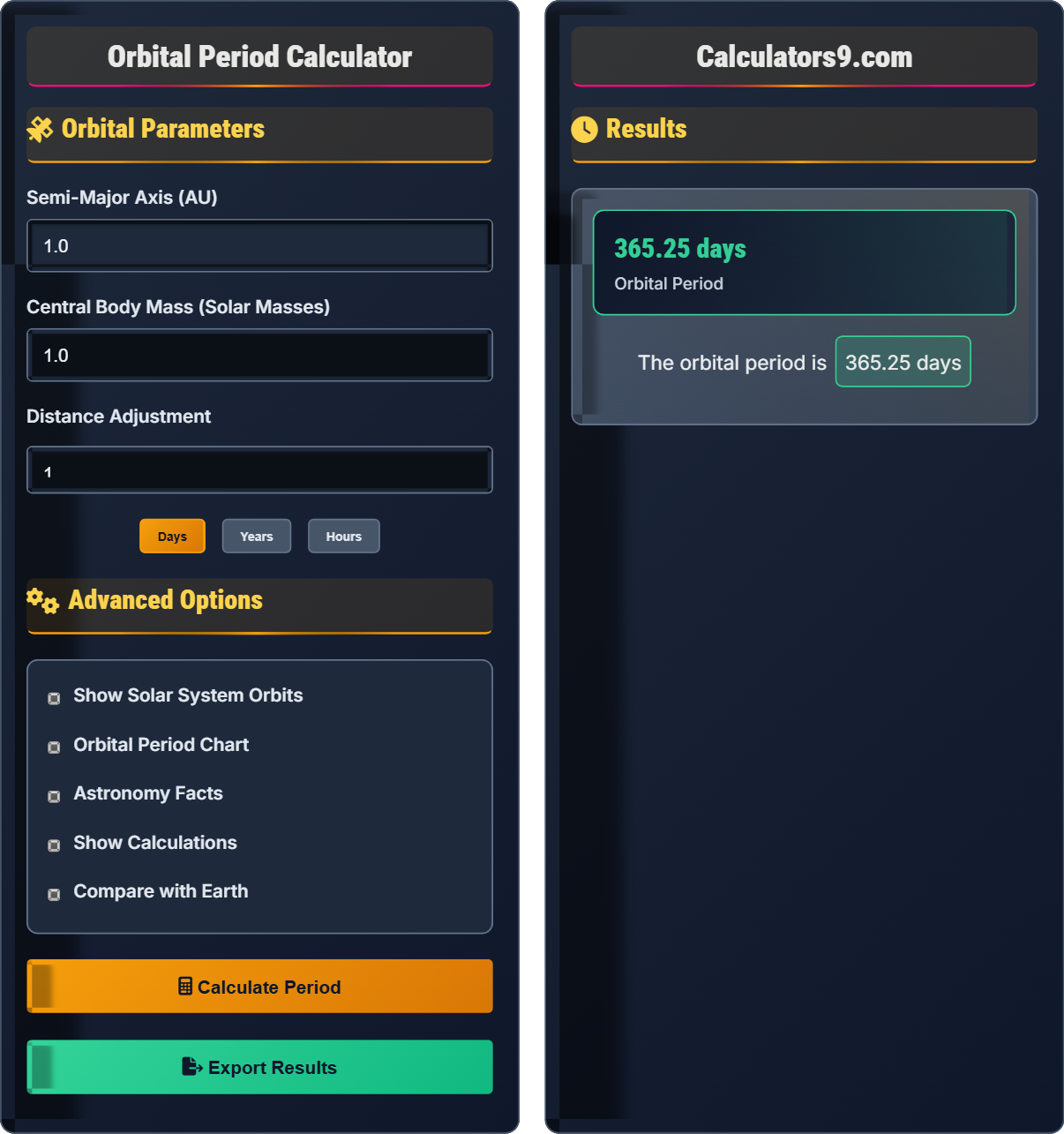
Thus, Earth's orbital period is 365.25 days.
Orbital Parameters
Advanced Options
Results
Orbital Mechanics Guide
Kepler's third law of planetary motion establishes the relationship between an object's orbital period and its average distance from the body it orbits. The law states that the square of the orbital period is proportional to the cube of the semi-major axis of its orbit.
Mathematically expressed as:
Where T is the orbital period, a is the semi-major axis, G is the gravitational constant, and M is the mass of the central body. This law applies to all orbiting bodies in the universe.
| Planet | Distance (AU) | Period (Days) | Period (Years) | Velocity (km/s) |
|---|---|---|---|---|
| Mercury | 0.39 | 88 | 0.24 | 47.4 |
| Venus | 0.72 | 225 | 0.62 | 35.0 |
| Earth | 1.00 | 365 | 1.00 | 29.8 |
| Mars | 1.52 | 687 | 1.88 | 24.1 |
| Jupiter | 5.20 | 4,333 | 11.86 | 13.1 |
| Saturn | 9.58 | 10,759 | 29.46 | 9.7 |
| Uranus | 19.22 | 30,687 | 84.01 | 6.8 |
| Neptune | 30.05 | 60,190 | 164.8 | 5.4 |
Orbital Calculations
Half the longest diameter of an elliptical orbit.
\(T^2 \propto a^3\)
Period squared is proportional to distance cubed.
- Farther = longer period
- Distance³ ∝ Period²
- Applies to all orbits
Space Mechanics
Speed required to maintain stable orbit.
\(v = \sqrt{\frac{GM}{r}}\)
Velocity for circular orbital motion.
- Elliptical orbits are common
- Energy conservation applies
- Angular momentum conserved
Orbital Mechanics Quiz
According to Kepler's third law, if the semi-major axis of a planet's orbit is doubled, how does its orbital period change?
The answer is D) Increases by a factor of 2³ᐟ². According to Kepler's third law, T² ∝ a³. If the semi-major axis (a) doubles, then T² ∝ (2a)³ = 8a³. Therefore, T ∝ √8a³ᐟ² = 2³ᐟ²a³ᐟ². So the period increases by a factor of 2³ᐟ² = 2√2 ≈ 2.83.
Kepler's third law demonstrates the non-linear relationship between orbital distance and period. When distance doubles, the period doesn't simply double—it increases by a factor of 2 to the power of 3/2. This cubic relationship explains why outer planets take disproportionately longer to orbit the Sun compared to inner planets.
Semi-Major Axis: Half the longest diameter of an elliptical orbit
Proportional Relationship: How one quantity changes relative to another
Kepler's Third Law: T² ∝ a³, relating orbital period to distance
• T² ∝ a³ (period squared is proportional to distance cubed)
• Doubling distance increases period by factor of 2^(3/2)
• This relationship holds for all orbiting bodies
• Remember: Distance³ ∝ Period²
• Use the formula T₁²/T₂² = a₁³/a₂³ for comparisons
• Thinking that doubling distance doubles the period
• Forgetting the cubic relationship in Kepler's law
Mars has a semi-major axis of 1.52 AU. Calculate its orbital period using Kepler's third law, given that Earth's orbital period is 365.25 days at 1.00 AU. Show your work.
Using Kepler's third law in ratio form: \( \frac{T_M^2}{T_E^2} = \frac{a_M^3}{a_E^3} \)
Given:
- \(T_E = 365.25\) days
- \(a_E = 1.00\) AU
- \(a_M = 1.52\) AU
Step 1: \( \frac{T_M^2}{365.25^2} = \frac{1.52^3}{1.00^3} \)
Step 2: \( \frac{T_M^2}{133,407.56} = 3.51 \)
Step 3: \( T_M^2 = 3.51 \times 133,407.56 = 468,260.54 \)
Step 4: \( T_M = \sqrt{468,260.54} = 684.3 \) days
Therefore, Mars' orbital period is approximately 684.3 days (close to the actual 687 days).
Using ratios allows us to calculate orbital periods without knowing the gravitational constant. This method compares the unknown orbit to a known one (like Earth's). The ratio approach eliminates the need for absolute values of G and M, making calculations more practical when comparing objects orbiting the same central body.
Ratio Method: Comparing orbital parameters using Kepler's law
Astronomical Unit (AU): Average distance from Earth to Sun (149.6 million km)
• Use the ratio form of Kepler's law for comparisons
• T²/a³ is constant for all bodies orbiting the same central object
• The ratio method simplifies calculations
• Remember: T₁²/a₁³ = T₂²/a₂³ for the same central body
• Use Earth as a reference point for solar system calculations
• Forgetting to square the period or cube the distance
• Using the wrong units for distance comparisons
A satellite orbits a planet at a distance of 4.0 times the planet's radius. If another satellite orbits at 9.0 times the planet's radius, how many times longer is the orbital period of the second satellite compared to the first? Express your answer as a simplified radical.
Using Kepler's third law: T² ∝ a³
For the first satellite: T₁² ∝ (4R)³ = 64R³
For the second satellite: T₂² ∝ (9R)³ = 729R³
Step 1: Find the ratio of periods: T₂²/T₁² = 729R³/64R³ = 729/64
Step 2: Take the square root: T₂/T₁ = √(729/64) = √729/√64 = 27/8
Therefore, the second satellite's orbital period is 27/8 times longer than the first satellite's period.
This problem demonstrates the cubic relationship between distance and orbital period. Even though the second satellite is only 2.25 times farther out (9R/4R = 2.25), its orbital period is 27/8 = 3.375 times longer. This shows how orbital periods increase dramatically with distance, which is why distant planets take so much longer to orbit the Sun.
Radial Distance: Distance from the center of the central body
Proportional Reasoning: Finding relationships between quantities
• T² ∝ a³ for all orbits around the same central body
• The ratio of periods squared equals the ratio of distances cubed
• Orbital period increases rapidly with distance
• When comparing two orbits, use T₁²/T₂² = a₁³/a₂³
• Remember to take the square root to get the period ratio
• Forgetting to take the square root when finding period ratios
• Confusing the direct proportionality with the squared relationship
In a binary star system, two stars orbit their common center of mass. If the stars are separated by 10 astronomical units (AU) and have a combined mass of 4 solar masses, calculate their orbital period. Use Kepler's third law modified for binary systems: T² = (4π²/G(M₁+M₂))a³, where a is the separation distance. (G = 6.674×10⁻¹¹ m³/kg⋅s², 1 AU = 1.496×10¹¹ m, 1 solar mass = 1.989×10³⁰ kg)
Given:
- a = 10 AU = 10 × 1.496×10¹¹ m = 1.496×10¹² m
- M₁ + M₂ = 4 solar masses = 4 × 1.989×10³⁰ kg = 7.956×10³⁰ kg
- G = 6.674×10⁻¹¹ m³/kg⋅s²
Step 1: Substitute into Kepler's third law: T² = (4π²/G(M₁+M₂))a³
Step 2: T² = (4π²/(6.674×10⁻¹¹ × 7.956×10³⁰))(1.496×10¹²)³
Step 3: T² = (39.48/(5.31×10²⁰))(3.35×10³⁶)
Step 4: T² = 2.49×10¹⁶ s²
Step 5: T = √(2.49×10¹⁶) = 1.58×10⁸ s
Step 6: Convert to years: T = 1.58×10⁸ s ÷ (365.25 × 24 × 3600 s/year) ≈ 5.0 years
Therefore, the orbital period of the binary star system is approximately 5.0 years.
This problem extends Kepler's third law to binary systems, where two massive objects orbit each other. The modification accounts for both masses contributing to the gravitational field. Binary star systems are common in the universe, and understanding their orbital dynamics is crucial for astrophysics research and exoplanet detection.
Binary Star System: Two stars orbiting their common center of mass
Center of Mass: The point around which both bodies orbit
• For binary systems, use total mass (M₁ + M₂)
• The separation distance replaces the semi-major axis
• Kepler's laws apply to all orbital systems
• Remember to use combined mass for binary systems
• Convert units consistently (AU to meters, solar masses to kg)
• Convert final answer to more meaningful units (years)
• Forgetting to convert units properly
• Using only one mass instead of combined mass
• Making calculation errors with scientific notation
Which of the following statements about orbital periods is FALSE?
The answer is D) A satellite's orbital period depends only on its distance from the central body. This statement is false because orbital period also depends on the mass of the central body. According to Kepler's third law: T² = (4π²/GM)a³, where M is the mass of the central body. The period depends on both the distance (a) and the central mass (M). The other statements are true: doubling distance increases period by 2^(3/2) = 2√2 times, inner planets do orbit faster, and the orbiting body's mass doesn't affect its period.
While distance is the primary factor affecting orbital period, the mass of the central body is equally important. This is evident in Kepler's third law, where both distance cubed and central mass appear in the equation. For example, a satellite orbiting Earth at a certain distance will have a different period than the same satellite orbiting Jupiter at the same distance, because Jupiter's greater mass creates stronger gravitational pull.
Central Body Mass: The mass of the object being orbited
Orbital Dependencies: Factors that affect orbital characteristics
• T² ∝ a³/M (period squared proportional to distance cubed over mass)
• Greater central mass = shorter orbital period
• Orbiting body's mass doesn't affect its period
• Remember: T² = (4π²/GM)a³ includes both distance and mass
• More massive central body means faster orbit
• Forgetting that central body mass affects orbital period
• Thinking only distance matters in orbital mechanics
FAQ
Q: Why does Kepler's third law work for all planets in our solar system?
A: Kepler's third law works for all planets in our solar system because they all orbit the same central body—the Sun. The mathematical relationship \(T^2 = \frac{4\pi^2}{GM}a^3\) holds because the gravitational constant \(G\) and the mass of the Sun \(M\) remain constant for all planets.
Since the Sun contains over 99.8% of the solar system's mass, we can treat it as the central gravitational force for all planetary orbits. This means that for all planets orbiting the Sun, the quantity \(\frac{4\pi^2}{GM}\) is constant, so \(T^2 \propto a^3\) for all planets.
This relationship has been verified through centuries of observations and is now understood as a consequence of Newton's law of universal gravitation combined with the laws of motion.
Q: Can Kepler's third law be applied to exoplanets orbiting other stars?
A: Yes, Kepler's third law applies universally to all orbiting bodies, including exoplanets orbiting other stars. The law is expressed as:
\(T^2 = \frac{4\pi^2}{G(M_* + M_p)}a^3\)
Where \(M_*\) is the mass of the host star and \(M_p\) is the mass of the planet. For most exoplanet systems, the planet's mass is negligible compared to the star's mass, so the law simplifies to:
\(T^2 = \frac{4\pi^2}{GM_*}a^3\)
This is exactly how astronomers determine the semi-major axes of exoplanets when they know the orbital period and stellar mass. Kepler's third law has been instrumental in characterizing thousands of exoplanet systems discovered by missions like Kepler and TESS.