Planet Weight Calculator
Cosmic gravity converter • Space science tool
Weight Conversion Formula:
Show the calculator\( W_p = W_e \times \frac{g_p}{g_e} \)
Where:
- \( W_p \) = weight on target planet
- \( W_e \) = weight on Earth
- \( g_p \) = gravitational acceleration on target planet
- \( g_e \) = gravitational acceleration on Earth (9.8 m/s²)
This formula calculates your weight on different planets based on their gravitational pull relative to Earth. Weight changes with gravity, but mass remains constant throughout the universe.
Example: For a person weighing 150 lbs on Earth, their weight on Mars (gravity 0.38× Earth) would be:
\( W_{Mars} = 150 \times 0.38 = 57 \) lbs
Thus, the person would weigh 57 pounds on Mars.
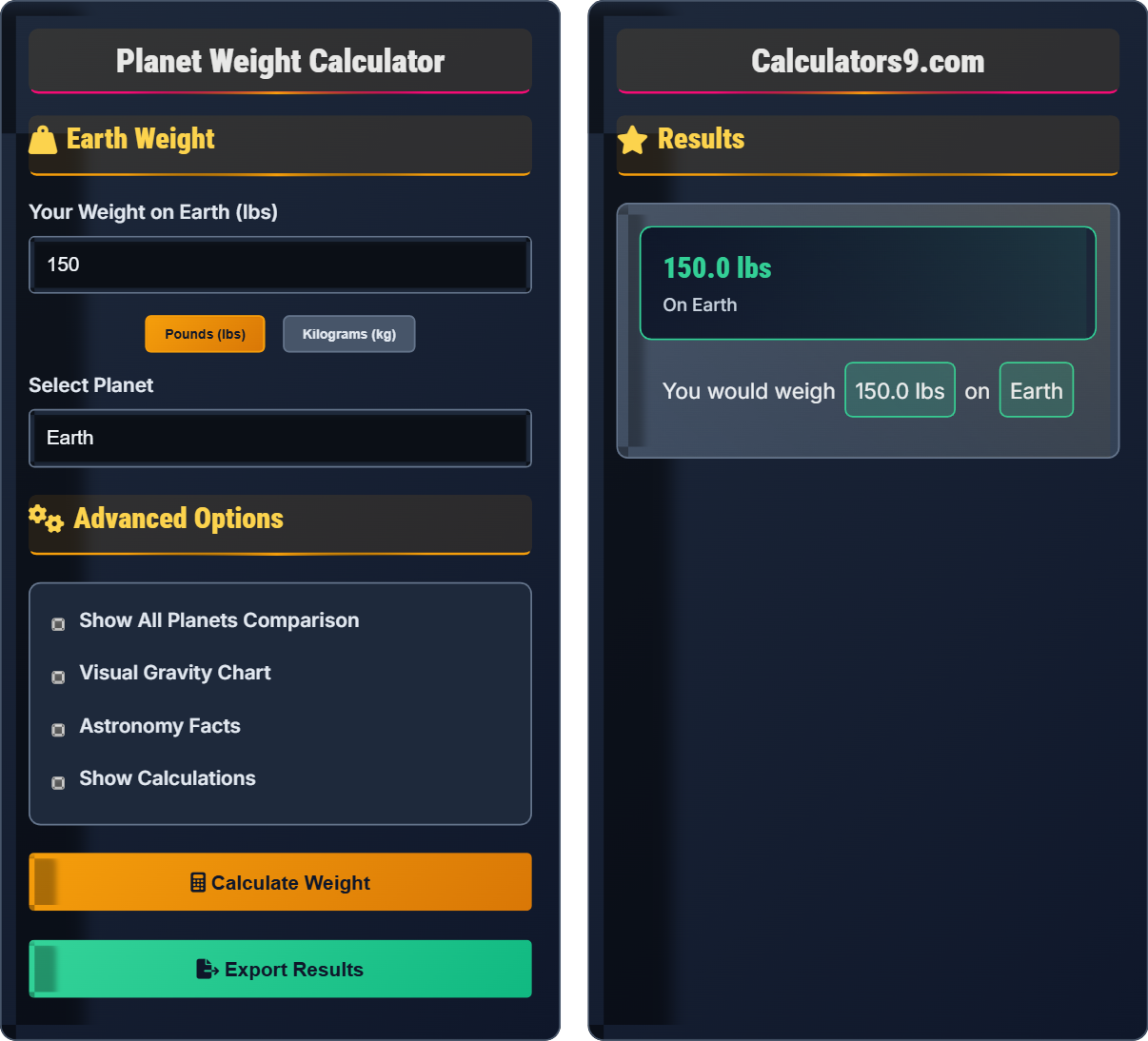
Earth Weight
Advanced Options
Results
Planetary Gravity Guide
Gravity varies across celestial bodies based on their mass and radius. Your weight changes depending on the gravitational pull of the planet or moon you're standing on, but your mass remains constant throughout the universe.
Weight is the force of gravity acting on an object, measured in pounds or kilograms-force. Mass is the amount of matter in an object, measured in kilograms. On Earth, 1 kg of mass weighs approximately 2.2 lbs due to Earth's gravity.
Where W=weight, m=mass, g=gravitational acceleration
| Planet/Moon | Gravity (m/s²) | Multiplier | Weight (150 lbs) |
|---|---|---|---|
| Mercury | 3.7 | 0.38 | 57.0 lbs |
| Venus | 8.9 | 0.91 | 136.5 lbs |
| Earth | 9.8 | 1.00 | 150.0 lbs |
| Mars | 3.7 | 0.38 | 57.0 lbs |
| Jupiter | 23.1 | 2.36 | 354.0 lbs |
| Saturn | 9.0 | 1.06 | 159.0 lbs |
| Uranus | 8.7 | 0.89 | 133.5 lbs |
| Neptune | 11.0 | 1.12 | 168.0 lbs |
| Moon | 1.6 | 0.17 | 25.5 lbs |
| Sun | 265.0 | 27.06 | 4,059.0 lbs |
Cosmic Calculations
Mass remains constant; weight changes with gravity.
\(W_p = W_e \times \frac{g_p}{g_e}\)
Where Wp=planet weight, We=Earth weight, gp=planet gravity, ge=Earth gravity.
- Mass stays same in space
- Weight = Mass × Gravity
- Larger planets = stronger gravity
Space Science
Depends on mass and distance from planet's center.
\(F = G \frac{m_1 m_2}{r^2}\)
Newton's law of universal gravitation.
- Surface gravity varies by planet
- Gas giants have different compositions
- Distance affects gravitational pull
Cosmic Calculations Quiz
If a person has a mass of 70 kg on Earth, what would their mass be on Mars?
The answer is A) 70 kg. Mass is an intrinsic property of matter and remains constant regardless of location. Whether on Earth, Mars, or in deep space, the person's mass remains 70 kg. However, their weight would change based on the gravitational pull of the planet.
It's crucial to distinguish between mass and weight. Mass is the amount of matter in an object and is measured in kilograms. It never changes regardless of location. Weight, however, is the force exerted by gravity on that mass and is measured in Newtons or pounds. Weight changes with gravity - it's zero in space but increases on massive planets.
Mass: The amount of matter in an object, measured in kilograms
Weight: The force of gravity acting on an object, measured in Newtons or pounds
Gravity: The force that attracts objects toward each other
• Mass is constant everywhere in the universe
• Weight changes with gravitational field strength
• Weight = Mass × Gravity
• Remember: Mass is what you're made of; weight is what gravity does to you
• Use the mnemonic "Mass Always Stays Same"
• Confusing mass with weight and thinking mass changes in space
• Using the wrong units for mass and weight
Calculate your weight on Jupiter if you weigh 165 lbs on Earth. Jupiter's gravity is 2.36 times Earth's gravity. Show your work.
Using the weight conversion formula: \(W_p = W_e \times \frac{g_p}{g_e}\)
Given:
- \(W_e = 165\) lbs
- \(\frac{g_p}{g_e} = 2.36\)
Step 1: Apply the formula: \(W_p = 165 \times 2.36\)
Step 2: Calculate: \(W_p = 389.4\) lbs
Therefore, you would weigh 389.4 lbs on Jupiter.
This calculation demonstrates how dramatically weight can change with gravity. Jupiter's immense mass creates a gravitational field 2.36 times stronger than Earth's, making you weigh nearly 2.5 times more. This shows why astronauts need special equipment to handle different gravitational environments.
Gravitational Multiplier: The ratio of a planet's gravity to Earth's gravity
Weight Conversion: Changing weight values based on different gravitational forces
• Always multiply Earth weight by the gravitational multiplier
• The multiplier represents how many times stronger/weaker the gravity is
• Larger planets generally have stronger gravity
• Remember: If gravity multiplier > 1, you'll weigh more
• If gravity multiplier < 1, you'll weigh less
• Dividing instead of multiplying by the gravity ratio
• Forgetting to apply the conversion factor
An astronaut weighs 180 lbs on Earth. If the Moon's gravity is 0.17 times Earth's gravity, how much would the astronaut weigh on the Moon? What percentage of their Earth weight is this?
Step 1: Calculate weight on Moon = Earth weight × Moon gravity multiplier
Step 2: Weight on Moon = 180 lbs × 0.17 = 30.6 lbs
Step 3: Percentage of Earth weight = 0.17 × 100% = 17%
Therefore, the astronaut would weigh 30.6 lbs on the Moon, which is 17% of their Earth weight.
This example illustrates the dramatic effect of reduced gravity. The Moon's weak gravitational pull makes objects weigh only 17% of their Earth weight, which is why astronauts can jump higher and move more easily on the lunar surface. This principle is fundamental to understanding space exploration and the challenges of adapting to different gravitational environments.
Lunar Gravity: The gravitational force exerted by the Moon (1.6 m/s²)
Percentage Calculation: Converting ratios to percentage values
• Moon's gravity is about 1/6th of Earth's gravity
• Weight on Moon = Weight on Earth × 0.166
• The same mass feels much lighter on the Moon
• Remember: Moon weight ≈ Earth weight ÷ 6
• Use this calculation for any object's weight on the Moon
• Forgetting that Moon gravity is much weaker than Earth's
• Confusing the direction of the calculation (multiplying instead of dividing)
A person weighs 140 lbs on Earth. They travel to three different celestial bodies: Venus (0.91× Earth gravity), Mars (0.38× Earth gravity), and Jupiter (2.36× Earth gravity). Calculate their weight on each body and determine where they would feel the heaviest and lightest. What is the difference between their heaviest and lightest weights?
Step 1: Weight on Venus = 140 × 0.91 = 127.4 lbs
Step 2: Weight on Mars = 140 × 0.38 = 53.2 lbs
Step 3: Weight on Jupiter = 140 × 2.36 = 330.4 lbs
Step 4: Heaviest weight = 330.4 lbs (Jupiter)
Step 5: Lightest weight = 53.2 lbs (Mars)
Step 6: Difference = 330.4 - 53.2 = 277.2 lbs
Therefore, the person would feel heaviest on Jupiter (330.4 lbs) and lightest on Mars (53.2 lbs), with a difference of 277.2 lbs.
This problem demonstrates the vast range of gravitational experiences possible in our solar system. The difference between Jupiter and Mars (nearly 6 times heavier on Jupiter) shows how planetary mass dramatically affects weight. This understanding is crucial for space missions, where engineers must account for different gravitational forces affecting spacecraft and astronauts.
Gravitational Range: The variation in gravitational force across different celestial bodies
Weight Extremes: The heaviest and lightest possible weights for a given mass
• Gas giants have the strongest gravity
• Smaller rocky planets have weaker gravity
• The Sun has the strongest gravity of all
• Compare gravity multipliers to quickly assess weight differences
• Remember gas giants (Jupiter, Saturn) have strong gravity
• Smaller bodies (Moon, Mercury) have weak gravity
• Mixing up which bodies have stronger or weaker gravity
• Miscalculating the differences between extreme values
Which of the following statements about weight and gravity is FALSE?
The answer is C) Weight is independent of gravitational field strength. This statement is false because weight is directly dependent on gravitational field strength. Weight is defined as mass times gravitational acceleration (W = mg), so as gravity changes, weight changes proportionally. The other statements are true: mass remains constant, Jupiter's gravity is stronger than Earth's (making you weigh more), and the Moon's gravity is indeed weaker than Earth's.
This question tests the fundamental relationship between weight and gravity. Weight is not an intrinsic property like mass; it's a force that results from the interaction between mass and gravitational field. Understanding this relationship is essential for space science, engineering, and physics applications. The misconception that weight is independent of gravity is common but incorrect.
Gravitational Field Strength: The intensity of gravitational force at a point in space
Force Dependence: How one quantity changes with another
• Weight ∝ Gravity (weight is proportional to gravity)
• Mass is always constant
• Gravity determines weight, not the other way around
• Remember: W = mg, so if g changes, W changes
• Think of gravity as a "scale factor" for weight
• Believing weight is an inherent property like mass
• Thinking gravity doesn't affect weight measurements
FAQ
Q: Why does my weight change on different planets but my mass stays the same?
A: This is a fundamental concept in physics. Mass is the amount of matter in your body and remains constant regardless of location. Weight, however, is the force exerted by gravity on that mass.
Mathematically: \( W = m \times g \)
Where \( W \) is weight, \( m \) is mass, and \( g \) is gravitational acceleration. On Earth, \( g \approx 9.8 \, m/s^2 \), but on Mars, \( g \approx 3.7 \, m/s^2 \). So if your mass is 70 kg, your weight on Earth is approximately 686 N (about 154 lbs), but on Mars it's only 259 N (about 58 lbs).
This is why astronauts appear to float on the Moon - not because there's no gravity, but because the Moon's gravity is only about 17% of Earth's.
Q: Could someone survive on Jupiter or the Sun based on the weight calculations?
A: No, survival would be impossible on Jupiter or the Sun despite the weight calculations. While our calculator shows that you would weigh 2.36 times more on Jupiter and 27.06 times more on the Sun than on Earth, these celestial bodies present other insurmountable challenges:
- Jupiter: No solid surface to stand on, crushing atmospheric pressure, toxic gases, and extreme temperatures.
- Sun: Surface temperature of 5,500°C (9,932°F), intense radiation, and no solid surface.
The weight calculations are purely theoretical for understanding gravitational effects. In reality, the environmental conditions would prevent any human presence. The extreme weight on these bodies would also cause immediate physical harm due to the intense gravitational forces.