Rocket Fuel Calculator
Tsiolkovsky equation • Space engineering tool
Tsiolkovsky Rocket Equation:
Show the calculator\( \Delta v = v_e \ln \left(\frac{m_0}{m_f}\right) \)
Where:
- \( \Delta v \) = change in velocity
- \( v_e \) = effective exhaust velocity
- \( m_0 \) = initial mass (including fuel)
- \( m_f \) = final mass (without fuel)
This fundamental equation of rocket propulsion, derived by Konstantin Tsiolkovsky, describes the relationship between the velocity change achievable by a rocket and the mass of propellant consumed. It's the cornerstone of space mission planning and rocket design.
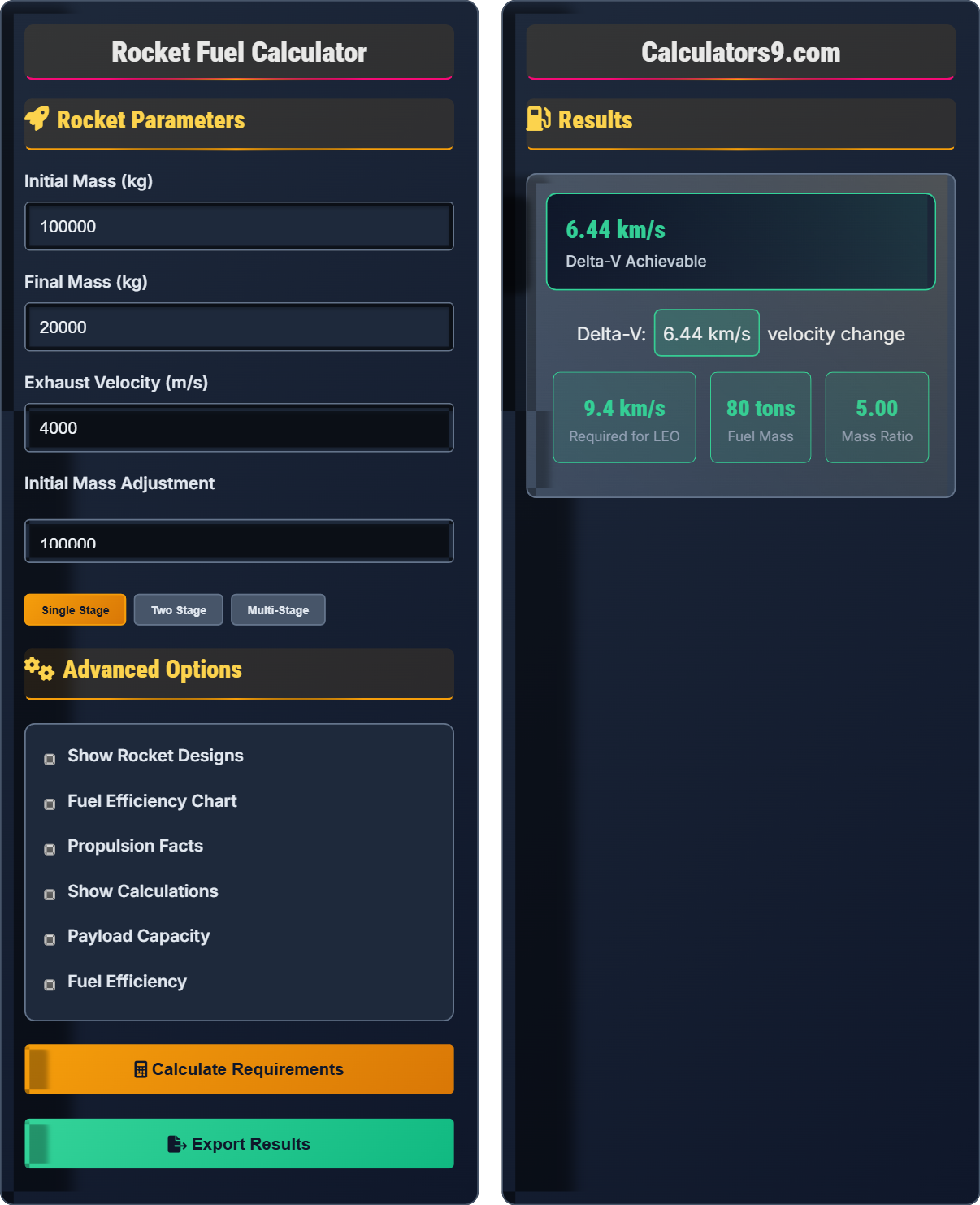
Example: For a rocket with exhaust velocity of 4,000 m/s, initial mass of 100,000 kg, and final mass of 20,000 kg:
\( \Delta v = 4000 \times \ln(100000/20000) = 4000 \times \ln(5) = 4000 \times 1.609 = 6,436 \) m/s
Therefore, the rocket can achieve a velocity change of 6.44 km/s.
Rocket Parameters
Advanced Options
Results
Rocket Propulsion Guide
Rocket propulsion operates on Newton's third law of motion: for every action, there is an equal and opposite reaction. Rockets expel propellant at high velocity to generate thrust, allowing them to operate in the vacuum of space where traditional air-breathing engines cannot function.
Mathematically expressed as:
This fundamental equation describes the relationship between the velocity change achievable by a rocket and the mass of propellant consumed. It's the foundation of all space mission planning and rocket design.
| System | Exhaust Velocity (km/s) | Specific Impulse (s) | Applications | Fuel Efficiency |
|---|---|---|---|---|
| Solid Fuel | 2.5 | 250 | Boosters, missiles | Lower |
| Liquid Fuel (RP-1/O₂) | 3.0 | 300 | Main stages | Medium |
| Liquid Fuel (H₂/O₂) | 4.4 | 450 | Upper stages | High |
| Ionic Thruster | 30 | 3000 | Deep space | Very High |
| Plasma Thruster | 50 | 5000 | Future missions | Extremely High |
Rocket Science
Change in velocity required for space maneuvers.
\( \Delta v = v_e \ln(m_0/m_f) \)
Velocity change based on mass ratio and exhaust velocity.
- Higher mass ratio = greater delta-v
- Higher exhaust velocity = greater efficiency
- 90% of launch mass is typically fuel
Space Engineering
Thrust efficiency of rocket engines.
\( MF = (m_0 - m_f)/m_0 \)
Proportion of fuel in total mass.
- Multi-stage rockets improve efficiency
- Structural mass limits performance
- Atmospheric drag affects early flight
Rocket Propulsion Quiz
According to the Tsiolkovsky rocket equation, if a rocket's mass ratio (m₀/mf) doubles, how does the achievable delta-v change?
The answer is B) It increases by a factor of ln(2). The Tsiolkovsky equation is Δv = ve × ln(m₀/mf). If the mass ratio doubles, then the new delta-v becomes Δv_new = ve × ln(2 × (m₀/mf)) = ve × [ln(2) + ln(m₀/mf)] = ve × ln(2) + ve × ln(m₀/mf). This means the delta-v increases by ve × ln(2) ≈ 0.693 × ve, which is equivalent to an increase by a factor of ln(2) in the logarithmic term.
The logarithmic relationship in the Tsiolkovsky equation means that doubling the mass ratio does not double the delta-v. Instead, the relationship is logarithmic, which means that as the mass ratio increases, the additional delta-v gained diminishes. This is why it becomes increasingly difficult to achieve higher velocities with chemical rockets.
Mass Ratio: Ratio of initial mass to final mass (m₀/mf)
Delta-V: Change in velocity achievable by a rocket
Logarithmic Relationship: Relationship where output changes proportionally to log of input
• Δv = ve × ln(m₀/mf) (logarithmic relationship)
• Doubling mass ratio adds ln(2) to logarithm
• Logarithmic relationships have diminishing returns
• Remember: Δv grows logarithmically with mass ratio
• Large mass ratios are needed for significant delta-v gains
• Thinking mass ratio and delta-v have linear relationship
• Forgetting the logarithmic nature of the equation
A rocket has an initial mass of 200,000 kg and a final mass of 40,000 kg. If the exhaust velocity is 3,500 m/s, calculate the achievable delta-v. Show your work.
Using the Tsiolkovsky rocket equation: Δv = ve × ln(m₀/mf)
Given:
- m₀ = 200,000 kg
- mf = 40,000 kg
- ve = 3,500 m/s
Step 1: Calculate the mass ratio: m₀/mf = 200,000/40,000 = 5
Step 2: Calculate the natural logarithm: ln(5) = 1.609
Step 3: Calculate delta-v: Δv = 3,500 × 1.609 = 5,632 m/s
Therefore, the rocket can achieve a delta-v of 5.63 km/s.
This problem demonstrates how to apply the Tsiolkovsky equation with real values. The mass ratio of 5 means that 80% of the rocket's initial mass is fuel, which is typical for many rocket designs. The calculated delta-v of 5.63 km/s would be sufficient for reaching low Earth orbit, though atmospheric drag and gravity losses would require additional delta-v.
Exhaust Velocity: Speed at which propellant exits the rocket engine
Mass Ratio: Initial mass divided by final mass
• Δv = ve × ln(m₀/mf)
• Mass ratio must be > 1 for positive delta-v
• Higher mass ratios require more fuel
• Remember: ln(5) ≈ 1.609
• Convert to km/s for easier interpretation
• Confusing initial and final mass in the ratio
• Using common logarithm instead of natural logarithm
A spacecraft needs to achieve a delta-v of 9,000 m/s to reach Mars. If the rocket engine has an exhaust velocity of 4,000 m/s, what mass ratio is required? If the dry mass (payload and structure) is 15,000 kg, what is the required initial mass and fuel mass?
Step 1: Rearrange the Tsiolkovsky equation to solve for mass ratio:
Δv = ve × ln(m₀/mf) → ln(m₀/mf) = Δv/ve
m₀/mf = e^(Δv/ve)
Step 2: Calculate mass ratio: m₀/mf = e^(9000/4000) = e^2.25 = 9.49
Step 3: Calculate initial mass: m₀ = mass ratio × mf = 9.49 × 15,000 = 142,350 kg
Step 4: Calculate fuel mass: Fuel = m₀ - mf = 142,350 - 15,000 = 127,350 kg
Therefore, the required mass ratio is 9.49, initial mass is 142,350 kg, and fuel mass is 127,350 kg.
This problem shows how to work backwards from a required delta-v to determine the necessary rocket parameters. The mass ratio of 9.49 means that for every 1 kg of dry mass, 8.49 kg of fuel is required. This demonstrates why interplanetary missions require such large amounts of fuel.
Dry Mass: Mass of rocket excluding fuel
Fuel Mass: Mass of propellant carried by rocket
• m₀/mf = e^(Δv/ve)
• Fuel mass = m₀ - mf
• Higher delta-v requires exponentially more fuel
• Remember: e^(x) is the inverse of ln(x)
• Check: fuel mass should be much larger than dry mass
• Forgetting to use the inverse relationship (e^x)
• Confusing fuel mass with dry mass
A two-stage rocket has the following characteristics: Stage 1 has an exhaust velocity of 3,000 m/s and a mass ratio of 4, Stage 2 has an exhaust velocity of 4,000 m/s and a mass ratio of 5. Calculate the total delta-v achievable by the rocket. What percentage of the initial mass is fuel if the final stage has a dry mass of 10,000 kg?
Step 1: Calculate delta-v for each stage using Δv = ve × ln(mass ratio)
Stage 1: Δv₁ = 3,000 × ln(4) = 3,000 × 1.386 = 4,158 m/s
Stage 2: Δv₂ = 4,000 × ln(5) = 4,000 × 1.609 = 6,436 m/s
Step 2: Calculate total delta-v: Δv_total = Δv₁ + Δv₂ = 4,158 + 6,436 = 10,594 m/s
Step 3: Calculate initial mass for each stage:
Stage 2 initial mass: m₀₂ = 10,000 × 5 = 50,000 kg
Stage 1 initial mass: m₀₁ = (50,000 + structural mass) × 4
Assuming structural mass is 10% of stage 2 initial mass: 5,000 kg
So m₀₁ = (50,000 + 5,000) × 4 = 220,000 kg
Step 4: Calculate fuel percentage: (220,000 - 10,000) / 220,000 = 210,000 / 220,000 = 95.5%
Therefore, the total delta-v is 10.59 km/s and 95.5% of initial mass is fuel.
Multi-stage rockets add the delta-v of each stage together. This problem shows why multi-stage rockets are necessary for achieving high velocities - the total delta-v is the sum of individual stage contributions. The fuel percentage of 95.5% demonstrates how most of a rocket's mass is propellant.
Multi-Stage Rocket: Rocket with multiple sections that can be discarded
Structural Mass: Mass of rocket structure excluding fuel and payload
• Total Δv = Σ(ve × ln(mass ratio))
• Each stage contributes independently
• Discarding stages reduces dead weight
• Add delta-v of each stage
• Calculate mass backwards from final stage
• Multiplying rather than adding stage delta-v
• Forgetting to account for structural mass
Which of the following factors has the greatest impact on rocket efficiency?
The answer is B) Exhaust velocity of the propellant. In the Tsiolkovsky equation Δv = ve × ln(m₀/mf), the exhaust velocity (ve) directly multiplies the logarithmic term, making it the most significant factor in determining the rocket's efficiency. Higher exhaust velocity means more thrust per unit of propellant mass, leading to greater delta-v for the same mass ratio. The other factors, while they may have minor effects, don't directly impact the fundamental relationship between mass and velocity change.
Exhaust velocity is the key parameter that determines how efficiently a rocket converts propellant mass into velocity. Chemical rockets have exhaust velocities of 2-4.5 km/s, while advanced ion thrusters can achieve 30-50 km/s, though with much lower thrust. The exhaust velocity depends on the energy content of the propellant and the efficiency of the engine.
Specific Impulse: Measure of rocket efficiency (thrust per unit of propellant)
Exhaust Velocity: Speed of propellant leaving the engine
• ve directly affects delta-v in Tsiolkovsky equation
• Higher ve = more efficient propulsion
• Chemical rockets limited by chemistry
• Focus on improving exhaust velocity for efficiency
• Different propellants have different ve values
• Thinking initial mass is the most important factor
• Confusing shape with aerodynamic efficiency
FAQ
Q: Why do rockets need multiple stages instead of just one?
A: Rockets use multiple stages to improve efficiency by discarding empty fuel tanks and heavy engines as they are no longer needed. The Tsiolkovsky equation shows that delta-v depends on the mass ratio (m₀/mf). By dropping spent stages:
- Reduced Dead Weight: Empty fuel tanks and engines are jettisoned, reducing the mass that needs to be accelerated
- Optimized Engines: Different stages can use engines optimized for different conditions (atmospheric vs. vacuum)
- Improved Mass Ratio: Each stage has its own favorable mass ratio, cumulatively achieving higher total delta-v
Without staging, a single-stage rocket would need an impractically high mass ratio to achieve orbital velocity. The rocket equation shows that achieving 9.4 km/s for LEO requires a mass ratio of about 15:1 for typical chemical rockets, which is only feasible with staging.
Q: What is specific impulse and why is it important?
A: Specific impulse (Isp) is a measure of rocket engine efficiency, defined as the thrust produced per unit of propellant flow rate. It's measured in seconds and represents how long one pound of propellant can produce one pound of thrust.
Mathematically: \(I_{sp} = \frac{F}{\dot{m} \cdot g_0}\)
Where F is thrust, ṁ is mass flow rate, and g₀ is standard gravity.
Specific impulse is directly related to exhaust velocity: \(v_e = I_{sp} \cdot g_0\)
Higher specific impulse means:
- More thrust per unit of fuel consumed
- Greater delta-v for the same mass ratio
- Less fuel needed for a given mission
Chemical rockets typically have Isp of 250-450 seconds, while ion thrusters can achieve 3000+ seconds, though with much lower thrust.