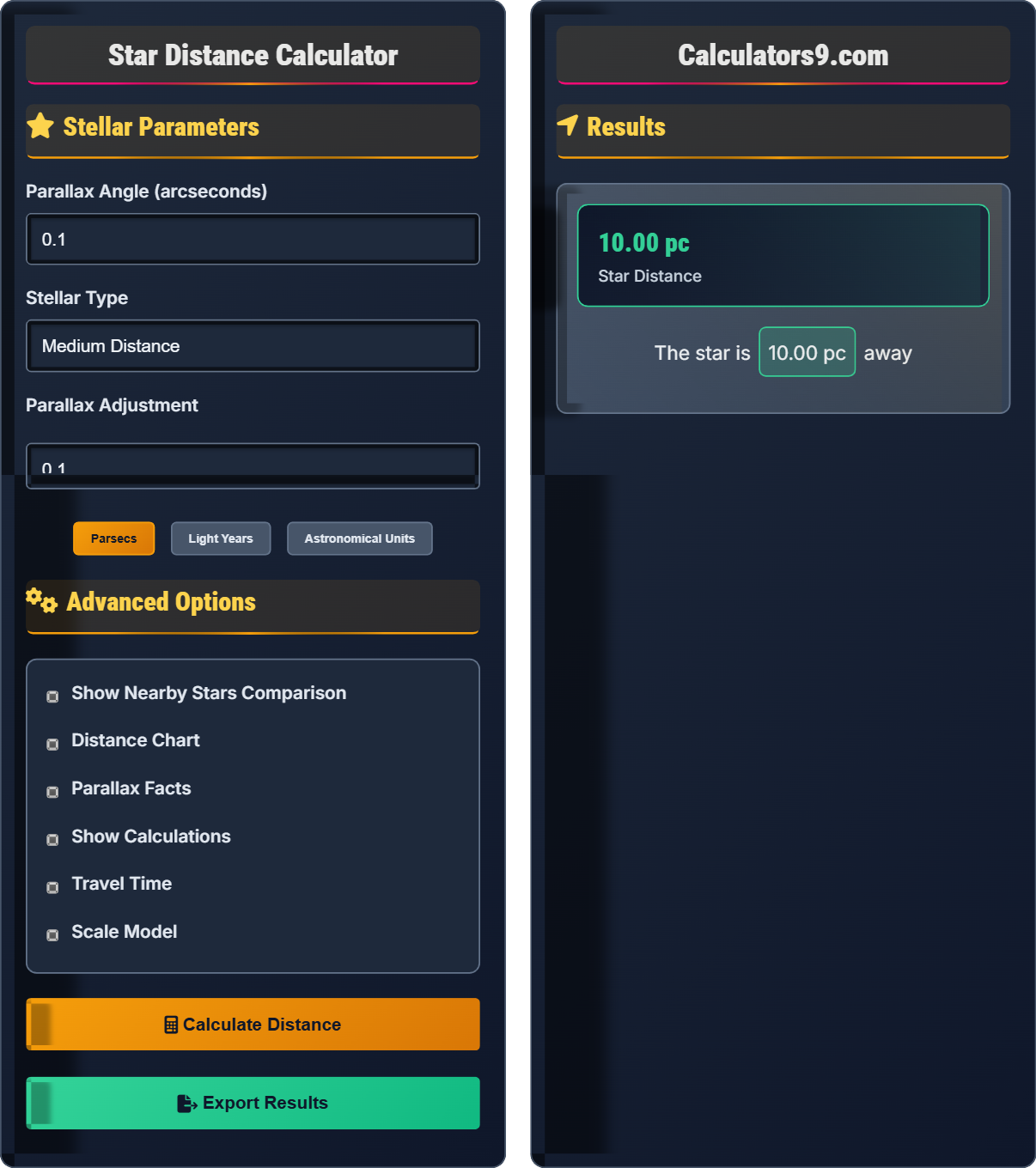
Star Distance Calculator
Parallax method • Astronomy tool
Parallax Distance Formula:
Show the calculator\( d = \frac{1}{p} \)
Where:
- \( d \) = distance to star (in parsecs)
- \( p \) = parallax angle (in arcseconds)
This fundamental formula of stellar astronomy relates the distance to a star to its observed parallax shift as Earth orbits the Sun. The parallax method is the most direct way to measure distances to nearby stars.
Example: For a star with a parallax of 0.1 arcseconds:
\( d = \frac{1}{0.1} = 10 \) parsecs
Converting to light-years: 10 parsecs × 3.26 = 32.6 light-years.
Stellar Parameters
Advanced Options
Results
Stellar Distance Guide
Stellar parallax is the apparent shift in position of a nearby star against the background of more distant stars as Earth orbits the Sun. This tiny angular shift allows astronomers to calculate distances to stars using trigonometry.
Mathematically expressed as:
Where d is distance in parsecs and p is parallax angle in arcseconds. This simple reciprocal relationship forms the foundation of cosmic distance measurements.
| Star | Parallax (") | Distance (pc) | Distance (ly) | Constellation |
|---|---|---|---|---|
| Proxima Centauri | 0.772 | 1.295 | 4.24 | Centaurus |
| Alpha Centauri A | 0.742 | 1.348 | 4.39 | Centaurus |
| Barnard's Star | 0.549 | 1.821 | 5.94 | Ophiuchus |
| Wolf 359 | 0.419 | 2.387 | 7.78 | Leo |
| Lalande 21185 | 0.387 | 2.584 | 8.42 | Ursa Major |
| Sirius | 0.379 | 2.639 | 8.60 | Canis Major |
Cosmic Distances
Distance at which 1 AU subtends 1 arcsecond (3.26 light-years).
\(d = 1/p\)
Distance in parsecs equals inverse of parallax angle.
- Smaller parallax = greater distance
- 1 parsec = 3.26 light-years
- Only works for nearby stars
Astronomy Methods
Distance light travels in one year (9.46 trillion km).
\(d = \frac{1}{p}\)
Basic trigonometry for stellar distances.
- Measurable only for nearby stars
- Requires precise instruments
- Foundation for cosmic distance ladder
Stellar Distance Quiz
If a star has a parallax of 0.5 arcseconds, how far away is it?
The answer is C) 2.0 parsecs. Using the parallax formula: d = 1/p = 1/0.5 = 2.0 parsecs. The distance in parsecs is the reciprocal of the parallax angle in arcseconds. This means the star is 2.0 parsecs or about 6.52 light-years away.
The parallax formula is a simple reciprocal relationship. As the parallax angle gets smaller (indicating a more distant star), the distance increases. Conversely, as the parallax angle gets larger (indicating a closer star), the distance decreases. This inverse relationship is fundamental to stellar distance measurement.
Parsec: Distance at which 1 AU subtends 1 arcsecond (3.26 light-years)
Parallax Angle: Angular shift of star position as Earth orbits Sun
Arcsecond: 1/3600 of a degree
• d = 1/p (distance equals inverse of parallax)
• Smaller parallax = greater distance
• Larger parallax = closer distance
• Remember: Distance = 1/Parallax
• The closest stars have the largest parallax angles
• The furthest measurable stars have the smallest parallax angles
• Thinking parallax is directly proportional to distance
• Confusing the formula (multiplying instead of dividing)
Convert a stellar distance of 10 parsecs to light-years. Show your work.
Conversion factor: 1 parsec = 3.26 light-years
Step 1: Multiply distance in parsecs by conversion factor
Step 2: 10 parsecs × 3.26 light-years/parsec = 32.6 light-years
Therefore, 10 parsecs equals 32.6 light-years.
Converting between distance units is essential in astronomy. The parsec is defined based on geometric measurements (trigonometric parallax), while the light-year is defined by the speed of light. Understanding both units and their relationship is important for astronomical communication and calculations.
Parsec: Astronomical unit based on trigonometric parallax measurement
Light-Year: Distance light travels in one year
Conversion Factor: 1 pc = 3.26 ly
• 1 parsec = 3.26 light-years
• 1 light-year = 9.46 × 10¹² km
• 1 parsec = 3.09 × 10¹³ km
• Remember: 1 pc ≈ 3.26 ly
• Use dimensional analysis for conversions
• Confusing the conversion factor (3.26 vs 1/3.26)
• Forgetting to carry units through calculations
Astronomers measure the parallax of a star to be 0.025 arcseconds. Calculate the distance to the star in parsecs and light-years. If the star emits light that takes 40 years to reach Earth, verify if the parallax measurement is consistent with this travel time.
Step 1: Calculate distance in parsecs using parallax formula: d = 1/p
d = 1/0.025 = 40 parsecs
Step 2: Convert to light-years: 40 pc × 3.26 ly/pc = 130.4 light-years
Step 3: Verify consistency with light travel time:
The parallax measurement indicates a distance of 130.4 light-years, meaning light from the star takes 130.4 years to reach Earth. This is inconsistent with the stated 40-year travel time, suggesting either an error in the parallax measurement or the travel time information.
Therefore, the star is 40 parsecs (130.4 light-years) away based on the parallax measurement.
This problem demonstrates how to verify astronomical measurements using different methods. The parallax method provides a direct geometric measurement of distance, while light travel time gives distance based on the speed of light. Inconsistencies between methods can indicate measurement errors or unknown factors.
Light Travel Time: Time for light to travel from source to observer
Geometric Distance: Distance measured using trigonometric methods
• Distance (ly) = Light travel time (years)
• Parallax provides direct geometric measurement
• Different methods should yield consistent results
• Always verify measurements using multiple methods
• Remember that parallax is most accurate for nearby stars
• Confusing distance with light travel time
• Not recognizing when measurements are inconsistent
The Hipparcos satellite could measure parallaxes with an accuracy of about 0.001 arcseconds. What is the maximum distance at which it could measure stellar distances with reasonable accuracy? If the Gaia satellite can measure parallaxes as small as 0.00001 arcseconds, how much farther can it measure distances compared to Hipparcos? Express your answer in both parsecs and light-years.
Step 1: Calculate Hipparcos maximum distance: d = 1/p = 1/0.001 = 1,000 parsecs
Step 2: Convert to light-years: 1,000 pc × 3.26 ly/pc = 3,260 light-years
Step 3: Calculate Gaia maximum distance: d = 1/0.00001 = 100,000 parsecs
Step 4: Convert to light-years: 100,000 pc × 3.26 ly/pc = 326,000 light-years
Step 5: Calculate improvement: 100,000/1,000 = 100 times farther
Therefore, Hipparcos could measure distances up to 1,000 parsecs (3,260 light-years), while Gaia can measure distances up to 100,000 parsecs (326,000 light-years), which is 100 times farther.
This problem illustrates how technological improvements in measurement precision dramatically expand our ability to map the universe. The 100-fold improvement in parallax measurement capability allowed Gaia to map distances 100 times farther than Hipparcos, greatly expanding our knowledge of the Milky Way galaxy.
Hipparcos: European Space Agency mission (1989-1993) measuring stellar positions
Gaia: Current ESA mission providing unprecedented parallax measurements
Measurement Precision: Accuracy of astronomical measurements
• Better precision enables greater distance measurements
• Parallax measurements are limited by observational accuracy
• Technology improvements expand cosmic distance measurements
• Remember: d = 1/p (smaller p = greater d)
• Technology improvements multiply measurement capabilities
• Forgetting that smaller parallaxes represent greater distances
• Not recognizing the multiplicative effect of precision improvements
Which of the following statements about stellar parallax is FALSE?
The answer is C) Parallax can measure distances to galaxies millions of light-years away. This statement is false because parallax measurements are only effective for relatively nearby stars within our galaxy. The parallax angles for galaxies millions of light-years away are immeasurably small with current technology. Parallax is limited to distances of about 100,000 parsecs (for Gaia satellite), which is still within our galaxy. The other statements are true: parallax is greatest for nearest stars, angles are measured in arcseconds, and distance equals the reciprocal of parallax.
Understanding the limitations of parallax measurements is crucial for appreciating the cosmic distance ladder. Parallax is only the first step in measuring cosmic distances. For more distant objects, astronomers use other methods like Cepheid variables, Type Ia supernovae, and redshift measurements.
Cosmic Distance Ladder: Series of methods to measure astronomical distances
Measurement Limitations: Constraints on how far methods can measure
• Parallax works only for nearby stars
• Other methods needed for distant objects
• Each method has specific range limitations
• Remember: Parallax is for nearby stars only
• Different methods are needed for different distance ranges
• Thinking parallax can measure extremely distant objects
• Not recognizing the limitations of measurement methods
FAQ
Q: Why can't we use parallax to measure distances to all stars?
A: Parallax measurements are limited by the precision of our instruments. As stars get farther away, their parallax angles become incredibly small:
- Nearby stars (within ~100 ly): Parallax angles are large enough to measure precisely
- Moderate distances (~100-1000 ly): Requires space-based telescopes like Hipparcos and Gaia
- Distant stars (beyond ~1000 ly): Parallax angles are too small to measure accurately
For more distant objects, astronomers use other methods like standard candles (Cepheid variables, Type Ia supernovae) and redshift measurements. The Gaia satellite can measure parallaxes as small as 0.00001 arcseconds, extending the method to about 100,000 parsecs, but even this is limited compared to the size of our galaxy.
Q: What is the difference between a parsec and a light-year?
A: Both parsecs and light-years are units of distance used in astronomy, but they are defined differently:
Parsec (pc): Defined based on geometry and trigonometric parallax. One parsec is the distance at which 1 astronomical unit (the Earth-Sun distance) subtends an angle of 1 arcsecond. This comes from the parallax measurement technique.
Light-year (ly): Defined based on the speed of light. One light-year is the distance that light travels in one year in a vacuum (about 9.46 trillion kilometers).
The relationship between them is: 1 parsec = 3.26 light-years. Astronomers often prefer parsecs because they relate directly to the measurement method (parallax), while light-years are more intuitive for general public understanding.