Telescope Magnification Calculator
Optical power • Astronomy tool
Telescope Magnification Formula:
Show the calculator\( M = \frac{f_o}{f_e} \)
Where:
- \( M \) = magnification
- \( f_o \) = focal length of objective lens/mirror
- \( f_e \) = focal length of eyepiece
This fundamental formula of telescope optics determines how much larger an object appears through the telescope compared to naked eye observation. The magnification is the ratio of the objective's focal length to the eyepiece's focal length.
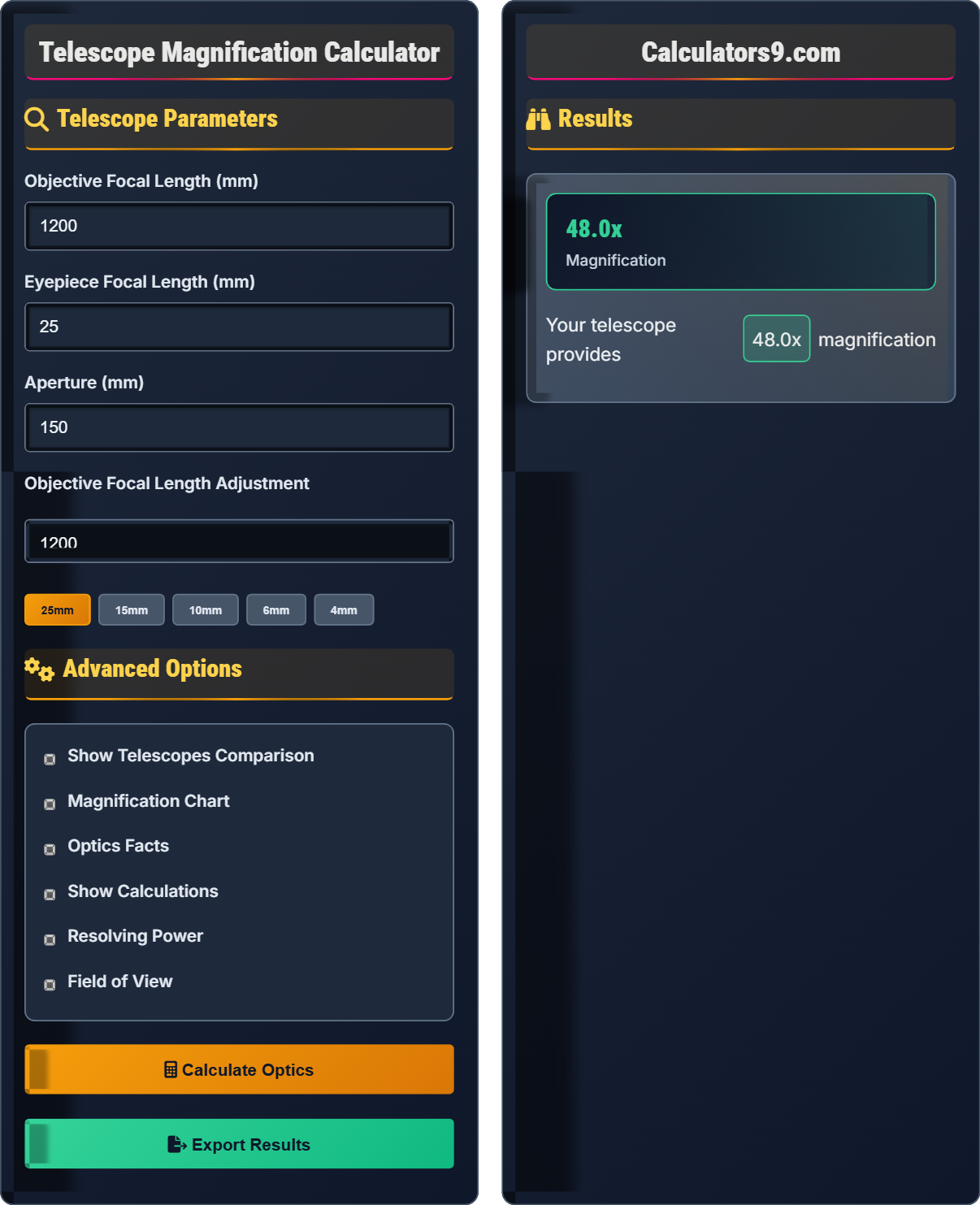
Example: For a telescope with a 1200mm focal length objective and a 25mm eyepiece:
\( M = \frac{1200}{25} = 48 \)
Thus, the telescope provides 48x magnification.
Telescope Parameters
Advanced Options
Results
Telescope Optics Guide
Telescope magnification is determined by the ratio of the focal length of the objective lens or mirror to the focal length of the eyepiece. This fundamental principle allows telescopes to make distant objects appear closer and larger.
Mathematically expressed as:
Where M is magnification, fo is the focal length of the objective, and fe is the focal length of the eyepiece. This simple ratio determines how much larger an object appears through the telescope.
| Configuration | Aperture (mm) | Focal Length (mm) | Max Useful Mag | Light Gathering |
|---|---|---|---|---|
| Small Refractor | 70 | 700 | 140x | 39x |
| Medium Reflector | 150 | 1200 | 300x | 156x |
| Large Reflector | 250 | 2000 | 500x | 434x |
| Professional | 1000 | 15000 | 2000x | 7000x |
Optical Calculations
Aperture divided by focal length (f = focal/aperture).
\(M = f_o/f_e\)
Objective focal length divided by eyepiece focal length.
- Higher mag = smaller field of view
- Aperture limits max useful mag
- Atmospheric seeing affects image quality
Telescope Design
Minimum angular separation distinguishable by telescope.
\(\theta = 1.22\lambda/D\)
Diffraction-limited resolution for circular aperture.
- Aperture determines light gathering
- Focal length affects magnification
- Atmospheric conditions limit performance
Telescope Optics Quiz
If a telescope has an objective focal length of 1200mm and an eyepiece focal length of 10mm, what is the magnification?
The answer is B) 120x. Using the magnification formula: M = fo/fe = 1200mm/10mm = 120x. The magnification is simply the ratio of the objective focal length to the eyepiece focal length. This means the object appears 120 times larger than it does to the naked eye.
The magnification formula is straightforward: divide the objective focal length by the eyepiece focal length. Shorter eyepieces provide higher magnification, while longer eyepieces provide lower magnification. This inverse relationship is fundamental to telescope operation.
Objective: The main lens or mirror that collects light
Eyepiece: The lens assembly that magnifies the image formed by the objective
Magnification: How many times larger an object appears compared to naked eye
• M = fo/fe (magnification equals objective focal length divided by eyepiece focal length)
• Shorter eyepieces give higher magnification
• Longer eyepieces give lower magnification
• Remember: Divide objective FL by eyepiece FL
• Use longer eyepieces for wide-field views
• Use shorter eyepieces for high-power views
• Multiplying focal lengths instead of dividing them
• Confusing which focal length goes in numerator/denominator
A telescope has an objective focal length of 2000mm. What eyepiece focal length is needed to achieve 100x magnification? Show your work.
Using the magnification formula: M = fo/fe
Given:
- M = 100x
- fo = 2000mm
- fe = ?
Step 1: Rearrange the formula to solve for eyepiece focal length: fe = fo/M
Step 2: fe = 2000mm/100x = 20mm
Therefore, a 20mm eyepiece is needed to achieve 100x magnification.
This problem requires algebraic manipulation of the basic magnification formula. By rearranging M = fo/fe to fe = fo/M, we can find the required eyepiece focal length for a desired magnification. This is a common calculation for astronomers planning observations.
Algebraic Manipulation: Rearranging equations to solve for different variables
Desired Magnification: The magnification level needed for specific observations
• To find eyepiece FL: fe = fo/M
• To find objective FL: fo = M × fe
• To find magnification: M = fo/fe
• Remember: Objective FL = Magnification × Eyepiece FL
• Use this to plan your eyepiece collection
• Forgetting to rearrange the formula properly
• Using the wrong units for focal lengths
Compare the light gathering power of a 150mm telescope to a 75mm telescope. How many times more light does the larger telescope gather? Express your answer as a ratio.
Light gathering power is proportional to the area of the aperture, which is proportional to the square of the diameter.
For the 150mm telescope: Area ∝ (150)² = 22,500
For the 75mm telescope: Area ∝ (75)² = 5,625
Step 1: Calculate the ratio: 22,500/5,625 = 4
Step 2: Alternatively, (150/75)² = 2² = 4
Therefore, the 150mm telescope gathers 4 times more light than the 75mm telescope.
This demonstrates the quadratic relationship between aperture and light gathering power. When you double the diameter of a telescope, you quadruple its light gathering ability. This is why larger telescopes reveal fainter objects and provide better detail.
Light Gathering Power: The ability of a telescope to collect photons from distant objects
Aperture: The diameter of the objective lens or mirror
• Light gathering ∝ D² (area of circular aperture)
• Doubling aperture quadruples light gathering
• Larger aperture = fainter objects visible
• Remember: Light gathering ∝ (aperture)²
• A 200mm scope gathers 4x more light than a 100mm scope
• Thinking light gathering is linear with aperture
• Forgetting that area is proportional to the square of diameter
A telescope has an aperture of 200mm. Calculate its maximum useful magnification using the rule of thumb that maximum magnification is approximately 2 times the aperture in millimeters. Then explain why going beyond this limit degrades image quality. If the telescope has a focal length of 2000mm, what eyepiece focal length would correspond to this maximum magnification?
Step 1: Maximum useful magnification = 2 × aperture = 2 × 200mm = 400x
Step 2: Using the magnification formula to find eyepiece focal length:
fe = fo/M = 2000mm/400x = 5mm
Therefore, the maximum useful magnification is 400x, achieved with a 5mm eyepiece.
Going beyond this limit degrades image quality because of diffraction effects and atmospheric turbulence. The telescope cannot resolve details smaller than the diffraction limit, so increasing magnification further only makes the image dimmer and blurrier without revealing more detail.
The 2x per mm rule is a practical guideline for maximum useful magnification. Beyond this limit, the image becomes too dim and blurry to be useful. This is because the telescope's resolution is limited by diffraction, and atmospheric seeing conditions also limit the practical magnification. The 5mm eyepiece would be needed to achieve the maximum useful magnification.
Maximum Useful Magnification: The highest magnification that provides useful detail
Diffraction Limit: The fundamental limit on resolution due to wave nature of light
Atmospheric Seeing: Image degradation caused by atmospheric turbulence
• Max useful mag ≈ 2 × aperture (in mm)
• Beyond max useful mag, image quality degrades
• Diffraction limits ultimate resolution
• Use 2x per mm as a starting point
• Consider atmospheric conditions when determining max mag
• Sometimes 1x per mm is more practical
• Thinking higher magnification always means better views
• Ignoring atmospheric seeing limitations
• Confusing magnification with resolution
Which of the following statements about telescope performance is FALSE?
The answer is C) Magnification can be increased indefinitely without limit. This statement is false because there are practical limits to magnification. The maximum useful magnification is approximately 2 times the aperture in millimeters. Beyond this limit, the image becomes too dim and blurry to be useful due to diffraction and atmospheric seeing. The other statements are true: aperture does determine light gathering, focal length affects magnification with a given eyepiece, and longer focal lengths do produce higher magnification with the same eyepiece.
Understanding the limits of telescope performance is crucial for astronomers. While it's mathematically possible to achieve very high magnifications by using very short focal length eyepieces, the practical utility is limited by the telescope's optical quality and atmospheric conditions. This misconception leads many beginners to believe that higher magnification always means better viewing, which is not the case.
Practical Limits: Real-world constraints on telescope performance
Optical Quality: The ability of telescope optics to form sharp images
• There are practical limits to magnification
• Light gathering power depends on aperture
• Magnification is limited by diffraction
• Quality often beats quantity in astronomy
• Low magnification can provide better views for extended objects
• Consider atmospheric conditions when observing
• Believing that higher magnification always means better views
• Ignoring the relationship between aperture and performance
FAQ
Q: How do I choose the right eyepiece for different types of observations?
A: Choosing the right eyepiece depends on what you want to observe:
- Deep Sky Objects (galaxies, nebulae): Use low magnification (10-50x) with longer focal length eyepieces (20-40mm) for wide fields of view to capture extended objects.
- Planetary Observation: Use high magnification (100-300x) with shorter focal length eyepieces (2-10mm) to see fine surface details.
- Lunar Observation: Medium to high magnification (50-200x) works well for craters and maria.
- Star Clusters: Low to medium magnification (20-100x) to fit multiple stars in the field of view.
Remember that atmospheric conditions also affect optimal magnification. On nights with poor seeing, lower magnifications often provide better views than higher ones.
Q: What is the difference between apparent field of view and true field of view?
A: The distinction between apparent and true field of view is important for telescope users:
Apparent Field of View (AFOV): This is the angle of sky visible through the eyepiece alone, measured in degrees. It's a characteristic of the eyepiece design and typically ranges from 40° (narrow field) to 120° (ultra-wide field).
True Field of View (TFOV): This is the actual angle of sky visible when the eyepiece is inserted into the telescope, calculated as: TFOV = AFOV/Magnification.
For example, if you have an eyepiece with a 50° AFOV in a telescope providing 100x magnification, the true field of view would be 50°/100 = 0.5°. This is about the same width as the full Moon.