Split Time Calculator
Fast performance calculator • 2026 standards
Split Time Calculation Formula:
Show the calculator\( ST = \frac{T}{D} \times SD \)
Where:
- \( ST \) = Split Time
- \( T \) = Total Time
- \( D \) = Total Distance
- \( SD \) = Split Distance
Alternative formulas:
- Pace = Time ÷ Distance
- Time = Pace × Distance
- Distance = Time ÷ Pace
This formula calculates the time required to complete a specific segment of a race based on overall pace. For example, if you run a 5K in 20 minutes, your pace is 6:26/km. A 1K split would take 6:26.
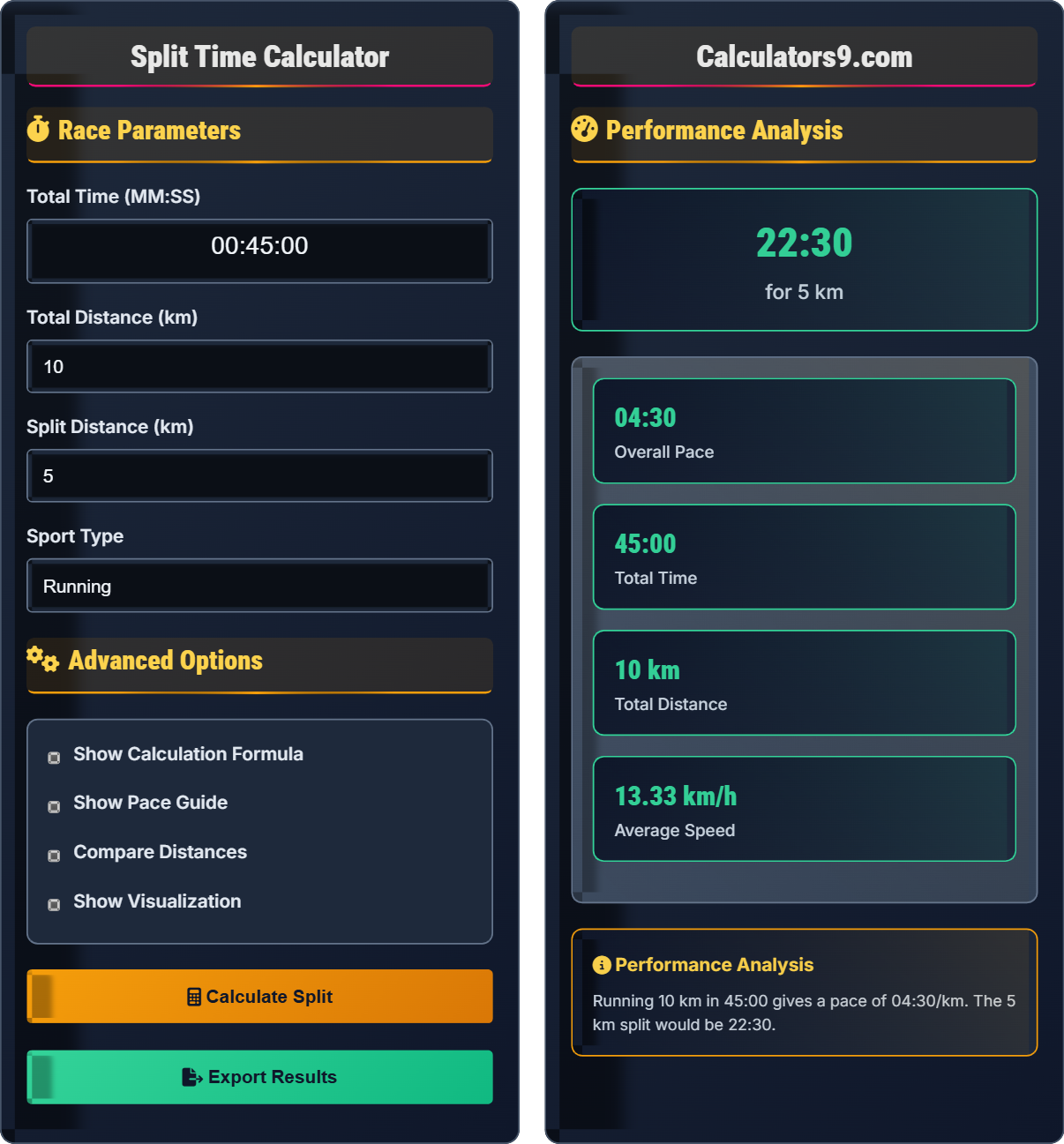
Example: For a 10K race completed in 45 minutes:
Overall pace = 45 min ÷ 10 km = 4:30/km
5K split time = 4:30/km × 5 km = 22:30
Thus, the runner would complete the first 5K in 22:30.
Race Parameters
Advanced Options
Performance Analysis
| Distance | Split Time | Cumulative Time | Pace |
|---|
| Level | Pace (min/km) | Speed (km/h) | Description |
|---|
Performance Tracking Guide & Sports Tools
Split time calculation helps athletes track performance and maintain consistent pacing. The formula is: Split Time = (Total Time ÷ Total Distance) × Split Distance. This allows for precise pacing strategy during races and training.
Key performance calculation formulas:
Where:
- \(Pace\) = Time per unit distance (min/km or min/mile)
- \(Time\) = Total elapsed time
- \(Distance\) = Total distance covered
Other formulas: Speed = Distance ÷ Time, Time = Pace × Distance
Typical pace ranges for different performance levels:
- Running - Elite: 3:00-4:00 min/km (20-15 km/h)
- Running - Competitive: 4:00-5:00 min/km (15-12 km/h)
- Running - Recreational: 5:00-7:00 min/km (12-8.5 km/h)
- Cycling - Elite: 20-25+ km/h
- Swimming - Elite: 1:30-2:00 min/100m
- Practice splits: Train at goal pace in segments to build race familiarity
- Monitor heart rate: Correlate splits with physiological effort
- Weather adjustments: Account for conditions when comparing performances
- Course variations: Adjust expectations for terrain differences
- Recovery periods: Include rest between interval training sessions
Performance Tracking Basics
Segmented timing to track performance at regular intervals during exercise.
\(ST = \frac{T}{D} \times SD\)
Where ST=split time, T=total time, D=total distance, SD=split distance.
- Pace = Time ÷ Distance
- Speed = Distance ÷ Time
- Consistent pacing optimizes performance
Training Applications
Using split times to evaluate and improve athletic performance.
- Running: 1K, 5K, 10K splits
- Cycling: 10K, 25K splits
- Swimming: 100m, 400m splits
- Walking: 1K splits
- Condition variations affect performance
- Consistency is key to improvement
- Recovery is essential for adaptation
- Track progress over time
Performance Tracking Quiz
If a runner completes 10 kilometers in 40 minutes, what is their pace per kilometer?
The answer is A) 4:00 min/km. Pace is calculated as Total Time ÷ Total Distance. 40 minutes ÷ 10 kilometers = 4 minutes per kilometer. This is equivalent to 4:00 per kilometer.
Pace calculation is fundamental to performance tracking. The formula Pace = Time ÷ Distance shows how long it takes to cover a unit of distance. This metric allows athletes to compare performances across different distances and maintain consistent effort during races.
Pace: Time taken to cover a unit of distance
Split Time: Time for a specific segment of a race
Consistent Pacing: Maintaining the same pace throughout a race
• Pace = Time ÷ Distance
• Time = Pace × Distance
• Distance = Time ÷ Pace
• Convert time to decimal minutes for easier calculations
• 4:30 pace = 4.5 minutes per km
• Practice with common distances
• Confusing pace with speed
• Using inconsistent time units
• Not converting seconds properly
If a cyclist maintains a pace of 25 km/h for 2 hours, how far will they travel? Show your work.
Using the formula: Distance = Speed × Time
Given:
- Speed = 25 km/h
- Time = 2 hours
Step 1: Apply the formula
Distance = 25 km/h × 2 h = 50 km
Therefore, the cyclist will travel 50 kilometers.
This calculation demonstrates the relationship between speed, time, and distance. The formula Distance = Speed × Time is fundamental to performance tracking. In this case, maintaining a constant speed for a given time results in a predictable distance covered.
Speed: Distance covered per unit of time
Constant Speed: Unchanging rate of movementDistance-Time Relationship: Linear correlation at constant speed
• Distance = Speed × Time
• Time = Distance ÷ Speed
• Speed = Distance ÷ Time
• Use consistent units (km, hours)
• 15 km/h = 4:00 min/km pace
• Always check units match
• Mixing time units (minutes vs hours)
• Confusing speed with pace
• Not checking unit consistency
A marathon runner completes the first 21km (half marathon) in 1 hour 45 minutes. If they maintain the same pace for the remaining 21km, what will be their total marathon time?
Step 1: Calculate the pace for the first half
Time = 1 hour 45 minutes = 105 minutes
Distance = 21 km
Pace = 105 minutes ÷ 21 km = 5 minutes per km
Step 2: Calculate time for the second half
Distance = 21 km
Pace = 5 minutes per km
Time = 21 km × 5 min/km = 105 minutes
Step 3: Calculate total time
Total time = First half + Second half
Total time = 105 minutes + 105 minutes = 210 minutes
210 minutes = 3 hours 30 minutes
Therefore, the total marathon time will be 3 hours 30 minutes.
This problem demonstrates the importance of consistent pacing in endurance events. By calculating the pace from the first half and applying it to the second half, we can predict the total time. This approach is valuable for race strategy and performance evaluation.
Marathon Pace: Consistent speed maintained over 42.195km
Consistent Pacing: Equal effort throughout the race
Performance Prediction: Estimating results based on current pace
• Maintain consistent pace for best results
• Analyze splits to adjust strategy
• Predict time based on current pace
• Negative splits (faster second half) are ideal
• Monitor pace at regular intervals
• Adjust for fatigue in longer races
• Not accounting for fatigue in predictions
• Inconsistent unit conversions
• Forgetting to add both halves
An athlete wants to run 10 intervals of 400m each at a pace of 75 seconds per 400m. How long will the entire workout take, and what is this equivalent to in minutes per kilometer?
Step 1: Calculate total time for all intervals
Number of intervals = 10
Time per interval = 75 seconds
Total time = 10 × 75 seconds = 750 seconds
750 seconds = 12.5 minutes = 12 minutes 30 seconds
Step 2: Calculate total distance
Distance per interval = 400 meters = 0.4 km
Total distance = 10 × 0.4 km = 4 km
Step 3: Calculate pace per kilometer
Total time = 12.5 minutes
Total distance = 4 km
Pace = 12.5 minutes ÷ 4 km = 3.125 minutes per km
3.125 minutes = 3 minutes + 0.125 × 60 seconds = 3 minutes 7.5 seconds
Therefore, the workout will take 12 minutes 30 seconds, at a pace of 3:07.5 per kilometer.
This problem combines interval training calculations with pace conversion. It demonstrates how to work with different distance units (meters vs kilometers) and convert between time formats. Understanding these relationships is essential for designing effective training programs.
Interval Training: Alternating high-intensity efforts with recovery
Distance Conversion: Changing between measurement units
Time Conversion: Changing between formats (decimal vs mm:ss)
• Convert units consistently
• Track total distance and time
• Calculate average pace across intervals
• 400m = 0.4 km
• Convert to decimal minutes for calculations
• Convert back to mm:ss for reporting
• Not converting meters to kilometers
• Forgetting to convert decimal minutes to mm:ss
• Adding up times incorrectly
Which of the following factors has the greatest impact on maintaining consistent pace during a long-distance race?
The answer is C) Even pacing (consistent speed throughout). Research consistently shows that maintaining an even pace throughout a race is the most efficient strategy for endurance events. This approach conserves energy and prevents premature fatigue, leading to better overall times compared to positive or negative splitting.
Even pacing optimizes performance by maintaining consistent energy expenditure throughout the race. The body's aerobic system works most efficiently at a steady state. While negative splitting (faster in second half) is sometimes effective, even pacing typically yields the best results for most athletes across various distances.
Even Pacing: Maintaining consistent speed throughout
Negative Split: Running second half faster than first
Positive Split: Running first half faster than second
• Even pacing is most efficient
• Avoid starting too fast
• Practice pacing in training
• Start conservatively
• Monitor splits regularly
• Train at goal pace
• Starting too fast due to adrenaline
• Not practicing pacing strategy
• Focusing only on finish time
FAQ
Q: How do I calculate my target splits for a race?
A: To calculate target splits, divide your goal race time by the number of segments you want to track. For example, if you want to run a 10K in 40 minutes, your target pace is 4:00/km. Your 1K splits should be approximately 4:00 each.
Using the formula: \(Split\ Time = \frac{Goal\ Time}{Total\ Distance} \times Split\ Distance\)
For a 10K goal of 40 minutes with 1K splits:
\(Split\ Time = \frac{40\ minutes}{10\ km} \times 1\ km = 4\ minutes\)
It's often wise to run the first few splits slightly slower than target to avoid starting too fast, then maintain even pace or negative split for the remainder of the race.
Q: How do I convert between different pace units (min/km vs min/mile)?
A: To convert between pace units, use the conversion factor: 1 mile = 1.60934 kilometers.
From min/km to min/mile: Multiply by 1.60934
From min/mile to min/km: Divide by 1.60934
Example: 5:00 min/km = 5.00 × 1.60934 = 8.05 min/mile (approximately 8:03 min/mile)
Example: 8:00 min/mile = 8.00 ÷ 1.60934 = 4.97 min/km (approximately 4:58 min/km)
For quick mental calculations, you can use 1.6 as an approximation, which is close enough for most practical purposes.