Tournament Bracket Calculator
Fast tournament planner • 2026 standards
Tournament Bracket Formulas:
Show the calculator\( Rounds = \log_2(Participants) \)
\( Matches = Participants - 1 \)
\( Byes = 2^{\lceil \log_2(Participants) \rceil} - Participants \)
Where:
- \( Rounds \) = Number of tournament rounds
- \( Participants \) = Total number of teams/players
- \( Matches \) = Total number of matches in tournament
- \( Byes \) = Number of participants receiving first-round bye
Alternative formulas:
- Single Elimination: \( Matches = Participants - 1 \)
- Double Elimination: \( Matches = 2 \times Participants - 2 \)
- Round Robin: \( Matches = \frac{Participants \times (Participants - 1)}{2} \)
These formulas calculate tournament structure parameters. For single elimination brackets, the number of rounds is determined by finding the smallest power of 2 that accommodates all participants. Byes are assigned to ensure the bracket fills properly.
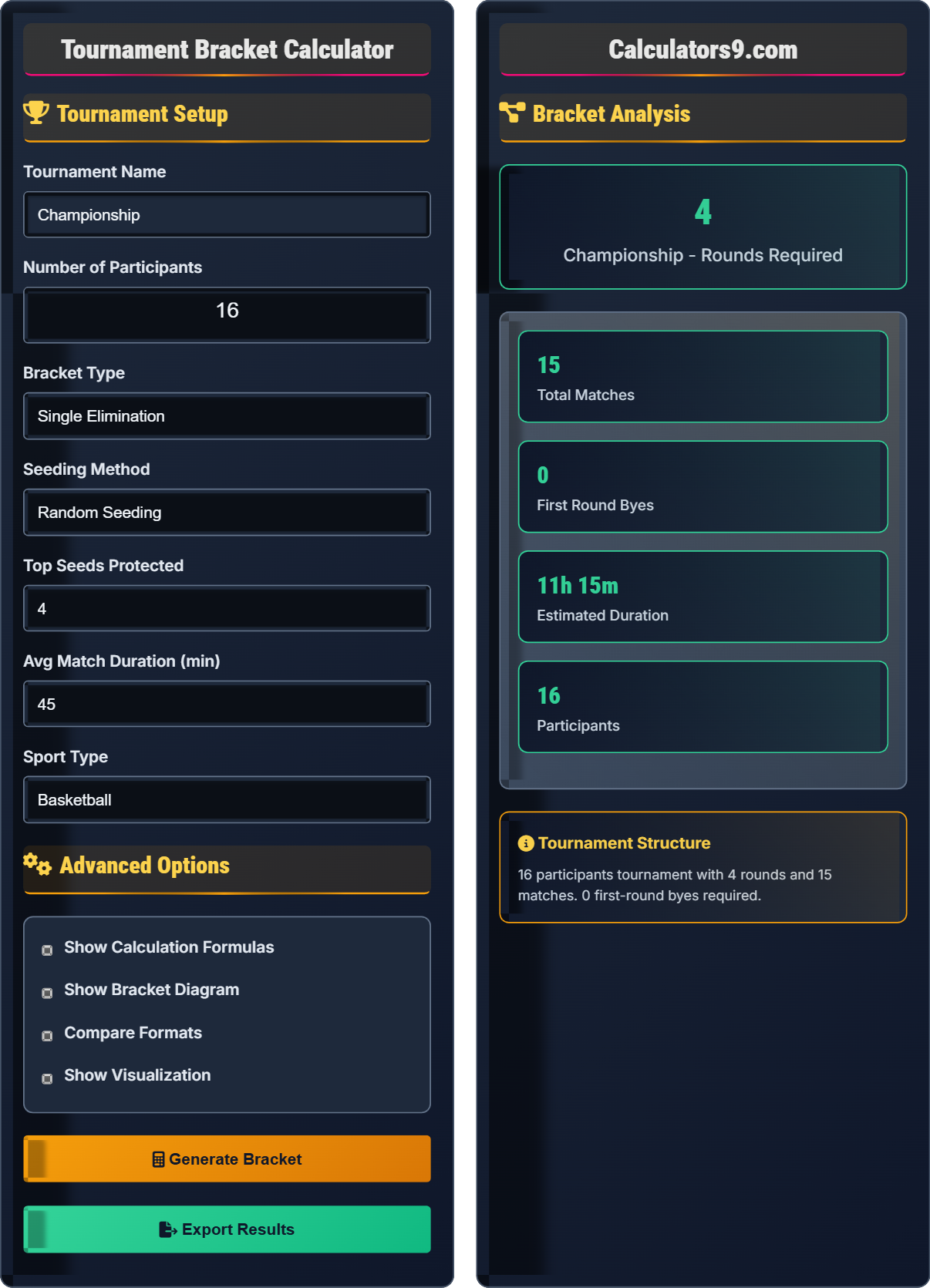
Example: Tournament with 16 participants:
\( Rounds = \log_2(16) = 4 \)
\( Matches = 16 - 1 = 15 \)
\( Byes = 2^4 - 16 = 16 - 16 = 0 \)
Thus, a 16-player tournament requires 4 rounds, 15 matches, and 0 byes.
Tournament Setup
Advanced Options
Bracket Analysis
| Round | Matches | Participants | Duration |
|---|
| Round | Matches | Time Required | Simultaneous |
|---|
Tournament Bracket Guide & Performance Tracking
Tournament brackets organize participants into structured competitions. Single elimination brackets eliminate losers after one loss, while double elimination allows one loss before elimination. Round robin formats have all participants compete against each other.
Key tournament structure calculation formulas:
Where:
- \(Rounds\) = Number of tournament rounds
- \(Participants\) = Total number of teams/players
For single elimination: \(Matches = Participants - 1\)
For byes: \(Byes = 2^{\lceil \log_2(Participants) \rceil} - Participants\)
Comparison of tournament formats:
- Single Elimination: Fastest format, 1 loss = elimination, n-1 matches
- Double Elimination: 2 losses required, more matches but fairer, 2n-2 matches
- Round Robin: All vs all, most comprehensive, n(n-1)/2 matches
- Swiss System: Pairing based on performance, good for many participants
- Group Stage + Knockout: Pool play followed by elimination bracket
- Seeding: Protect top performers in early rounds
- Byes: Assign to highest seeds to ensure fair competition
- Timing: Calculate total duration based on match length
- Backup plans: Prepare for weather/venue disruptions
- Communication: Clearly communicate schedule and pairings
Bracket Basics
Organized system for competitive elimination and advancement.
\(Rounds = \log_2(Participants)\)
\(Matches = Participants - 1\) (for single elimination)
- Rounds Required
- Total Matches
- Byes Needed
- Duration Estimate
Advanced Analytics
Comparative evaluation of different tournament structures.
- Single Elimination
- Double Elimination
- Round Robin
- Swiss System
- Participant count affects format choice
- Time constraints influence selection
- Fairness vs efficiency trade-offs
- Venue availability matters
Tournament Planning Quiz
How many rounds are needed for a single-elimination tournament with 32 participants?
The answer is B) 5 rounds. Using the formula \(Rounds = \log_2(Participants)\): \(Rounds = \log_2(32) = 5\). This is because 2⁵ = 32, so 5 rounds are needed to reduce 32 participants to 1 winner.
Bracket rounds follow a binary tree structure where each round halves the number of participants. For 32 participants: Round 1 (16 matches) → Round 2 (8 matches) → Round 3 (4 matches) → Round 4 (2 matches) → Round 5 (1 match) = Champion.
Single Elimination: One loss eliminates participant
Binary Tree: Each round halves participants
Power of 2: 2ⁿ participants require n rounds
• 2ⁿ participants = n rounds
• 32 = 2⁵ → 5 rounds
• Always log₂(participants)
• 4 = 2² → 2 rounds
• 8 = 2³ → 3 rounds
• 16 = 2⁴ → 4 rounds
• Counting participants as rounds
• Forgetting logarithm base 2
• Miscounting powers of 2
Calculate the number of matches needed for a single-elimination tournament with 24 participants. Show your work.
For single elimination tournaments, the formula is: \(Matches = Participants - 1\)
Step 1: Identify the number of participants
\(Participants = 24\)
Step 2: Apply the formula
\(Matches = 24 - 1 = 23\)
Step 3: Calculate byes needed
Next power of 2 above 24 = 32
\(Byes = 32 - 24 = 8\)
Therefore, the tournament requires 23 matches and 8 first-round byes.
In single elimination, every match eliminates exactly one participant. To determine a single winner from 24 participants, 23 participants must be eliminated, requiring 23 matches. Since 24 is not a power of 2, byes are needed to fill the bracket.
Single Elimination: One loss = elimination
Byes: Automatic advancement to next roundPower of 2: 2, 4, 8, 16, 32, 64...
• Matches = Participants - 1
• Byes = Next power of 2 - Participants
• Bracket size must be power of 2
• Always subtract 1 for matches
• Find next power of 2 for byes
• 24 → 32 (next power of 2)
• Using participant count as match count
• Forgetting to calculate byes
• Not recognizing power of 2 requirement
How many matches would be required in a double-elimination tournament with 16 participants? (In double elimination, a participant must lose twice to be eliminated.)
For double elimination tournaments, the formula is: \(Matches = 2 \times Participants - 2\)
Step 1: Identify the number of participants
\(Participants = 16\)
Step 2: Apply the formula
\(Matches = 2 \times 16 - 2 = 32 - 2 = 30\)
Step 3: Reasoning
In double elimination:
- Each participant except the champion can lose once
- 15 participants must lose once in winners bracket
- 15 participants must lose once in losers bracket
- Total losses = 30, so 30 matches
Therefore, the tournament requires 30 matches.
Double elimination is more forgiving as participants get a second chance after one loss. The loser's bracket provides redemption opportunities. Since 15 participants must be eliminated twice (requiring 2 losses each) and the champion loses 0 times, the total number of losses (matches) is 30.
Double Elimination: Two losses required for elimination
Winner's Bracket: Main bracket for undefeated participants
Losers Bracket: Second chance for single-elimination participants
• Double elimination: Matches = 2n - 2
• More matches than single elimination
• Fairer but longer
• Approximately 2× matches of single elim
• Better for fairness
• More time required
• Using single elimination formula for double elimination
• Not accounting for loser's bracket
• Forgetting champion has 0 losses
Calculate the number of matches required for a round-robin tournament with 8 participants, where each participant plays every other participant exactly once.
For round-robin tournaments, the formula is: \(Matches = \frac{Participants \times (Participants - 1)}{2}\)
Step 1: Identify the number of participants
\(Participants = 8\)
Step 2: Apply the formula
\(Matches = \frac{8 \times (8 - 1)}{2} = \frac{8 \times 7}{2} = \frac{56}{2} = 28\)
Step 3: Verification
Each of the 8 participants plays 7 matches (against each other participant)
Total would be 8 × 7 = 56, but this counts each match twice
So actual matches = 56 ÷ 2 = 28
Therefore, the tournament requires 28 matches.
Round-robin ensures every participant competes against every other participant. The division by 2 accounts for the fact that when A plays B, it's the same match as B playing A. This format provides the most comprehensive comparison of all participants.
Round Robin: All participants play each other
Comprehensive: Complete comparison of all participants
Time Intensive: Most matches required of all formats
• Matches = n(n-1)/2
• Each participant plays n-1 matches
• Most comprehensive but time-consuming
• 4 participants = 6 matches
• 8 participants = 28 matches
• 16 participants = 120 matches
• Forgetting to divide by 2
• Using elimination tournament formulas
• Not accounting for duplicate counting
Why are top seeds typically given byes in tournament brackets?
The answer is B) To protect them from early elimination. Seeding and byes ensure that the strongest participants don't face each other in early rounds, allowing the tournament to progress with the best players competing in later, more exciting rounds. This also ensures that top performers have a better chance of advancing.
Seeding creates a fair structure where superior performers are rewarded with easier paths in early rounds. This system prevents early mismatches between top performers and preserves competitive balance throughout the tournament. Byes are typically given to top seeds to ensure they don't face each other until later rounds.
Seeding: Ranking participants based on skill/performance
Byes: Automatic advancement without playing
Tournament Integrity: Ensuring fair competition structure
• Top seeds get protection
• Prevents early mismatches
• Preserves competitive balance
• Higher seed = better placement
• Byes given to top performers
• Fair competition structure
• Thinking byes guarantee wins
• Not understanding competitive fairness
• Confusing seeding with ranking
FAQ
Q: What's the difference between Swiss system and round-robin tournaments?
A: The key differences are:
Round Robin: Every participant plays every other participant. Formula: \(Matches = \frac{n(n-1)}{2}\). For 8 participants: \(\frac{8 \times 7}{2} = 28\) matches.
Swiss System: Participants are paired based on performance in previous rounds, ensuring similar-performing participants compete against each other. Number of rounds is \(\log_2(n)\) but number of matches per round is \(n/2\).
For example, a Swiss tournament with 8 participants over 3 rounds would have: 3 rounds × 4 matches per round = 12 total matches, compared to 28 for round-robin. Swiss is more efficient while still providing fair competition.
Q: How are tournament seeds calculated?
A: Tournament seeding is calculated using various methods:
Ranking-based: Use current official rankings or ratings (Elo, etc.)
Performance-based: Calculate from recent results using weighted averages: \(Seed\ Score = \sum(W_i \times R_i)\) where \(W_i\) is weight and \(R_i\) is result.
Historical: Based on past tournament performance
For example, if Player A has recent performance scores of 90, 85, 95 (weighted 0.5, 0.3, 0.2 respectively): \(Seed\ Score = (0.5 \times 90) + (0.3 \times 85) + (0.2 \times 95) = 45 + 25.5 + 19 = 89.5\).
Players are then ranked by seed score and assigned positions 1, 2, 3...n in the bracket.