Training Load Calculator
Fast performance tracker • 2026 standards
Training Load Calculation Formula:
Show the calculator\( TL = Volume \times Intensity \)
\( RPE \times Duration = Session\ Load \)
\( ACWR = \frac{Acute\ Load}{Chronic\ Load} \)
Where:
- \( TL \) = Training Load
- \( Volume \) = Training volume (hours, reps, sets)
- \( Intensity \) = Training intensity (RPE, HR, %Max)
- \( RPE \) = Rate of Perceived Exertion (1-10)
- \( Duration \) = Session duration in minutes
- \( ACWR \) = Acute Chronic Workload Ratio
Alternative formulas:
- TRIMP: \( \sum(Duration \times HR_{Intensity}) \)
- Power Load: \( \sum(Power \times Duration) \)
- Distance Load: \( \sum(Distance \times Intensity) \)
- Impulse Load: \( Load = \sum(Intensity \times Duration) \)
These formulas calculate training load using various metrics. The acute:chronic workload ratio (ACWR) helps identify injury risk zones. Values between 0.8-1.3 are considered optimal, while values above 1.5 indicate high injury risk.
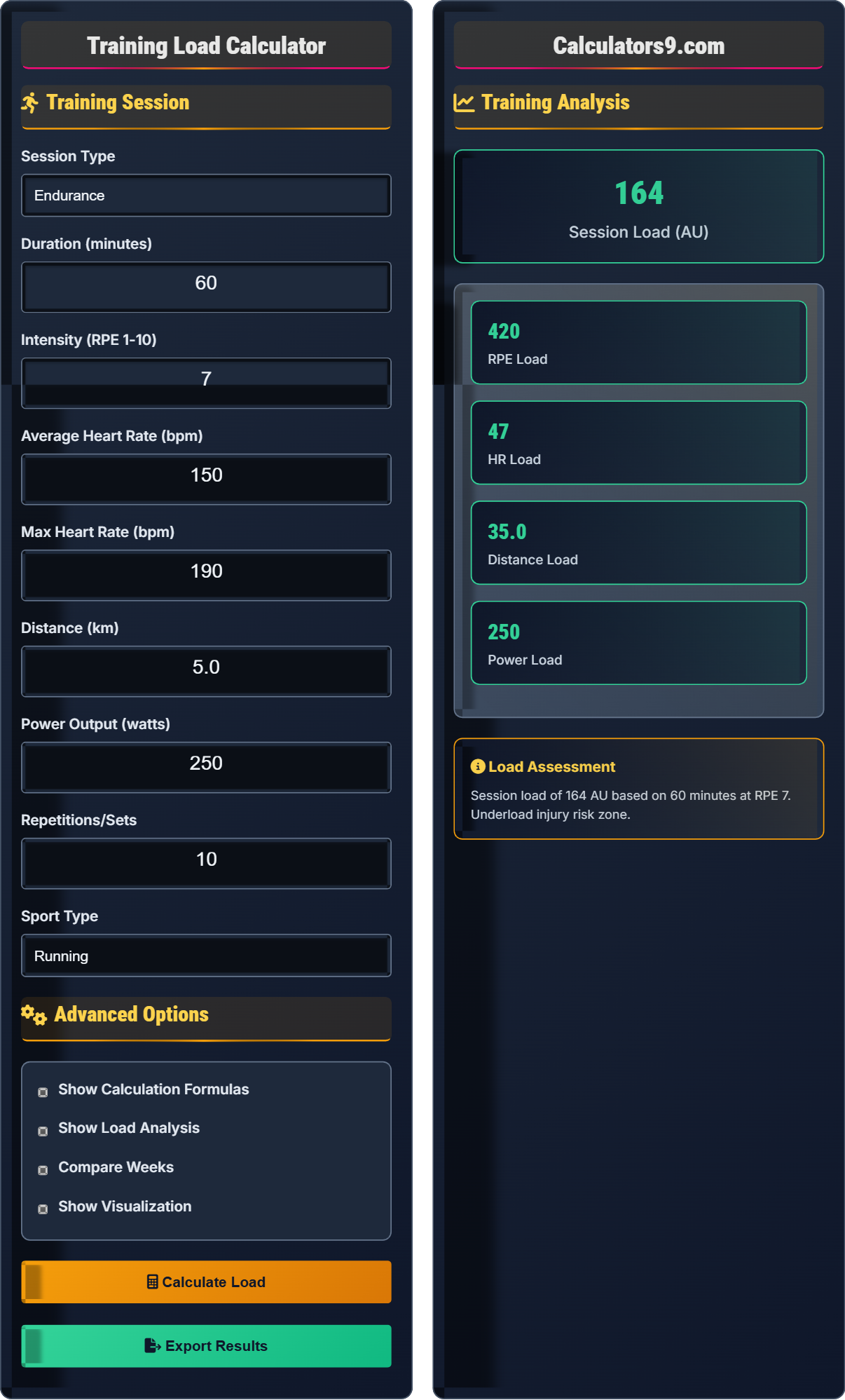
Example: 60-minute session at RPE 7:
\( Session\ Load = 7 \times 60 = 420\ AU \)
Example: Acute Load = 2000 AU, Chronic Load = 1500 AU:
\( ACWR = \frac{2000}{1500} = 1.33 \) (optimal zone)
Thus, the session load is 420 arbitrary units.
Training Session
Advanced Options
Training Analysis
| Metric | Value | Optimal | Status |
|---|
| Recovery Metric | Value | Recommendation | Timeframe |
|---|
Training Load Guide & Performance Tracking
Training load quantifies the physiological stress placed on an athlete during training. Common methods include RPE-based loads, heart rate monitoring, GPS tracking, and power measurements. The acute:chronic workload ratio (ACWR) is calculated as Acute Load (1 week) divided by Chronic Load (4 weeks) to assess injury risk.
The standard training load calculation formula is:
Where:
- \(TL\) = Training Load
- \(Volume\) = Training volume (time, distance, reps)
- \(Intensity\) = Training intensity (RPE, HR, Power)
For RPE: \(Session\ Load = RPE \times Duration\ (minutes)\)
For ACWR: \(ACWR = \frac{Acute\ Load}{Chronic\ Load}\)
ACWR (Acute:Chronic Workload Ratio) injury risk categories:
- Low Risk: ACWR 0.8-1.3 (Optimal training zone)
- Moderate Risk: ACWR 1.3-1.5 (Approaching danger zone)
- High Risk: ACWR >1.5 (Significantly increased injury risk)
- Underloading: ACWR <0.8 (Reduced fitness, potential injury)
- Gradual increases: Limit weekly load increases to 10% (10% rule)
- Monitor responses: Track subjective feelings and objective markers
- Periodize loads: Plan load cycles with recovery phases
- Individualize: Adjust based on athlete's tolerance and history
- Combine metrics: Use multiple load measures for accuracy
Training Load Basics
Quantitative measures of training stress and physiological demand.
\(TL = Volume \times Intensity\)
Where TL=Training Load, Volume=time/distance/reps, Intensity=RPE/HR/Power.
- ACWR 0.8-1.3 = Optimal
- ACWR >1.5 = High Risk
- 10% Rule = Weekly increase
Load Applications
Using load metrics to optimize training and prevent injury.
- RPE Load: Duration × RPE
- TRIMP: Duration × HR Intensity
- Power Load: Power × Duration
- Distance Load: Distance × Intensity
- Individual tolerance varies
- Combine multiple metrics
- Monitor recovery
- Adjust for competition
Training Load Quiz
According to research, what ACWR (Acute:Chronic Workload Ratio) range represents the optimal training zone with lowest injury risk?
The answer is B) 0.8-1.3. Research consistently shows that ACWR values between 0.8 and 1.3 represent the optimal training zone with the lowest injury risk. This is known as the "sweet spot" where athletes receive sufficient training stimulus while avoiding excessive load increases that lead to injury.
The ACWR formula \(\frac{Acute\ Load}{Chronic\ Load}\) measures the ratio between recent training load (acute, typically 1 week) and the athlete's chronic training load (typically 4 weeks). The 0.8-1.3 range indicates that the athlete is training within 80-130% of their chronic load, which research shows provides optimal adaptation while minimizing injury risk.
ACWR: Acute:Chronic Workload Ratio
Acute Load: Recent training load (1 week)
Chronic Load: Long-term training load (4 weeks)
• 0.8-1.3 = Optimal zone
• >1.5 = High injury risk
• <0.8 = Underloading risk
• Calculate weekly to monitor trends
• Combine with other metrics
• Individualize based on tolerance
• Confusing acute and chronic loads
• Not calculating weekly
• Using only one metric
Calculate the session load for a 45-minute training session with an RPE of 8. Show your work.
Using the RPE-based load formula: \(Session\ Load = RPE \times Duration\)
Step 1: Identify values
- RPE = 8
- Duration = 45 minutes
Step 2: Apply formula
\(Session\ Load = 8 \times 45 = 360\ AU\)
Therefore, the session load is 360 arbitrary units.
The RPE (Rate of Perceived Exertion) method is widely used because it's simple and accounts for internal load perception. The formula multiplies the subjective intensity rating by the duration, providing a quantifiable measure of training stress. This method is particularly useful when objective measures like heart rate are unavailable.
RPE: Rate of Perceived Exertion (1-10 scale)
Session Load: Total training stress for one sessionArbitrary Units: Relative measure of training load
• RPE scale: 1-10
• Duration in minutes
• Multiply, don't add
• Use immediately after session
• Consistent rating criteria
• Combine with objective measures
• Using different RPE scales
• Forgetting to multiply by duration
• Rating during session instead of after
An athlete's chronic load (4-week average) is 2000 arbitrary units. Their acute load (current week) is 2500 arbitrary units. Calculate their ACWR and determine their injury risk category.
Step 1: Apply the ACWR formula
\(ACWR = \frac{Acute\ Load}{Chronic\ Load}\)
\(ACWR = \frac{2500}{2000} = 1.25\)
Step 2: Determine injury risk category
ACWR = 1.25
Since 0.8 ≤ 1.25 ≤ 1.3, this falls in the optimal zone.
Therefore, the ACWR is 1.25, which represents optimal training load with low injury risk.
This calculation demonstrates how the ACWR identifies training load patterns. An ACWR of 1.25 indicates the athlete has increased their load by 25% compared to their chronic average, which is within the safe range for adaptation. This represents a moderate increase that should promote fitness gains while maintaining low injury risk.
Chronic Load: 4-week rolling average of training load
Acute Load: Current week's training load
Optimal Zone: ACWR range of 0.8-1.3
• Chronic = 4-week average
• Acute = 1-week load
• Optimal: 0.8-1.3
• Calculate weekly for monitoring
• Watch for >1.5 values
• Consider individual thresholds
• Inverting the fraction
• Using wrong time frames
• Not updating chronically
An athlete has a chronic load of 1800 AU. Using the 10% rule, what is the maximum safe acute load for the upcoming week? If they want to increase their load by 15%, what would their acute load be and what injury risk category would that fall into?
Part 1: Calculate maximum safe load using 10% rule
Maximum safe increase = Chronic Load × 1.10
Maximum safe load = 1800 × 1.10 = 1980 AU
Part 2: Calculate 15% increase
Load with 15% increase = 1800 × 1.15 = 2070 AU
Part 3: Calculate ACWR for 15% increase
ACWR = 2070 ÷ 1800 = 1.15
Since 0.8 ≤ 1.15 ≤ 1.3, this is still in the optimal zone, but closer to the upper limit.
Therefore, the maximum safe load is 1980 AU, and a 15% increase would result in 2070 AU with an ACWR of 1.15 (optimal zone).
The 10% rule is a guideline for safe training progression. It suggests that training load should not increase by more than 10% from one week to the next. This helps prevent sudden spikes that could lead to injury. However, increases within 15% may still be acceptable if they keep the ACWR in the optimal range.
10% Rule: Maximum weekly load increase recommendation
Training Progression: Gradual increase in training load
Safe Increase: Load increase that minimizes injury risk
• 10% rule for safe progression
• ACWR 0.8-1.3 = optimal
• Gradual increases prevent injury
• Calculate safe limits before planning
• Monitor ACWR weekly
• Individualize based on experience
• Ignoring the 10% rule
• Not considering individual tolerance
• Rapid load increases
Which of the following is NOT a primary benefit of training load monitoring?
The answer is C) Guaranteeing athletic success. While training load monitoring provides significant benefits in injury prevention, performance optimization, and tracking adaptations, it cannot guarantee athletic success. Success depends on multiple factors including genetics, coaching, psychology, nutrition, and other variables beyond training load.
Training load monitoring is a powerful tool for optimizing athletic development and reducing injury risk, but it's just one component of a comprehensive training program. Athletic success is multifactorial and influenced by many variables beyond measurable training loads. Monitoring helps optimize the training process but doesn't guarantee outcomes.
Training Load Monitoring: Systematic tracking of training stress
Performance Optimization: Maximizing training adaptations
Injury Prevention: Reducing injury risk through load management
• Load monitoring reduces injury risk
• Helps optimize performance
• Cannot guarantee success
• Use as part of comprehensive plan
• Combine with other metrics
• Individualize approach
• Over-relying on load metrics alone
• Expecting guaranteed results
• Not combining with other factors
FAQ
Q: How do I calculate TRIMP for heart rate-based training load?
A: TRIMP (Training Impulse) uses heart rate to calculate training load. The formula is:
\(TRIMP = \sum(Duration \times HR_{Intensity})\)
Where HR_intensity is calculated as: \(\%HRR^{1.67} \times 0.64 \times Duration\)
\(%HRR = \frac{HR_{avg} - HR_{rest}}{HR_{max} - HR_{rest}} \times 100\)
For example, with 60 min at 150 bpm, resting HR 60, max HR 190:
%HRR = \(\frac{150-60}{190-60} \times 100 = \frac{90}{130} \times 100 = 69.2\%\)
HR_intensity = \(0.692^{1.67} \times 0.64 \times 60 = 0.53 \times 0.64 \times 60 = 20.3\)
TRIMP = 20.3 (simplified calculation)
Q: What's the difference between internal and external training load measures?
A: Training loads are categorized as internal or external:
Internal Load: Physiological stress experienced by the athlete
- Heart rate
- RPE (Rate of Perceived Exertion)
- Blood lactate
- Cortisol levels
External Load: Physical work performed
- Distance covered
- Power output
- Speed metrics
- Training volume (sets/reps)
Both types of measures provide complementary information for comprehensive load monitoring. Internal measures reflect the body's response to training, while external measures quantify the work performed.