Permutation Calculator
Fast permutation analysis • 2026 edition
Permutation Formula:
Show the calculatorPermutation: \(P(n,r) = \frac{n!}{(n-r)!}\)
Combination: \(C(n,r) = \frac{n!}{r!(n-r)!}\)
Factorial: \(n! = n \times (n-1) \times (n-2) \times ... \times 1\)
Permutations count arrangements where order matters. For example, arranging 3 books from a collection of 5: P(5,3) = 5!/(5-3)! = 5!/2! = 60 possible arrangements. Combinations count selections where order doesn't matter: C(5,3) = 5!/(3!×2!) = 10 possible groups.
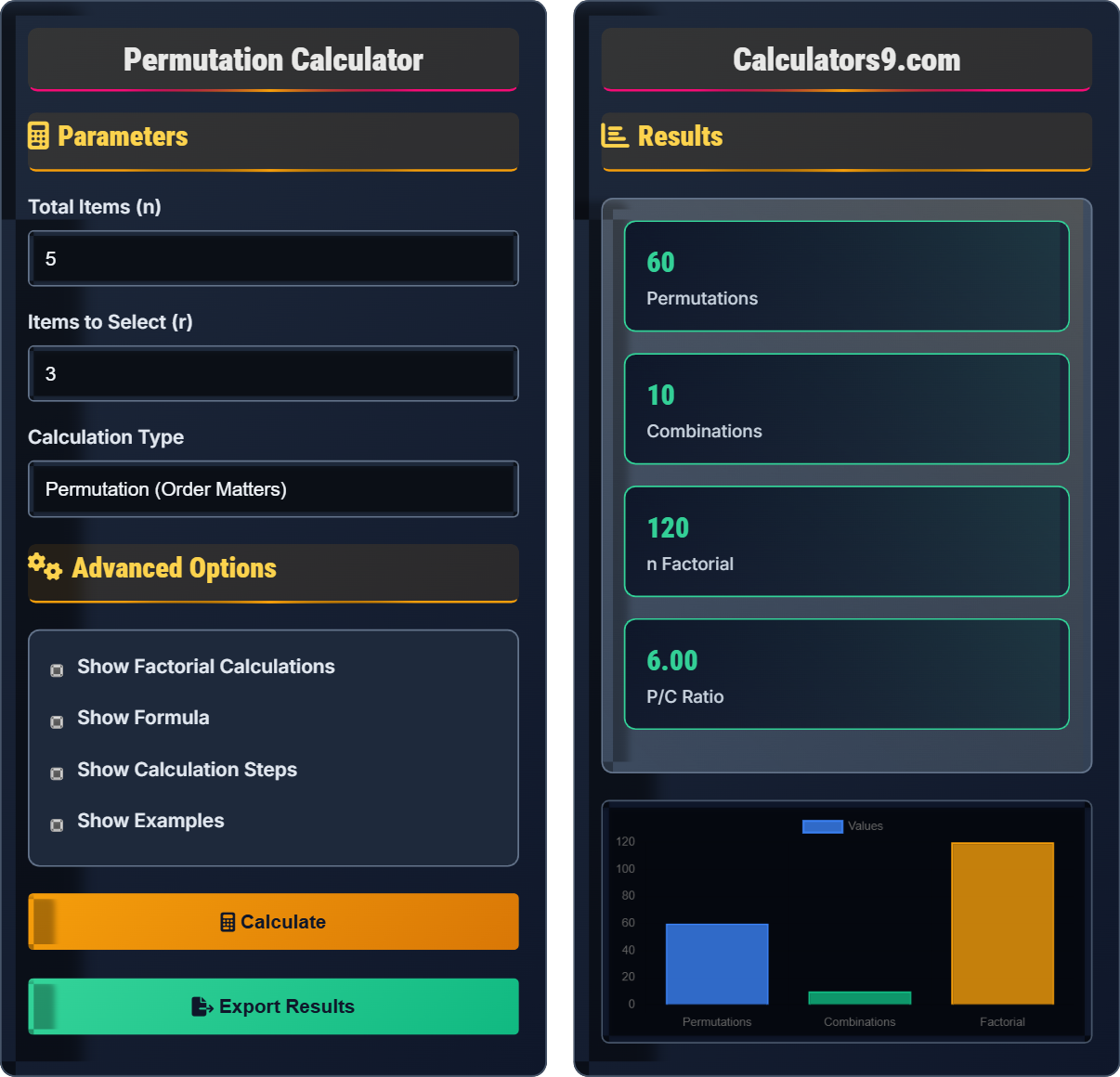
Example: For n=5 and r=3:
- Permutations: P(5,3) = 5!/(5-3)! = 120/2 = 60
- Combinations: C(5,3) = 5!/(3!×2!) = 120/(6×2) = 10
- Factorial: 5! = 5×4×3×2×1 = 120
These formulas are fundamental in probability theory and combinatorics.
Parameters
Advanced Options
Results
| Calculation | Result |
|---|---|
| Permutations P(n,r) | 60 |
| Combinations C(n,r) | 10 |
| Value | Result |
|---|---|
| n | 5 |
| r | 3 |
| n-r | 2 |
| r! | 6 |
Comprehensive Permutation Guide
Permutations are arrangements of objects where the order matters. For example, the arrangement of letters ABC is different from BAC, even though they contain the same letters. The number of permutations of n objects taken r at a time is given by the formula P(n,r) = n!/(n-r)!. Permutations are used in various applications including scheduling, password creation, and arranging items.
The permutation formula calculates the number of ways to arrange r objects selected from n distinct objects:
Permutation: \(P(n,r) = \frac{n!}{(n-r)!}\)
Combination: \(C(n,r) = \frac{n!}{r!(n-r)!}\)
Where:
- \(P(n,r)\) = number of permutations
- \(C(n,r)\) = number of combinations
- \(n\) = total number of objects
- \(r\) = number of objects to arrange/select
- \(n!\) = n factorial (n × (n-1) × ... × 1)
The key difference between permutations and combinations is whether order matters:
Factorial (denoted as n!) is the product of all positive integers less than or equal to n:
\(n! = n \times (n-1) \times (n-2) \times ... \times 2 \times 1\)
Special cases: 0! = 1 and 1! = 1
- Password Security: Calculating possible combinations
- Scheduling: Arranging meetings or events
- Cryptography: Creating secure encryption keys
- Game Theory: Calculating possible moves
Permutation Concepts
An arrangement of objects where order matters.
\(P(n,r) = \frac{n!}{(n-r)!}\)
Arrangements of r objects from n distinct objects.
- Order matters in permutations
- r cannot exceed n
- P(n,n) = n! (all objects arranged)
Advanced Concepts
This calculator assumes no repetition allowed.
\(n^r\)
- Objects can be reused
- First position: n choices
- Second position: n choices
- And so on for r positions
- Permutations > Combinations (when r > 1)
- Factorials grow very quickly
- Large values may cause overflow
Permutation Learning Quiz
How many ways can you arrange 3 letters from the set {A, B, C, D} if order matters?
The answer is C) 24. Since order matters, we use the permutation formula: P(n,r) = n!/(n-r)!, where n=4 (total letters) and r=3 (letters to arrange). So P(4,3) = 4!/(4-3)! = 4!/1! = 24/1 = 24. Some possible arrangements: ABC, ABD, ACB, ACD, ADB, ADC, BAC, BAD, BCA, BCD, BDA, BDC, CAB, CAD, CBA, CBD, CDA, CDB, DAB, DAC, DBA, DBC, DCA, DCB.
This problem demonstrates why order matters in permutations. ABC and BAC are considered different arrangements because the order of the letters is different. If order didn't matter, we would use combinations instead, which would give C(4,3) = 4 possible groups: {ABC}, {ABD}, {ACD}, {BCD}.
Permutation: An arrangement where order matters
Combination: A selection where order doesn't matter
Factorial: Product of all positive integers up to n
• Use permutation when order matters
• Use combination when order doesn't matter
• P(n,r) = C(n,r) × r!
• Remember: "Permutation" has "position" in it
• Think of arranging people in a line vs selecting team members
• Always check if repetition is allowed
• Confusing permutation with combination
• Forgetting that order matters in permutations
• Not considering whether repetition is allowed
A company has 8 employees and needs to select a president, vice-president, and secretary. How many different ways can these positions be filled if each person can hold only one position?
This is a permutation problem because the order matters (the president position is different from the vice-president position).
Step 1: Identify the values
Total employees (n) = 8
Positions to fill (r) = 3
Step 2: Apply the permutation formula
P(n,r) = n!/(n-r)!
P(8,3) = 8!/(8-3)! = 8!/5!
Step 3: Calculate factorials
8! = 8 × 7 × 6 × 5 × 4 × 3 × 2 × 1 = 40,320
5! = 5 × 4 × 3 × 2 × 1 = 120
Step 4: Complete the calculation
P(8,3) = 40,320/120 = 336
Alternative approach:
First position (president): 8 choices
Second position (vice-president): 7 choices (since one person already chosen)
Third position (secretary): 6 choices (since two people already chosen)
Total arrangements: 8 × 7 × 6 = 336
Final Answer: There are 336 different ways to fill the three positions.
This problem illustrates the practical application of permutations in organizational structures. The key insight is recognizing that each position is distinct, so order matters. The alternative approach (multiplying available choices at each step) often helps visualize the problem more intuitively.
Distinct positions: Different roles with unique responsibilities
Without replacement: Once chosen, a person cannot hold another position
Ordered arrangement: Position matters in the selection
• Each position is unique
• One person per position
• Order of assignment matters
• Look for keywords like "arrange", "order", "sequence"
• Consider if positions are distinct
• Draw out the process step by step
• Using combination instead of permutation
• Not accounting for decreasing choices
• Forgetting that one person can't hold multiple positions
FAQ
Q: What's the difference between permutation and combination?
A: The key difference is whether order matters:
Permutation: Order matters. For example, if you're arranging 3 books on a shelf from a collection of 5, the sequence matters (Book A first is different from Book A second). The formula is P(n,r) = n!/(n-r)!
Combination: Order doesn't matter. For example, if you're selecting 3 books from a collection of 5 to take on vacation, the order in which you select them doesn't matter - you still end up with the same 3 books. The formula is C(n,r) = n!/(r!(n-r)!)
Think of it this way: permutations are for arranging (where sequence counts), combinations are for selecting (where only the group matters).
For n=5 and r=3: P(5,3) = 60 while C(5,3) = 10. The permutation count is much higher because it considers all possible orderings of the same group.
Q: When would I use permutations with repetition allowed?
A: Permutations with repetition allowed use the formula n^r, where you can reuse objects. Here are common scenarios:
1. Password Creation: Creating a 4-digit PIN where digits can repeat (0000 to 9999). With n=10 digits and r=4 positions, there are 10^4 = 10,000 possibilities.
2. License Plates: If a license plate format has 3 letters followed by 3 digits, and repetition is allowed, there are 26^3 × 10^3 possibilities.
3. DNA Sequences: For a sequence of r nucleotides (A, T, G, C), with n=4 bases and repetition allowed, there are 4^r possibilities.
Without repetition (our calculator's default), the formula is P(n,r) = n!/(n-r)!. With repetition allowed, it's simply n^r. Note that with repetition, r can exceed n, which isn't possible in the no-repetition scenario.