CAPM Calculator
Expected return analysis tool • 2026 standards
CAPM Formula:
Show the calculator\( E(R_i) = R_f + \beta_i(E(R_m) - R_f) \)
\( \text{Expected Return} = \text{Risk-Free Rate} + \beta \times \text{Market Risk Premium} \)
Where:
- \( E(R_i) \) = Expected return on the investment
- \( R_f \) = Risk-free rate (return on riskless asset)
- \( \beta_i \) = Beta coefficient of the investment
- \( E(R_m) \) = Expected return on the market
- \( E(R_m) - R_f \) = Market risk premium
The Capital Asset Pricing Model (CAPM) describes the relationship between systematic risk and expected return for assets. It's used to determine a theoretically appropriate required rate of return of an asset, considering its risk compared to the market.
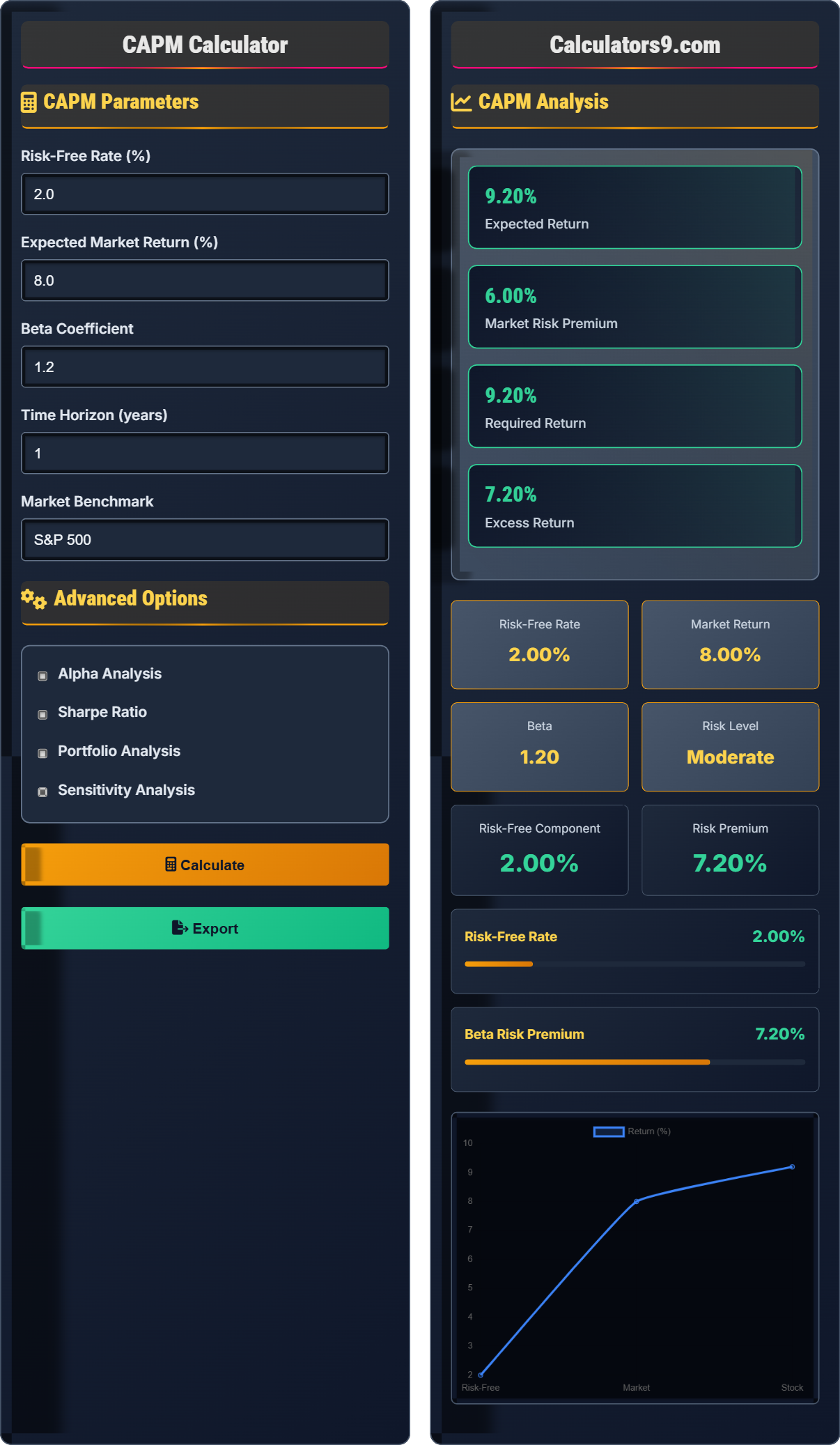
Example: If risk-free rate is 2%, market return is 8%, and stock beta is 1.2, then: Expected return = 2% + 1.2(8% - 2%) = 2% + 1.2(6%) = 2% + 7.2% = 9.2%.
CAPM Parameters
Advanced Options
CAPM Analysis
| Component | Value | Explanation |
|---|
| Analysis | Value | Significance |
|---|
| Scenario | Beta | Return |
|---|
CAPM Fundamentals
The Capital Asset Pricing Model (CAPM) is a financial model that describes the relationship between systematic risk and expected return for assets, particularly stocks. It provides a framework for determining the theoretically appropriate required rate of return of an asset, considering its risk compared to the market.
Where:
- \( \text{Risk-Free Rate} \) = Return on riskless asset (Treasury bonds)
- \( \beta \) = Systematic risk measure
- \( \text{Market Return} \) = Expected return on market portfolio
- Markets are efficient: All investors have access to same information
- Investors are rational: All investors make decisions based on available information
- Homogeneous expectations: All investors have same expectations
- No transaction costs: Trading costs are negligible
- Linear relationship: Risk-return relationship is linear
Risk and Return Analysis
Investment Decision Framework
- Accept Projects: When expected return > required return
- Reject Projects: When expected return < required return
- Indifferent: When expected return = required return
- Portfolio Construction: Use CAPM to balance risk and return
- Valuation: CAPM provides discount rate for DCF models
- Assumes perfect markets (not realistic)
- Only considers systematic risk (ignores firm-specific risk)
- Relies on historical data for future predictions
- Difficulty in defining "market portfolio"
- Empirical evidence mixed on effectiveness
CAPM Calculation Quiz
A stock has a beta of 1.5. The risk-free rate is 3% and the expected market return is 9%. What is the required rate of return according to CAPM?
The answer is B) 12.0%. Using the CAPM formula: Required Return = Risk-Free Rate + Beta × (Market Return - Risk-Free Rate) = 3% + 1.5 × (9% - 3%) = 3% + 1.5 × 6% = 3% + 9% = 12%.
CAPM decomposes required return into two components: the risk-free rate (compensation for time value of money) and the risk premium (compensation for systematic risk). The risk premium is calculated as beta multiplied by the market risk premium. In this example, the investor requires 3% for the time value of money and 9% for bearing systematic risk.
Risk-Free Rate: Return on an investment with zero systematic risk
Market Risk Premium: Excess return of market over risk-free rate
Beta: Sensitivity of asset returns to market returns
• Required Return = Risk-Free Rate + Beta × Market Risk Premium
• Market Risk Premium = Market Return - Risk-Free Rate
• Higher beta = higher required return
• Remember: Required Return = Risk-Free + Beta × (Market - Risk-Free)
• Beta multiplies the market risk premium, not the market return
• Always subtract risk-free rate from market return first
• Adding beta directly to market return instead of multiplying
An investment has a beta of 0.8, risk-free rate of 2%, and expected market return of 7%. If the actual expected return on this investment is 6.5%, should an investor pursue this investment according to CAPM? Calculate and explain your reasoning.
First, calculate the required return using CAPM: Required Return = 2% + 0.8 × (7% - 2%) = 2% + 0.8 × 5% = 2% + 4% = 6%. The actual expected return is 6.5%, which is higher than the required return of 6%. According to CAPM, the investment is undervalued and should be pursued.
Since the actual return (6.5%) exceeds the required return (6%), the investment offers positive alpha (excess return) of 0.5%. This means investors are being compensated more than required for the systematic risk they're taking.
This example demonstrates how CAPM guides investment decisions. When actual return exceeds required return, the investment has positive alpha, indicating it's generating more return than required for its level of systematic risk. Such investments are attractive because they provide excess compensation for risk taken.
Alpha: Excess return over required return (Actual - Required)
Undervalued: When actual return > required return
Overvalued: When actual return < required return
• Accept if Actual Return > Required Return
• Reject if Actual Return < Required Return
• Indifferent if Actual Return = Required Return
• Calculate required return first, then compare to actual
• Positive alpha indicates attractive investment
• CAPM helps determine fair compensation for risk
• Comparing returns without calculating required return first
• Ignoring systematic risk when making investment decisions
• Confusing total return with risk-adjusted return
Investment Q&A
Q: What is the risk-free rate in CAPM and how is it determined?
A: The risk-free rate in CAPM represents the theoretical return on an investment with zero risk. It's typically proxied by the yield on long-term government bonds (10-year Treasury in the US) or short-term Treasury bills.
The risk-free rate serves as the baseline return that investors require for deferring consumption. It compensates for the time value of money without any risk premium. In practice, the 10-year Treasury yield is commonly used as it matches the typical investment horizon for many projects.
Q: How does CAPM differ from other valuation models?
A: CAPM focuses exclusively on systematic (market) risk, unlike other models that may consider firm-specific risks. It assumes a linear relationship between risk and return, whereas models like Fama-French consider multiple risk factors.
CAPM is simpler than multifactor models but may be less accurate. It's widely used for its simplicity and theoretical foundation, but practitioners often supplement it with other models. CAPM provides the cost of equity for discounted cash flow models and helps determine required returns for investment projects.