Stock Profit Calculator
Investment analysis tool • 2026 standards
Stock Profit Formula:
Show the calculator\( \text{Profit/Loss} = (\text{Selling Price} - \text{Purchase Price}) \times \text{Shares} - \text{Fees} \)
\( \text{ROI} = \left( \frac{\text{Profit/Loss}}{\text{Total Investment}} \right) \times 100 \)
Where:
- \( \text{Purchase Price} \) = price per share when bought
- \( \text{Selling Price} \) = price per share when sold
- \( \text{Shares} \) = number of shares owned
- \( \text{Fees} \) = transaction costs and commissions
- \( \text{Total Investment} \) = Purchase Price × Shares + Fees
These formulas calculate the profit or loss from a stock investment and the return on investment (ROI). The calculation accounts for transaction fees which can significantly impact profitability, especially for smaller investments.
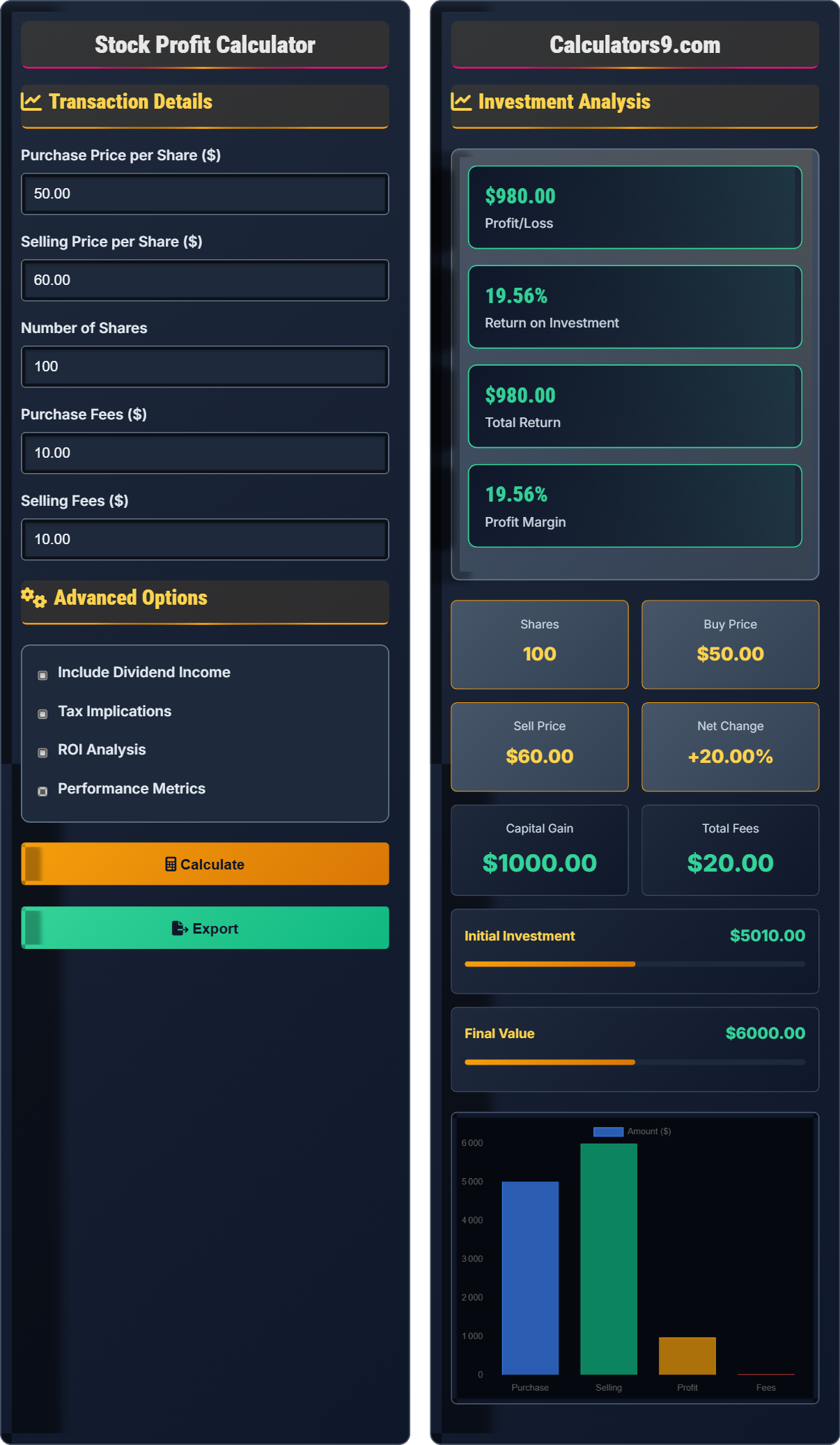
Example: Buying 100 shares at $50 each with $10 fees, selling at $60 with $10 fees: Profit = (60-50) × 100 - 20 = $980. ROI = (980/5010) × 100 = 19.56%.
Transaction Details
Advanced Options
Investment Analysis
| Item | Amount | Description |
|---|
| Return Type | Amount | Percentage |
|---|
| Tax Item | Amount | Rate |
|---|
Stock Profit Analysis Fundamentals
Stock profit is the financial gain realized when selling shares for more than the purchase price. It includes capital appreciation and any dividends received during the holding period. Understanding stock profit calculations is essential for evaluating investment performance and making informed trading decisions.
Where:
- \( \text{Gross Profit} \) = (Selling Price - Purchase Price) × Shares
- \( \text{Fees} \) = Purchase + Selling Transaction Costs
- \( \text{Taxes} \) = Capital Gains Tax on Profits
- Short-term: Holdings <1 year taxed as ordinary income (10-37%)
- Long-term: Holdings ≥1 year taxed at preferential rates (0-20%)
- Transaction Fees: Can significantly impact small trades
- Dividends: Qualified dividends taxed at preferential rates
- Wash Sale Rule: Cannot claim loss if repurchasing same stock within 30 days
Investment Performance Metrics
Investment Strategy Tips
- Fee Management: Use low-cost brokers to minimize transaction fees
- Tax Planning: Hold investments >1 year to qualify for lower long-term rates
- Dividend Reinvestment: Compound returns through DRIP programs
- Position Sizing: Avoid overconcentration in single positions
- Stop-Loss Orders: Limit potential losses with predetermined exit points
- Not accounting for transaction fees in profit calculations
- Ignoring tax implications of short-term trading
- Chasing performance without considering risk
- Emotional trading based on market news
- Not diversifying investment portfolio
Stock Profit Calculation Quiz
An investor buys 200 shares at $30 per share with a $15 commission. Later, they sell all shares at $35 per share with another $15 commission. What is the net profit?
The answer is A) $970. Calculation: Purchase cost = (200 × $30) + $15 = $6,015. Selling proceeds = (200 × $35) - $15 = $6,985. Net profit = $6,985 - $6,015 = $970. The commissions are subtracted from the selling proceeds and added to the purchase cost.
When calculating stock profits, commissions are part of the transaction costs. The purchase commission increases the total cost basis, while the selling commission decreases the total proceeds. Both commissions reduce the net profit. This is important because transaction fees can significantly impact profitability, especially for smaller trades.
Cost Basis: Total amount paid for an asset including fees
Proceeds: Total amount received from sale minus fees
Net Profit: Total gain after accounting for all costs
• Commissions increase cost basis on purchase
• Commissions decrease proceeds on sale
• Both commissions reduce net profit
• Always include transaction fees in profit calculations
• Consider fee-free brokers for frequent traders
• Calculate profit percentage to evaluate performance
• Forgetting to include transaction fees
An investor sells shares for a $5,000 profit. If the investment was held for 8 months, and the investor is in the 22% ordinary income tax bracket, calculate the tax liability. If held for 18 months instead, with long-term capital gains rate of 15%, what would the tax be? Show the tax advantage of the longer holding period.
Short-term holding (8 months): Tax = $5,000 × 22% = $1,100. Long-term holding (18 months): Tax = $5,000 × 15% = $750. Tax savings = $1,100 - $750 = $350. The investor saves $350 by holding for more than a year, representing a 31.8% reduction in tax liability.
This demonstrates the significant tax advantage of long-term investing. The preferential tax treatment for assets held over one year encourages patient investment strategies over frequent trading.
The U.S. tax code incentivizes long-term investing by taxing long-term capital gains at lower rates than short-term gains. Short-term gains (assets held ≤1 year) are taxed as ordinary income, while long-term gains (assets held >1 year) are taxed at preferential rates of 0%, 15%, or 20% depending on income level. This creates a substantial tax advantage for patient investors.
Short-term Capital Gains: Profits from assets held ≤1 year
Long-term Capital Gains: Profits from assets held >1 year
Ordinary Income Tax: Standard tax rate on regular income
• Short-term gains taxed as ordinary income (10-37%)
• Long-term gains taxed at preferential rates (0-20%)
• Holding period begins day after purchase
• Consider tax implications when planning trades
• Hold profitable positions >1 year when possible
• Harvest losses to offset gains for tax efficiency
• Not considering tax implications in trading decisions
• Frequent trading that triggers short-term rates
• Forgetting to report all transactions
Investment Q&A
Q: How do I calculate my return on investment for a stock that paid dividends?
A: To calculate ROI with dividends, add dividend income to capital gains. ROI = (Sale Proceeds + Dividends Received - Total Investment) / Total Investment × 100. For example, if you invested $1,000, received $50 in dividends, and sold for $1,100, your ROI would be (1,100 + 50 - 1,000) / 1,000 × 100 = 15%.
Dividends contribute to total return and should be included in performance calculations. Qualified dividends are also taxed at favorable rates if held for more than 60 days during the 121-day period beginning 60 days before the ex-dividend date.
Q: What's the difference between paper profit and realized profit?
A: Paper profit (unrealized profit) is the gain you would have if you sold your investment at current market prices, but you haven't actually sold it yet. Realized profit occurs when you sell the investment and lock in the gain. Paper profits can disappear with market fluctuations, while realized profits are locked in (though subject to taxes).
It's important to distinguish between the two because paper profits are not taxable until realized. Many investors make the mistake of treating paper profits as actual cash, which can lead to overconfidence in investment decisions.