Paycheck Tax Calculator
Take-home pay estimator • 2026 rates
Paycheck Tax Formula:
Show the calculator\( N = G - (F + S + O) \)
Where:
- \( N \) = Net pay (take-home pay)
- \( G \) = Gross pay
- \( F \) = Federal taxes
- \( S \) = State taxes
- \( O \) = Other deductions (Social Security, Medicare, etc.)
This formula calculates net pay by subtracting all taxes and deductions from gross pay.
Example: With gross pay of \( G = \$5{,}000 \), federal tax of \( F = \$750 \), state tax of \( S = \$250 \), and other deductions of \( O = \$400 \):
Net pay: \( N = 5{,}000 - (750 + 250 + 400) = \$3{,}600 \)
Thus, the employee takes home $3,600 from their $5,000 paycheck.
Income Information
Additional Deductions
Advanced Options
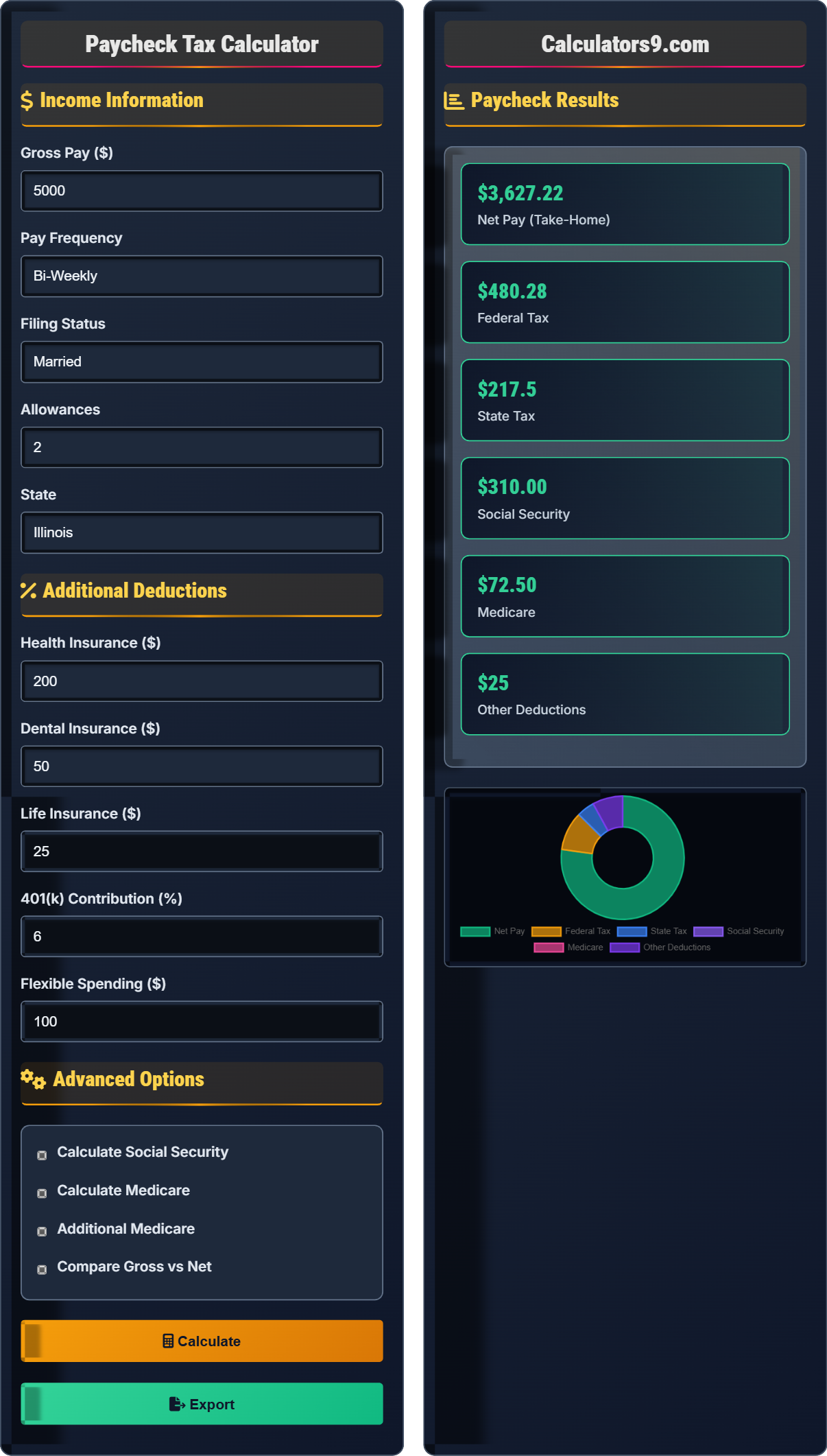
Paycheck Results
| Deduction Type | Amount | Percentage |
|---|---|---|
| Gross Pay | $5,000.00 | 100% |
| Federal Tax | $750.00 | 15% |
| State Tax | $250.00 | 5% |
| Social Security | $310.00 | 6.2% |
| Medicare | $72.50 | 1.45% |
| Health Insurance | $200.00 | 4% |
| 401(k) Contribution | $300.00 | 6% |
| Other Deductions | $117.50 | 2.35% |
| Net Pay | $3,600.00 | 72% |
| Scenario | Gross Pay | Taxes/Deductions | Net Pay |
|---|---|---|---|
| Current Paycheck | $5,000.00 | $1,400.00 | $3,600.00 |
| Without 401(k) | $5,000.00 | $1,100.00 | $3,900.00 |
| Without Health Insurance | $5,000.00 | $1,200.00 | $3,800.00 |
Comprehensive Paycheck Tax Guide
Paycheck tax withholding is the process where employers deduct taxes and other deductions from an employee's gross pay before issuing their paycheck. These deductions include federal income tax, state income tax, Social Security, Medicare, and other voluntary deductions like health insurance premiums.
The basic formula for calculating net pay:
Where:
- \(N\) = Net pay (take-home pay)
- \(G\) = Gross pay
- \(F\) = Federal income tax
- \(S\) = State income tax
- \(SS\) = Social Security tax
- \(M\) = Medicare tax
- \(O\) = Other deductions
Standard payroll tax rates:
- Social Security: 6.2% (employee) + 6.2% (employer) = 12.4% total
- Medicare: 1.45% (employee) + 1.45% (employer) = 2.9% total
- Additional Medicare: 0.9% on wages over $200,000 (employee only)
- Federal Income Tax: Varies by income bracket (10% to 37%)
- State Income Tax: Varies by state (0% to 13%+)
- Maximize 401(k) Contributions: Reduces taxable income and grows tax-deferred
- Utilize Flexible Spending Accounts: Pre-tax deductions for medical/dependent care
- Review W-4 Annually: Adjust allowances to match life changes
- Consider Tax-Loss Harvesting: Offset gains with losses in investment accounts
- Plan for Quarterly Payments: If self-employed or have significant non-wage income
Tax Basics
Deductions made from gross pay to cover taxes and other obligations.
\(N = G - (F + S + SS + M + O)\)
Where N=net pay, G=gross pay, F=federal tax, S=state tax, SS=Social Security, M=Medicare, O=other.
- Social Security tax applies up to wage base limit
- Additional Medicare tax applies above income threshold
- State tax rates vary by state
Strategies
Reduce taxable income through pre-tax deductions and strategic planning.
- Maximize 401(k) contributions
- Use FSA/HSA for medical expenses
- Adjust W-4 allowances appropriately
- Consider tax-loss harvesting
- Pre-tax deductions reduce taxable income
- Post-tax deductions don't affect tax liability
- Over-withholding gives interest-free loan to IRS
- Under-withholding may result in penalties
Paycheck Tax Learning Quiz
Which of the following statements about Social Security tax is TRUE?
The answer is B) Social Security tax rate is 6.2% on wages up to $168,600 (2026). The Social Security tax is 6.2% paid by the employee and 6.2% paid by the employer, for a total of 12.4%. However, the tax only applies to wages up to the wage base limit, which is $168,600 for 2026. Any wages earned above this limit are not subject to Social Security tax.
Understanding payroll tax limits is crucial for accurate financial planning. The Social Security tax has a wage base limit that changes annually based on inflation. This means that once an employee earns above the limit, they stop paying Social Security tax on additional income. This differs from Medicare tax, which has no wage base limit. The wage base limit helps ensure that higher earners don't pay disproportionately more into the system relative to benefits received.
Wage Base Limit: Maximum amount of earnings subject to Social Security tax
Payroll Taxes: Taxes withheld from employee paychecks for Social Security and Medicare
Employee/Employer Share: Both contribute equally to Social Security and Medicare taxes
• Social Security tax: 6.2% on wages up to $168,600 (2026)
• Employer matches employee contribution (6.2%)
• No Social Security tax on wages above the limit
• Remember "6.2% up to the limit" for Social Security
• Employer matches employee contributions
• Assuming Social Security tax applies to all income without limit
• Forgetting that employer also contributes matching amount
Jane earns $6,000 bi-weekly and has 2 allowances. She lives in Illinois (5% state tax rate). Calculate Jane's total federal and state tax deduction for one paycheck using the percentage method. Assume she's single with 2 allowances.
1. Calculate federal tax using percentage method:
• Allowance value for bi-weekly: $213.46
• Total allowance reduction: $213.46 × 2 = $426.92
• Taxable income: $6,000 - $426.92 = $5,573.08
• Apply tax brackets (2026): $5,573.08 falls in 12% bracket
• Federal tax: $110 + ($5,573.08 - $1,100) × 0.12 = $110 + $536.77 = $646.77
2. Calculate state tax: $6,000 × 0.05 = $300
3. Total tax deduction: $646.77 + $300 = $946.77
This problem demonstrates the complexity of payroll tax calculations using the percentage method. The allowance value changes based on pay frequency, which is why we use $213.46 for bi-weekly pay periods. The tax calculation follows the progressive tax bracket system where different portions of income are taxed at different rates. Understanding these calculations helps employees verify their pay stubs and plan their finances accurately.
Percentage Method: System for calculating withholding based on percentage brackets
Allowance Value: Dollar amount that represents each withholding allowance
Progressive Tax System: Higher income levels taxed at higher rates
• Allowance values vary by pay frequency
• Tax brackets apply progressively to different income portions
• State tax rates vary by state
• Know your pay frequency's allowance value
• Understand progressive tax brackets
• Using wrong allowance value for pay frequency
• Applying flat tax rate instead of progressive brackets
FAQ
Q: Why is my take-home pay less than expected even with low tax rates?
A: Several factors beyond income tax affect your take-home pay. Payroll taxes include Social Security (6.2%) and Medicare (1.45%), which are mandatory regardless of your tax bracket. Additionally, state income tax, local taxes, and pre-tax deductions like health insurance, 401(k) contributions, and flexible spending accounts all reduce your gross pay.
Mathematically, your net pay calculation is:
\(Net = Gross - (Fed\_Tax + State\_Tax + SS + Med + Other\_Deductions)\)
Even with a low federal tax rate of 10%, the combination of mandatory payroll taxes (7.65%) and other deductions can significantly impact your take-home pay. For example, on a $5,000 gross paycheck, you might lose $382.50 to payroll taxes alone (6.2% + 1.45% = 7.65%), regardless of your income tax rate.
Q: How does increasing my 401(k) contribution affect my taxes?
A: Increasing your 401(k) contribution reduces your taxable income for both federal and state income taxes (in most states). This creates a "double benefit" - you save on current taxes and build retirement savings.
For example, if you earn $5,000 bi-weekly and increase your 401(k) contribution from 3% to 6%:
Original 401(k): $5,000 × 0.03 = $150 (taxable income: $4,850)
New 401(k): $5,000 × 0.06 = $300 (taxable income: $4,700)
Using a 22% combined federal and state tax rate, the additional $150 contribution saves you $33 in taxes ($150 × 0.22). So your after-tax cost for the additional $150 contribution is only $117 ($150 - $33).