Property Tax Calculator
Real estate tax estimator • 2026 rates
Property Tax Formula:
Show the calculator\( PT = (AV \times AR) \times TR \)
Where:
- \( PT \) = Property tax
- \( AV \) = Assessed value
- \( AR \) = Assessment ratio
- \( TR \) = Tax rate
This formula calculates property tax by multiplying the assessed value by the assessment ratio and tax rate.
Example: With an assessed value of \( AV = \$300{,}000 \), assessment ratio of \( AR = 0.85 \), and tax rate of \( TR = 0.012 \):
Property tax: \( PT = (300{,}000 \times 0.85) \times 0.012 = 255{,}000 \times 0.012 = \$3{,}060 \)
Thus, the property owner pays $3,060 in annual property taxes.
Property Information
Exemptions & Credits
Advanced Options
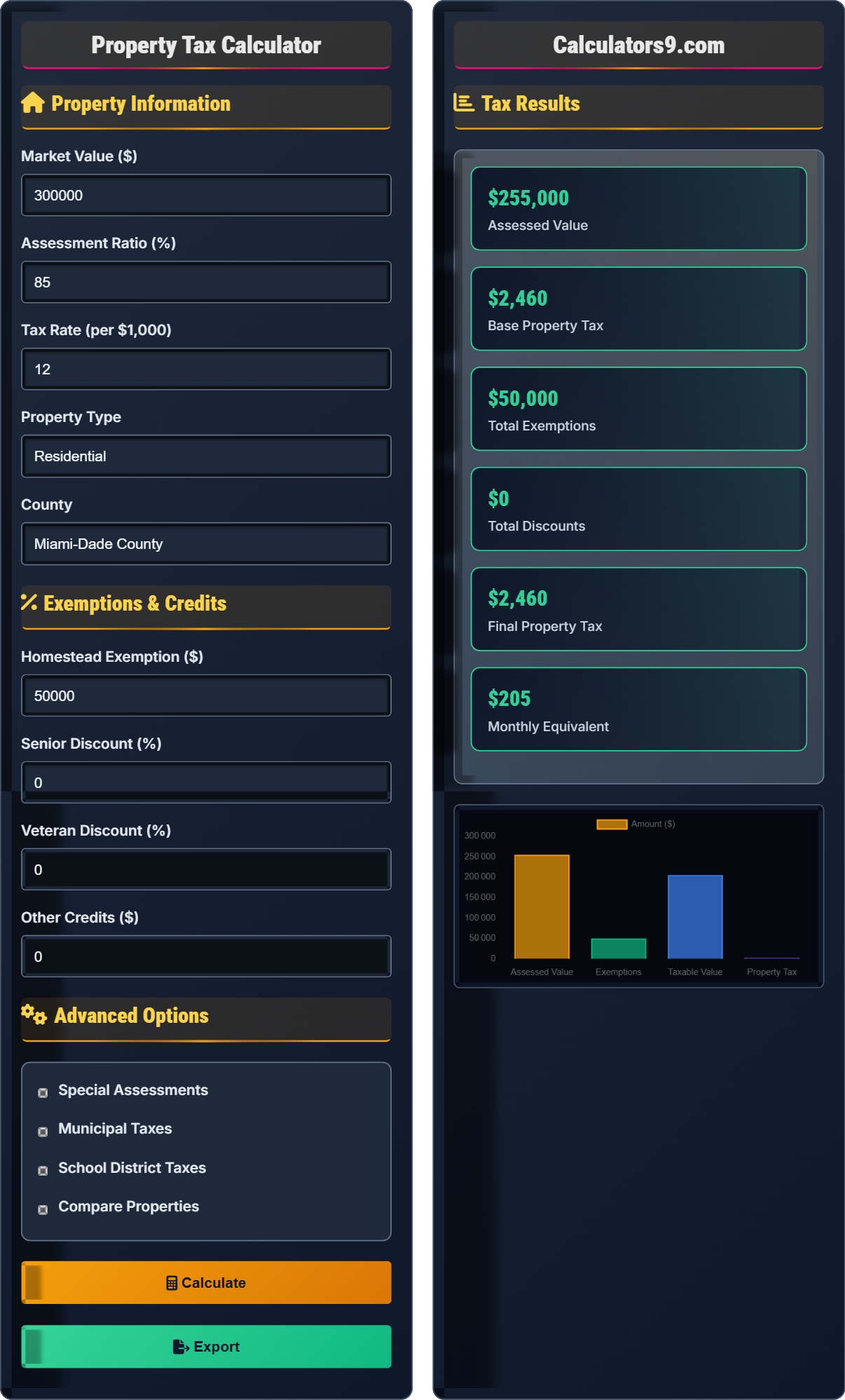
Tax Results
| Calculation Component | Amount |
|---|---|
| Market Value | $300,000.00 |
| Assessment Ratio | 85% |
| Assessed Value | $255,000.00 |
| Homestead Exemption | -$50,000.00 |
| Taxable Value | $205,000.00 |
| Tax Rate | 1.2% |
| Base Property Tax | $2,460.00 |
| Special Assessments | $500.00 |
| Final Property Tax | $2,960.00 |
| Property | Market Value | Tax Rate | Annual Tax |
|---|---|---|---|
| Current Property | $300,000.00 | 1.2% | $2,560.00 |
| Similar Property ($350K) | $350,000.00 | 1.2% | $2,960.00 |
| High-Tax Area ($300K) | $300,000.00 | 2.5% | $5,250.00 |
Comprehensive Property Tax Guide
Property tax is a tax levied on real estate by local governments based on the assessed value of the property. It's typically the largest source of revenue for local governments and funds schools, roads, public safety, and other municipal services. Property taxes are usually paid annually or semi-annually.
The basic formula for calculating property tax:
Where:
- \(PT\) = Property tax
- \(AV\) = Assessed value
- \(AR\) = Assessment ratio
- \(TR\) = Tax rate
Popular exemptions that can reduce property tax bills:
- Homestead Exemption: Reduces taxable value for primary residences
- Senior Discount: Additional discount for qualifying seniors
- Veteran Exemption: For qualifying military veterans
- Disability Exemption: For qualifying disabled individuals
- Farmland Exemption: Lower rates for agricultural land
- Appeal Assessments: Challenge high valuations during appeal periods
- Maximize Exemptions: Apply for all available exemptions
- Timing Improvements: Avoid major improvements before assessment dates
- Compare Properties: Research similar properties' assessments
- Consider Appeals: File appeals if assessment seems unfair
Tax Basics
Tax on real estate based on assessed value to fund local services.
\(PT = (AV \times AR) \times TR\)
Where PT=property tax, AV=assessed value, AR=assessment ratio, TR=tax rate.
- Assessment ratios vary by jurisdiction
- Homestead exemptions reduce taxable value
- Seniors/disabled may qualify for discounts
Strategies
Reduce property tax through exemptions, appeals, and strategic planning.
- Apply for all applicable exemptions
- Appeal assessments if too high
- Research comparable properties
- Time improvements strategically
- Appeal deadlines are strict
- Documentation is required for exemptions
- Assessment appeals can take time
- Property tax rates vary significantly by location
Property Tax Learning Quiz
Which of the following best describes the relationship between market value and assessed value?
The answer is B) Assessed value equals market value multiplied by assessment ratio. The assessment ratio is a percentage set by local jurisdictions that determines what portion of the market value will be used for tax purposes. For example, if a property has a market value of $300,000 and the assessment ratio is 85%, the assessed value would be $300,000 × 0.85 = $255,000.
Understanding the relationship between market value, assessment ratio, and assessed value is crucial for property tax calculations. The assessment ratio varies by jurisdiction and property type. Some areas use 100% assessment (assessed value equals market value), while others use lower ratios like 85% or 50%. This ratio is applied to ensure fairness and consistency in the tax system across different property types and neighborhoods.
Market Value: Estimated fair market price of the property
Assessment Ratio: Percentage of market value used for taxation
Assessed Value: Value used to calculate property tax
• Assessed value = Market value × Assessment ratio
• Assessment ratios vary by location and property type
• Some jurisdictions use 100% assessment
• Remember: Assessed value is often less than market value
• Check your local jurisdiction's assessment ratio
• Confusing market value with assessed value
• Forgetting to apply the assessment ratio
A homeowner in Miami-Dade County has a property with a market value of $450,000. The assessment ratio is 85%, and the tax rate is $15 per $1,000 of assessed value. The property qualifies for a $50,000 homestead exemption and a 10% senior discount on the remaining tax. Calculate the final property tax.
1. Calculate assessed value: $450,000 × 0.85 = $382,500
2. Apply homestead exemption: $382,500 - $50,000 = $332,500
3. Calculate base tax: $332,500 × (15/1000) = $332,500 × 0.015 = $4,987.50
4. Apply senior discount: $4,987.50 × 0.10 = $498.75
5. Final tax: $4,987.50 - $498.75 = $4,488.75
This problem demonstrates the multi-step nature of property tax calculations. First, the assessed value is calculated from market value and assessment ratio. Then, exemptions are subtracted to determine the taxable value. The tax rate is applied to the taxable value to get the base tax. Finally, discounts are applied to the tax amount. Each step builds upon the previous calculation, showing how multiple factors affect the final tax bill.
Homestead Exemption: Reduction in taxable value for primary residence
Senior Discount: Percentage reduction in tax for qualifying seniors
Tax Rate: Amount charged per $1,000 of assessed value
• Exemptions reduce taxable value, not tax amount
• Discounts are applied to the calculated tax
• Tax rates are often expressed per $1,000
• Convert tax rate to decimal: $15 per $1,000 = 0.015
• Apply exemptions before calculating tax
• Applying discounts to taxable value instead of tax amount
• Forgetting to convert tax rate to decimal form
FAQ
Q: How can I lower my property tax bill?
A: There are several ways to potentially reduce your property tax bill. The mathematical approach involves understanding the property tax formula: \(PT = (AV \times AR) \times TR\). You can reduce any of these components:
1. Challenge Assessment: Appeal if you believe your assessed value is too high. Gather evidence of comparable properties selling for less.
2. Maximize Exemptions: Apply for all available exemptions (homestead, senior, veteran, disability, etc.). For example, a $50,000 homestead exemption on a property with a 1.2% tax rate saves $600 annually ($50,000 × 0.012).
3. Qualify for Discounts: Many jurisdictions offer senior, disabled, or veteran discounts. A 10% discount on a $3,000 tax bill saves $300 per year.
4. Strategic Timing: Avoid major improvements before assessment dates, as they may increase your assessed value.
Q: What's the difference between assessment ratio and tax rate?
A: The assessment ratio and tax rate serve different functions in property tax calculations. The assessment ratio determines what portion of the market value is used for taxation, while the tax rate determines how much tax is charged per unit of assessed value.
Mathematically: \(Assessed\_Value = Market\_Value \times Assessment\_Ratio\)
Then: \(Property\_Tax = Assessed\_Value \times Tax\_Rate\)
For example, if a property has a market value of $300,000, an assessment ratio of 85%, and a tax rate of $12 per $1,000:
Assessed Value = $300,000 × 0.85 = $255,000
Property Tax = $255,000 × (12/1000) = $3,060
The assessment ratio is set by local law and affects the base value, while the tax rate is set by various taxing authorities (county, city, school district) and determines the actual tax amount.