Tax Refund Estimator
Tax savings calculator • 2026 rates
Tax Refund Formula:
Show the calculator\( R = (T - C) - (W + P) \)
Where:
- \( R \) = Refund amount (or additional tax due)
- \( T \) = Total tax liability
- \( C \) = Total credits
- \( W \) = Withheld taxes
- \( P \) = Estimated tax payments
This formula calculates your tax refund by subtracting taxes paid from taxes owed (plus credits).
Example: With total tax liability of \( T = \$15{,}000 \), total credits of \( C = \$2{,}000 \), withholdings of \( W = \$14{,}000 \), and estimated payments of \( P = \$500 \):
Refund: \( R = (15{,}000 - 2{,}000) - (14{,}000 + 500) = 13{,}000 - 14{,}500 = -\$1{,}500 \)
Since the result is negative, the taxpayer would owe $1,500 when filing.
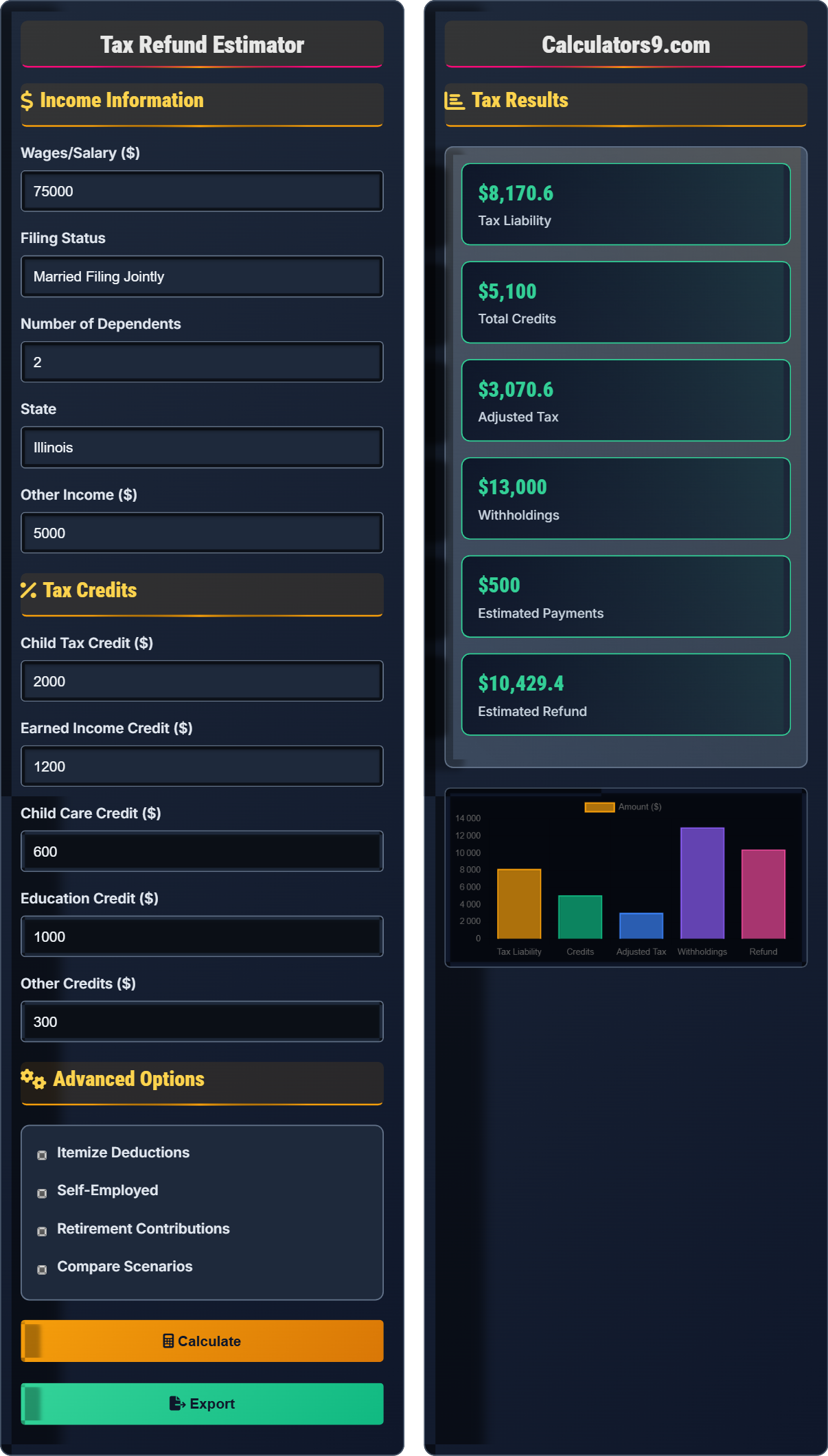
Income Information
Tax Credits
Advanced Options
Tax Results
| Component | Amount |
|---|---|
| Gross Income | $80,000.00 |
| Standard Deduction | -$29,200.00 |
| Personal Exemptions | -$0.00 |
| Taxable Income | $50,800.00 |
| Federal Tax | $6,100.00 |
| State Tax | $2,500.00 |
| Self-Employment Tax | $0.00 |
| Total Tax Liability | $8,600.00 |
| Total Credits | -$5,100.00 |
| Adjusted Tax | $3,500.00 |
| Scenario | Tax Liability | Credits | Refund |
|---|---|---|---|
| Current Plan | $12,500.00 | $5,100.00 | $5,100.00 |
| + Additional $2K Retirement | $11,500.00 | $5,100.00 | $6,100.00 |
| + More Child Care ($1K) | $12,500.00 | $6,100.00 | $6,100.00 |
Comprehensive Tax Refund Guide
A tax refund occurs when the total amount of taxes paid through withholdings and estimated payments exceeds the actual tax liability calculated on your tax return. The IRS returns the excess amount to the taxpayer. Conversely, if taxes paid are less than the liability, the taxpayer owes additional tax.
The basic formula for calculating tax refund or additional tax due:
Where:
- \(R\) = Refund amount (or additional tax due)
- \(T\) = Total tax liability
- \(C\) = Total credits
- \(W\) = Withholdings
- \(P\) = Estimated tax payments
Valuable credits that directly reduce tax liability:
- Child Tax Credit: Up to $2,000 per qualifying child
- Earned Income Credit: For low-to-moderate income workers
- Child Care Credit: For dependent care expenses
- American Opportunity Credit: For education expenses
- Child Tax Credit: Up to $2,000 per qualifying child under 17
- Maximize Credits: Focus on credits rather than just deductions
- Plan Quarterly Payments: Adjust estimated payments to optimize refunds
- Time Deductions: Bunch deductions in alternating years
- Contribute to Retirement: Reduce taxable income with pre-tax contributions
- Track Expenses: Document all potential credits and deductions
Tax Basics
Excess tax paid returned by IRS when withholdings exceed tax liability.
\(R = (T - C) - (W + P)\)
Where R=refund, T=tax liability, C=credits, W=withholdings, P=payments.
- Credits are more valuable than deductions
- Child Tax Credit is partially refundable
- Earned Income Credit is fully refundable
Strategies
Maximize credits and plan withholdings to optimize refunds.
- Maximize available tax credits
- Adjust withholding to match actual liability
- Contribute to retirement accounts
- Track all deductible expenses
- Large refunds mean interest-free loan to IRS
- Underpayment penalties may apply
- Credit eligibility requirements vary
- Documentation is required for all claims
Tax Refund Learning Quiz
What is the key difference between a tax credit and a tax deduction?
The answer is B) Credits reduce tax liability dollar-for-dollar, while deductions reduce taxable income. This is a fundamental concept in tax planning. A $1,000 tax credit reduces your tax bill by exactly $1,000, regardless of your tax bracket. However, a $1,000 deduction only reduces your tax bill by your marginal tax rate times $1,000. For someone in the 22% tax bracket, a $1,000 deduction only saves $220 in taxes.
Understanding the difference between credits and deductions is crucial for effective tax planning. Credits provide a direct reduction in tax liability, making them inherently more valuable than deductions. The value of a deduction depends on the taxpayer's marginal tax rate, while the value of a credit is always equal to its face amount. This is why tax planners prioritize finding credits over deductions when possible.
Tax Credit: Direct reduction in tax liability dollar-for-dollar
Tax Deduction: Reduction in taxable income that saves tax at the marginal rate
Marginal Tax Rate: Rate at which the last dollar of income is taxed
• Credits are worth face value regardless of tax bracket
• Deductions save tax equal to deduction amount × marginal rate
• Credits are more valuable than deductions
• Remember: Credits = direct tax reduction
• Deductions = indirect tax savings through income reduction
• Assuming all tax benefits are equally valuable
• Not distinguishing between credits and deductions
John and Mary are married filing jointly with $80,000 in wages. They have 2 children under 17, contributing $6,000 to a 401(k). Their standard deduction is $29,200, and they qualify for a $4,000 Child Tax Credit. If their employer withheld $12,000 in federal taxes, calculate their expected refund.
1. Calculate taxable income: $80,000 - $29,200 = $50,800
2. Calculate tax liability: $50,800 falls in 12% bracket for MFJ: $2,163 + ($50,800 - $22,000) × 0.12 = $2,163 + $3,456 = $5,619
3. Apply Child Tax Credit: $5,619 - $4,000 = $1,619 (adjusted tax)
4. Calculate refund: $12,000 (withholdings) - $1,619 (adjusted tax) = $10,381
John and Mary can expect a refund of $10,381.
This problem demonstrates the multi-step process of tax calculation. First, we determine taxable income by subtracting the standard deduction from gross income. Then we calculate the tax liability using the appropriate tax brackets. Next, we apply credits to reduce the tax liability. Finally, we compare the adjusted tax liability to the amount withheld to determine the refund. Each step builds upon the previous calculation, showing how multiple factors affect the final tax outcome.
Standard Deduction: Fixed amount that reduces taxable income
Tax Bracket: Rate at which income in that range is taxedChild Tax Credit: Credit for each qualifying child under 17
• Tax brackets apply progressively to different income portions
• Credits reduce tax liability directly
• Withholdings are credited against tax liability
• Know your filing status and corresponding brackets
• Track all withholdings throughout the year
• Applying flat tax rate instead of progressive brackets
• Confusing credits with deductions
FAQ
Q: Is it better to get a large tax refund or owe a small amount?
A: From a pure financial perspective, owing a small amount is generally better than receiving a large refund. When you receive a large refund, you've essentially given the IRS an interest-free loan throughout the year. The optimal situation is to have withholdings closely match your actual tax liability.
Mathematically, if you receive a $3,000 refund, you've effectively lent the government $3,000 interest-free for up to a year. If you had invested that money at 3% annual return, you'd have earned $90. The formula for opportunity cost is:
\(Opportunity\_Cost = Refund\_Amount \times Investment\_Return \times Time\_Factor\)
However, psychologically, some people prefer refunds as forced savings. The key is finding the right balance for your financial situation and risk tolerance.
Q: How do tax credits differ from tax deductions in terms of value?
A: Tax credits and deductions have fundamentally different values. A tax credit provides a dollar-for-dollar reduction in tax liability, while a tax deduction reduces taxable income by the amount of the deduction multiplied by the taxpayer's marginal tax rate.
Mathematically:
Value of Credit = Credit Amount
Value of Deduction = Deduction Amount × Marginal Tax Rate
For example, a $1,000 tax credit saves exactly $1,000 in taxes. However, a $1,000 deduction for someone in the 22% tax bracket only saves $220 in taxes ($1,000 × 0.22). This is why tax credits are considered more valuable than deductions. The Child Tax Credit ($2,000) is worth significantly more than a $2,000 deduction, which would only save $440 in taxes at the 22% bracket.