Rent Calculator
Fast budget calculator • 2026 rates
Rent Affordability Formula:
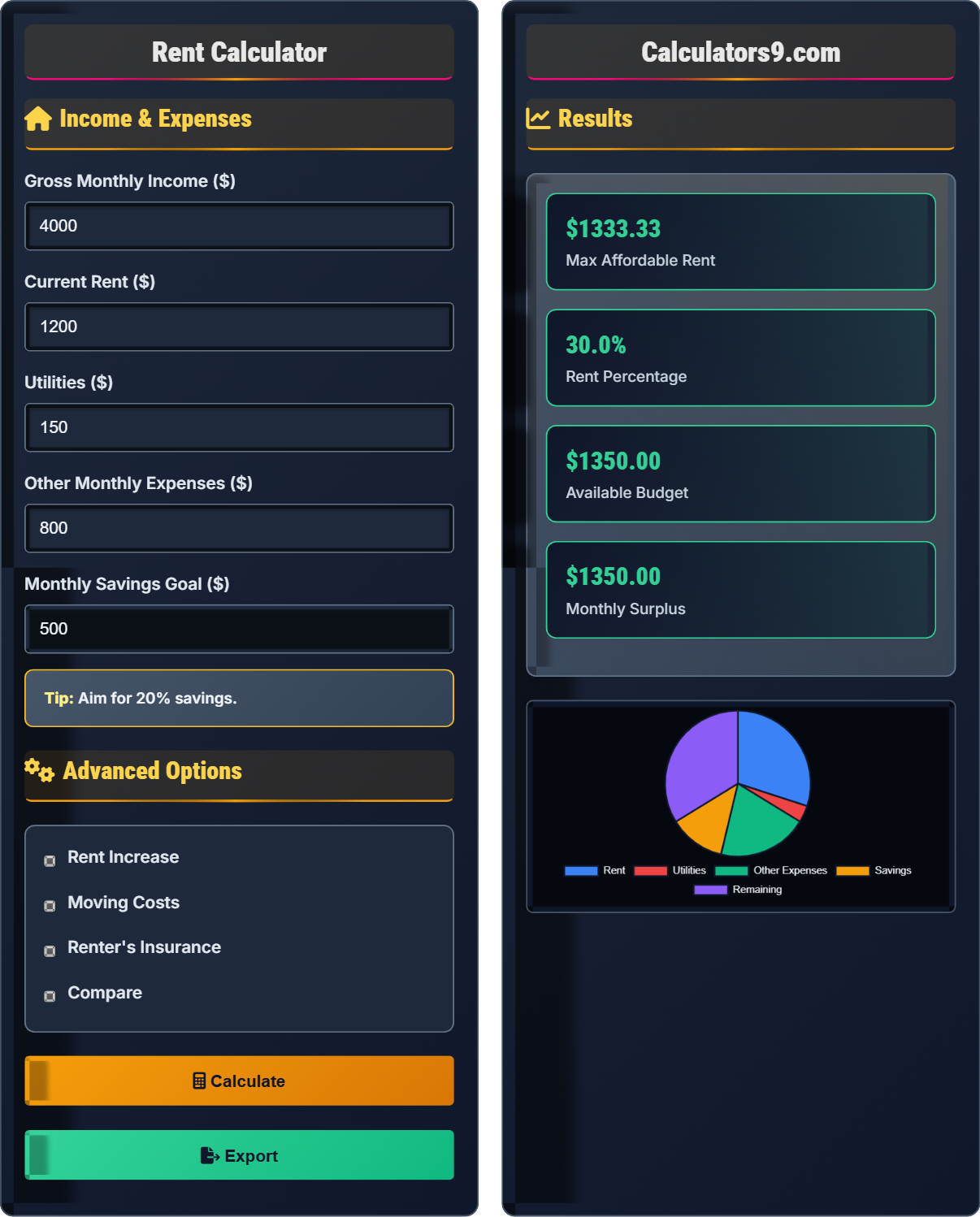
Show the calculator\( R = \frac{I}{3} \)
Where:
- \( R \) = Maximum affordable rent
- \( I \) = Gross monthly income
This formula calculates the maximum rent amount you can afford based on the common 30% rule, which suggests that housing costs should not exceed 30% of your gross monthly income.
Example: For a monthly income of \( I = \$4{,}000 \):
Maximum affordable rent: \( R = \frac{4{,}000}{3} \approx \$1{,}333 \)
Thus, the renter should aim to spend no more than $1,333 per month on rent.
Income & Expenses
Advanced Options
Results
| Category | Amount | Percentage | Status |
|---|
| Category | Monthly | Yearly | Percentage |
|---|
Comprehensive Rent Guide
Rent is the periodic payment made by a tenant to a landlord for the use of property, typically residential space. The rent amount is agreed upon in a lease contract and usually paid monthly. Rent can include various costs such as utilities, parking, or amenities depending on the lease agreement.
The standard rent affordability calculation uses the following formula:
Where:
- \(R\) = Maximum affordable rent
- \(I\) = Gross monthly income
Your monthly rental budget typically includes:
- Rent: The primary monthly payment for housing
- Utilities: Electricity, gas, water, internet, and other services
- Renter's Insurance: Protection for personal belongings and liability
- Moving Costs: Initial expenses including security deposits
- Maintenance: Minor repairs and cleaning supplies
- 30% Rule: Spend no more than 30% of gross income on housing
- 50/30/20 Rule: 50% needs, 30% wants, 20% savings
- Negotiate: Ask about discounts for longer leases or referrals
- Location: Consider commuting costs when evaluating rent
- Utilities Included: Factor in whether utilities are included
Rent Basics
Payment for temporary use of property.
\(R = \frac{I}{3}\)
Where R=max affordable rent, I=gross monthly income.
- Housing costs shouldn't exceed 30% of income
- Consider all associated costs, not just rent
- Factor in future income changes
Strategies
30% for housing, 20% for savings, 50% for other expenses.
- Find roommates
- Look for utility-included options
- Choose longer-term leases
- Research neighborhoods thoroughly
- Security deposits
- First month's rent
- Transportation costs
- Future rent increases
Rent Learning Quiz
Which of the following is typically NOT included in a basic rent payment?
The answer is B) Electricity. While some rental agreements include utilities, electricity is often not included in basic rent payments. Basic rent typically covers only the use of the living space itself, while utilities like electricity, internet, and sometimes water need to be paid separately.
Understanding what's included in rent is crucial for budget planning. The rent amount varies significantly depending on whether utilities are included. Some landlords offer "all-inclusive" rent packages, but these are less common. Always clarify what utilities are covered in your lease agreement to avoid unexpected expenses.
Base Rent: The fundamental amount paid for the right to occupy the property
Utilities: Essential services like electricity, water, gas, and internet
All-Inclusive Rent: Rent that includes utilities and other services
• Always verify what utilities are included in rent
• Electricity is commonly excluded from base rent
• Water and heat may be included in some properties
• Request a detailed breakdown of all costs before signing
• Compare total monthly costs (rent + utilities) across properties
• Estimate utility costs if not included
• Assuming utilities are always included in rent
• Not budgeting for utilities separately
• Forgetting seasonal variations in utility costs
Calculate the maximum affordable rent for someone earning $4,500 per month using the 30% rule. Show your work.
Using the rent affordability formula: \(R = \frac{I}{3}\)
Given:
- I = $4,500 (gross monthly income)
Step 1: Apply the 30% rule (which is equivalent to dividing by 3.33, but we'll use the simplified 1/3 formula)
Step 2: Calculate R = $4,500 ÷ 3 = $1,500
Alternatively, using the 30% rule directly: R = $4,500 × 0.30 = $1,350
Therefore, the maximum affordable rent is $1,350 per month.
The 30% rule is a widely accepted guideline for housing affordability. It ensures that renters maintain enough income for other necessities and savings. The simplified 1/3 formula is easier to calculate mentally, though it's slightly more conservative than the exact 30% rule. Both approaches help prevent housing from consuming too large a portion of income.
30% Rule: Housing costs should not exceed 30% of gross monthly income
Gross Income: Total income before taxes and deductions
Disposable Income: Income available after essential expenses
• Housing costs should not exceed 30% of gross income
• Use 1/3 for quick mental calculations
• For precise planning, use 30% of gross income
• Adjust the percentage based on your other financial obligations
• Confusing net and gross income when calculating affordability
• Forgetting to include utilities in the housing cost calculation
• Not accounting for future income changes
Sarah earns $5,000 per month and wants to follow the 30% rule. She finds an apartment with $1,400 rent and $200 utilities. Does this fit within her budget? Calculate the percentage of income spent on housing.
Step 1: Calculate maximum affordable housing cost = $5,000 × 0.30 = $1,500
Step 2: Calculate total housing cost = Rent + Utilities = $1,400 + $200 = $1,600
Step 3: Calculate percentage of income spent on housing = ($1,600 ÷ $5,000) × 100 = 32%
Since $1,600 exceeds the maximum affordable amount of $1,500, and the percentage (32%) exceeds the 30% rule, this apartment does not fit within Sarah's budget.
This example demonstrates why it's important to consider total housing costs, not just rent. Many people focus only on the base rent amount and forget about utilities, which can significantly impact affordability. In Sarah's case, the total housing cost exceeds the recommended 30% threshold, indicating that she might struggle financially with this arrangement.
Total Housing Cost: Sum of rent and all associated housing expenses
Housing Ratio: Percentage of income spent on housing
Budget Constraint: Limitation on spending based on income
• Total housing cost = Rent + All utilities + Other housing expenses
• Housing ratio = (Total housing cost ÷ Gross income) × 100
• Housing ratio should not exceed 30%
• Always calculate total housing cost, not just rent
• Include utilities, insurance, and other recurring housing expenses
• Consider seasonal utility variations
• Only considering rent and forgetting utilities
• Calculating percentage based on net income instead of gross
• Not accounting for other housing-related expenses
Mike earns $3,600 per month and currently spends $1,300 on rent (which is 36% of his income). He wants to follow the 30% rule. How much should he reduce his rent by, and what would be his new housing percentage? If he can't find cheaper housing, what other adjustments could he make?
Step 1: Calculate maximum affordable rent = $3,600 × 0.30 = $1,080
Step 2: Calculate rent reduction needed = $1,300 - $1,080 = $220
Step 3: New housing percentage = ($1,080 ÷ $3,600) × 100 = 30%
If Mike cannot reduce rent, he could:
- Increase his income to reach a new target (e.g., earn $4,333 to afford $1,300 rent)
- Reduce other expenses to accommodate the higher housing percentage
- Find ways to reduce utilities or other housing-related costs
- Temporarily accept the higher percentage if it's for a short-term lease
Therefore, Mike should reduce his rent by $220 to meet the 30% rule.
This problem illustrates the challenge many renters face when ideal affordability guidelines don't match market realities. The 30% rule is a guideline, not an absolute requirement, but exceeding it significantly can strain finances. When market rents exceed affordability guidelines, renters must make trade-offs in other areas or seek alternative solutions.
Housing Affordability Gap: Difference between desired housing cost and actual affordable amount
Budget Adjustment: Changing spending patterns to meet financial goals
Trade-off Analysis: Evaluating alternatives when budget constraints exist
• The 30% rule is a guideline, not an absolute limit
• Exceeding the rule may require compensating elsewhere in the budget
• Long-term sustainability is more important than short-term compliance
• Consider short-term leases if you expect income increases
• Look for utility-included options to reduce total housing costs
• Evaluate whether higher rent is justified by location or amenities
• Ignoring the cumulative effect of exceeding the 30% rule
• Not planning for other expenses when housing costs are high
• Assuming the 30% rule applies equally in all markets
Which of the following is the most effective strategy for managing rent within budget?
The answer is B) Use 30% of income for rent and adjust other expenses accordingly. This approach follows established financial planning principles, ensuring that housing costs remain manageable while leaving adequate funds for other necessities and savings. It considers total housing costs and maintains a sustainable financial balance.
Effective rent management requires a holistic view of personal finances. The 30% rule serves as a starting point, but successful budgeting also involves adjusting other expenses to accommodate housing costs. This creates a balanced budget where no single expense category dominates income, providing financial stability and flexibility.
Budget Balance: Distributing income across all necessary expenses
Financial Sustainability: Maintaining spending patterns over time
Expense Prioritization: Ranking expenses by necessity and importance
• Housing costs should not exceed 30% of gross income
• Total housing costs (including utilities) should be considered
• Other expenses must be adjusted to accommodate housing costs
• Start with housing budget and plan other expenses around it
• Consider all housing-related costs, not just rent
• Maintain an emergency fund alongside housing expenses
• Focusing solely on rent amount without considering utilities
• Not accounting for other essential expenses when budgeting for rent
• Ignoring the importance of maintaining savings while paying rent
FAQ
Q: How do I determine what rent I can afford?
A: The most common method is the 30% rule, which states that housing costs should not exceed 30% of your gross monthly income.
For example, if you earn \( I = \$4{,}000 \) per month, the maximum affordable rent would be:
\( R = \frac{4{,}000}{3.33} \approx \$1{,}200 \)
Or using the exact 30% calculation:
\( R = 4{,}000 \times 0.30 = \$1{,}200 \)
However, you should also consider other housing-related expenses like utilities, renter's insurance, and maintenance costs. A more comprehensive approach would be to calculate your total housing costs against your income:
\( \text{Housing Ratio} = \frac{\text{Rent + Utilities + Insurance}}{\text{Gross Income}} \times 100 \)
This ratio should ideally stay below 30% to maintain financial flexibility.
Q: What factors influence rent prices?
A: Several factors influence rent prices in a given area:
- Location: Proximity to employment centers, schools, and transportation
- Supply and Demand: More available housing tends to lower rents
- Property Condition: Newer or recently renovated units command higher rents
- Local Economy: Average incomes and job availability in the area
- Seasonal Trends: Rents may fluctuate based on moving seasons
As a general rule, rent prices follow the principle of supply and demand. When there are more renters than available units, prices increase. Conversely, when there's excess inventory, landlords may lower rents to attract tenants. Economic indicators like unemployment rates and average wages also play significant roles in determining rental prices.