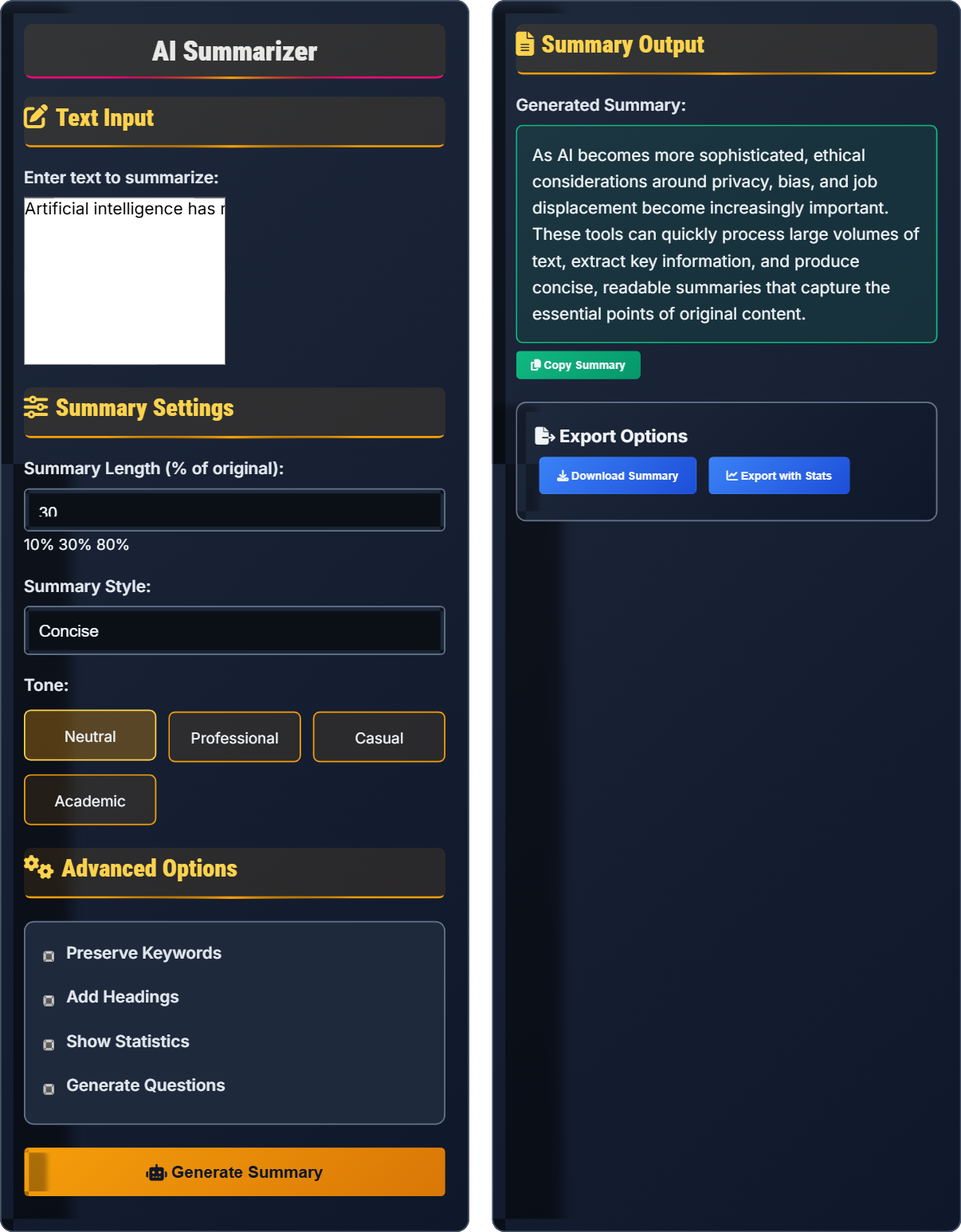
AI Summarizer
Intelligent text summarization • AI writing assistant
AI summarizers use advanced natural language processing (NLP) techniques to automatically generate concise, accurate summaries of lengthy texts. The technology employs extractive and abstractive methods to identify key information, preserve semantic meaning, and produce coherent summaries.
Key Technologies:
- Extractive Summarization: Selects and combines important sentences from the original text
- Abstractive Summarization: Generates new sentences that capture the essence of the original
- TF-IDF: Term frequency-inverse document frequency for importance scoring
- Neural Networks: Deep learning models for understanding context and meaning
- Attention Mechanisms: Focuses on relevant parts of the text during processing
SEO Applications: AI-generated summaries can improve content discoverability, create meta descriptions, and generate social media previews. Search engines favor content that provides clear value, and well-crafted summaries signal content quality.
Text Input
Summary Settings
Advanced Options
Summary Output
Export Options
AI Summarization Methods
Extractive Summarization: Selects and combines the most important sentences from the original text without altering the wording. Preserves original meaning and accuracy but may lack coherence.
Abstractive Summarization: Generates new sentences that capture the essence of the original text using different words and phrasing. More natural and concise but potentially less accurate.
Modern AI summarizers employ various approaches:
- TextRank: Graph-based ranking algorithm similar to PageRank
- TF-IDF: Term frequency-inverse document frequency weighting
- Neural Networks: Deep learning models for contextual understanding
- Transformer Models: Attention-based architectures like BERT
- Choose appropriate summary length for your needs
- Verify accuracy of AI-generated summaries
- Preserve key terms and important information
- Consider context and domain-specific requirements
SEO & Content Applications
AI summarization enhances SEO efforts by creating meta descriptions, content previews, and structured data. Search engines value concise, informative content that quickly communicates value to users. Well-summarized content improves click-through rates and user engagement metrics.
Summaries help create:
- Compelling meta descriptions within character limits
- Social media previews that drive engagement
- Table of contents for long-form content
- Executive summaries for reports and articles
Summarization Techniques
AI Summarization Quiz
What is the main difference between extractive and abstractive summarization?
The answer is A) Extractive uses original text, abstractive creates new text. Extractive summarization selects and combines existing sentences from the source text, preserving the original wording. Abstractive summarization generates new sentences that convey the same meaning using different words and phrasing, similar to how a human would summarize.
Understanding the distinction between these approaches is fundamental to AI summarization. Extractive methods are generally more accurate because they use verbatim text, but may lack coherence. Abstractive methods create more natural-sounding summaries but risk introducing inaccuracies. Modern systems often combine both approaches for optimal results.
Extractive Summarization: Selection of existing sentences from the source text
Abstractive Summarization: Generation of new text that captures the essence of the original
Coherence: Logical flow and connection between ideas in the summary
• Extractive preserves original accuracy but may lack flow
• Abstractive creates natural summaries but risks inaccuracies
• Both approaches have trade-offs between accuracy and fluency
• Use extractive for technical or legal documents
• Use abstractive for marketing or creative content
• Always verify AI-generated summaries for accuracy
• Assuming all AI summaries are equally accurate
• Not considering the appropriate approach for content type
• Failing to verify AI-generated content for errors
Explain the concept of compression ratio in AI summarization and discuss the trade-offs between different ratios. Include specific examples of when different ratios are appropriate.
Compression ratio is the relationship between the length of the summary and the original text, expressed as Original_Length:Summary_Length. For example, a 1000-word text summarized to 200 words has a 5:1 compression ratio.
Compression Ratios and Applications:
- High Compression (10:1 or higher): Executive summaries, news headlines
- Medium Compression (5:1 to 8:1): Social media previews, abstracts
- Low Compression (2:1 to 4:1): Detailed summaries, study guides
Higher compression ratios risk losing important information, while lower ratios may not provide sufficient condensation. The optimal ratio depends on the intended use and audience needs.
Compression ratio directly impacts summary quality and utility. Too high a ratio sacrifices information fidelity, while too low a ratio fails to provide meaningful condensation. Effective summarization balances conciseness with completeness, preserving critical information while eliminating redundancy.
Compression Ratio: The proportion of original text to summary length
Information Fidelity: The degree to which the summary preserves original meaning
Redundancy Elimination: Removing repetitive or non-essential information
• Higher compression = greater risk of information loss
• Lower compression = less effective summarization
• Context determines appropriate compression ratio
• Use 10:1 ratio for social media previews
• Use 5:1 ratio for article abstracts
• Use 3:1 ratio for detailed content summaries
• Using the same ratio for all content types
• Not considering the audience's information needs
• Prioritizing brevity over information preservation
An AI summarizer processes a 2,000-word article and produces a 300-word summary. Calculate the compression ratio and reduction percentage. If the summary preserves 85% of the original article's key information, calculate the information retention rate.
Calculations:
- Compression Ratio = Original Length / Summary Length = 2000 / 300 = 6.67:1 ≈ 7:1
- Reduction Percentage = (Original - Summary) / Original × 100 = (2000 - 300) / 2000 × 100 = 85%
- Information Retention Rate = 85% (given)
This represents a well-balanced summary that achieves significant compression (85% reduction) while maintaining good information retention (85% of key points preserved). This would be suitable for applications requiring both brevity and comprehensive coverage.
This example demonstrates the ideal balance in AI summarization. An 85% reduction with 85% information retention indicates effective compression without sacrificing key content. The 7:1 ratio is appropriate for detailed summaries that need to remain substantially shorter than the original while preserving essential information.
Compression Ratio: Proportion of original to summary length
Reduction Percentage: Percentage of original text eliminated
Information Retention: Percentage of key information preserved
• Aim for 70-90% information retention
• Balance compression with comprehensiveness
• Consider context when evaluating quality metrics
• Track both compression and retention metrics
• Adjust parameters based on content type
• Verify quality beyond quantitative measures
• Focusing only on compression ratio
• Ignoring information retention quality
• Not validating summaries against original meaning
You're optimizing a 1,500-word blog post for SEO. You need to create a meta description (under 160 characters), a social media preview (under 200 characters), and a content summary (300 words). Calculate the compression ratios for each and explain which approach (extractive or abstractive) would be most appropriate for each.
Compression Ratios:
- Meta Description: 1500 words → ~25 words = 60:1 ratio (very high compression)
- Social Preview: 1500 words → ~35 words = 43:1 ratio (extremely high compression)
- Content Summary: 1500 words → 300 words = 5:1 ratio (moderate compression)
Approach Recommendations:
- Meta Description: Abstractive (need to craft compelling, concise text)
- Social Preview: Abstractive (requires engaging, platform-appropriate language)
- Content Summary: Extractive or Hybrid (preserves accuracy while condensing)
For SEO applications, abstractive methods work better for very short formats where natural language and engagement are crucial, while extractive methods suit longer summaries where accuracy is paramount.
This problem illustrates how different applications require different summarization strategies. SEO constraints often demand extreme compression ratios, making abstractive methods more suitable despite potential accuracy trade-offs. The key is matching the approach to the specific requirements and constraints of each application.
Meta Description: HTML attribute summarizing page content for search engines
Character Limit: Maximum allowed text length for specific applications
Platform Requirements: Format-specific constraints for different channels
• Match approach to application requirements
• Consider character limits and platform constraints
• Balance accuracy with engagement for SEO applications
• Use abstractive for very short formats
• Use extractive for accuracy-critical applications
• Test different ratios for optimal results
• Using the same approach for all applications
• Ignoring platform-specific constraints
• Not validating format compliance
Which combination of metrics indicates the highest quality AI summary?
The answer is B) 80% compression, 85% retention, hybrid method. This combination achieves significant condensation (80%) while preserving most of the important information (85%). The hybrid approach leverages the accuracy of extractive methods and the fluency of abstractive methods, creating summaries that are both accurate and readable.
Quality AI summarization requires balancing multiple competing factors. The best summaries achieve meaningful compression without sacrificing critical information. A hybrid approach often provides optimal results by combining the strengths of both extractive and abstractive methods, though the specific approach should be tailored to the application's requirements.
Hybrid Method: Combination of extractive and abstractive summarization
Quality Metrics: Measures of summary effectiveness and accuracy
Trade-off Balance: Optimization between competing quality requirements
• Balance compression with information retention
• Aim for 70-90% information retention
• Use hybrid approaches for optimal quality
• Always validate summaries against original meaning
• Prioritizing compression over accuracy
• Using inappropriate methods for the application
• Not validating summary quality thoroughly
FAQ
Q: How accurate are AI-generated summaries compared to human-written ones?
A: AI-generated summaries have improved dramatically with advances in transformer models and neural networks. Modern AI summarizers can achieve 80-90% accuracy for extractive summarization and 70-80% for abstractive summarization when compared to human-written summaries.
However, AI still struggles with nuanced understanding, sarcasm, and complex logical relationships. The accuracy depends on several factors: the quality of the training data, the specific algorithm used (extractive vs. abstractive), and the domain of the text being summarized.
For best results, treat AI summaries as starting points that should be reviewed and refined by humans, especially for critical applications like legal documents or medical information.
Q: What's the difference between extractive and abstractive summarization, and when should I use each?
A: Extractive summarization selects and combines existing sentences from the source text, preserving the original wording. This approach ensures factual accuracy but may result in less coherent summaries. It's ideal for technical documents, legal texts, and situations where accuracy is paramount.
Abstractive summarization generates new sentences that convey the same meaning using different words and phrasing, similar to how a human would summarize. This creates more natural, readable summaries but introduces potential inaccuracies. It's better for marketing content, social media, and creative applications.
Many modern systems use hybrid approaches, starting with extractive methods to identify key content and then applying abstractive techniques to improve readability and coherence.