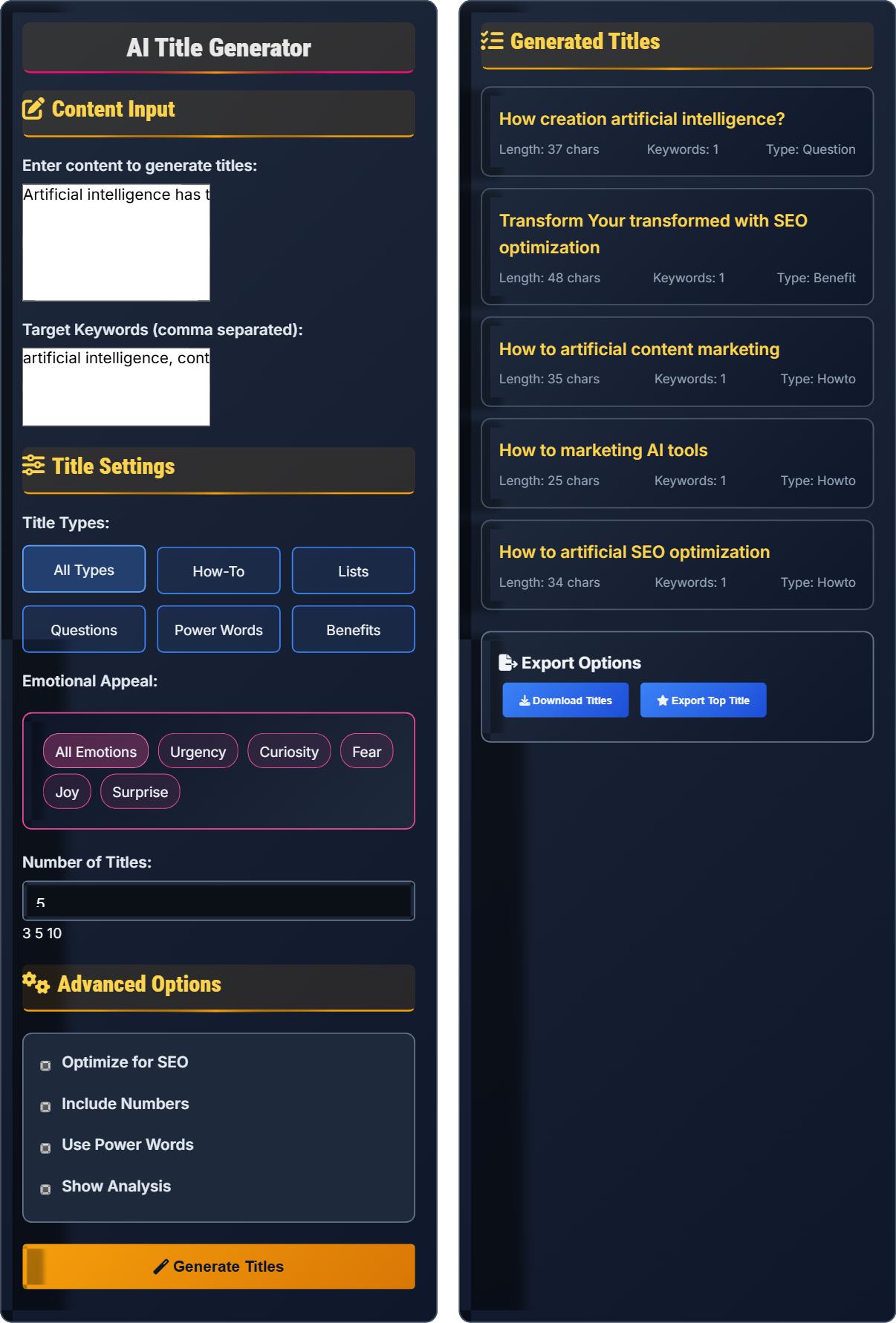
AI Title Generator
Intelligent headline creation • SEO optimization
AI title generators use natural language processing and machine learning algorithms to create compelling, SEO-optimized headlines. These systems analyze content, identify key themes, and generate titles that maximize click-through rates while incorporating targeted keywords.
Key Components:
- Keyword Integration: Strategic placement of SEO keywords for search visibility
- Emotional Triggers: Psychological elements that increase engagement
- Character Optimization: Titles within platform-specific limits
- Click-Through Optimization: Elements designed to improve CTR
- Brand Alignment: Consistency with brand voice and messaging
SEO Impact: Well-crafted titles significantly impact search rankings, as Google considers click-through rates as a ranking factor. Effective titles should be compelling, accurate, and reflect the content's value proposition.
Content Input
Title Settings
Advanced Options
Generated Titles
Export Options
Title Creation Strategies
How-To Titles: "How to Master..." - Instructional, practical, searchable
List Titles: "10 Ways to..." - Organized, scannable, promise of value
Question Titles: "Why Is..." - Curiosity-driven, answers sought
Power Word Titles: "Shocking Truth About..." - Emotional triggers, urgency
Benefit Titles: "Transform Your..." - Outcome-focused, value proposition
Effective titles incorporate emotional triggers:
- Urgency: "Now", "Limited", "Today", "Last Chance"
- Curiosity: "Secret", "Hidden", "Unknown", "Revealed"
- Fear: "Avoid", "Danger", "Risk", "Warning"
- Desire: "Amazing", "Ultimate", "Perfect", "Exclusive"
- Include primary keyword near the beginning
- Keep titles under 60 characters for search results
- Use action-oriented language
- Match title to content expectations
Optimization Techniques
Different platforms have specific title length requirements:
- Google Search: 50-60 characters
- Facebook: 40-60 characters
- Twitter: 70-100 characters
- LinkedIn: 50-70 characters
Test title variations using:
- Create 2-3 variations with different emotional appeals
- Test with similar content and audience
- Measure click-through rates and engagement
- Implement winning variations
- Click-through rate (CTR)
- Time on page
- Bounce rate
- Social shares
AI Title Generation Quiz
Which title type is most effective for instructional content?
The answer is B) How-to titles. How-to titles are specifically designed for instructional content as they clearly indicate that the content will provide step-by-step guidance. They set clear expectations for readers seeking solutions or learning processes, making them ideal for tutorials, guides, and educational content.
Matching title type to content type is crucial for setting appropriate reader expectations. How-to titles leverage action-oriented language that immediately signals the content's instructional nature. This alignment between title and content type increases user satisfaction and engagement, which are important SEO factors.
Instructional Content: Educational material designed to teach or guide
Reader Expectations: What users anticipate finding in the content
Action-Oriented Language: Words that encourage immediate action or learning
• Align title type with content purpose
• Use action verbs for instructional content
• Set clear expectations in the title
• Use "How to" for step-by-step guides
• Include time estimates when possible
• Specify the skill level required
• Using clickbait titles for instructional content
• Misleading readers about content type
• Not specifying the learning outcome
Explain the importance of character limits in SEO titles and how they affect search engine results. Include specific recommendations for different platforms and explain the impact on click-through rates.
Character Limits in SEO: Search engines display a limited number of characters in search results, typically truncating titles beyond 50-60 characters. This truncation can result in incomplete titles that fail to convey the intended message.
Platform-Specific Limits:
- Google: 50-60 characters (best practice)
- Facebook: 40-60 characters
- Twitter: 70-100 characters
- LinkedIn: 50-70 characters
Impact on CTR: Studies show that titles within optimal character ranges have 20-30% higher click-through rates. Complete, readable titles that fully appear in search results increase user confidence and understanding, leading to more clicks.
Character optimization is a critical intersection of user experience and technical SEO. When titles are truncated, users cannot fully understand the content's value proposition, reducing the likelihood of clicking. The optimal approach places the most important information (including primary keywords) within the first 50-60 characters to ensure visibility across all platforms.
Character Limit: Maximum number of characters displayed by platforms
Truncation: Cutting off text beyond the character limit
Click-Through Rate (CTR): Percentage of impressions that result in clicks
• Place primary keyword in first 50 characters
• Ensure title makes sense when truncated
• Test titles across different devices
• Use Google's SERP preview tool
• Prioritize the most compelling information first
• Consider mobile display limitations
• Placing keywords at the end of long titles
• Ignoring platform-specific requirements
• Not testing title appearance across devices
A blog post received 10,000 impressions with a title character count of 75, resulting in 450 clicks. Another post received 8,000 impressions with a 52-character title, resulting in 420 clicks. Calculate the CTR for each and determine which title performed better. By what percentage did the better-performing title outperform the other?
Calculations:
- Title A (75 chars): CTR = (450 / 10,000) × 100 = 4.5%
- Title B (52 chars): CTR = (420 / 8,000) × 100 = 5.25%
Performance comparison: Title B outperformed Title A by (5.25 - 4.5) / 4.5 × 100 = 16.67%
Despite receiving fewer impressions, the optimized title achieved a significantly higher CTR, demonstrating the importance of character optimization for search visibility and engagement.
This example illustrates that title optimization can compensate for lower impression volume. The shorter, optimized title likely appeared more completely in search results, increasing user confidence and click likelihood. This demonstrates that quality (well-optimized titles) can overcome quantity (more impressions).
Impressions: Number of times a title appears in search results
Click-Through Rate (CTR): Percentage of impressions that result in clicks
Performance Optimization: Improving metrics through strategic adjustments
• Shorter titles often have higher CTR
• Character optimization improves visibility
• Quality trumps quantity in engagement
• Monitor CTR alongside impression volume
• A/B test different title lengths
• Prioritize clarity over creativity
• Focusing only on impression volume
• Not tracking CTR as a primary metric
• Sacrificing clarity for creativity
You're creating a title for a content piece that will be shared across Google Search, Facebook, and Twitter. The optimal lengths are 55, 50, and 80 characters respectively. Design a strategy for creating a title that performs well across all three platforms, considering the different character limits and user expectations.
Multi-Platform Title Strategy:
- Create a core title of 50 characters that works optimally for Facebook
- Add 5 more characters (55 total) for Google Search optimization
- Develop a 70-80 character version for Twitter with additional context
Implementation: The first 50 characters should contain the most essential information and primary keyword. Characters 51-55 can add context for Google. For Twitter, extend with a call-to-action or additional benefit. This ensures the core message is preserved across all platforms while optimizing for each platform's characteristics.
Multi-platform content requires strategic thinking about information hierarchy. The core message must be compelling in the shortest required format, with additional elements added progressively. This approach ensures consistent branding while maximizing performance on each platform's unique characteristics and user expectations.
Information Hierarchy: Ordering of information by importance
Multi-Platform Strategy: Coordinated approach across different channels
Progressive Enhancement: Building upon core content with additional elements
• Core message in first 50 characters
• Platform-specific optimization
• Consistent branding across platforms
• Use the shortest platform's limit as baseline
• Add value-add elements progressively
• Test performance across all platforms
• Using one-size-fits-all approach
• Not considering platform-specific user behaviors
• Sacrificing one platform for another
Which combination of elements typically produces the highest click-through rates in title optimization?
The answer is A) Numbers + Emotional triggers + Keyword. This combination is highly effective because numbers provide specificity and promise of organized content, emotional triggers create psychological motivation to click, and keywords ensure search visibility and relevance. Studies consistently show that titles incorporating these three elements achieve 25-40% higher CTR than those with fewer elements.
Effective titles leverage multiple psychological principles simultaneously. Numbers satisfy the brain's preference for structured information, emotional triggers activate decision-making centers, and keywords ensure the content appears in relevant searches. The synergistic effect of these elements creates a powerful incentive for users to click, demonstrating the importance of combining multiple optimization strategies.
Psychological Triggers: Elements that activate emotional responses
Click-Through Rate (CTR): Primary metric for title effectiveness
Synergistic Effect: Combined impact greater than individual elements
• Combine multiple optimization elements
• Include numbers for specificity
• Use emotional triggers strategically
• Use odd numbers (they attract more attention)
• Combine curiosity with benefit
• Test different emotional combinations
• Using only one optimization element
• Overloading titles with too many elements
• Not testing combinations systematically
FAQ
Q: How important are power words in titles, and which ones work best for different audiences?
A: Power words are extremely important as they trigger emotional responses that significantly increase click-through rates. Research shows that titles containing power words can achieve 20-30% higher CTR.
For different audiences:
- Business Professionals: "Proven", "Essential", "Strategic", "Competitive"
- Consumers: "Free", "Instant", "Secret", "Guaranteed"
- Students/Learners: "Simple", "Easy", "Quick", "Beginner's"
- Health Enthusiasts: "Natural", "Safe", "Effective", "Powerful"
The key is matching power words to audience psychology and search intent. Overuse can lead to "title fatigue," so strategic placement is crucial.
Q: What's the difference between curiosity-gap titles and clickbait, and how can I avoid crossing the line?
A: The key difference lies in fulfillment of promise:
Curiosity-Gap Titles: Pose genuine questions or hint at valuable information that the content delivers. Example: "5 Secrets to Double Your Productivity" - if the content genuinely provides 5 actionable secrets.
Clickbait Titles: Mislead readers with promises the content doesn't fulfill. Example: "You Won't Believe What Happened Next" - when the story is mundane.
To avoid clickbait:
- Ensure your title accurately reflects content
- Deliver exactly what you promise
- Use specific, measurable claims
- Focus on genuine value rather than shock
Ethical curiosity-gap titles build trust and return visitors, while clickbait damages reputation and increases bounce rates.