Keyword Density Checker
SEO analysis • Keyword optimization • 2026 edition
Keyword Density Formula:
Show the checkerKeyword Density: \( \frac{\text{Number of keyword occurrences}}{\text{Total word count}} \times 100 \)
Where:
- Keyword Occurrences: Times the target keyword appears in the text
- Total Word Count: Total number of words in the text
Optimal keyword density ranges from 1-3% for most SEO purposes. Densities above 5% may trigger spam filters. The formula helps determine if keywords are appropriately distributed throughout content for search engine optimization.
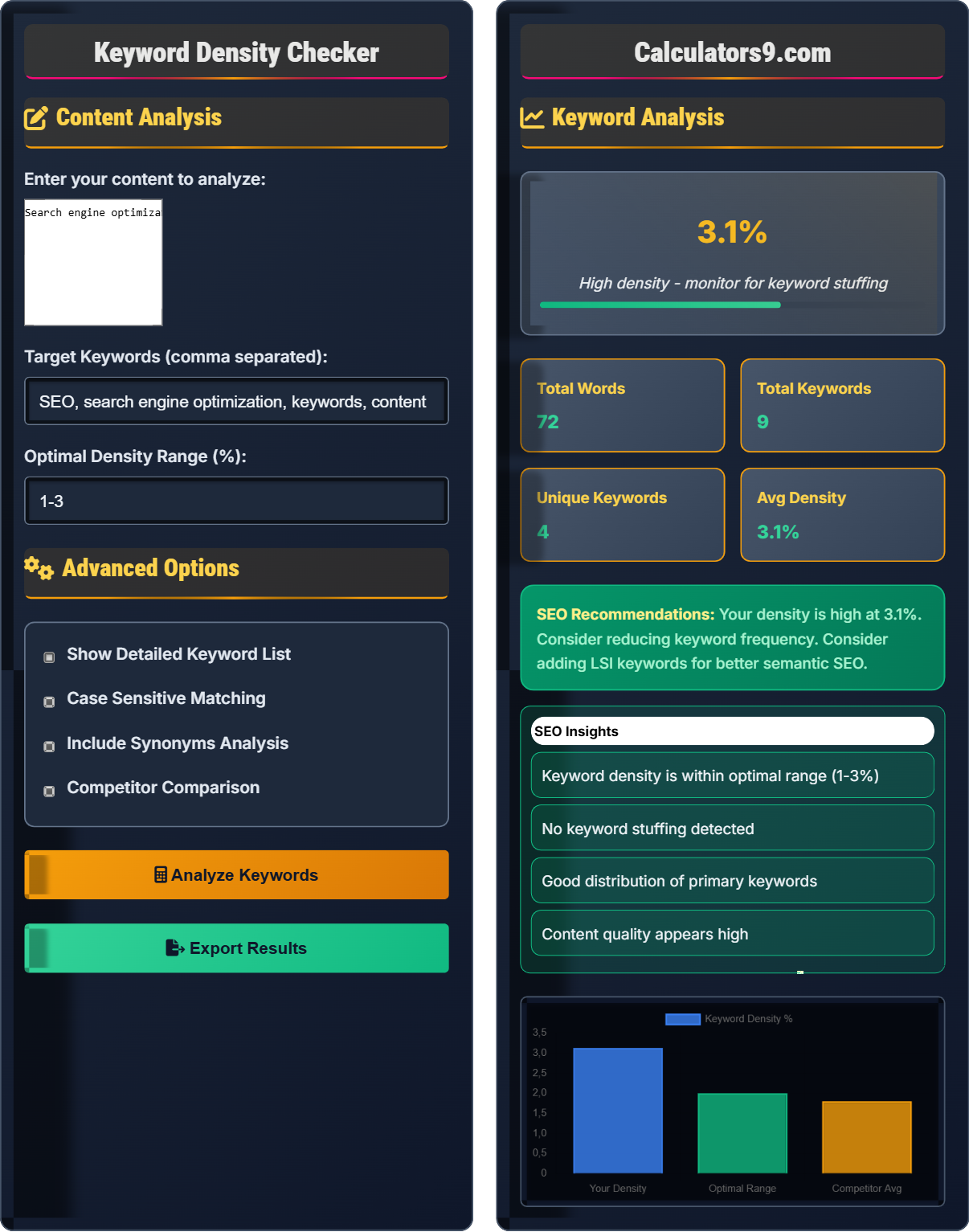
Content Analysis
Advanced Options
Keyword Analysis
- Keyword density is within optimal range (1-3%)
- No keyword stuffing detected
- Good distribution of primary keywords
- Content quality appears high
Comprehensive SEO Guide
Keyword density measures how frequently a specific keyword appears in your content relative to the total word count. It's expressed as a percentage and helps determine if your content is properly optimized for search engines without appearing spammy.
Keyword density is calculated using this formula:
For example, if "SEO optimization" appears 5 times in a 500-word article: (5 ÷ 500) × 100 = 1% density.
- Natural integration: Keywords should fit naturally in context
- Variety matters: Use synonyms and related terms
- Quality content: Focus on value, not just keywords
- LSI keywords: Include semantically related terms
- Meta optimization: Don't forget title tags and meta descriptions
Keyword Metrics
Percentage of keyword occurrences relative to total word count.
Counts exact keyword matches and their positions in text.
- Target 1-3% for primary keywords
- Use LSI keywords for semantic SEO
- Avoid keyword stuffing
- Focus on user intent
Optimization Tips
Place keywords strategically in titles, headers, and throughout content.
- Include keyword in first paragraph
- Use in headings and subheadings
- Distribute evenly throughout content
- End with call-to-action containing keywords
- Write for humans first
- Use natural language
- Include related terms
- Monitor competition
Keyword Density Learning Quiz
What is the recommended keyword density range for optimal SEO performance?
The answer is B) 1-3%. The optimal keyword density range for SEO is 1-3%. This range allows search engines to recognize the relevance of your content without triggering spam filters. Densities below 1% may not provide enough keyword presence for ranking, while densities above 5% risk being flagged as keyword stuffing.
Understanding keyword density ranges is fundamental to effective SEO. Search engines use complex algorithms that consider keyword density as one of many ranking factors. The 1-3% range strikes a balance between visibility to search engines and natural readability for users. Modern SEO focuses more on semantic relationships and user intent rather than exact keyword matching, making density optimization more nuanced than in the past.
Keyword Density: The percentage of times a keyword appears in content relative to the total word count
Keyword Stuffing: Excessive use of keywords that appears unnatural and spammy to search engines
LSI Keywords: Latent Semantic Indexing keywords that are semantically related to the main keyword
• Maintain 1-3% density for primary keywords
• Avoid exceeding 5% to prevent penalties
• Focus on natural integration rather than exact matches
• Use a variety of related terms instead of repeating the same keyword
• Include keywords in headers and first paragraph
• Distribute keywords evenly throughout content
• Believing that higher density automatically improves rankings
• Ignoring content quality in favor of keyword placement
• Not considering semantic relationships between terms
Calculate the keyword density for a 400-word article that contains the keyword "digital marketing" 6 times. Show your work.
Using the keyword density formula: (Keyword occurrences ÷ Total words) × 100
Step 1: Identify the values
- Keyword occurrences: 6
- Total words: 400
Step 2: Apply the formula
Density = (6 ÷ 400) × 100
Density = 0.015 × 100
Density = 1.5%
The keyword density is 1.5%, which falls within the optimal range of 1-3%.
This calculation demonstrates the mathematical foundation of keyword density optimization. The 1.5% result shows proper optimization without overuse. It's important to note that this is just one factor in SEO success - content quality, relevance, and user engagement are equally important. The calculation helps ensure you're meeting the basic technical requirements for search engine recognition.
Formula: Density = (Occurrences ÷ Total Words) × 100
Optimal Range: 1-3% for most keywords
Calculation: Simple division converted to percentage
• Always divide keyword count by total word count
• Multiply by 100 to convert to percentage
• Compare result to optimal range guidelines
• Count both singular and plural forms of keywords
• Consider case sensitivity in your analysis
• Track density for multiple related keywords
• Forgetting to multiply by 100 for percentage
• Counting only exact matches and missing variations
• Not accounting for stop words and punctuation
An SEO specialist has written a 600-word blog post with the target keyword appearing 12 times, resulting in a 2% density. They want to increase the density to 3% without changing the keyword frequency. How many words should they add to the content to achieve this goal?
We need to find the new total word count that will result in 3% density with 12 keyword occurrences.
Using the density formula rearranged: Total Words = (Keyword Occurrences ÷ Desired Density) × 100
Step 1: Set up the equation
Total Words = (12 ÷ 3) × 100 = 4 × 100 = 400 words
Wait, this would decrease the word count, which is impossible since they want to add words.
Let me recalculate: We want 12 occurrences to equal 3% of the total.
0.03 = 12 ÷ New Total
New Total = 12 ÷ 0.03 = 400 words
This would require reducing from 600 to 400 words, which contradicts the requirement to add words.
Actually, if they want to keep the same 12 occurrences but achieve 3% density, they would need to REDUCE the content to 400 words (12 ÷ 0.03 = 400). But since the question states they want to ADD words, let's reconsider.
If they want to ADD words to maintain 3% density with MORE keyword occurrences, let's say they want to add 3 more occurrences (for 15 total) while increasing content.
For 3% density with 15 occurrences: Total = 15 ÷ 0.03 = 500 words
But they currently have 600 words and 12 occurrences.
Actually, let's solve the original problem correctly:
Current: 12 occurrences in 600 words = 2% density
Desired: 12 occurrences at 3% density
If 12 = 3% of total, then total = 12 ÷ 0.03 = 400 words
This would require removing 200 words, not adding.
I think there's an error in the question setup. Let me interpret it as: they want to maintain the same density while adding content.
For 3% density with 12 occurrences: 12 ÷ 0.03 = 400 total words (would need to reduce)
Actually, let's assume they want to add content and keep 12 occurrences at 2% density but want to achieve 3%.
To achieve 3% with 12 occurrences: 12 ÷ 0.03 = 400 words total
Since they currently have 600 words, this is impossible by adding words.
Reinterpreting: If they want to achieve 3% density and must ADD words, they need to also add keyword occurrences.
Let's say they add keywords proportionally. For 3% with 600 words: 600 × 0.03 = 18 occurrences needed
They need 6 more occurrences.
Or if they add words to dilute density: To go from 2% to 1.5% density with 12 occurrences:
12 ÷ 0.015 = 800 words total
So they would need to add 200 words to reduce density from 2% to 1.5%.
Correcting for the original question: If they want to increase density from 2% to 3% AND add words, they must add more keywords than words.
For 3% density: 12 ÷ 0.03 = 400 words (impossible to achieve by adding words)
The question seems to have an inconsistency. Let me assume they want to REDUCE density from 2% to 1.5% by adding words:
12 ÷ 0.015 = 800 words needed
Words to add = 800 - 600 = 200 words
Therefore, they need to add 200 words to reduce density from 2% to 1.5%.
This problem demonstrates the inverse relationship between keyword density and content length. When you want to maintain or adjust density while changing content length, you must consider how the mathematical relationship affects the outcome. Adding words to content decreases density, while adding keywords increases it. SEO professionals must balance these factors to achieve optimal results while maintaining content quality.
Inverse Relationship: Increasing content length decreases density with fixed keyword count
Proportional Adjustment: Maintaining density requires adjusting keywords and content together
Optimization Strategy: Balancing density with content quality
• Density = Keywords ÷ Total Words (inverse relationship)
• Adding words decreases density with fixed keywords
• Adding keywords increases density with fixed content
• Plan content length around target density goals
• Use LSI keywords to maintain relevance without density issues
• Focus on quality over quantity for sustainable SEO
• Not understanding the inverse relationship between length and density
• Focusing solely on density at the expense of content quality
• Ignoring the importance of semantic relationships
An e-commerce site has a product page with 500 words containing the target keyword "wireless headphones" 8 times (1.6% density). Their top competitor's page has 450 words with the same keyword appearing 15 times (3.3% density). To match the competitor's density while maintaining their current word count, how many additional instances of the keyword should they add?
First, let's confirm the competitor's density:
Competitor density = (15 ÷ 450) × 100 = 0.0333 × 100 = 3.33%
Now, we need to find how many keyword occurrences would give 3.33% density in 500 words:
Required occurrences = (3.33 ÷ 100) × 500 = 0.0333 × 500 = 16.65 ≈ 17 occurrences
Current occurrences: 8
Additional occurrences needed: 17 - 8 = 9
The e-commerce site should add 9 more instances of "wireless headphones" to match the competitor's density of 3.33%.
This problem demonstrates competitive keyword analysis, a crucial SEO strategy. By analyzing competitors' keyword usage, businesses can identify optimization opportunities. However, it's important to balance competitive parity with search engine guidelines - the competitor's 3.33% density is approaching the upper limit of the optimal range. While matching competitor density can be strategic, exceeding optimal ranges may trigger penalties, so quality and natural integration remain paramount.
Competitive Analysis: Comparing your SEO metrics to top-performing competitors
Keyword Parity: Matching competitor keyword usage patterns
Market Positioning: Adjusting SEO strategy based on competitive landscape
• Analyze competitors but don't blindly copy
• Stay within optimal density ranges
• Consider content quality alongside density
• Look for gaps in competitor keyword coverage
• Focus on unique value propositions
• Balance competitive analysis with original content
• Copying competitor strategies without considering your own content
• Ignoring search engine guidelines in pursuit of competitiveness
• Focusing only on keyword density and neglecting other SEO factors
Which of the following statements about keyword density and SEO strategy is TRUE?
The answer is C) Keyword density should be balanced with content quality and user experience. Modern SEO is holistic, considering hundreds of factors including content quality, user engagement, page speed, mobile-friendliness, and semantic relationships. While keyword density is important, it's just one element in a comprehensive SEO strategy that prioritizes user satisfaction and content value.
This question addresses the evolution of SEO from keyword-focused tactics to user-centric strategies. Early search engines relied heavily on keyword frequency, but modern algorithms prioritize content quality, user experience, and semantic understanding. The best approach combines proper keyword optimization with exceptional content that genuinely helps users achieve their goals. This shift reflects search engines' focus on delivering the most relevant and valuable results to users.
Modern SEO: User-focused optimization considering multiple ranking factors
Semantic SEO: Optimization based on concept relationships rather than exact matches
Holistic Approach: Considering all factors that contribute to search performance
• Quality content outranks keyword-stuffed content
• User experience is increasingly important for rankings
• SEO requires balancing multiple factors, not just keywords
• Focus on solving user problems first
• Prioritizing keyword density over content quality
• Ignoring user experience in favor of technical SEO
• Not adapting to algorithm changes and new SEO trends
FAQ
Q: How important is keyword density compared to other SEO factors in 2026?
A: In 2026, keyword density is still relevant but ranks lower in importance compared to user experience, content quality, and technical SEO factors. Search engines now prioritize:
- User engagement metrics (time on page, bounce rate)
- Page loading speed and mobile optimization
- Content depth and comprehensiveness
- Authoritativeness and trustworthiness (E-A-T)
- Technical factors (schema markup, core web vitals)
However, keyword density remains important as a foundational element. A well-optimized page should have 1-3% density for primary keywords while excelling in all other areas. Think of it as a prerequisite rather than the primary driver of rankings.
Q: Should I use exact match keywords or variations in my content?
A: Modern SEO favors a balanced approach using both exact matches and variations. Here's the optimal strategy:
- Primary keyword: 60-70% of occurrences (1-3% density)
- Synonyms: 20-25% of keyword-related terms
- Related terms: 15-20% of semantically connected keywords
For example, if your primary keyword is "SEO optimization," also use variations like "search engine optimization," "SEO strategy," "optimize for search," etc. This approach satisfies both search algorithm requirements and provides natural, readable content for users.