Meta Tag Generator
SEO optimization • Meta tags • 2026 edition
Meta Tag Standards:
Show the generatorTitle Tag: 50-60 characters (recommended)
Description: 150-160 characters (recommended)
Keywords: Comma-separated, 10-20 words
Best practices for 2026 include:
- Unique titles and descriptions for each page
- Include primary keywords near the beginning
- Write compelling copy that encourages clicks
- Avoid keyword stuffing
- Ensure mobile-friendly character lengths
These standards help search engines understand and rank your content effectively.
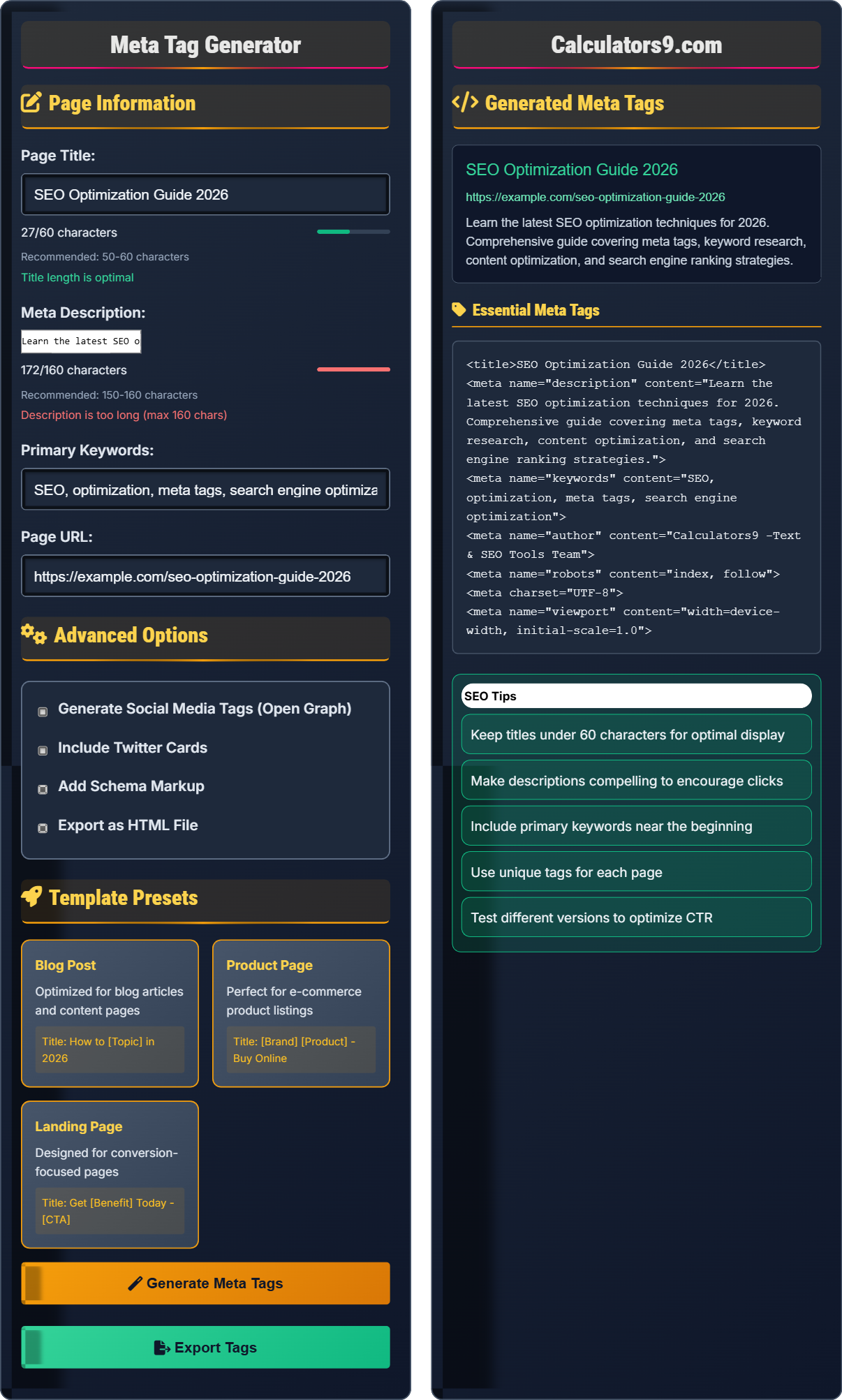
Page Information
Advanced Options
Template Presets
Generated Meta Tags
Essential Meta Tags
- Keep titles under 60 characters for optimal display
- Make descriptions compelling to encourage clicks
- Include primary keywords near the beginning
- Use unique tags for each page
- Test different versions to optimize CTR
Comprehensive Meta Tag Guide
Meta tags are HTML elements that provide metadata about a webpage. They don't appear on the page itself but are crucial for search engines and social media platforms. Meta tags help search engines understand your content and influence how your page appears in search results.
- Unique content: Every page should have unique meta tags
- Keyword placement: Include primary keywords near the beginning
- Compelling copy: Write for users, not just search engines
- Mobile optimization: Ensure tags work well on mobile devices
- Regular updates: Refresh tags as content changes
Open Graph and Twitter Card tags control how your content appears when shared on social media:
<meta name="twitter:card" content="summary_large_image">
These tags ensure your content looks professional and engaging when shared.
Meta Tag Standards
50-60 characters, unique per page, includes primary keywords.
150-160 characters, compelling summary, includes call-to-action.
- Title: 50-60 characters
- Description: 150-160 characters
- Keywords: 10-20 words
- URL: Keep clean and readable
Optimization Tips
Place primary keywords early in title and description.
- Track click-through rates
- A/B test different versions
- Monitor search rankings
- Update based on performance
- Write for humans first
- Include location if relevant
- Use action words
- Test across devices
Meta Tag Learning Quiz
What is the recommended character length for a meta title tag in 2026?
The answer is B) 50-60 characters. The optimal length for meta title tags is 50-60 characters. This ensures that search engines display the entire title without truncating it. Titles longer than 60 characters may be cut off in search results, reducing their effectiveness. The first 50-60 characters are most visible to users scanning search results.
Understanding character limits is crucial for effective meta tag optimization. Search engines like Google typically display up to 60 characters of a title tag in search results. If your title exceeds this limit, it gets truncated with an ellipsis (...), potentially cutting off important information. This truncation can reduce click-through rates since users may not see the complete value proposition. The 50-60 character range provides a safe buffer while maximizing visible content.
Meta Title: The HTML element that defines the title of a web page, displayed in search results and browser tabs
Character Limit: The maximum number of characters that display properly in search results
Truncation: When search engines cut off text that exceeds the display limit
• Keep titles between 50-60 characters
• Place important keywords at the beginning
• Ensure each page has a unique title
• Test titles in Google's SERP preview tool
• Creating titles that are too long and get cut off
• Using the same title for multiple pages
• Placing important keywords at the end where they might be truncated
Calculate the optimal meta description length for a page that needs to include the primary keyword "digital marketing" twice, along with a compelling call-to-action. Show your work.
Following optimal meta description guidelines:
Step 1: Reserve space for primary keyword
"digital marketing" = 16 characters × 2 occurrences = 32 characters
Step 2: Reserve space for compelling copy and CTA
Recommended structure: Hook + Primary keyword + Additional info + Second keyword + CTA
Example breakdown: "Master [keyword] today! Learn [keyword] secrets for 2026. [CTA]"
Step 3: Calculate remaining space
Optimal description: 150-160 characters total
Reserved for keywords: 32 characters
Remaining for copy: ~120-130 characters
This allows for compelling copy while staying within optimal length.
This calculation demonstrates the balance between keyword inclusion and compelling copy in meta descriptions. The 150-160 character range provides enough space for both strategic keyword placement and persuasive messaging. Including the primary keyword twice can reinforce relevance to search engines while maintaining natural readability for users. The key is to integrate keywords seamlessly into compelling copy that encourages clicks.
Call-to-Action (CTA): A phrase that encourages users to take action
Keyword Integration: Naturally incorporating keywords into compelling copy
Character Budget: Allocating characters for different elements within limits
• Maintain 150-160 character limit
• Include primary keyword near the beginning
• Make it compelling to encourage clicks
• Start with the most important information
• Include action words like "learn," "discover," "get"
• Test different CTAs to optimize click-through rates
• Stuffing too many keywords at the expense of readability
• Writing generic descriptions that don't encourage clicks
• Ignoring the importance of the first 100 characters
An e-commerce website has a product page with the following details: Product name "Premium Wireless Headphones", target keyword "wireless headphones", and wants to include a price point "$99" in the meta description. If they want to create a 155-character meta description that includes the keyword at the beginning, the price, and a compelling call-to-action, how many characters remain for additional descriptive text after accounting for the keyword (18 characters), price ($99 = 4 characters), and basic structure?
Breaking down the character allocation:
Step 1: Account for the primary keyword
"wireless headphones" = 18 characters
Step 2: Account for the price point
"$99" = 3 characters
Step 3: Account for basic structural elements
Spaces and punctuation: approximately 10 characters
Step 4: Calculate remaining characters
Total available: 155 characters
Used: 18 (keyword) + 3 (price) + 10 (structure) = 31 characters
Remaining: 155 - 31 = 124 characters
Therefore, 124 characters remain for additional descriptive text and call-to-action.
This problem demonstrates practical character budgeting for meta descriptions. E-commerce sites often want to include price points to attract bargain-conscious shoppers, making character allocation even more critical. The calculation shows that even with a specific keyword and price point, there's still ample room for compelling copy. However, the challenge lies in crafting persuasive text within the remaining character budget while maintaining readability and search engine optimization.
Character Budgeting: Strategically allocating characters for different elements within limits
E-commerce Meta Tags: Descriptions that include product-specific information like prices
Price Point Integration: Including pricing information to attract customers
• Include price points if they're competitive advantages
• Maintain keyword prominence in the first 100 characters
• Balance information with compelling copy
• Use abbreviations like "w/" for "with" to save space
• Include urgency words like "sale" or "limited" if applicable
• Test whether including prices improves CTR
• Including too much product information at the expense of persuasion
• Not testing whether price inclusion helps or hurts CTR
• Forgetting that the first 100 characters are most important
A content marketer wants to create meta tags for a blog post titled "10 SEO Tips for 2026". They need to generate both standard meta tags and Open Graph tags for social sharing. If the meta description is "Discover the top 10 SEO strategies that will dominate search rankings in 2026. Learn how to optimize your website for the future." (158 characters), what should the Open Graph description be, and how should it differ from the standard meta description for optimal social sharing?
For optimal social sharing, the Open Graph description should be adapted from the standard meta description:
Standard Meta Description: "Discover the top 10 SEO strategies that will dominate search rankings in 2026. Learn how to optimize your website for the future." (158 chars)
Open Graph Description: "Discover the top 10 SEO strategies for 2026 that will boost your search rankings. Learn essential optimization tips for the future."
Key differences for social sharing:
- Slightly more engaging tone for social platforms
- May include emotional triggers that perform well on social
- Could be adjusted to exactly 150 characters if preferred
- Focuses on benefits rather than just information
Both serve different purposes: meta description for search engines, Open Graph for social media previews.
This demonstrates the importance of tailoring content for different contexts. While search engine meta descriptions focus on information and keyword inclusion, social media descriptions need to capture attention in a crowded feed. Social platforms reward engaging, shareable content, so the Open Graph description should emphasize benefits and use more compelling language. The slight variation allows for platform-specific optimization while maintaining core message consistency.
Open Graph Tags: Meta tags that control how content appears when shared on social media
Social Optimization: Adapting content for better performance on social platforms
Contextual Adaptation: Modifying content for different platforms and audiences
• Use different descriptions for search and social contexts
• Optimize Open Graph for engagement, not just information
• Maintain message consistency across platforms
• Test different Open Graph descriptions for engagement
• Include emotional triggers for social sharing
• Use platform-specific best practices
• Using identical descriptions for search and social
• Not optimizing for the platform's specific audience
• Ignoring the visual aspect of social sharing
Which of the following statements about modern meta tag strategy is TRUE?
The answer is C) Meta tags should be optimized for both search engines and user engagement. Modern SEO requires a dual focus: satisfying search engine algorithms while compelling users to click. Meta tags serve as advertisements for your content in search results, so they must be both technically sound and engaging. This approach recognizes that SEO success depends on attracting qualified visitors who engage with your content.
This question addresses the evolution of SEO from purely technical optimization to user-focused strategies. While meta tags do influence search engine rankings, their primary function is to attract clicks from search users. The most technically perfect meta tags are worthless if they don't entice users to visit your page. This dual-purpose approach reflects search engines' increasing emphasis on user satisfaction and engagement metrics as ranking factors.
Technical SEO: Optimizing for search engine algorithms
User-Focused SEO: Optimizing for user engagement and satisfaction
Click-Through Rate (CTR): Percentage of users who click on your listing
• Write unique meta tags for each page
• Focus on compelling copy that drives clicks
• Balance keyword optimization with readability
• A/B test different meta tag variations
• Focusing only on search engine optimization without considering user appeal
• Using duplicate meta tags across multiple pages
• Ignoring the connection between meta tags and actual page content
FAQ
Q: How important are meta keywords in 2026 SEO strategy?
A: Meta keywords have minimal importance for SEO in 2026. Major search engines like Google stopped using meta keywords as a ranking factor years ago due to widespread abuse. However, they might still be used by some smaller search engines or internal site searches.
Instead, focus on:
- Compelling title tags (50-60 characters)
- Engaging meta descriptions (150-160 characters)
- High-quality content that naturally incorporates keywords
- Structured data and schema markup
- Page loading speed and mobile optimization
While you can include meta keywords for completeness, don't spend significant time optimizing them.
Q: Should I use the same meta description for similar products on my e-commerce site?
A: No, each product page should have a unique meta description. Duplicate meta descriptions can hurt your SEO performance in several ways:
- Search engines may see the pages as duplicates
- Reduced click-through rates due to identical previews
- Potential penalties for duplicate content
- Poor user experience when browsing search results
Instead, create unique descriptions that highlight each product's specific features, benefits, or differentiators. Use a consistent template but customize key elements like specific features, price, availability, or unique selling points for each product.
Social Media Tags
Open Graph Tags
Twitter Card Tags