Flesch-Kincaid Readability Analyzer
Text complexity & grade level tool • 2026 writing
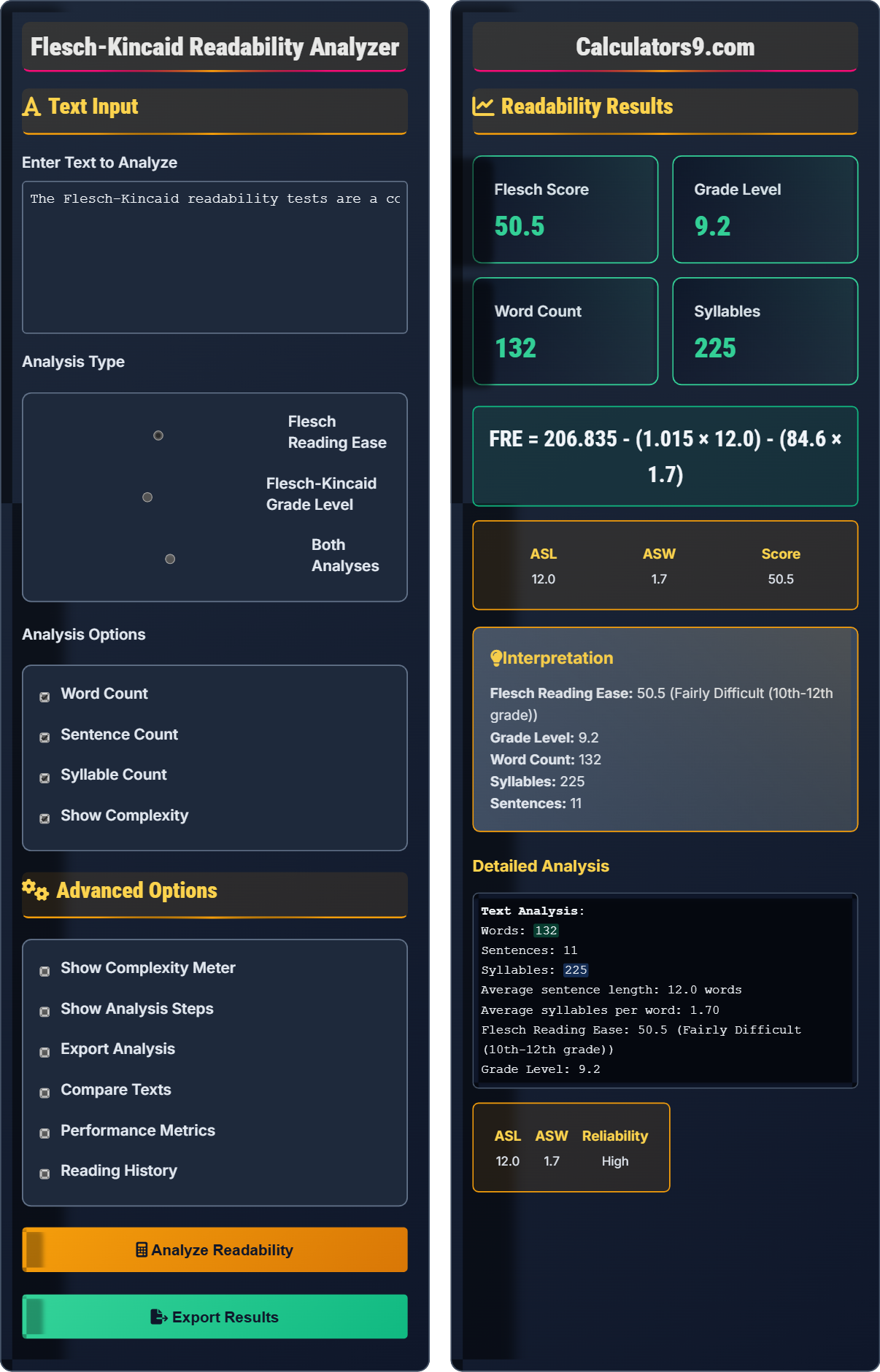
Flesch-Kincaid Formulas:
Show the analyzerFlesch Reading Ease: 206.835 - (1.015 × ASL) - (84.6 × ASW)
Flesch-Kincaid Grade Level: (0.39 × ASL) + (11.8 × ASW) - 15.59
Where:
- ASL: Average Sentence Length (words per sentence)
- ASW: Average Syllables per Word
Interpretation:
- 90-100: Very easy (5th grade)
- 80-89: Easy (6th grade)
- 70-79: Fairly easy (7th grade)
- 60-69: Standard (8th-9th grade)
- 50-59: Fairly difficult (10th-12th grade)
- 30-49: Difficult (College)
- 0-29: Very difficult (College Graduate)
Example: 100 words, 5 sentences, 120 syllables → ASL=20, ASW=1.2 → FRE=77.9 (Fairly easy)
Text Input
Advanced Options
Readability Results
Detailed Analysis
Comprehensive Readability Guide
The Flesch-Kincaid readability tests are a collection of formulas that assess the readability of a text. They measure how easy or difficult a text is to read based on the average sentence length and the average number of syllables per word. These tests are widely used in education, publishing, and content creation.
Flesch Reading Ease:
Score = 206.835 - (1.015 × ASL) - (84.6 × ASW)
Flesch-Kincaid Grade Level:
Grade Level = (0.39 × ASL) + (11.8 × ASW) - 15.59
Where:
ASL = Average Sentence Length (words per sentence)ASW = Average Syllables per Word
Readability scores are used in:
- Education: Determining appropriate reading level for students
- Publishing: Adapting content for target audiences
- Healthcare: Ensuring patient materials are accessible
- Government: Making official documents understandable
- SEO: Optimizing content for broader reach
- Marketing: Tailoring copy to audience comprehension
- Know your audience: Match reading level to target readers
- Use active voice: Generally improves readability
- Short sentences: Keep sentences under 20 words when possible
- Simple words: Use common, familiar terms
- Test regularly: Verify readability with actual readers
- Balance complexity: Don't oversimplify important concepts
Readability Fundamentals
Measure of text accessibility.
Score = 206.835 - (1.015 × ASL) - (84.6 × ASW)
ASL = Avg sentence length, ASW = Avg syllables.
- Higher scores = easier reading
- Match audience reading level
- Test with actual readers
Readability Applications
For audience-appropriate content.
- Education materials
- Healthcare documents
- Legal documents
- Marketing content
- Target audience literacy
- Content purpose
- Context of use
- Industry standards
Readability Learning Quiz
What does a Flesch Reading Ease score of 85 indicate?
The answer is B) Easy text (6th grade level). The Flesch Reading Ease scale ranges from 0-100, with higher scores indicating easier readability. Scores between 80-89 are considered "easy" and correspond to approximately 6th grade reading level.
The Flesch Reading Ease scale is inverted - higher scores mean easier reading. A score of 100 would be extremely easy to read, while a score of 0 would be extremely difficult. The scale is calibrated so that typical reading levels correspond to school grades.
Flesch Reading Ease: Scale 0-100 measuring readability
ASL: Average Sentence Length
ASW: Average Syllables per Word
• Higher scores = easier reading
• 90-100 = Very easy
• 0-30 = Very difficult
• Aim for 70-80 for general audience
• Higher scores for broader reach
• Match to target audience
• Confusing with Flesch-Kincaid grade level
• Thinking lower scores are better
• Not considering target audience
Calculate the Flesch Reading Ease score for a text with: 200 words, 10 sentences, 240 syllables.
First, calculate the averages:
ASL (Average Sentence Length) = Total words / Total sentences = 200 / 10 = 20.0
ASW (Average Syllables per Word) = Total syllables / Total words = 240 / 200 = 1.2
Now apply the Flesch Reading Ease formula:
Score = 206.835 - (1.015 × ASL) - (84.6 × ASW)
Score = 206.835 - (1.015 × 20.0) - (84.6 × 1.2)
Score = 206.835 - 20.3 - 101.52 = 85.015
The Flesch Reading Ease score is approximately 85, which corresponds to "easy" reading (6th grade level).
This example shows how sentence length and syllable count affect readability. Longer sentences and more complex words (more syllables) decrease the readability score. The formula weights syllable count more heavily than sentence length (84.6 vs 1.015).
ASL: Average Sentence Length (words/sentence)
ASW: Average Syllables per Word
FRE: Flesch Reading Ease Score
• ASL = Total words / Total sentences
• ASW = Total syllables / Total words
• Score = 206.835 - (1.015×ASL) - (84.6×ASW)
• Focus on reducing syllables per word
• Shorter sentences improve scores
• Use simple, common words
• Confusing numerators and denominators
• Incorrect syllable counting
• Using wrong formula constants
A medical consent form has an average sentence length of 25 words and an average of 1.8 syllables per word. What is the Flesch-Kincaid Grade Level, and is this appropriate for patient education materials?
Using the Flesch-Kincaid Grade Level formula:
Grade Level = (0.39 × ASL) + (11.8 × ASW) - 15.59
Grade Level = (0.39 × 25) + (11.8 × 1.8) - 15.59
Grade Level = 9.75 + 21.24 - 15.59 = 15.4
The grade level is approximately 15.4, which is college graduate level. This is NOT appropriate for patient education materials, which should ideally be at 6th-8th grade level (Flesch Reading Ease of 70-80) to ensure broad accessibility.
Medical documents often score at very high grade levels due to complex terminology and long sentences. This example demonstrates why readability analysis is crucial for healthcare communications. Patient materials should aim for much lower grade levels to accommodate diverse literacy levels.
FKGL: Flesch-Kincaid Grade Level
Health Literacy: Ability to understand health information
Accessibility: Making content understandable to target audience
• Healthcare: Aim for 6th-8th grade level
• General audience: 7th-8th grade level
• Legal documents: Often too high
• Use patient education standards
• Simplify complex terms
• Shorten sentences
• Not considering audience literacy
• Using complex terminology unnecessarily
• Assuming all readers are highly educated
You're writing for a general audience and want to achieve a Flesch Reading Ease score of 75. Your current text has 15 words per sentence and 1.4 syllables per word. What adjustments could you make to reach your target?
Current Flesch Reading Ease calculation:
Score = 206.835 - (1.015 × 15) - (84.6 × 1.4)
Score = 206.835 - 15.225 - 118.44 = 73.17
Your current score is 73, which is close to the target of 75. To improve:
1. Reduce average sentence length to 14 words: Score would increase by ~1.015
2. Reduce average syllables per word to 1.3: Score would increase by ~84.6
3. A combination of both: Shorter sentences with simpler words
For example: ASL=14, ASW=1.3 → Score = 206.835 - 14.21 - 110.0 = 82.6
Reducing syllables per word has a much larger impact on readability than reducing sentence length, because the syllable factor (84.6) is much larger than the sentence factor (1.015). This demonstrates that vocabulary choice has a greater impact on readability than sentence structure.
Vocabulary Complexity: Average syllables per word
Syntactic Complexity: Average sentence length
Readability Target: Desired score for audience
• Syllables have bigger impact than sentences
• Simplify vocabulary first
• Shorten sentences second
• Replace complex words with simple ones
• Break long sentences into shorter ones
• Use active voice over passive
• Over-focusing on sentence length
• Not simplifying vocabulary enough
• Forgetting to test with target audience
Which of the following is the LEAST appropriate use of Flesch-Kincaid readability scores?
The answer is B) Academic research papers. Flesch-Kincaid scores are designed to measure accessibility for general audiences. Academic papers intentionally use complex terminology and sentence structures appropriate for specialized audiences. Using readability scores to evaluate academic writing would encourage oversimplification of complex concepts that require specialized vocabulary.
Readability scores are most appropriate when the goal is to communicate with a broad, general audience. For specialized audiences (like academics, legal professionals, or medical experts), using readability metrics could actually harm communication by encouraging oversimplification of necessary complex concepts.
Specialized Audience: Readers with specific expertise
General Audience: Broad population with average literacy
Communication Goal: Match complexity to audience needs
• Match readability to audience
• Complex topics may require complex language
• Don't oversimplify technical concepts
• Identify your target audience
• Consider purpose of the text
• Balance accessibility with accuracy
• Applying to specialized technical documents
• Assuming all content should be simple
• Not considering audience expertise
FAQ
Q: What's the difference between Flesch Reading Ease and Flesch-Kincaid Grade Level?
A: Flesch Reading Ease (FRE) produces a score from 0-100 where higher numbers indicate easier reading. Flesch-Kincaid Grade Level (FKGL) converts FRE to a U.S. grade level number (e.g., 8.0 means 8th grade).
FRE formula: 206.835 - (1.015 × ASL) - (84.6 × ASW)
FKGL formula: (0.39 × ASL) + (11.8 × ASW) - 15.59
Both measure the same underlying readability but present it differently. FRE is easier to interpret (higher is better), while FKGL directly indicates educational level needed.
Q: What readability level should I aim for in patient education materials?
A: The National Institutes of Health (NIH) and American Medical Association recommend patient materials be written at a 6th-8th grade reading level:
• Flesch Reading Ease: 70-80
• Flesch-Kincaid Grade Level: 6.0-8.0
This accommodates the average American adult reading level and ensures accessibility for patients with lower literacy levels. Studies show that 90% of adults struggle with health information written above 8th grade level.