Headline Analyzer
Title optimization & emotional impact tool • 2026 writing
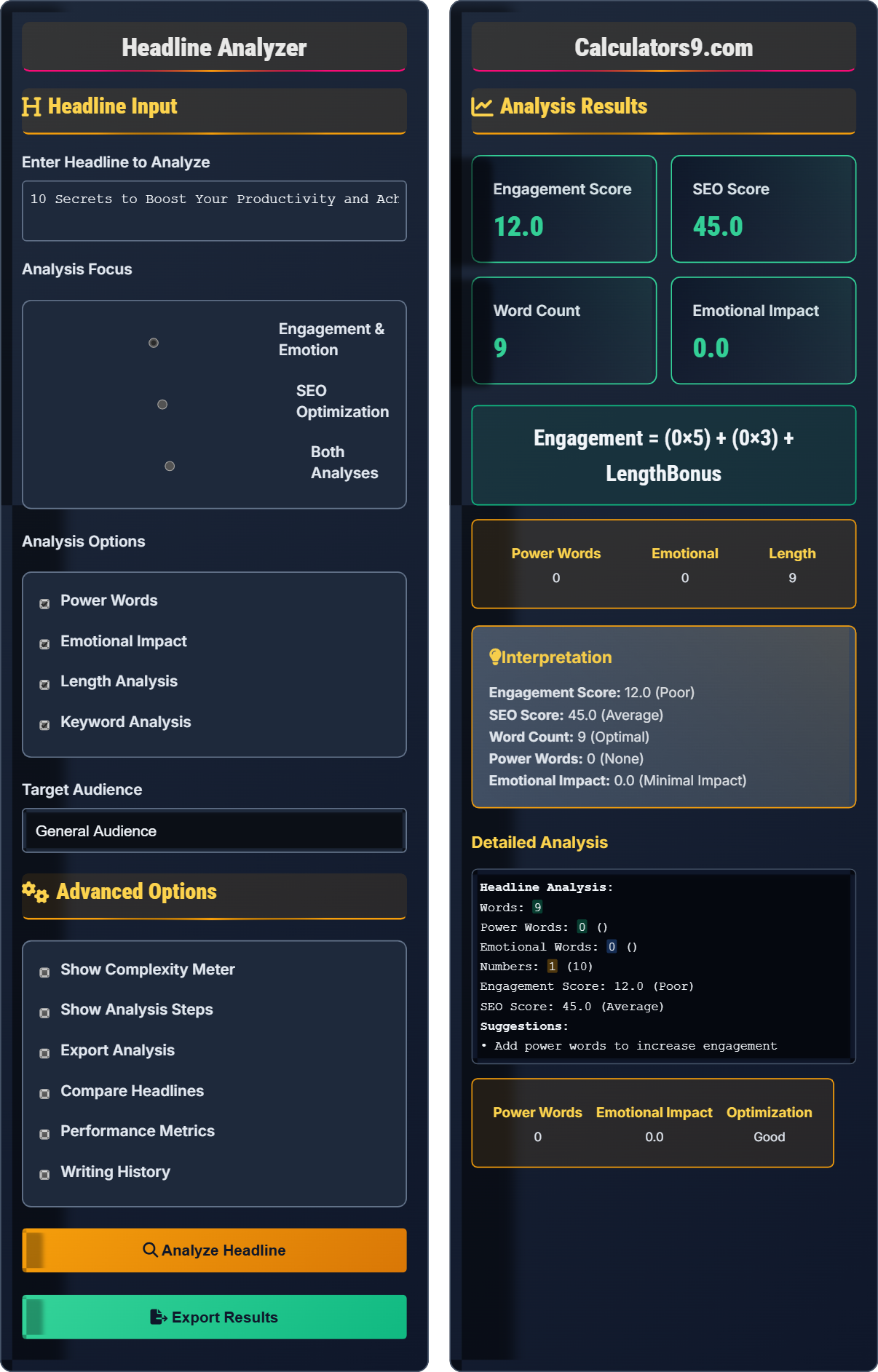
Headline Analysis Formula:
Show the analyzerEmotional Impact Score: (Power Words × 5) + (Emotional Words × 3) + (Numbers × 2) + (Questions × 4)
SEO Score: Keyword Density + Title Length + Power Words
Components:
- Power Words: Words that trigger emotions (amazing, free, secret)
- Emotional Words: Words that evoke feelings (happy, sad, excited)
- Numbers: Quantifiers that grab attention
- Questions: Curiosity-inducing titles
Optimal Headline Characteristics:
- 6-9 words for best engagement
- Start with action verbs
- Include benefit-focused language
- Use emotional triggers
- Optimize for search engines
Example: "10 Secrets to Boost Your Productivity" = High impact (10=numbers, secrets=power word)
Headline Input
Advanced Options
Analysis Results
Detailed Analysis
Comprehensive Headline Guide
Headline analysis evaluates the effectiveness of titles and headlines in capturing attention, driving engagement, and optimizing for search engines. Effective headlines use power words, emotional triggers, and strategic positioning to maximize impact.
Power Words:
Secrets- Creates curiosityFree- Offers valueAmazing- Evokes excitementProven- Builds credibilityInstant- Promises speed
Emotional Triggers:
Fear- Loss aversionHope- Positive outcomesCuriosity- Information gapUrgency- ScarcityBenefit- Value proposition
Effective headline formulas:
- How-To: "How to [Achieve Benefit] in [Time Period]"
- Lists: "[Number] [Power Word] [Topic] [Benefit]"
- Questions: "Are You [Missing Opportunity]?"
- Comparisons: "[Option A] vs [Option B]: Which is Better?"
- Announcements: "[Benefit] Now Available for [Target Audience]"
- Start strong: Lead with power words or numbers
- Be specific: Use concrete numbers and benefits
- Match content: Deliver what the headline promises
- Test variations: A/B test different approaches
- Optimize for mobile: Consider truncation on devices
- Consider emotions: Appeal to reader motivations
Headline Fundamentals
Title that captures attention.
Power words + Benefits + Curiosity = Engagement
Optimize for reader value.
- Use 6-9 words
- Include power words
- Promise value
Headline Applications
For content that needs attention.
- Blog posts
- Articles
- Product descriptions
- Marketing campaigns
- Target audience preferences
- Platform requirements
- SEO optimization
- Brand voice consistency
Headline Learning Quiz
Which of the following is considered a "power word" in headline writing?
The answer is B) Amazing. Power words are emotionally charged words that trigger immediate psychological responses. "Amazing" evokes excitement and wonder, making readers curious about what's amazing. Common power words include: secrets, free, guaranteed, proven, instant, exclusive, and amazing.
Power words work by triggering emotional responses in readers. They create curiosity, urgency, fear of missing out, or excitement. These words are strategically placed in headlines to grab attention and encourage clicks. They tap into fundamental human motivations and desires.
Power Words: Emotionally charged words that trigger responses
Emotional Trigger: Word that evokes feeling or reaction
Psychological Response: Automatic mental reaction
• Use sparingly (1-2 per headline)
• Match to audience interests
• Deliver on promises
• Place power words at beginning
• Use specific numbers
• Test different combinations
• Overusing power words
• Not delivering on promises
• Using generic terms
Analyze this headline: "5 Secrets to Lose 20 Pounds in 2 Weeks". What elements make this effective?
This headline is effective because it includes multiple engagement triggers:
- Number: "5" creates specificity and promise of organization
- Power Word: "Secrets" creates curiosity and exclusivity
- Benefit: "Lose 20 Pounds" promises specific, desirable outcome
- Time Frame: "in 2 Weeks" adds urgency and specificity
These elements combine to create a headline that promises specific value with urgency, appealing to readers seeking quick solutions.
This headline exemplifies the "list + benefit + urgency" formula. Numbers make content seem organized and digestible. Power words like "secrets" suggest exclusive information. The benefit (weight loss) addresses a common desire, and the timeframe creates urgency that motivates action.
Specificity: Concrete details that promise value
Urgency: Time pressure that motivates action
Benefit Promise: Clear value proposition
• Be specific with numbers
• Promise clear benefits
• Create urgency appropriately
• Use odd numbers (more appealing)
• Be specific about outcomes
• Match benefit to audience
• Making unrealistic promises
• Not delivering on headline
• Using vague terms
You're writing a blog post about productivity tools. Your current headline is "Productivity Tools". How could you improve this to increase engagement?
The current headline lacks specificity and emotional appeal. Improved versions could be:
- "10 Essential Productivity Tools That Will Transform Your Workday"
- "The 5 Best Productivity Apps That Actually Work"
- "How to Choose the Right Productivity Tools for Your Needs"
These improved versions add specificity (numbers), emotional appeal (transformation), and clear benefits (solve specific problems).
The original headline is too generic and doesn't promise specific value. Effective headlines answer "What's in it for me?" for the reader. They should be specific enough to promise value while being compelling enough to encourage reading.
Generic Headline: Too broad, lacks specificity
Value Proposition: Clear benefit for reader
Specificity: Concrete details that create interest
• Be specific rather than general
• Promise clear value
• Address reader pain points
• Add numbers for specificity
• Use power words
• Address reader problems
• Using generic terms
• Not addressing reader needs
• Being too vague
You're writing a post about meditation for busy professionals. Your target audience is stressed executives. How would you craft a headline that speaks to their specific needs?
For stressed executives, effective headlines might be:
- "5-Minute Meditation Techniques for Busy Executives"
- "How to Reduce Stress in 60 Seconds: Executive Edition"
- "Meditation for Busy Leaders: 3 Quick Techniques"
These headlines address the specific constraint (time) and benefit (stress reduction) that resonate with busy executives. They promise quick, practical solutions that fit into a demanding schedule.
Effective headlines must match the specific concerns and constraints of the target audience. For busy professionals, time is the primary constraint, so headlines that promise quick solutions are most effective. The benefit (stress reduction) addresses their primary concern.
Target Audience: Specific group with common needs
Constraint: Limitation that affects decision-makingBenefit: Value that addresses audience needs
• Know your audience
• Address specific constraints
• Promise relevant benefits
• Research audience pain points
• Use audience-specific language
• Test with target demographic
• Using generic headlines
• Not understanding audience
• Ignoring specific constraints
According to research, what is the optimal length for headlines to maximize engagement?
The answer is B) 6-9 words. Research shows that headlines of 6-9 words tend to perform best in terms of engagement and click-through rates. This length is long enough to convey value and specificity but short enough to be quickly readable and memorable.
The optimal headline length balances information density with readability. Too short and the headline lacks specificity; too long and it becomes overwhelming. The 6-9 word range allows for enough words to include power words, numbers, and benefits while remaining scannable.
Optimal Length: Balance of information and readability
Click-Through Rate: Percentage of viewers who click
Scannable: Quickly readable format
• 6-9 words for optimal engagement
• Consider platform requirements
• Test different lengths
• Test with A/B experiments
• Consider mobile truncation
• Include essential words only
• Making headlines too long
• Not considering platform limits
• Ignoring mobile users
FAQ
Q: How many power words should I use in a headline?
A: Research suggests using 1-2 power words per headline for optimal effectiveness. Using too many power words can make headlines seem clickbait-y or inauthentic. The most effective headlines use power words strategically:
• One power word: "5 Powerful Ways to Improve Your Skills"
• Two power words: "Amazing Secret to Double Your Productivity"
Focus on quality over quantity - choose power words that are most relevant to your audience and topic.
Q: Should I prioritize SEO or engagement when writing headlines?
A: The best approach is to balance both. Modern SEO prioritizes user engagement signals, so a headline that doesn't engage users will perform poorly in search results. Ideal headlines:
• Include relevant keywords naturally
• Use power words that appeal to your audience
• Promise clear value
• Are specific and actionable
For example: "10 Proven SEO Strategies That Actually Work in 2026" includes SEO keywords ("SEO strategies") while maintaining engagement (numbers, power words, time relevance).