Paragraph Counter
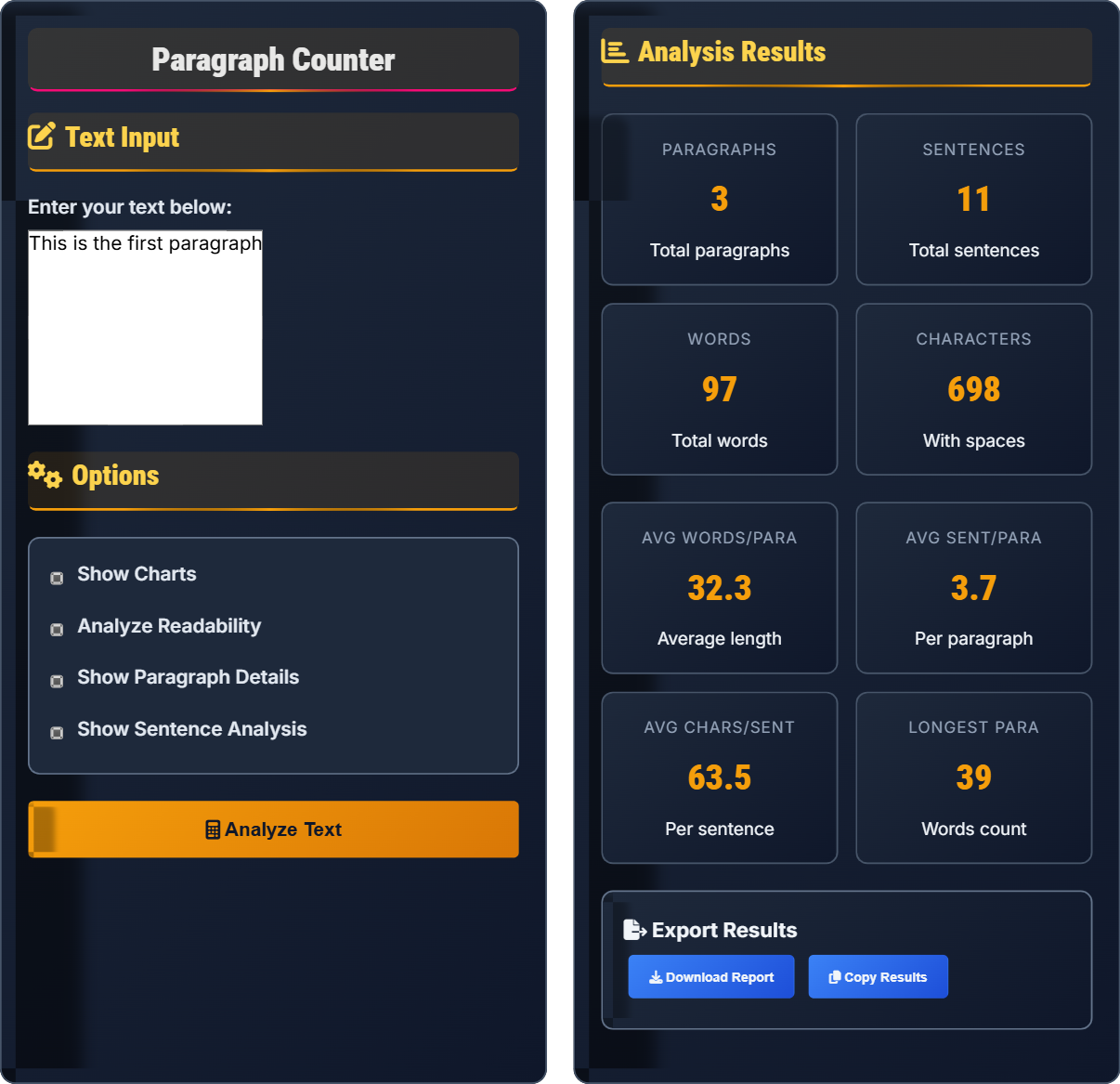
Advanced writing analysis • Text metrics • SEO insights
A paragraph counter analyzes text by counting distinct paragraphs, sentences, and words to provide comprehensive writing metrics. It identifies paragraph breaks (typically marked by double line breaks, blank lines, or indentation), calculates average paragraph length, and provides readability analysis.
Key Metrics:
- Paragraph Count: Number of distinct paragraphs
- Sentence Count: Number of sentences (ending with ., !, ?)
- Word Count: Total words in the text
- Character Count: Total characters including spaces
- Reading Level: Estimated grade level using Flesch-Kincaid formula
SEO Impact: Well-structured paragraphs improve readability and search engine comprehension. Google's algorithms favor content with clear paragraph structure, optimal paragraph length (50-100 words), and good readability scores.
Text Input
Options
Analysis Results
Export Results
Writing Analysis Insights
Paragraph analysis examines text structure by identifying individual paragraphs, measuring their length, and evaluating their effectiveness. It counts paragraphs based on formatting patterns (double line breaks, blank lines, or indentation) and provides metrics about paragraph distribution and average length.
The paragraph counter uses multiple detection algorithms:
- Double line break detection (most common)
- Blank line separation
- Indentation pattern recognition
- Sentence clustering algorithms
- Optimal paragraph length: 50-100 words
- One main idea per paragraph
- Use transition sentences between paragraphs
- Vary paragraph length for rhythm
SEO & Readability Impact
Well-structured paragraphs improve search engine crawling and indexing. Google's algorithms favor content with clear paragraph breaks, proper heading hierarchy, and readable text structure. Good paragraph organization signals content quality and relevance.
We use the Flesch-Kincaid Grade Level formula:
Grade Level = (0.39 × ASL) + (11.8 × ASW) - 15.59
Where ASL = Average Sentence Length (words/sentences) and ASW = Average Syllables per Word
SEO Writing Tips
Writing Analysis Quiz
What is the recommended optimal length for a paragraph in digital content for best SEO performance?
The answer is B) 50-100 words. This length provides enough space to develop ideas while maintaining reader engagement. Shorter paragraphs can seem choppy, while longer ones may overwhelm readers and hurt readability scores.
Paragraph length affects both human readability and search engine optimization. Search engines favor content that keeps users engaged, and well-sized paragraphs contribute to better dwell time and lower bounce rates. The 50-100 word range allows for complete thought development without cognitive overload.
Dwell Time: The amount of time a user spends on a page before returning to search results
Bounce Rate: Percentage of visitors who leave after viewing only one page
Cognitive Load: The mental effort required to process information
• Keep paragraphs focused on one main idea
• Maintain consistent length for rhythm
• End paragraphs with transition or conclusion
• Use a paragraph counter to identify overly long sections
• Break long paragraphs at logical transition points
• Aim for visual consistency across your content
• Creating walls of text without breaks
• Having inconsistent paragraph lengths
• Not considering mobile reading experience
Explain how the Flesch-Kincaid Grade Level formula works and why it's important for content optimization. Include the mathematical formula and explain each component.
The Flesch-Kincaid Grade Level formula is: Grade Level = (0.39 × ASL) + (11.8 × ASW) - 15.59
Where:
- ASL = Average Sentence Length (total words ÷ total sentences)
- ASW = Average Syllables per Word (total syllables ÷ total words)
This formula estimates the U.S. school grade level needed to understand the text. For example, a score of 8.0 means eighth-graders can understand the content.
Readability formulas help writers match their content complexity to their target audience. The Flesch-Kincaid formula balances sentence length and word complexity. Longer sentences and complex words increase the grade level, while shorter sentences and simpler words decrease it. This is crucial for SEO because search engines favor content that matches user intent and reading level.
Flesch Reading Ease: Scale from 0-100 indicating readability (higher is easier)
Syllable Counting: Method to determine word complexity
Target Audience: The intended readership demographic
• Match reading level to target audience
• Most web content should be 6th-8th grade level
• Complex topics need simpler presentation
• Use active voice to improve readability
• Replace jargon with simpler alternatives
• Test content with readability analysis tools
• Using overly complex vocabulary unnecessarily
• Writing for experts when targeting general audiences
• Ignoring readability metrics completely
A blog post has 1,200 words in 8 paragraphs, with 48 sentences total. Calculate the average words per paragraph, sentences per paragraph, and words per sentence. Based on these metrics, evaluate the content structure.
Calculations:
- Average words per paragraph = 1,200 ÷ 8 = 150 words
- Average sentences per paragraph = 48 ÷ 8 = 6 sentences
- Average words per sentence = 1,200 ÷ 48 = 25 words
Evaluation: The paragraphs are quite long (150 words vs. ideal 50-100), which may hurt readability. The sentence length is also long (25 words vs. ideal 15-20), suggesting complex sentences that could be simplified. The content would benefit from breaking longer paragraphs into shorter ones and simplifying some sentences.
This example demonstrates how paragraph and sentence metrics impact content quality. Long paragraphs can overwhelm readers, especially on mobile devices. Similarly, long sentences require more cognitive processing and can lose reader attention. Ideal content maintains a balance between thoroughness and accessibility.
Content Structure: The organization and formatting of written content
Cognitive Processing: Mental effort required to understand information
Mobile Optimization: Adapting content for mobile device consumption
• Keep paragraphs under 150 words
• Limit sentences to 15-20 words
• Balance detail with readability
• Use a paragraph counter to identify structural issues
• Break long paragraphs at logical points
• Vary sentence length for rhythm
• Prioritizing word count over readability
• Not considering mobile user experience
• Ignoring paragraph and sentence metrics
You're analyzing a competitor's article that ranks well for a target keyword. The article has 2,400 words in 12 paragraphs and 96 sentences. Calculate the metrics and explain how this structure contributes to its SEO success. Then suggest improvements.
Current metrics:
- Average words per paragraph = 2,400 ÷ 12 = 200 words
- Average sentences per paragraph = 96 ÷ 12 = 8 sentences
- Average words per sentence = 2,400 ÷ 96 = 25 words
Analysis: The long paragraphs (200 words) may hurt readability and engagement. However, the comprehensive coverage (2,400 words) provides extensive information that search engines value. To improve while maintaining SEO value: break paragraphs into 100-word sections (creating 24 paragraphs), reduce average sentence length to 15 words, and add subheadings to improve structure.
This example illustrates the balance between SEO requirements (comprehensive content) and user experience (readability). Successful content must satisfy both search engines looking for thorough information and users wanting easy-to-read content. Modern SEO heavily weighs user engagement metrics like time on page and bounce rate.
Search Intent: The purpose behind a search query
User Engagement: How users interact with content
Content Depth: Thoroughness of topic coverage
• Satisfy both search engines and users
• Balance comprehensiveness with readability
• Structure content for skimming and scanning
• Analyze successful competitors' structure
• Use subheadings to break up long content
• Maintain information density while improving readability
• Focusing only on word count for SEO
• Neglecting user experience for search rankings
• Not adapting successful strategies for your audience
Which combination of metrics indicates the best content structure for both SEO and user experience?
The answer is B) 75 words/paragraph, 15 words/sentence, 7th grade reading level. This combination provides optimal readability with paragraphs that are substantial enough to develop ideas (75 words) but not overwhelming, sentences that are clear and direct (15 words), and a reading level accessible to most adults (7th grade). This structure supports both good SEO performance and positive user experience.
Effective content strikes a balance between providing sufficient information and maintaining accessibility. The ideal metrics allow for complete thought development while keeping cognitive load manageable. The 7th-grade reading level reaches the broadest audience while still allowing for sophisticated concepts when needed.
Accessibility: How easily content can be understood by the target audience
Cognitive Load: The mental effort required to process information
Information Architecture: The structural design of shared information environments
• Aim for 7th-grade reading level for broad reach
• Keep paragraphs between 50-100 words
• Limit sentences to 15-20 words
• Use analysis tools to identify metric gaps
• Test readability with sample audiences
• Iterate based on engagement metrics
• Targeting too high a reading level
• Having inconsistent paragraph lengths
• Not testing content with actual users
FAQ
Q: How does paragraph structure affect my search engine rankings?
A: Paragraph structure significantly impacts SEO through multiple factors. Search engines like Google analyze content structure to understand context and relevance. Well-organized paragraphs with clear topic sentences help search algorithms comprehend your content's hierarchy and key points.
From a user experience perspective, proper paragraph structure improves engagement metrics that Google tracks: dwell time, bounce rate, and pages per session. When readers can easily scan and digest your content, they stay longer and explore more pages, signaling to Google that your content is valuable.
Additionally, structured content tends to perform better with featured snippets and rich results, as search engines can more easily extract relevant information from well-defined paragraphs. The ideal structure includes 50-100 word paragraphs with topic-focused opening sentences.
Q: What's the ideal paragraph length for different types of content?
A: Paragraph length varies by content type and platform:
- Web Content: 50-100 words (optimizes for screen reading and mobile)
- Academic Papers: 100-200 words (allows for detailed argument development)
- Social Media: 25-50 words (matches attention span on scrolling platforms)
- Email Newsletters: 50-75 words (balances information with scannability)
- Technical Documentation: 75-150 words (provides sufficient context for complex topics)
The key principle is matching paragraph length to your audience's cognitive capacity and the platform's consumption patterns. Digital readers have shorter attention spans and prefer scannable content, while academic readers expect more developed arguments.