Readability Checker
Text analysis • Writing optimization • 2026 edition
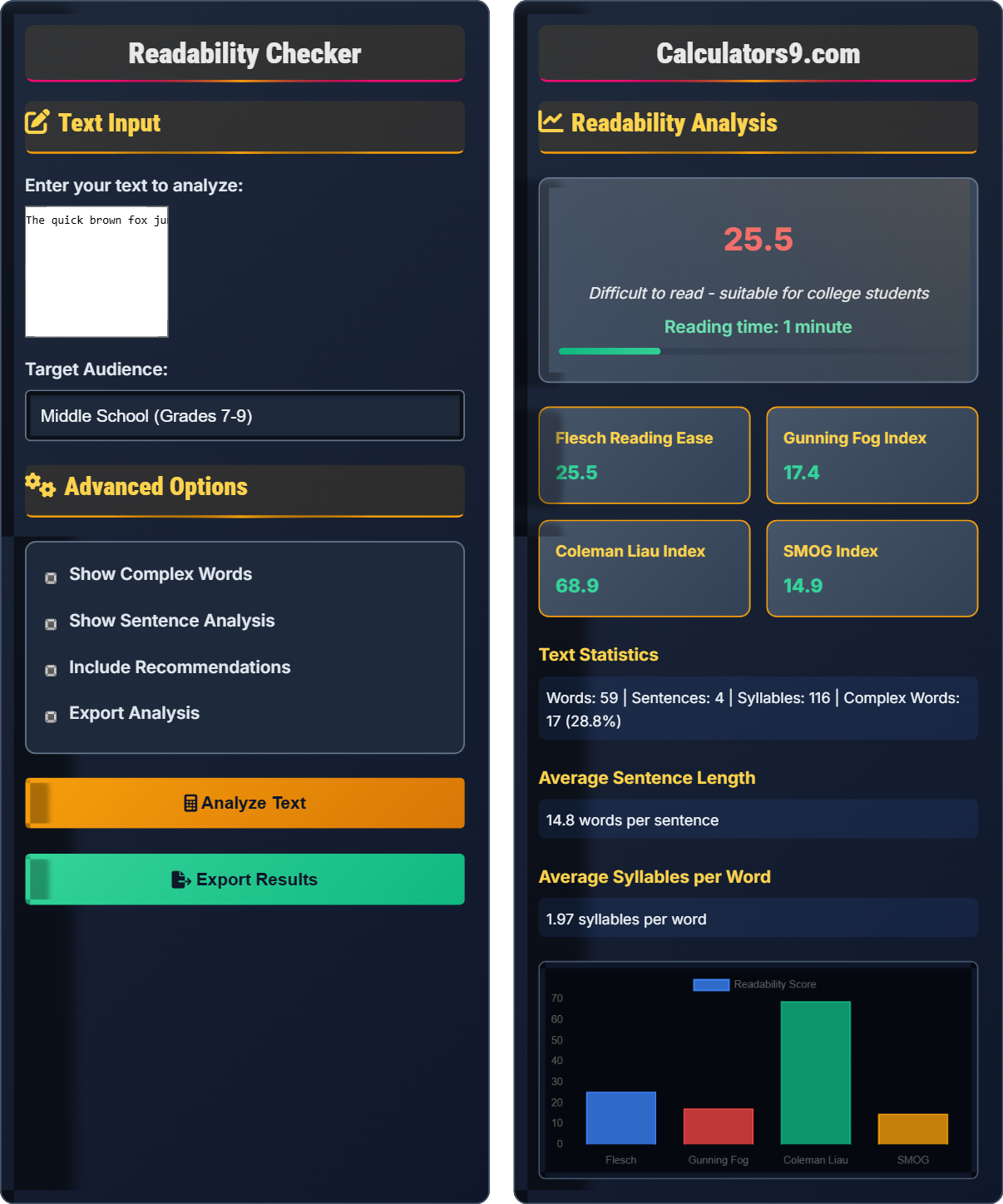
Readability Formulas:
Show the checkerFlesch Reading Ease: \(206.835 - (1.015 \times ASL) - (84.6 \times ASW)\)
Gunning Fog Index: \(0.4 \times (ASL + (100 \times PHW))\)
Where:
- ASL = Average Sentence Length (words per sentence)
- ASW = Average Syllables per Word
- PHW = Percentage of Hard Words (words with 3+ syllables)
These formulas measure text complexity and readability. Flesch scores range from 0-100 (higher = easier to read), while Gunning Fog indicates the grade level needed to understand the text.
Text Input
Advanced Options
Readability Analysis
Comprehensive Readability Guide
Readability measures how easy it is to read and understand a text. It considers factors like sentence length, word complexity, and text structure. Good readability ensures your content reaches and engages your target audience effectively.
Multiple formulas measure readability:
Where ASL = Average Sentence Length, ASW = Average Syllables per Word, PHW = Percentage of Hard Words.
- Use active voice: "The company delivered the product" vs "The product was delivered by the company"
- Keep sentences short: Aim for 15-20 words average
- Choose simple words: "Use" instead of "utilize", "help" instead of "facilitate"
- Break up complex ideas: Use bullet points and subheadings
- Define technical terms: Explain jargon when first used
Readability Metrics
Scores 0-100, higher is easier to read. Based on sentence length and word length.
Estimates grade level needed to understand text. Counts complex words and long sentences.
- Score 60+ for general audiences
- Score 80+ for broad reach
- Match score to target audience
- Test readability regularly
Optimization Tips
Simple sentences with clear subjects and verbs improve readability.
- Use common words over technical terms
- Replace Latin-based words with Germanic alternatives
- Eliminate unnecessary adverbs and adjectives
- Use concrete nouns over abstract concepts
- Use bullet points for lists
- Add subheadings for sections
- Include white space
- Use bold for emphasis
Readability Learning Quiz
What does a Flesch Reading Ease score of 75 indicate about the text?
The answer is B) Fairly easy to read. A Flesch Reading Ease score of 75 falls within the range of 70-80, which indicates the text is fairly easy to read and suitable for 7th-8th grade students. Higher scores mean easier reading, with 100 being the easiest possible score.
Understanding readability score ranges is fundamental to writing effectively for your target audience. The Flesch Reading Ease scale works in reverse - higher numbers indicate easier reading. This counterintuitive system means that a score of 90+ represents very easy text, while a score below 30 represents extremely difficult text. Writers must know these ranges to match their content to their intended readership.
Flesch Reading Ease: A readability test that measures how easy a text is to read, scoring from 0-100
Score Range: 0-30 = Very Confusing, 30-50 = Difficult, 50-70 = Fairly Difficult, 70-80 = Fairly Easy, 80-100 = Very Easy
Grade Level: The educational level required to understand the text
• Higher Flesch scores indicate easier reading
• Score of 60+ is recommended for general audiences
• Match readability to your target audience's literacy level
• Remember: Higher number = easier to read
• For business communication, aim for 60-70
• For general public content, aim for 80+
• Confusing the direction of the scale (thinking higher numbers mean harder reading)
• Not matching readability to target audience needs
• Assuming all audiences need the same readability level
Calculate the Flesch Reading Ease score for a text with 200 words, 10 sentences, and 300 syllables. Show your work.
Using the Flesch Reading Ease formula: 206.835 - (1.015 × ASL) - (84.6 × ASW)
Step 1: Calculate Average Sentence Length (ASL)
ASL = Total words ÷ Total sentences = 200 ÷ 10 = 20.0 words per sentence
Step 2: Calculate Average Syllables per Word (ASW)
ASW = Total syllables ÷ Total words = 300 ÷ 200 = 1.5 syllables per word
Step 3: Apply the formula
Flesch Score = 206.835 - (1.015 × 20.0) - (84.6 × 1.5)
= 206.835 - 20.3 - 126.9
= 59.635
The text has a Flesch Reading Ease score of approximately 60, indicating it's fairly difficult to read.
This calculation demonstrates how sentence length and word complexity affect readability. The text has an average sentence length of 20 words (longer than optimal) and 1.5 syllables per word (moderately complex), resulting in a score of 60, which suggests it would be challenging for many readers. This shows why shorter sentences and simpler words improve readability.
ASL: Average Sentence Length (words per sentence)
ASW: Average Syllables per Word
Word Complexity: Measured by syllable count per word
• ASL = Total words ÷ Total sentences
• ASW = Total syllables ÷ Total words
• Both ASL and ASW negatively impact readability scores
• Aim for ASL under 15 words per sentence
• Keep ASW under 1.4 syllables per word
• Count syllables by counting vowel sounds
• Miscounting syllables (remember silent 'e' doesn't count)
• Including punctuation in word counts
• Calculating ratios incorrectly
A marketing team has written a product description with a Flesch Reading Ease score of 45. They want to improve it to 70 to reach a broader audience. If the current text has 300 words and 15 sentences, what is the maximum average sentence length they can have while keeping the average syllables per word at 1.3 to achieve their target score?
Using the Flesch Reading Ease formula rearranged to solve for ASL:
Target score: 70 = 206.835 - (1.015 × ASL) - (84.6 × 1.3)
Step 1: Calculate the syllable component
(84.6 × 1.3) = 110.0
Step 2: Rearrange the formula
70 = 206.835 - (1.015 × ASL) - 110.0
70 = 96.835 - (1.015 × ASL)
(1.015 × ASL) = 96.835 - 70 = 26.835
ASL = 26.835 ÷ 1.015 = 26.4
Therefore, the maximum average sentence length should be approximately 26 words to achieve a score of 70 while maintaining 1.3 syllables per word.
This problem demonstrates the mathematical relationship between readability metrics. To improve from a score of 45 (difficult) to 70 (fairly easy), the team needs to reduce sentence length significantly. The calculation shows that even with controlled word complexity (1.3 syllables per word), sentences must average under 27 words to reach the target readability. This illustrates why simplifying sentence structure is crucial for improving readability.
Readability Improvement: Changing text characteristics to make it easier to read
Target Score: The desired readability level for a specific audience
Constraint: A fixed parameter that cannot be changed in the optimization
• Readability formulas can be rearranged to solve for unknown variables
• Improving readability usually requires reducing sentence length or word complexity
• Small changes in metrics can significantly impact readability scores
• Use algebra to determine what changes are needed
• Focus on the metric with the greatest impact first
• Test changes incrementally
• Not understanding how to rearrange formulas
• Forgetting that multiple metrics interact
• Overestimating the impact of small changes
A technical writer needs to prepare a manual for high school students. The Gunning Fog Index should be 10 or below (10th grade level). Their current draft has 500 words, 25 sentences, and 100 hard words (3+ syllables). How many hard words must they eliminate to meet the target, assuming the sentence length remains constant?
Using the Gunning Fog Index formula: 0.4 × (ASL + (100 × PHW))
Step 1: Calculate current ASL
ASL = 500 ÷ 25 = 20 words per sentence
Step 2: Calculate current PHW (Percentage of Hard Words)
Current PHW = (100 ÷ 500) × 100 = 20%
Step 3: Current Gunning Fog Index
GFI = 0.4 × (20 + (100 × 0.20)) = 0.4 × (20 + 20) = 0.4 × 40 = 16
Step 4: Solve for target PHW to get GFI ≤ 10
10 = 0.4 × (20 + (100 × PHW))
25 = 20 + (100 × PHW)
5 = 100 × PHW
PHW = 0.05 or 5%
Step 5: Calculate required hard words
Hard words needed = 500 × 0.05 = 25 words
Hard words to eliminate = 100 - 25 = 75 words
The writer must eliminate 75 hard words to meet the target Gunning Fog Index of 10.
This demonstrates the significant impact of complex vocabulary on readability scores. The writer started with 20% hard words (100 out of 500), resulting in a Gunning Fog Index of 16 (16th grade level), far above the target of 10. To meet the 10th-grade target, they must reduce complex vocabulary to only 5% of the text (25 hard words). This shows why technical writers must carefully control vocabulary complexity for their intended audience.
Hard Words: Words with three or more syllables
Gunning Fog Index: Estimates the grade level needed to understand text
PHW: Percentage of Hard Words in the text
• GFI = 0.4 × (ASL + (100 × PHW))
• PHW = (Hard words ÷ Total words) × 100
• Complex vocabulary significantly impacts readability scores
• Replace Latin/Greek roots with Germanic alternatives
• Use online thesauruses for simpler synonyms
• Focus on the most frequent hard words first
• Misidentifying hard words (counting syllables incorrectly)
• Not accounting for the multiplicative effect in the formula
• Underestimating the effort needed to reduce GFI
Which of the following statements about readability applications is TRUE?
The answer is C) Readability should match the target audience's education level. Effective communication requires tailoring readability to your specific audience. For example, medical information for patients should have higher readability than research papers for doctors. Matching readability to audience ensures optimal comprehension and engagement.
Readability is not about achieving the highest possible score; it's about achieving the appropriate score for your audience. A score that's too high for your audience creates barriers to understanding, while a score that's too low may seem condescending. The key principle is audience-centered writing, where readability serves as a tool to maximize communication effectiveness for the intended readers.
Audience-Centered Writing: Writing that prioritizes the reader's needs and abilities
Communication Effectiveness: How well the message achieves its intended purpose
Readability Matching: Aligning text complexity with audience capabilities
• Know your audience's literacy level
• Adjust readability accordingly
• Balance clarity with content accuracy
• Research your audience's typical reading level
• Test content with representative readers
• Use multiple readability formulas for comprehensive analysis
• Assuming all audiences need the same readability level
• Prioritizing readability over accuracy in technical content
• Not considering cultural or linguistic diversity in audiences
FAQ
Q: How do readability scores help with SEO and content optimization?
A: Readability scores significantly impact SEO performance. Search engines like Google prioritize content that provides a good user experience, which includes easy-to-read text. Content with better readability scores tends to have:
- Lower bounce rates (users stay longer)
- Higher engagement metrics
- Better social sharing rates
- Improved accessibility compliance
Additionally, readable content is more likely to generate backlinks and citations, which are important ranking factors. For optimal SEO, aim for Flesch Reading Ease scores of 60-80 for general content, ensuring it's accessible to a broad audience while maintaining authority and depth.
Q: What's the difference between various readability formulas, and which should I use?
A: Different readability formulas emphasize different aspects of text complexity:
- Flesch Reading Ease: Based on sentence length and word length (syllables). Best for general assessment.
- Gunning Fog Index: Considers sentence length and complex words. Good for business and technical writing.
- Coleman-Liau Index: Uses character count instead of syllables. More reliable for texts with many technical terms.
- SMOG Index: Based on 30-sentence sample and complex words. Good for health communications.
For most purposes, use multiple formulas together. Flesch Reading Ease gives you a quick overall assessment, while Gunning Fog helps identify complex vocabulary issues. The combination provides a comprehensive view of readability challenges.