Reading Time Estimator
Text analysis & reading speed tool • 2026 writing
Reading Time Formula:
Show the estimatorReading Time (minutes) = Words / (Words Per Minute × 60)
Standard Reading Speeds:
- Slow Reader: 150-200 WPM
- Average Reader: 200-250 WPM
- Fast Reader: 250-350 WPM
- Skimmer: 350-500 WPM
Additional Factors:
- Text complexity
- Reader familiarity with topic
- Visual layout
- Reading purpose
Example: 1000 words at 200 WPM = 5 minutes reading time
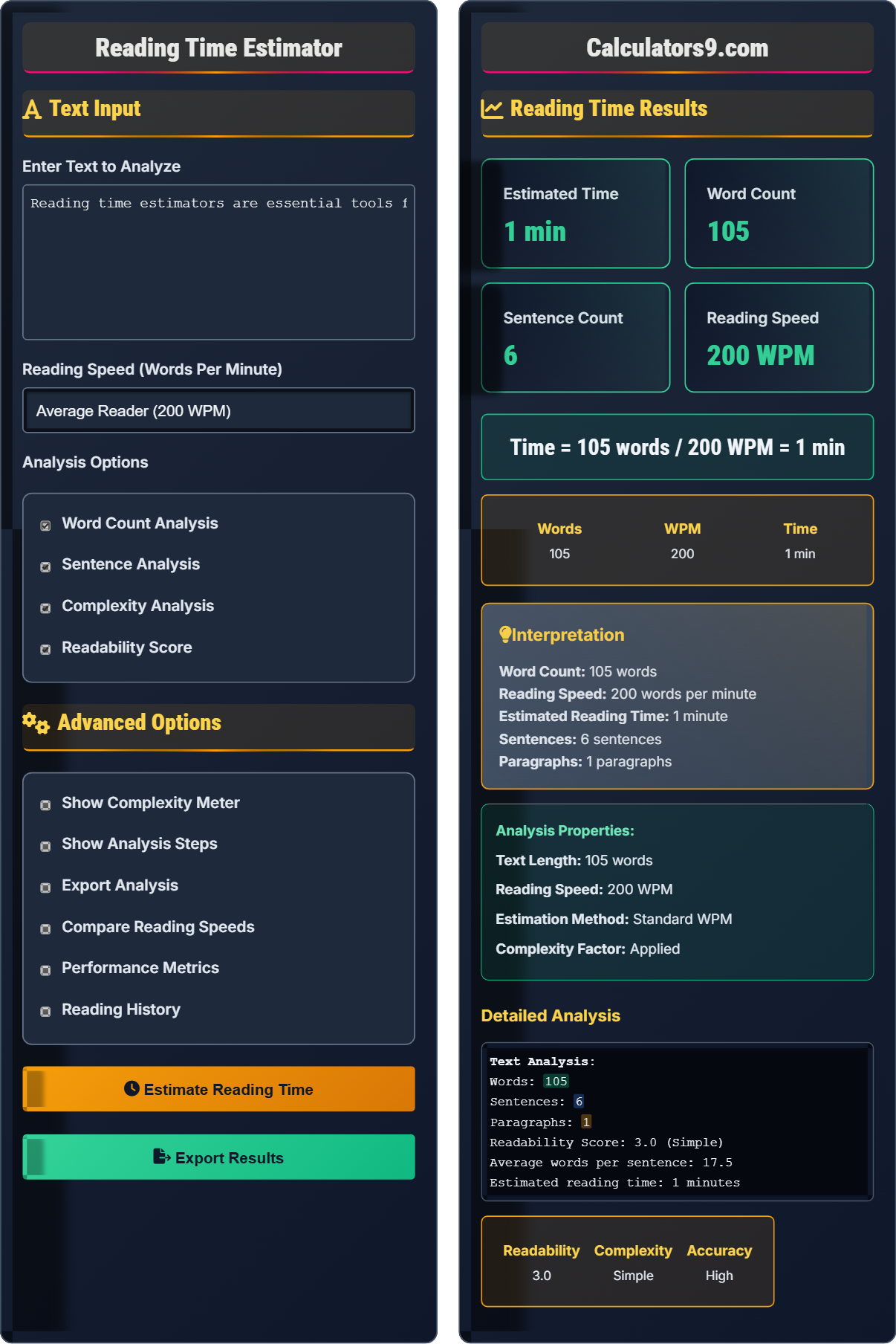
Text Input
Advanced Options
Reading Time Results
Detailed Analysis
Comprehensive Reading Time Guide
Reading time estimation is the process of calculating how long it takes an average reader to consume a piece of text. This metric helps content creators set appropriate expectations, optimize content length, and improve user engagement.
Basic Formula:
Reading Time = Total Words / Reading SpeedStandard reading speed: 200-250 WPMTime = Words / (WPM × 60) for minutes
Factors Affecting Reading Time:
- Text complexity
- Reader familiarity with topic
- Visual elements (images, code)
- Reading purpose (skimming vs deep reading)
- Layout and formatting
Reading speed varies based on several factors:
- Text Complexity: Technical or academic texts take longer
- Reader Experience: Familiar topics are read faster
- Reading Purpose: Skimming vs careful reading
- Visual Elements: Images, tables, and code slow reading
- Format: Digital vs physical reading speeds vary
- Provide estimates: Help readers plan their time
- Consider audience: Adjust for your readers' skill level
- Account for complexity: Adjust estimates for difficult content
- Include visuals: Factor in time spent viewing images
- Test accuracy: Validate your estimates with real users
Reading Time Fundamentals
Estimated duration to read text.
Time = Words / Reading Speed
Standard: 200-250 WPM.
- Adjust for text complexity
- Consider reader experience
- Account for visual elements
Reading Time Applications
For content consumption planning.
- Blog posts
- Articles
- Documentation
- Research papers
- Reader skill level
- Text complexity
- Visual elements
- Reading purpose
Reading Time Learning Quiz
What is the average reading speed for a typical adult reader?
The answer is B) 200-250 words per minute. This is the generally accepted average reading speed for typical adult readers. However, this can vary significantly based on factors like text complexity, reader familiarity with the topic, and reading purpose.
Reading speed varies greatly among individuals and contexts. The 200-250 WPM figure is a statistical average that accounts for the wide variation in reading speeds across different types of content and reader abilities.
WPM: Words Per Minute - measure of reading speed
Reading Speed: Number of words read per unit time
Typical Reader: Average adult with normal literacy skills
• 200-250 WPM is the standard
• Varies with content type
• Individual differences exist
• Use 200 WPM for conservative estimates
• Adjust for complex content
• Consider your audience's skill level
• Assuming all readers are the same speed
• Not accounting for content complexity
• Using too optimistic speed estimates
How long would it take an average reader (200 WPM) to read a 1,200-word article?
Using the formula: Time = Words / Reading Speed
Time = 1,200 words / 200 WPM = 6 minutes
However, in practice, reading time estimators often add buffer time for visual elements, pausing to process information, and potential re-reading of complex sections. So the actual estimated time might be closer to 7-8 minutes.
While the basic calculation is straightforward, real-world reading involves more than just word processing. Readers pause to understand concepts, look at images, and sometimes re-read difficult passages. Professional reading time estimators account for these factors.
Basic Formula: Words ÷ WPM = Time
Buffer Time: Additional time for processing
Real-world Factors: Elements affecting actual reading time
• Basic formula: Words ÷ WPM
• Add buffer for complex content
• Consider visual elements
• Add 20-30% buffer for complex content
• Account for images and tables
• Consider reading purpose
• Not accounting for content complexity
• Forgetting visual elements
• Using exact mathematical calculation only
You're analyzing a technical document with 2,000 words that includes code snippets, diagrams, and complex terminology. The standard reading speed is 200 WPM. How should you adjust your reading time estimate?
For technical content with visual elements:
1. Basic calculation: 2,000 words ÷ 200 WPM = 10 minutes
2. Adjust for complexity: Technical content typically reduces reading speed by 20-40%
3. Adjust for visual elements: Images, code, diagrams require additional processing time
4. Revised estimate: 10 minutes × 1.5 = 15 minutes
Therefore, the estimated reading time should be approximately 15 minutes to account for the complexity and visual elements.
Technical documents require more cognitive processing than casual reading. Readers need to understand code, interpret diagrams, and process complex terminology. This significantly slows down the reading pace compared to standard prose.
Technical Content: Material with specialized vocabulary
Visual Elements: Images, charts, code that require processing
Cognitive Load: Mental effort required to process information
• Technical content slows reading
• Visual elements add time
• Adjust estimates accordingly
• Add 50% for technical content
• Account for code and diagrams
• Consider reader expertise level
• Treating all content equally
• Not accounting for visual processing
• Using same estimates for all audiences
You're writing for a specialized audience (engineers) about a familiar topic (software development). The article is 1,500 words with some code examples. How does this affect reading time estimation compared to a general audience?
For a specialized audience reading familiar content:
1. Basic calculation: 1,500 words ÷ 200 WPM = 7.5 minutes
2. Positive factors: Audience is familiar with terminology and concepts
3. Negative factors: Code examples require careful reading
4. Net effect: Reading speed may be slightly faster than average (perhaps 220-230 WPM)
5. Revised estimate: 1,500 ÷ 225 = approximately 6.7 minutes, rounded to 7 minutes
So the reading time would be slightly less than the standard estimate due to audience familiarity.
Reader familiarity with a topic significantly affects reading speed. Experts in a field can process domain-specific language and concepts much faster than novices. However, certain elements like code examples still require careful attention regardless of expertise level.
Domain Knowledge: Familiarity with subject matter
Reading Fluency: Speed gained through familiarityExpertise Effect: Faster processing of familiar content
• Audience expertise affects speed
• Familiar content reads faster
• Still account for complex elements
• Adjust for audience expertise
• Consider topic familiarity
• Still account for visual elements
• Not considering audience expertise
• Assuming same speed for all readers
• Ignoring content-topic familiarity
Which of the following has the LEAST impact on reading time estimation?
The answer is D) Paper quality. While text complexity, visual elements, and font characteristics significantly affect reading time, paper quality has minimal impact on digital reading time estimation. For printed materials, paper quality might affect comfort but not the fundamental reading speed.
When creating reading time estimators for digital content, focus on factors that actually affect the reading process: content complexity, visual elements that require processing, and presentation format. Physical paper characteristics are irrelevant for online content.
Impact Factors: Elements affecting reading time
Relevance: How much a factor affects the metric
Digital vs Physical: Different considerations
• Focus on content-related factors
• Consider digital vs physical differences
• Prioritize significant impact factors
• Focus on content complexity
• Account for visual elements
• Consider presentation format
• Including irrelevant factors
• Not prioritizing impact factors
• Confusing digital and physical factors
FAQ
Q: How accurate are reading time estimators?
A: Reading time estimators provide reasonable approximations but vary in accuracy based on several factors:
Basic accuracy: ±10-20% for simple text
Complex content: ±30-50% due to varying comprehension speeds
Individual differences: 50-100% variation between readers
Advanced estimators account for text complexity, sentence structure, and visual elements to improve accuracy.
Q: Should I include time for images and videos in reading time estimates?
A: Yes, visual elements significantly impact total consumption time:
Images: Add 2-5 seconds per image viewed
Videos: Add full playtime to reading estimate
Charts/infographics: 10-30 seconds per item
Many professional reading time tools now account for visual elements, often adding 10-20% to the base reading time for articles with significant visual content.