Project Timeline Calculator
Plan Project Schedules & Milestones Efficiently
Project Timeline Formula:
Show the calculatorProject End Date = Start Date + (Total Duration + Buffer Time) - Holidays/Weekends
Key components of project timeline calculation:
- Duration = Sum of all task durations
- Dependencies determine sequence of tasks
- Buffer time accounts for uncertainties (typically 10-20%)
- Non-working days exclude weekends and holidays
Example: A project starting January 1, 2024, with 20 working days duration, 2 days buffer, and 2 holidays would end on January 25, 2024.
Calculating project timelines requires considering:
• Task dependencies and critical path
• Resource availability and constraints
• Risk factors and contingency plans
• Working days versus calendar days
This ensures realistic and achievable project schedules.
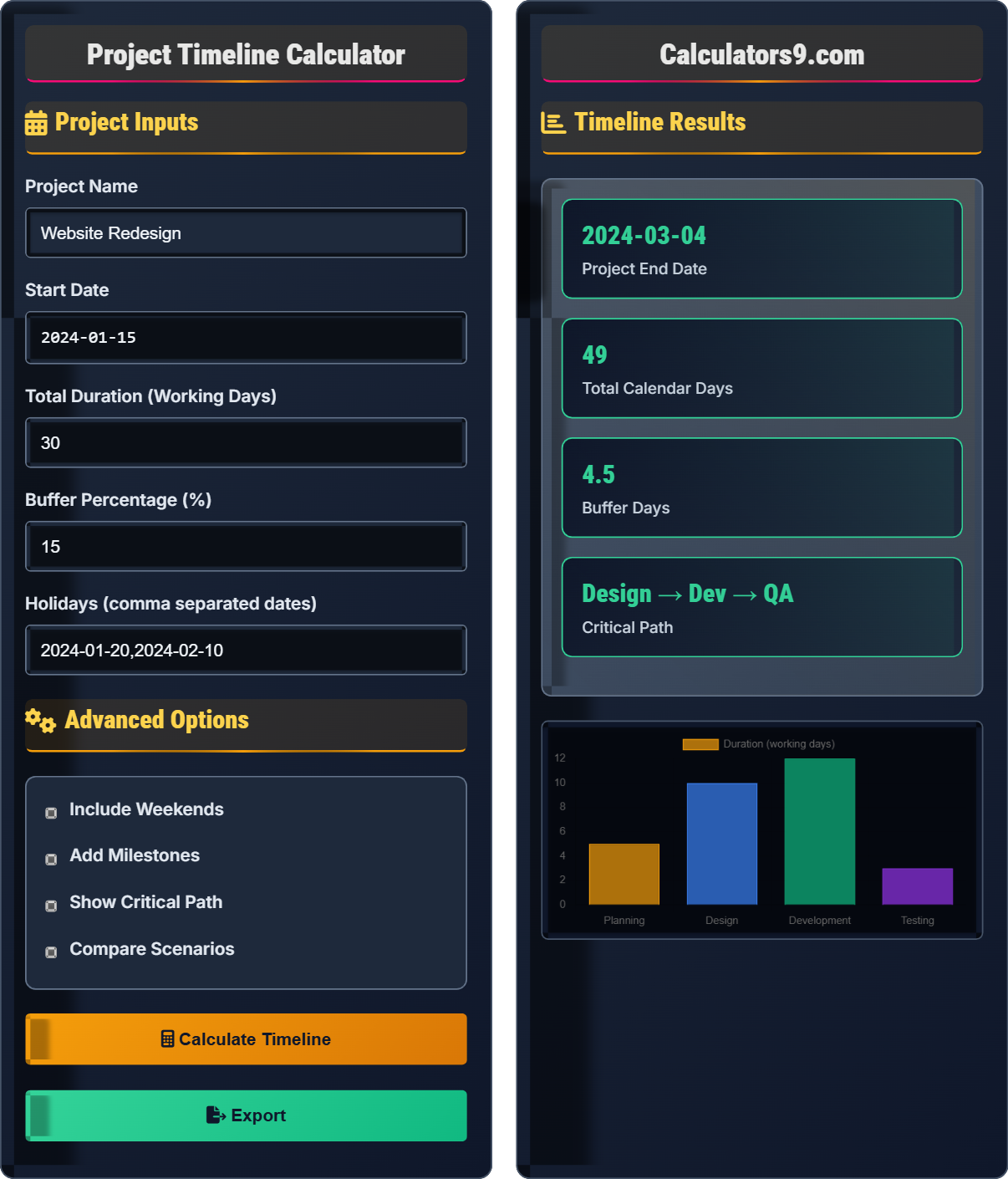
Project Inputs
Advanced Options
Timeline Results
| Phase | Duration | Start Date | End Date |
|---|---|---|---|
| Planning | 5 days | 2024-01-15 | 2024-01-20 |
| Design | 10 days | 2024-01-22 | 2024-02-02 |
| Development | 12 days | 2024-02-05 | 2024-02-21 |
| Testing | 3 days | 2024-02-22 | 2024-02-26 |
| Milestone | Date | Status |
|---|
Project Timeline Guide
A project timeline is a visual representation of a project's schedule that maps out all the key tasks, milestones, and deliverables in chronological order. It helps project managers and team members understand what needs to be done, when it needs to be done, and how long each phase will take.
Effective project timelines include several key components: start and end dates, task durations, dependencies between tasks, milestones, resource allocation, and buffer time for contingencies. The critical path represents the longest sequence of dependent tasks that determines the minimum project duration.
Projects often fail due to unrealistic timelines, failure to account for dependencies, inadequate buffer time, or not considering resource constraints. It's important to involve team members in timeline estimation and to regularly review and adjust schedules as the project progresses.
Timeline Planning Basics
Chronological sequence of project phases, tasks, and milestones with specific start/end dates.
End Date = Start Date + (Working Days + Buffer Days) - Non-working Days
Where Buffer Days = (Working Days × Buffer Percentage) / 100
- Account for weekends and holidays
- Consider task dependencies
- Include buffer time for risks
- Identify the critical path
Time Management Strategies
Sequence of tasks that determines the minimum project duration.
- Break projects into manageable tasks
- Set realistic deadlines
- Monitor progress regularly
- Update timelines as needed
- Resource availability
- Stakeholder expectations
- Risk factors
- Quality requirements
Project Timeline Learning Quiz
If a project starts on Monday, January 1, 2024, and requires 10 working days to complete, with no holidays, what is the expected completion date?
The answer is C) January 15, 2024. Starting on Monday, January 1, the 10 working days are: Jan 1, 2, 3, 4, 5 (first week), Jan 8, 9, 10, 11, 12 (second week). The 10th working day falls on Monday, January 15, 2024, after accounting for weekends.
When calculating project timelines based on working days, it's crucial to distinguish between calendar days and business days. Working days typically exclude weekends (Saturday and Sunday) and holidays. This means a 10-day project doesn't necessarily finish in 10 calendar days if weekends fall within that period.
Working Days: Business days excluding weekends and holidays
Calendar Days: All days including weekends and holidays
Project Duration: Time required to complete project tasks
• Working days exclude weekends (Sat, Sun)
• Holidays also reduce working day count
• Project end date depends on start day
• Count weekdays only when calculating working days
• Use a calendar to visualize the timeline
• Account for holidays in your region
• Confusing working days with calendar days
• Forgetting to account for weekends
• Not considering holidays in calculations
A project has three sequential phases: Phase A takes 5 days, Phase B takes 8 days, and Phase C takes 3 days. However, Phase C can start 2 days before Phase B completes. If the project starts on January 1, 2024, calculate the earliest completion date and identify the critical path. Show your work.
Let's analyze the timeline:
Phase A: Starts Jan 1, ends Jan 6 (5 working days)
Phase B: Starts Jan 7, ends Jan 16 (8 working days)
Phase C: Can start 2 days before Phase B completes, so it starts Jan 15 (2 days before Phase B ends) and ends Jan 18
Earliest completion date: January 18, 2024
Critical path: A → B (since Phase C starts before Phase B completes, the B phase determines the overall timeline)
The critical path is the sequence of tasks that determines the minimum project duration. In this case, even though Phase C has some flexibility (starting 2 days before Phase B completes), the overall project cannot finish before Phase B completes. Therefore, the critical path is A → B, totaling 13 working days. Understanding task dependencies and overlaps is essential for accurate timeline planning.
Critical Path: Longest sequence of dependent tasks determining project duration
Task Dependency: Relationship where one task must finish before another starts
Overlapping Tasks: Tasks that can partially run simultaneously
• Critical path determines minimum project duration
• Delays on critical path delay the entire project
• Non-critical tasks have float time
• Map out all dependencies visually
• Look for opportunities to overlap tasks
• Focus management efforts on critical path tasks
• Ignoring task dependencies
• Failing to identify the true critical path
• Not accounting for overlapping tasks
FAQ
Q: How do I account for resource constraints when creating project timelines?
A: Resource constraints significantly impact project timelines. Consider these approaches:
1. Resource leveling: Adjust task schedules to prevent resource overallocation.
2. Parallel processing: Assign multiple resources to tasks that can be split.
3. Dependency mapping: Identify tasks that require specific resources and plan accordingly.
4. Buffer time: Add extra time for tasks that rely on scarce resources.
5. Alternative resources: Have backup resources identified for critical tasks.
Remember that resource constraints often extend the critical path, so adjust your timeline accordingly.
Q: What's the difference between PERT and CPM in project timeline planning?
A: Both PERT (Program Evaluation and Review Technique) and CPM (Critical Path Method) are project scheduling techniques but serve different purposes:
PERT: Uses three time estimates (optimistic, pessimistic, most likely) to calculate expected duration and account for uncertainty. It's probabilistic and focuses on time-cost trade-offs.
CPM: Uses a single time estimate for each activity and identifies the critical path to minimize project duration. It's deterministic and focuses on time scheduling.
In practice, modern project management often combines both approaches, using PERT for uncertain activities and CPM for well-defined tasks. PERT is better for research projects with unknowns, while CPM works well for construction or manufacturing where processes are well understood.