Flight Delay Compensation Estimator
EU261 calculator • Air passenger rights
Flight Details
Delay Information
Exception Circumstances
Advanced Options
Compensation Results
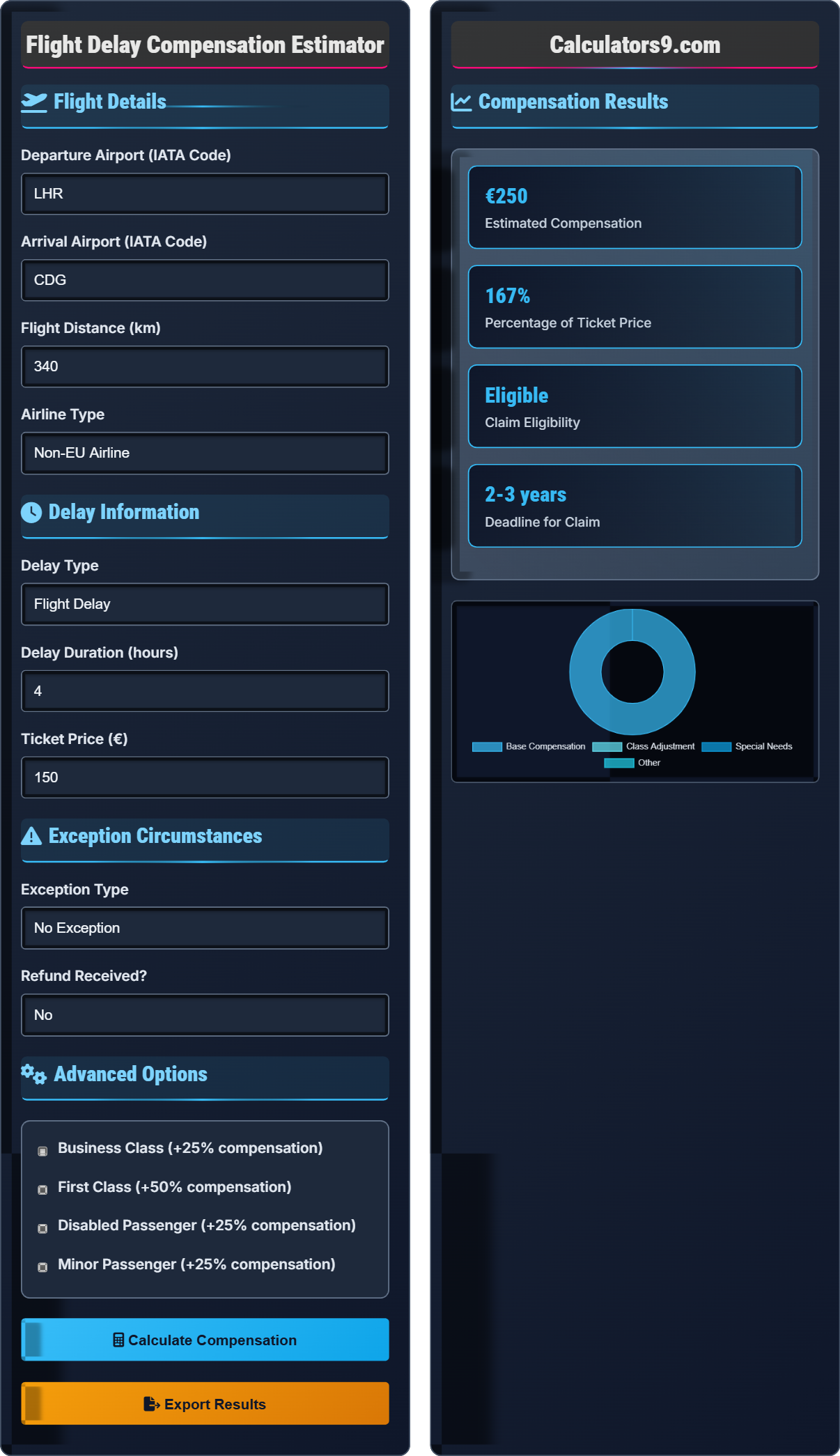
| Category | Amount (€) | Criteria |
|---|---|---|
| Base Compensation | €250 | Distance: 340 km, Delay: 4h |
| Class Adjustment | €0 | Standard class |
| Special Passenger | €0 | Standard passenger |
| Total Compensation | €250 | Sum of all adjustments |
| Requirement | Status | Details |
|---|---|---|
| Flight Origin/Destination | ✅ Met | Within EU or to/from EU with EU carrier |
| Delay Duration | ✅ Met | 3+ hours for short-haul flights |
| Exception Circumstances | ✅ Met | No extraordinary circumstances |
| Ticket Validity | ✅ Met | Valid ticket with confirmed booking |
Flight Compensation Fundamentals
EU Regulation 261/2004 establishes passenger rights for flight delays, cancellations, and denied boarding. It provides compensation ranging from €250 to €600 depending on flight distance and delay duration. The regulation applies to flights departing from EU airports and flights arriving at EU airports operated by EU carriers.
Compensation amounts are determined by flight distance and delay duration:
Maximize your compensation claim by:
- Document Everything: Keep boarding passes, delay notices, and expense receipts
- Act Quickly: File claims within the deadline (usually 2-3 years)
- Understand Exceptions: Know when airlines can avoid compensation
- Combine Rights: Claim both compensation and refunds when applicable
- Know Additional Rights: Food, accommodation, and re-routing assistance
Flight Compensation Quiz
Which flight scenario is covered by EU Regulation 261/2004?
The answer is D) Flight from London to Paris on EasyJet. EU261 covers flights departing from EU airports regardless of the airline, and flights arriving at EU airports operated by EU carriers. Options A and B are covered (departing EU), but D is the clearest example of EU261 coverage. Option C is not covered as it departs from a non-EU airport on a non-EU carrier.
This question tests understanding of EU261 jurisdiction. The regulation applies in three scenarios: 1) Any flight departing from an EU airport, 2) Any flight arriving at an EU airport operated by an EU carrier, and 3) Flights within the EU. This knowledge is crucial for determining eligibility for compensation claims.
EU Airline: Carrier with operating license from EU member state
EU Airport: Airport located in European Union territory
EU261 Coverage: Jurisdiction of EU Regulation 261/2004
• Departure from EU = EU261 coverage regardless of carrier
• Arrival at EU with EU carrier = EU261 coverage
• Non-EU departure with non-EU carrier = No EU261 coverage
• Check if flight departed from EU or arrived with EU carrier
• Verify airline's EU licensing status
• Consider connecting flights for coverage determination
• Assuming all international flights are covered by EU261
• Not verifying airline's EU licensing status
• Confusing EU261 with other passenger rights regulations
Calculate the compensation for a 2,000 km flight delayed by 4 hours. Then explain how the compensation changes if the passenger was traveling in business class and had special needs (wheelchair assistance). What is the total compensation?
Step 1: Determine base compensation
Flight distance: 2,000 km (medium-haul, 1,500-3,500 km)
Delay: 4 hours (≥3 hours threshold met)
Base compensation: €400 (medium-haul flights with ≥3h delay)
Step 2: Apply business class adjustment
Business class bonus: 25% of base compensation
Business adjustment: €400 × 0.25 = €100
Step 3: Apply special needs adjustment
Special needs bonus: 25% of base compensation
Special needs adjustment: €400 × 0.25 = €100
Step 4: Calculate total compensation
Total = Base + Business + Special Needs
Total = €400 + €100 + €100 = €600
Therefore, the total compensation is €600.
This problem demonstrates how multiple factors can increase compensation amounts. The calculation shows that adjustments are typically applied as percentages of the base compensation rather than being additive to each other. Understanding these multipliers is important for maximizing compensation claims.
Medium-haul Flight: Distance between 1,500 and 3,500 kilometers
Special Needs Passenger: Person requiring assistance due to disability
Class Adjustment: Additional compensation for premium cabin classes
• Class adjustments are percentages of base compensation
• Special needs adjustments are typically 25% of base
• Multiple adjustments can apply simultaneously
• Document premium cabin bookings for class adjustments
• Note special assistance requirements for additional compensation
• Understand how multiple factors combine
• Applying adjustments to the total rather than base compensation
• Not documenting special needs or premium cabin status
• Assuming adjustments are additive rather than percentage-based
A passenger booked a flight from Frankfurt to Barcelona (1,100 km) with Lufthansa. The flight was cancelled 2 hours before departure due to crew sickness. The airline offered a full refund and alternative flights the next day. The passenger had to book a hotel for €150 and missed an important business meeting. What compensation is the passenger entitled to?
Step 1: Determine if EU261 applies
Flight: Frankfurt (EU) to Barcelona (EU) on EU carrier (Lufthansa) = EU261 coverage
Step 2: Assess cancellation circumstances
Cancellation reason: Crew sickness (internal operational issue)
Notice provided: Less than 2 weeks (2 hours before departure)
Step 3: Calculate compensation
Flight distance: 1,100 km (short-haul ≤1,500 km)
Notice: Less than 2 weeks (full compensation applies)
Base compensation: €250 (short-haul flights cancelled with insufficient notice)
Step 4: Additional rights
Refund: Already offered by airline
Hotel expenses: €150 (reimbursable under EU261)
Therefore, passenger is entitled to €250 compensation plus €150 for hotel expenses.
This problem illustrates the distinction between compensation and reimbursement. EU261 provides both compensation for the inconvenience and reimbursement for additional expenses incurred due to the cancellation. The airline's offer of refund doesn't eliminate the right to compensation for the disruption.
Operational Issues: Internal problems that airlines cannot claim as extraordinary
Reimbursement: Compensation for additional expenses incurred
Notice Period: Time between cancellation notice and scheduled departure
• Cancellations with less than 2 weeks notice = full compensation
• Operational issues don't qualify as extraordinary circumstances
• Additional expenses are separately reimbursable
• Keep receipts for all additional expenses
• Understand the difference between compensation and reimbursement
• Don't accept refund as substitute for compensation
• Accepting refund as full settlement for cancellation
• Not claiming compensation when airline offers refund
• Confusing operational issues with extraordinary circumstances
A flight from Amsterdam to Rome (1,400 km) was delayed by 5 hours due to severe thunderstorms that grounded flights at the airport for 6 hours. The airline claims extraordinary circumstances and refuses compensation. Is the passenger eligible for compensation? Explain your reasoning.
Step 1: Assess EU261 coverage
Flight: Amsterdam (EU) to Rome (EU) = Covered by EU261
Step 2: Evaluate delay threshold
Flight distance: 1,400 km (short-haul ≤1,500 km)
Delay: 5 hours (≥3 hours threshold met)
Step 3: Assess extraordinary circumstances
Reason: Severe thunderstorms affecting airport operations
Weather conditions that affect airport operations are generally considered extraordinary circumstances under EU261
Step 4: Determine eligibility
Although delay meets EU261 criteria, the extraordinary circumstances exception applies
Therefore, the passenger is NOT eligible for compensation as the delay was caused by extraordinary circumstances beyond the airline's control.
This problem highlights the extraordinary circumstances exception, which is a critical limitation to EU261 rights. Airlines can avoid compensation if they prove the delay was caused by extraordinary circumstances that could not have been avoided even if all reasonable measures were taken. Weather-related disruptions often qualify as extraordinary circumstances.
Extraordinary Circumstances: Events beyond airline's control that couldn't be avoided
Reasonable Measures: Steps an airline should take to prevent disruption
Force Majeure: Legal concept of unforeseeable circumstances
• Weather events often qualify as extraordinary circumstances
• Airline must prove circumstances were truly extraordinary
• Technical issues usually don't qualify as extraordinary
• Research if weather affected multiple airlines
• Challenge technical issue claims as non-extraordinary
• Request documentation of extraordinary circumstances
• Assuming all delays qualify for compensation
• Not understanding extraordinary circumstances exceptions
• Accepting airline claims without verification
What is the typical deadline for filing an EU261 compensation claim?
The answer is C) 2-3 years from flight date (varies by country). EU261 does not specify a uniform deadline. Instead, the statute of limitations is governed by national law in the EU member state where the claim is filed. Most countries have deadlines between 2-3 years, but this can vary significantly. Some countries have shorter periods (e.g., 1 year in Germany), while others may have longer periods.
This question emphasizes the importance of understanding that EU261 doesn't establish a uniform deadline. The regulation is implemented through national laws, which means the statute of limitations varies by country. Passengers must be aware of the specific deadline in the jurisdiction where they plan to file their claim.
Statute of Limitations: Time limit for filing legal claims
Jurisdiction: Legal authority of a court or governing bodyImplementation: How EU regulations are enacted in national law
• EU261 doesn't specify a uniform deadline
• National laws govern statute of limitations
• Deadlines vary significantly between countries
• Research specific deadline in relevant country
• File claims as soon as possible after delay
• Consider filing in jurisdiction with longest deadline
• Assuming EU261 has a uniform deadline
• Not checking national statute of limitations
• Waiting too long to file claims
EU261 Essentials
Compensation ranges from €250-€600 depending on distance and delay. Applies to EU departures and EU arrivals with EU carriers. 2-3 year deadline varies by country.
Distance + Delay Duration = Base Compensation. Apply multipliers for premium classes and special needs.
- Short-haul (≤1,500 km): €250 for 3+ hours delay
- Medium-haul (1,500-3,500 km): €400 for 3+ hours delay
- Long-haul (>3,500 km): €600 for 4+ hours delay
Claim Strategies
Document everything, file quickly, understand exceptions, combine compensation with refunds, know additional rights (food, accommodation, re-routing).
- Verify EU261 coverage
- Confirm eligibility criteria
- Calculate compensation amount
- File claim within deadline
- Operational issues don't qualify as extraordinary circumstances
- Weather-related delays may be exempt
- Multiple passengers may claim individually
- Refunds and compensation are separate rights
FAQ
Q: Do I need to accept re-routing to claim compensation?
A: No, accepting re-routing is not required to claim compensation. You can refuse re-routing and claim compensation for cancellation. However, if you accept re-routing and arrive significantly late, you may still be eligible for delay compensation.
Q: Can I claim compensation for delays under 3 hours?
A: No, EU261 requires minimum delay thresholds (3 hours for short-haul, 4 hours for long-haul). However, you may have other rights for shorter delays under different regulations or airline policies.