Road Trip Fuel & Cost Planner
Travel budget calculator • Trip planning tool
Trip Details
Vehicle & Driver
Additional Expenses
Advanced Options
Trip Results
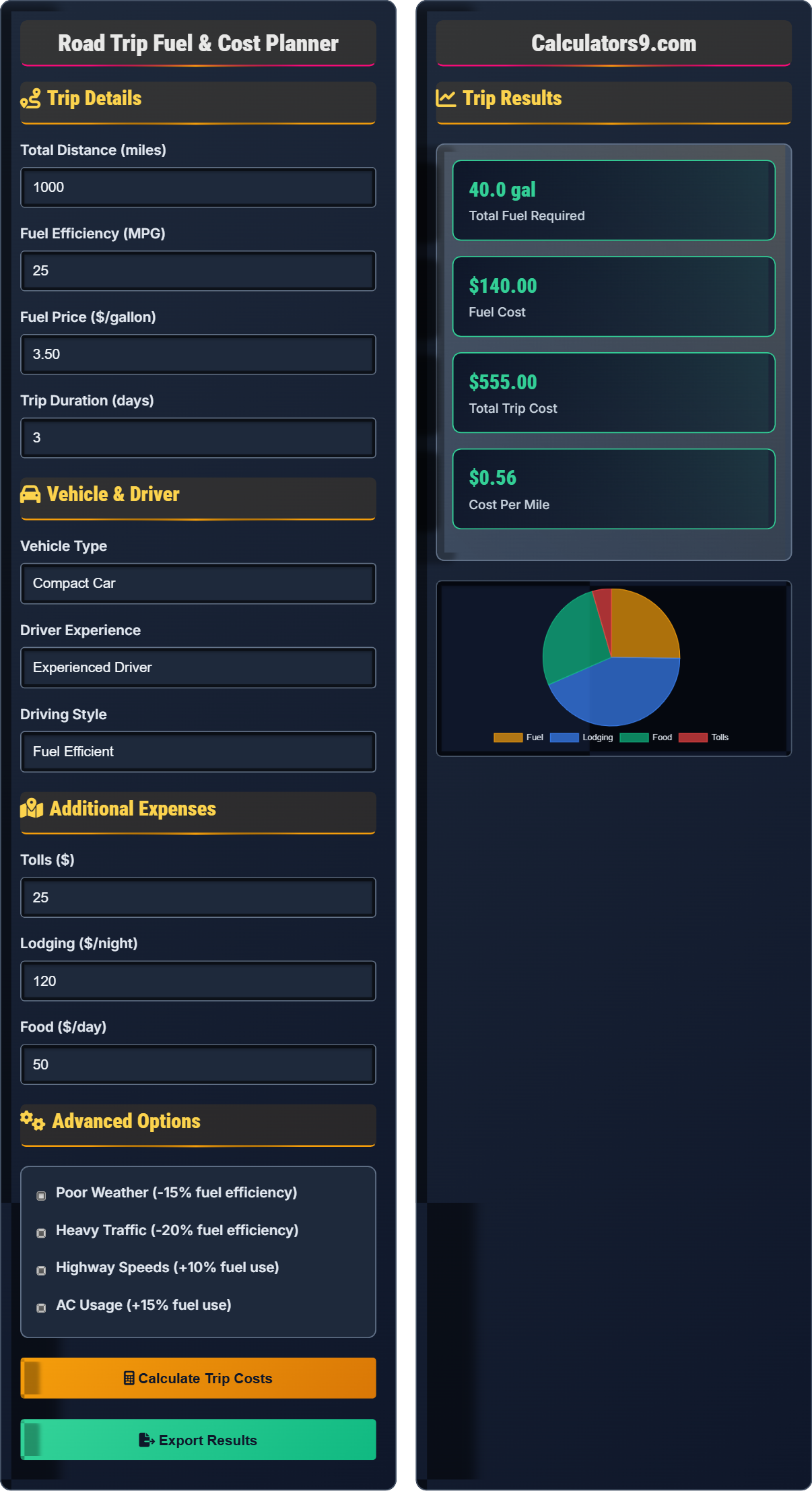
| Expense Category | Amount | % of Total |
|---|---|---|
| Fuel | $140.00 | 34% |
| Lodging | $360.00 | 87% |
| Food | $150.00 | 36% |
| Tolls | $25.00 | 6% |
| Stop # | Mile Marker | Fuel Needed | Estimated Cost |
|---|---|---|---|
| 1 | 250 | 10.0 gal | $35.00 |
| 2 | 500 | 10.0 gal | $35.00 |
| 3 | 750 | 10.0 gal | $35.00 |
| 4 | 1000 | 10.0 gal | $35.00 |
Road Trip Planning Fundamentals
Multiple factors affect your vehicle's fuel efficiency during road trips:
The basic formula for estimating road trip costs:
Several strategies can significantly reduce your road trip costs:
- Fuel Apps: Use apps to find cheapest gas stations along your route
- Accommodation: Book motels or vacation rentals instead of hotels
- Food: Pack snacks and meals to reduce restaurant expenses
- Driving: Maintain steady speeds and avoid aggressive driving
- Planning: Choose free attractions and scenic routes
Road Trip Planning Quiz
At what speed does fuel efficiency typically begin to decrease significantly?
The answer is C) 65 mph. Fuel efficiency typically begins to decrease significantly at speeds above 65 mph. For every 5 mph increase above 65 mph, fuel economy decreases by approximately 7-15%. This is due to increased aerodynamic drag and engine load.
This question highlights the relationship between speed and fuel efficiency. Many drivers assume that driving faster is more efficient, but in reality, aerodynamic drag increases exponentially with speed, making higher speeds much less fuel-efficient. This knowledge is crucial for trip planning and cost estimation.
Aerodynamic Drag: Resistance force experienced by a moving vehicle
Fuel Economy: Distance traveled per unit of fuel consumed
MPG: Miles per gallon measurement of fuel efficiency
• Fuel efficiency peaks around 45-65 mph
• Every 5 mph over 65 mph increases fuel cost by 7-15%
• Optimal speed balances time and fuel efficiency
• Maintain speeds between 45-65 mph for best efficiency
• Use cruise control on highways
• Plan for longer travel times at efficient speeds
• Assuming higher speeds are more efficient
• Not considering the exponential increase in drag
• Ignoring the impact of speed on fuel costs
Calculate the fuel cost for a 1,200-mile trip in a vehicle that gets 28 MPG, with fuel priced at $3.75 per gallon. If the driver expects to use air conditioning (increases fuel consumption by 15%) and encounters heavy traffic (reduces efficiency by 20%), what is the adjusted fuel cost?
Step 1: Calculate base fuel requirement
Fuel needed = 1,200 miles ÷ 28 MPG = 42.86 gallons
Base fuel cost = 42.86 gallons × $3.75 = $160.71
Step 2: Calculate efficiency reductions
AC effect = 15% reduction in efficiency
Traffic effect = 20% reduction in efficiency
Total efficiency reduction = 15% + 20% = 35%
Adjusted MPG = 28 × (1 - 0.35) = 28 × 0.65 = 18.2 MPG
Step 3: Calculate adjusted fuel requirement
Adjusted fuel needed = 1,200 miles ÷ 18.2 MPG = 65.93 gallons
Adjusted fuel cost = 65.93 gallons × $3.75 = $247.24
Therefore, the adjusted fuel cost is $247.24, representing a 54% increase from base conditions.
This problem demonstrates how multiple factors can compound to significantly increase fuel costs. The calculation shows that seemingly small percentage changes in efficiency can have substantial impacts on total fuel consumption and costs. Understanding these multiplicative effects is crucial for accurate trip planning.
Compounding Effects: Multiple factors that multiply rather than simply add
Efficiency Reduction: Percentage decrease in fuel economy
Fuel Surcharge: Additional cost due to adverse conditions
• Multiple efficiency reducers compound effects
• Small percentage changes can have large impacts
• Always plan for adverse conditions
• Add 10-20% buffer for adverse conditions
• Consider seasonal efficiency changes
• Plan for worst-case scenarios
• Not accounting for multiple efficiency reducers
• Assuming linear rather than compounding effects
• Underestimating the impact of adverse conditions
You're planning a 1,500-mile trip. Route A takes 22 hours with 25% highway driving, while Route B takes 26 hours with 80% highway driving. Your car gets 22 MPG in city driving and 30 MPG on highways. Fuel costs $3.60 per gallon. Which route is more economical, and what is the difference in fuel cost?
Step 1: Calculate Route A fuel consumption
Highway miles = 1,500 × 0.25 = 375 miles
City miles = 1,500 × 0.75 = 1,125 miles
Highway fuel = 375 ÷ 30 = 12.5 gallons
City fuel = 1,125 ÷ 22 = 51.14 gallons
Total fuel for Route A = 12.5 + 51.14 = 63.64 gallons
Fuel cost for Route A = 63.64 × $3.60 = $229.10
Step 2: Calculate Route B fuel consumption
Highway miles = 1,500 × 0.80 = 1,200 miles
City miles = 1,500 × 0.20 = 300 miles
Highway fuel = 1,200 ÷ 30 = 40 gallons
City fuel = 300 ÷ 22 = 13.64 gallons
Total fuel for Route B = 40 + 13.64 = 53.64 gallons
Fuel cost for Route B = 53.64 × $3.60 = $193.10
Step 3: Calculate difference
Difference = $229.10 - $193.10 = $36.00
Therefore, Route B is $36.00 more economical despite taking 4 more hours.
This problem illustrates the trade-off between time and fuel economy. While Route A is faster, Route B's higher percentage of highway driving results in significantly better fuel efficiency. This demonstrates that the fastest route isn't always the most economical, highlighting the importance of considering fuel efficiency when planning trips.
Trade-off Analysis: Evaluating competing factors in decision-making
Opportunity Cost: Value of the next best alternative forgone
Route Optimization: Selecting the most efficient travel path
• Highway driving is more fuel-efficient than city driving
• Time vs. fuel economy trade-offs exist
• Consider total cost, not just time
• Use route planning apps that consider fuel economy
• Factor in rest stops when calculating time
• Consider overnight stops for long trips
• Only considering travel time, not fuel costs
• Not accounting for city vs. highway driving ratios
• Assuming fastest route is always best
You're on a 600-mile trip in a car that gets 26 MPG. Your fuel tank holds 15 gallons and you start with a full tank. After 200 miles, you encounter a detour that adds 50 miles and reduces your fuel efficiency by 10% due to mountainous terrain. How far can you travel before needing to refuel, and how much fuel will you need to complete the original trip?
Step 1: Calculate fuel used for first 200 miles
Fuel used = 200 miles ÷ 26 MPG = 7.69 gallons
Fuel remaining = 15 - 7.69 = 7.31 gallons
Step 2: Calculate reduced efficiency due to terrain
Reduced MPG = 26 × (1 - 0.10) = 26 × 0.90 = 23.4 MPG
Step 3: Calculate distance remaining before refueling
Distance before refueling = 7.31 gallons × 23.4 MPG = 171.06 miles
Step 4: Calculate total trip distance
Total distance = 600 + 50 = 650 miles
Remaining distance after 250 miles = 650 - 250 = 400 miles
Step 5: Calculate fuel needed for remainder of trip
Fuel needed = 400 miles ÷ 23.4 MPG = 17.09 gallons
Since you have 7.31 gallons, you need 17.09 - 7.31 = 9.78 gallons more
Therefore, you can travel 171 miles before needing to refuel, and will need 9.78 gallons to complete the trip.
This problem demonstrates real-world trip planning challenges where conditions change unexpectedly. It shows the importance of understanding how terrain and other factors affect fuel efficiency, and why it's crucial to plan for contingencies. The calculation also illustrates how to determine refueling needs under changing conditions.
Range Anxiety: Worry about running out of fuel before reaching destination
Contingency Planning: Preparing for unexpected changes in conditions
Refueling Strategy: Planning fuel stops based on vehicle range
• Always monitor fuel consumption during trips
• Terrain significantly affects fuel efficiency
• Plan for contingencies and unexpected changes
• Keep at least 1/4 tank when traveling
• Use fuel apps to locate stations ahead
• Plan alternate routes in case of detours
• Not accounting for changing conditions during trip
• Assuming consistent fuel efficiency throughout journey
• Failing to plan for detours or emergencies
Which combination of strategies would most effectively reduce the cost of a 1,000-mile road trip?
The answer is B) Maintain 55 mph, use AC sparingly, pack food. This combination addresses the three major cost factors: fuel efficiency (optimal speed), fuel consumption (AC usage), and food expenses. Driving at 55 mph maximizes fuel economy, limiting AC use reduces fuel consumption by 10-15%, and packing food eliminates restaurant markups and convenience fees.
This question emphasizes the importance of addressing multiple cost factors simultaneously. The most effective cost reduction strategies target the largest expense categories: fuel, accommodation, and food. This approach demonstrates integrated trip planning that considers multiple variables for optimal results.
Integrated Planning: Considering multiple variables simultaneously
Cost Optimization: Minimizing expenses while meeting travel needs
Variable Management: Controlling multiple factors for best outcome
• Target the largest expense categories first
• Small changes in multiple areas add up
• Integrated approach is more effective than single changes
• Focus on fuel, food, and lodging costs
• Make multiple small changes for big impact
• Plan ahead to avoid expensive last-minute decisions
• Focusing on minor expenses while ignoring major ones
• Not considering the compounding effect of multiple changes
• Assuming speed always reduces total cost
Trip Planning Essentials
Typical cost: $0.40-0.75/mile. Fuel efficiency peaks at 45-65 mph. Highway driving is 20-30% more efficient than city driving.
(Distance ÷ MPG) × Price per Gallon + Additional Expenses. Add 10-15% buffer for unexpected costs.
- Fuel efficiency drops significantly above 65 mph
- Weather and terrain affect fuel consumption
- Plan refueling stops every 300-400 miles
Cost Optimization
Maintain 55-65 mph, pack food, book motels in advance, use fuel apps to find cheapest stations. Can reduce costs by 20-40%.
- Optimize driving speed
- Plan fuel stops
- Reduce food costs
- Book accommodations in advance
- Time vs. fuel economy trade-offs
- Seasonal fuel price variations
- Vehicle maintenance costs
- Emergency fund requirements
FAQ
Q: How accurate are fuel cost estimates?
A: Estimates are typically accurate to ±15% for normal conditions. Factors like traffic, weather, driving style, and elevation changes can cause variations. Always add 20-25% buffer for unexpected costs.
Q: What's the best way to reduce road trip costs?
A: Drive at 55-65 mph, pack food and snacks, book motels in advance, and use fuel apps. These strategies can reduce costs by 25-40% compared to standard travel.