Currency Exchange for Travel
Foreign exchange calculator • 2026 rates
Currency Exchange Formula:
Show the calculator\( CE = A \times R \)
Where:
- \( CE \) = Converted Amount
- \( A \) = Original Amount
- \( R \) = Exchange Rate
This formula calculates the amount of foreign currency you'll receive based on the original amount and the current exchange rate. It's essential for travel budgeting and expense planning.
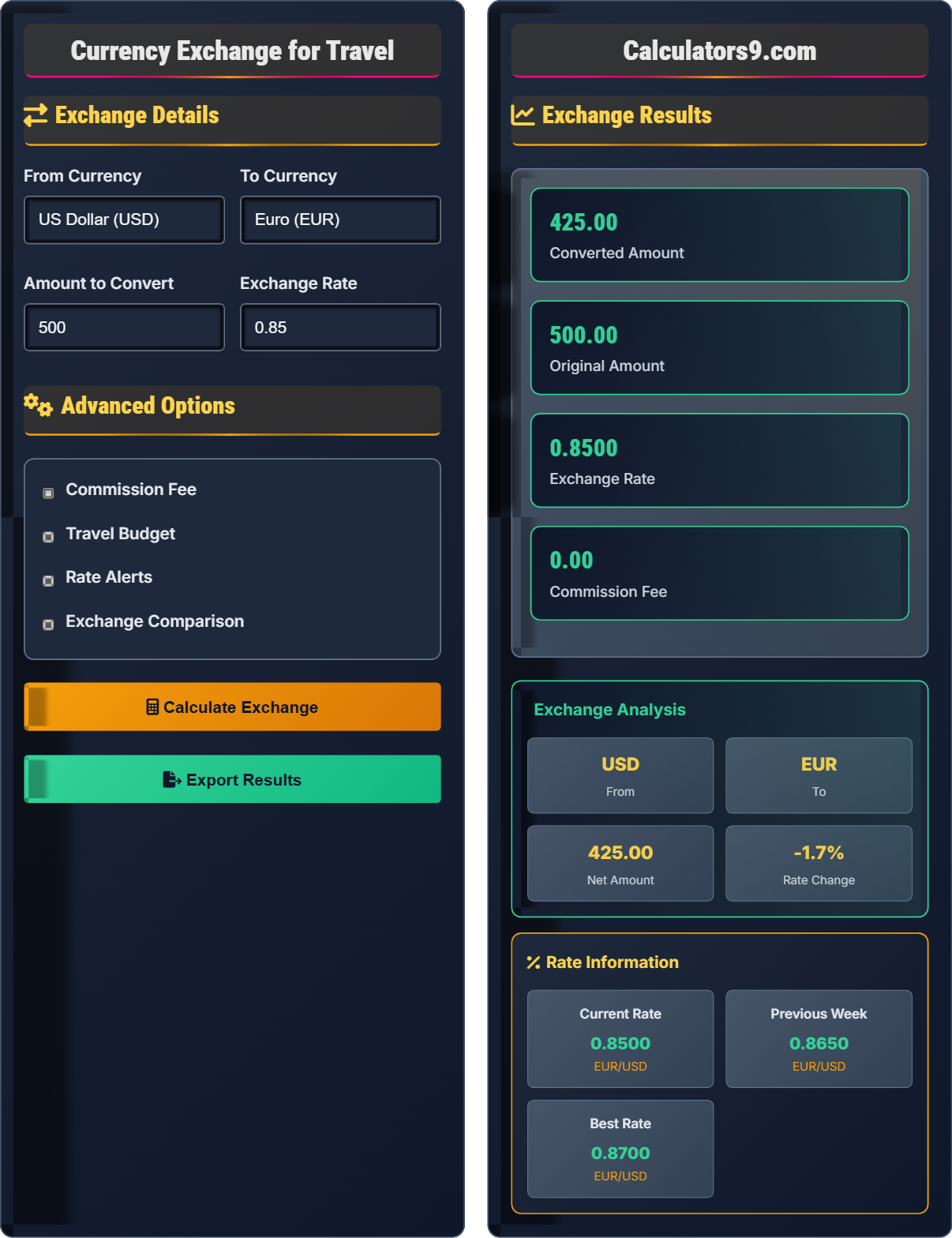
Example: Converting $500 USD to Euros at an exchange rate of 0.85 EUR per USD:
Original Amount = $500 USD
Exchange Rate = 0.85 EUR per USD
Converted Amount = 500 × 0.85 = 425 EUR
Thus, $500 USD converts to approximately 425 EUR.
Exchange Details
Advanced Options
Exchange Results
Currency Exchange Guide
Currency exchange is the process of converting one country's currency into another for international travel, business, or investment. Exchange rates fluctuate constantly based on economic factors, geopolitical events, and market demand. Understanding exchange rates is crucial for travel budgeting and avoiding unnecessary fees.
The standard currency exchange calculation uses the following formula:
Where:
- \(CE\) = Converted Amount
- \(A\) = Original Amount
- \(R\) = Exchange Rate
Common exchange fees and rates:
- Bank Exchange: 2-4% commission
- Currency Exchange Booth: 3-6% commission
- ATM Withdrawal: 2-3% + foreign fee
- Credit Card: 3% foreign transaction fee
- Online Services: 0.5-2% commission
- Monitor Rates: Track rates for weeks before exchanging
- Compare Providers: Check multiple sources for best rates
- Time Exchange: Avoid exchanging at airports
- Use Credit Cards: For purchases, avoid cash conversion fees
- Carry Backup: Have multiple payment methods
Exchange Calculation
Converting one country's currency into another at prevailing exchange rates.
\(CE = A \times R\)
Where CE=converted amount, A=original amount, R=exchange rate.
- Rates fluctuate constantly
- Fees vary by provider
- Compare before exchanging
Travel Finance
Commission charged by service providers for currency conversion.
- Estimate daily expenses
- Add 20% buffer for emergencies
- Check exchange fees
- Plan multiple payment methods
- Monitor rates before travel
- ATM fees abroad
- Credit card foreign fees
- Security concerns
- Local tipping customs
Currency Exchange Learning Quiz
A traveler needs to convert $1,200 USD to Japanese Yen (JPY). The current exchange rate is 1 USD = 145 JPY. The currency exchange service charges a 2.5% commission fee plus a flat $15 service fee. Calculate the total amount of JPY the traveler will receive after all fees. Show all calculations and explain how to compare this with other exchange options.
Step 1: Calculate Base Conversion
Base Amount = Original Amount × Exchange Rate
Base Amount = $1,200 × 145 = 174,000 JPY
Step 2: Calculate Commission Fee
Commission Fee = Base Amount × Commission Rate
Commission Fee = 174,000 × 0.025 = 4,350 JPY
Step 3: Calculate Total Fees
Total Fees = Commission Fee + Service Fee
Total Fees = 4,350 + 15 = 4,365 JPY
Step 4: Calculate Net Amount
Net Amount = Base Amount - Total Fees
Net Amount = 174,000 - 4,365 = 169,635 JPY
The traveler will receive 169,635 JPY after all fees. To compare with other options, calculate the effective exchange rate:
Effective Rate = Net Amount ÷ Original Amount
Effective Rate = 169,635 ÷ 1,200 = 141.36 JPY per USD
Compare this effective rate (141.36) to other providers to find the best deal.
This problem demonstrates how multiple fees can significantly impact the final amount received in currency exchange. The commission fee is calculated as a percentage of the converted amount, while the service fee is a flat rate. Both fees reduce the final amount, and understanding how they're calculated helps travelers make informed decisions. The effective exchange rate calculation allows for apples-to-apples comparison between different providers with varying fee structures.
Exchange Rate: Value of one currency relative to another
Commission Fee: Percentage charged for currency conversion
Effective Exchange Rate: Rate after all fees are considered
• Fees reduce the final converted amount
• Effective rate allows for comparison between providers
• Flat fees matter more for smaller transactions
• Calculate effective rate for comparison
• Larger transactions benefit more from low percentage fees
• Small transactions are more affected by flat fees
• Forgetting to account for flat service fees
• Not calculating effective exchange rates
• Assuming percentage fees are the only cost factor
A business traveler needs to convert $3,000 USD to Euros for a trip. Three exchange providers offer different deals: Provider A: 0.85 EUR/USD rate with 2% commission; Provider B: 0.84 EUR/USD rate with 1% commission; Provider C: 0.86 EUR/USD rate with 3% commission. Which provider gives the best deal? Calculate the final amount for each provider and determine the difference between the best and worst options.
Provider A:
Base Amount = $3,000 × 0.85 = 2,550 EUR
Commission = 2,550 × 0.02 = 51 EUR
Net Amount = 2,550 - 51 = 2,499 EUR
Provider B:
Base Amount = $3,000 × 0.84 = 2,520 EUR
Commission = 2,520 × 0.01 = 25.20 EUR
Net Amount = 2,520 - 25.20 = 2,494.80 EUR
Provider C:
Base Amount = $3,000 × 0.86 = 2,580 EUR
Commission = 2,580 × 0.03 = 77.40 EUR
Net Amount = 2,580 - 77.40 = 2,502.60 EUR
Comparison:
Best Deal: Provider C (2,502.60 EUR)
Worst Deal: Provider B (2,494.80 EUR)
Difference: 2,502.60 - 2,494.80 = 7.80 EUR
Provider C offers the best deal despite the highest commission rate because the superior exchange rate more than compensates for the higher fee.
This problem illustrates that the best exchange deal isn't always obvious. Provider C had the highest commission rate (3%) but offered the best overall deal due to the superior exchange rate (0.86). This demonstrates the importance of calculating the net result rather than focusing on individual components. The difference between the best and worst options was only 7.80 EUR, showing that for this amount, the choice didn't make a dramatic difference, but the principle of comparing net results is crucial for larger transactions.
Exchange Rate: Value of one currency relative to another
Commission Rate: Percentage charged for currency conversion
Net Result: Final amount after all fees are deducted
• Compare net results, not individual components
• Calculate the total cost including all fees
• Compare effective rates between providers
• Consider transaction size when evaluating fees
• Focusing only on exchange rate without considering fees
• Focusing only on fees without considering exchange rate
• Not calculating the net result for comparison
FAQ
Q: What's the difference between the interbank rate and retail exchange rates, and how do margins affect my conversion?
A: Understanding the difference between interbank and retail rates is crucial for currency exchange:
Interbank Rate:
- Definition: The wholesale rate at which large banks trade currencies with each other
- Volume: Traded in millions of dollars per transaction
- Spread: Very narrow margin (often 0.0001-0.0005)
- Accessibility: Only available to financial institutions
- Transparency: Updated in real-time globally
Retail Rate:
- Definition: The rate offered to individual consumers by banks and exchange services
- Margin: Significantly wider spread (often 2-4%)
- Components: Interbank rate + markup + fees
- Frequency: Updated less frequently (sometimes daily)
- Markup: Varies significantly between providers
Margin Impact:
- Simple Markup: Adding 2-4% to interbank rate
- Hidden Fees: Additional charges not clearly disclosed
- Spread: Difference between buy and sell rates
- Effective Cost: Total percentage lost in conversion
Practical Example: If the interbank rate is 0.8500 EUR/USD, a provider might offer 0.8330 EUR/USD to customers (2% markup). When selling back, they might offer 0.8670 EUR/USD, creating a 4% spread.
Optimization Tips:
- Compare Total Cost: Calculate net amount received, not just rate
- Check All Fees: Include commissions, spreads, and service charges
- Timing: Exchange when rates are favorable
- Method: Online services often offer better rates than physical locations
Q: How should I manage currency exchange for a multi-country business trip to minimize fees and maximize value?
A: Multi-country business trips require strategic currency management to minimize costs:
Pre-Trip Planning:
- Research Destinations: Identify which countries use the same currency (e.g., Eurozone)
- Monitor Rates: Track exchange rates for 2-4 weeks before travel
- Set Target Rates: Identify favorable rates to exchange at
- Prepare Multiple Methods: Mix cash, cards, and digital wallets
- Notify Banks: Alert financial institutions of travel plans
Exchange Strategy:
- Primary Currency: Exchange to main currency for region (e.g., EUR for Europe)
- Secondary Conversion: Convert locally to smaller countries (often better rates)
- ATM Strategy: Use home bank ATMs or partners to minimize fees
- Card Selection: Use cards without foreign transaction fees
- Cash Reserves: Keep backup cash in primary currency
On-the-Go Management:
- Mobile Apps: Use apps to track rates and find best local exchange services
- Receipts: Keep all exchange receipts for expense reporting
- Security: Distribute cash across different locations
- Rate Monitoring: Check rates daily to optimize timing
- Leftover Currency: Exchange back at destination if favorable
Business-Specific Considerations:
- Expense Policies: Follow company guidelines for currency expenses
- Receipt Requirements: Obtain official receipts for all exchanges
- Reporting: Track exchange rates for accurate expense reporting
- Reimbursement: Understand how company handles currency fluctuations
Tools and Resources: Use XE, OANDA, or other financial services for accurate rates. Consider prepaid travel cards for budget control and security.