Flight Time Calculator
Travel duration planner • 2026 routes
Flight Time Formula:
Show the calculator\( FT = AT + LT + WT \)
Where:
- \( FT \) = Total Flight Time
- \( AT \) = Actual Flight Time (Air Time)
- \( LT \) = Layover Time
- \( WT \) = Waiting Time (Airport Procedures)
This formula calculates the total time commitment for air travel, including actual flying time, layovers, and time spent on ground procedures. It helps travelers plan their schedules accurately.
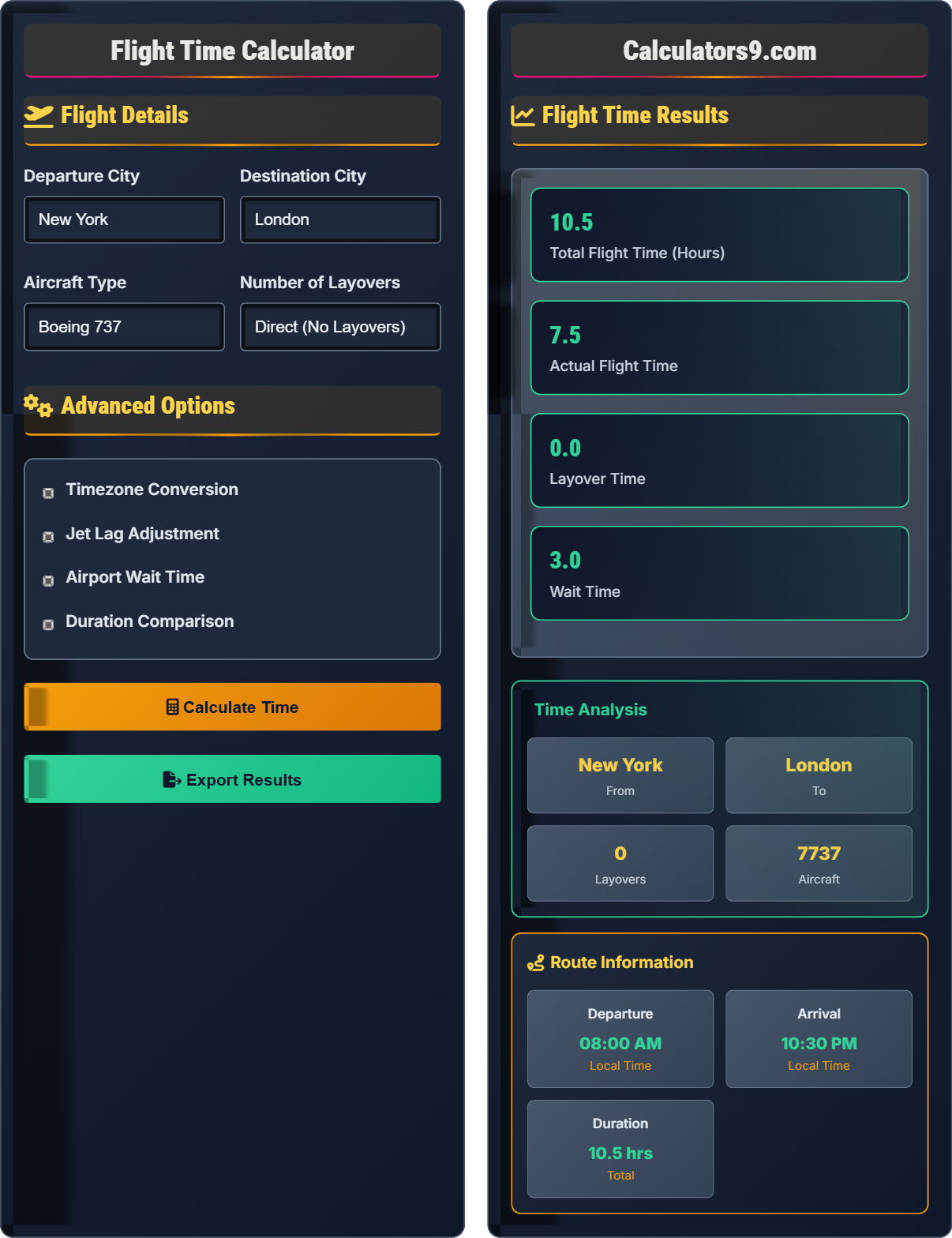
Example: For a flight from New York to London with 7.5 hours of actual flight time, 2 hours of layover, and 3 hours of airport procedures:
Actual Flight Time = 7.5 hours
Layover Time = 2.0 hours
Waiting Time = 3.0 hours
Total Flight Time = 7.5 + 2.0 + 3.0 = 12.5 hours
Thus, the total time commitment for the journey would be approximately 12.5 hours.
Flight Details
Advanced Options
Flight Time Results
Flight Time Planning Guide
Flight time encompasses the total duration of an air journey, including actual flying time, layovers, and ground procedures. Understanding flight time is crucial for travel planning, as it affects scheduling, jet lag preparation, and overall trip duration. Flight time differs from air time, which only counts the actual flying portion between takeoff and landing.
The standard flight time calculation uses the following formula:
Where:
- \(FT\) = Total Flight Time
- \(AT\) = Actual Flight Time (Air Time)
- \(LT\) = Layover Time
- \(WT\) = Waiting Time (Airport Procedures)
Different aircraft types have varying speeds that affect flight duration:
- Boeing 737: 530 mph (850 km/h) cruising speed
- Airbus A320: 537 mph (864 km/h) cruising speed
- Boeing 787: 560 mph (901 km/h) cruising speed
- Airbus A350: 560 mph (901 km/h) cruising speed
- Concorde: 1,354 mph (2,179 km/h) supersonic speed
- Choose Direct Flights: Eliminate layover time completely
- Book Morning Flights: Generally have fewer delays than afternoon/evening flights
- Consider Aircraft Type: Faster planes reduce actual air time
- Plan Airport Time: Arrive at appropriate times to minimize wait
- Timezone Awareness: Account for jet lag recovery time
Flight Time Calculation
Flight time is the total duration of an air journey including flying time, layovers, and ground procedures.
\(FT = AT + LT + WT\)
Where FT=total flight time, AT=actual time, LT=layover time, WT=waiting time.
- Direct flights eliminate layover time
- Ground procedures typically require 2-3 hours
- Timezone differences affect local arrival times
Travel Planning
Temporary disruption of circadian rhythms caused by rapid travel across multiple time zones.
- Arrive at airport 2-3 hours before departure
- Plan for 30-60 minute layovers minimum
- Account for timezone differences
- Allow jet lag recovery time
- Security wait times vary by airport
- Weather can affect flight duration
- Boarding times vary by airline
- Baggage claim takes 10-45 minutes
Flight Time Learning Quiz
A traveler is flying from Los Angeles to Tokyo with a layover in San Francisco. The first leg (LA to SF) takes 1.5 hours, with a 2-hour layover. The second leg (SF to Tokyo) takes 11 hours. The traveler spends 2.5 hours at the LA airport for check-in and security, and 1.5 hours at the Tokyo airport for immigration and baggage claim. Calculate the total time commitment for this journey. Show all calculations and explain how layover time affects the overall travel experience.
Step 1: Calculate Actual Flight Time
Flight Time = LA to SF + SF to Tokyo
Flight Time = 1.5 hours + 11.0 hours = 12.5 hours
Step 2: Calculate Layover Time
Layover Time = 2.0 hours (at SF)
Step 3: Calculate Ground Procedures
Ground Time = LA Airport Time + Tokyo Airport Time
Ground Time = 2.5 hours + 1.5 hours = 4.0 hours
Step 4: Calculate Total Time Commitment
Total Time = Flight Time + Layover Time + Ground Procedures
Total Time = 12.5 + 2.0 + 4.0 = 18.5 hours
The total time commitment for the journey is 18.5 hours. The layover in San Francisco adds 2 hours to the overall travel time, which is significant but necessary for this route. Longer layovers allow for rest and refreshment, but also extend the total travel time commitment.
This problem demonstrates how flight time extends beyond just the time spent in the air. The layover in San Francisco represents a necessary ground stop that adds to the total travel time without advancing the passenger toward their destination. The ground procedures at both ends of the journey (check-in/security at departure and immigration/baggage at arrival) are essential components of air travel that must be factored into total time planning.
Flight Time: Total duration of air travel including flying, layovers, and ground procedures
Layover: Scheduled stop at an intermediate airport during a journey
Ground Procedures: Airport activities including check-in, security, and baggage claim
• Layover time adds to total travel time without moving toward destination
• Ground procedures are necessary and must be planned for
• Total time commitment exceeds actual flight time significantly
• Choose shorter layovers to minimize total travel time
• Allow sufficient layover time to avoid missed connections
• Plan ground procedures time based on airport size and complexity
• Only counting actual flight time in travel planning
• Underestimating ground procedure time
• Not accounting for layover time in total travel commitment
A business traveler needs to get from Chicago to London. Option A: Direct flight taking 8 hours with 3 hours of ground time. Option B: Flight with 1 layover taking 6 hours total flying time, 1.5 hours layover, and 2.5 hours ground time. Option C: Flight with 2 layovers taking 5.5 hours flying time, 3 hours total layover time, and 2 hours ground time. Which option minimizes total travel time? Calculate the total time for each option and explain which would be best for a business traveler prioritizing efficiency.
Option A: Direct Flight
Formula: FT = AT + LT + WT
Total Time = 8.0 + 0.0 + 3.0 = 11.0 hours
Option B: 1 Layover
Total Time = 6.0 + 1.5 + 2.5 = 10.0 hours
Option C: 2 Layovers
Total Time = 5.5 + 3.0 + 2.0 = 10.5 hours
Comparison:
Option B is the most efficient with 10.0 hours total, followed by Option C (10.5 hours) and Option A (11.0 hours). Surprisingly, Option B is fastest despite having a layover, because it has significantly less actual flying time and moderate layover time.
For a business traveler prioritizing efficiency, Option B is best. Although it includes a layover, the total time commitment is lowest. The shorter actual flight time might also mean less fatigue despite the connection.
This problem challenges the common assumption that direct flights are always fastest. Sometimes, longer direct flights with slower aircraft or less efficient routes can take more total time than well-planned connecting flights. The key insight is that total travel time (including all components) matters more than just flight time. Business travelers should consider the complete time commitment when optimizing their schedules.
Travel Efficiency: Minimizing total time commitment for a journey
Direct Flight: Journey without intermediate stops
Connecting Flight: Journey with one or more intermediate stops
• Direct flights aren't always the fastest option
• Total time commitment includes all components
• Aircraft efficiency affects actual flight time
• Compare total time commitments, not just flight times
• Consider aircraft type and efficiency
• Factor in layover quality and airport facilities
• Assuming direct flights are always fastest
• Only comparing actual flight times
• Not considering ground procedure times
FAQ
Q: How do I account for jet lag when calculating total travel time, and what factors influence the severity of jet lag?
A: Jet lag is a significant consideration for travel time calculations, especially for long-haul flights. Here's how to account for it:
Jet Lag Calculation:
- Rule of Thumb: Expect 1 day of recovery per time zone crossed
- Eastward Travel: Typically more severe, recovery may take longer
- Westward Travel: Generally easier, recovery may be faster
- Individual Variation: Age, health, and sleep patterns affect recovery
Factors Influencing Severity:
- Number of Time Zones: More zones = more severe jet lag
- Direction of Travel: Eastward typically harder than westward
- Duration of Travel: Longer flights may intensify symptoms
- Age: Older travelers may experience more severe symptoms
- Pre-existing Conditions: Sleep disorders or medications may worsen effects
- Flight Conditions: Cabin pressure, humidity, and lighting affect comfort
Recovery Time Estimation:
- 1-3 time zones: 1-2 days recovery
- 4-6 time zones: 3-4 days recovery
- 7+ time zones: 4-7 days recovery
Accounting in Travel Planning: Add 1-2 days to your total travel time for jet lag recovery when planning important meetings or activities after long-haul flights. Consider adjusting your schedule to arrive earlier to allow for recovery.
Q: What's the difference between flight time and air time, and how do airlines determine actual flight duration?
A: The distinction between flight time and air time is important for accurate travel planning:
Flight Time vs. Air Time:
- Air Time: Actual time spent airborne between takeoff and landing. This is the pure flying duration.
- Flight Time: Total time from gate departure to gate arrival, including taxi time before takeoff and after landing.
- Block Time: Same as flight time - from pushback to parking.
Airline Flight Duration Calculation:
- Historical Data: Airlines use historical flight records for the same route
- Aircraft Performance: Cruising speed, fuel consumption, and operational capabilities
- Route Distance: Great circle distance between airports
- Wind Patterns: Prevailing winds that affect headwinds/tailwinds
- Air Traffic Control: Expected routing and potential delays
- Weather Conditions: Potential for turbulence or weather-related delays
Factors Affecting Actual Duration:
- Headwinds/Tailwinds: Can add/subtract significant time (up to 1-2 hours)
- Air Traffic Congestion: Delays during takeoff or landing
- Weather Conditions: Turbulence may require altitude/route changes
- Technical Issues: Mechanical problems or maintenance issues
- Regulatory Requirements: Extended taxi times for safety protocols
Practical Implications: Airlines typically add buffer time to scheduled durations to account for variability. Actual flight time may differ from scheduled time by ±30 minutes for domestic flights and ±1 hour for international flights.