Luggage Weight Calculator
Travel baggage planner • 2026 limits
Luggage Weight Formula:
Show the calculator\( LW = \sum_{i=1}^{n} W_i \)
Where:
- \( LW \) = Luggage Weight
- \( W_i \) = Weight of Item i
- \( n \) = Total Number of Items
This formula calculates the total weight of luggage by summing the weights of all items packed. It helps travelers stay within airline baggage limits and avoid excess fees.
Example: For a suitcase containing: 5 shirts (0.5 lbs each), 3 pairs of pants (0.8 lbs each), 1 laptop (4 lbs), and 1 pair of shoes (2 lbs):
Clothing Weight = (5 × 0.5) + (3 × 0.8) = 2.5 + 2.4 = 4.9 lbs
Electronics Weight = 4 lbs
Footwear Weight = 2 lbs
Total Luggage Weight = 4.9 + 4 + 2 = 10.9 lbs
Thus, the total luggage weight would be approximately 10.9 lbs.
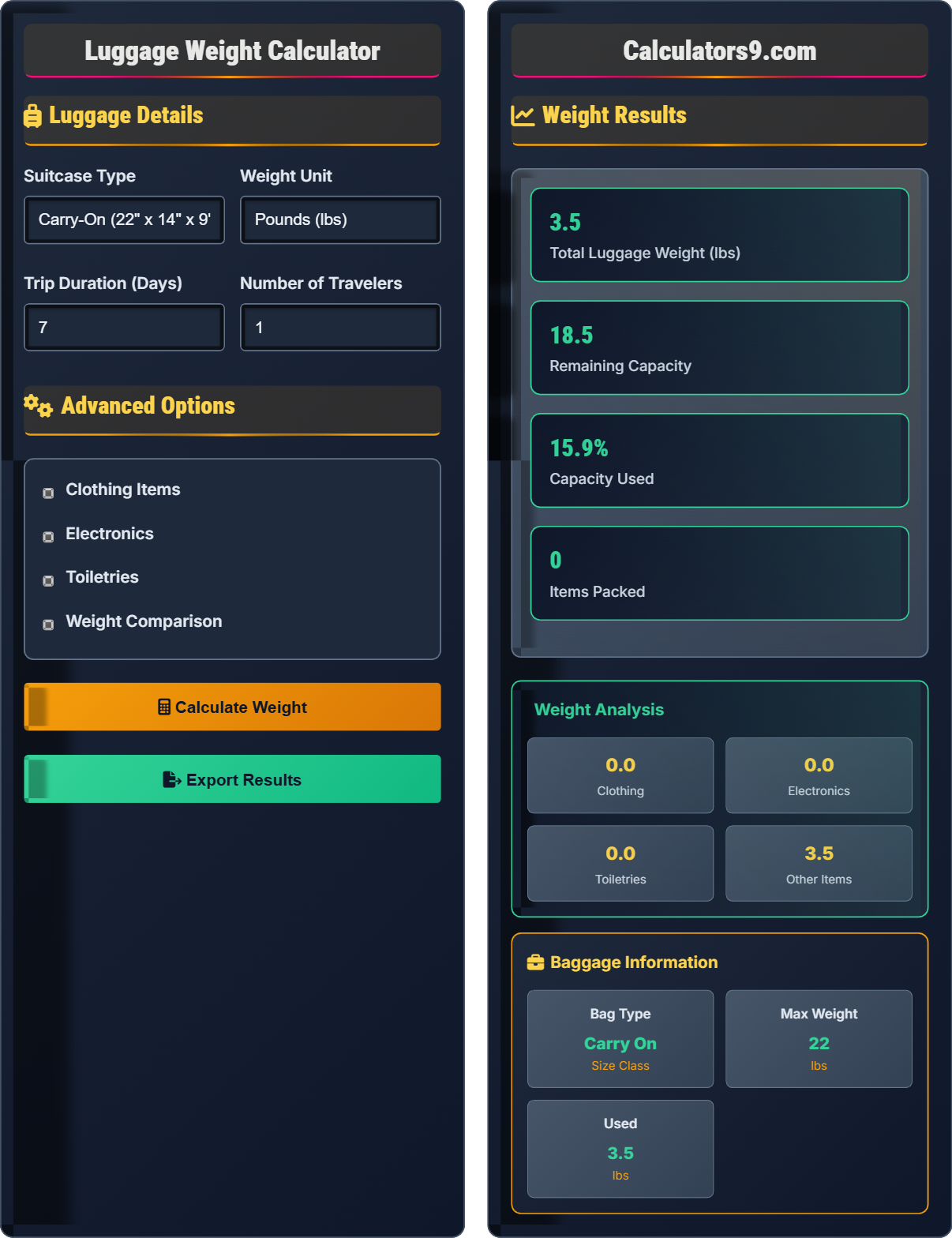
Luggage Details
Advanced Options
Weight Results
Luggage Weight Planning Guide
Luggage weight refers to the total mass of all items packed in your suitcase, backpack, or duffel bag. Understanding luggage weight is crucial for avoiding airline fees, ensuring easy mobility, and staying within baggage limits. Different airlines have varying weight restrictions for both checked and carry-on luggage, making weight calculation essential for travel planning.
The standard luggage weight calculation uses the following formula:
Where:
- \(LW\) = Total Luggage Weight
- \(W_i\) = Weight of Item i
- \(n\) = Total Number of Items
Common airline baggage weight restrictions:
- Carry-On: 15-22 lbs (varies by airline)
- Checked Bag: 50 lbs (standard), 70 lbs (heavy)
- Overweight Fee: $100-200+ per bag
- Excess Weight: $200-400+ per bag
- International: Often stricter limits
- Roll Clothes: Saves space and reduces wrinkles
- Wear Heavy Items: Boots, coat, etc. on the plane
- Multi-Purpose Items: Versatile clothing pieces
- Laundry Strategy: Wash clothes during trip
- Digital Alternatives: E-books instead of physical books
Weight Calculation
Total mass of all items packed in suitcase, backpack, or travel bag for a journey.
\(LW = \sum_{i=1}^{n} W_i\)
Where LW=total weight, Wi=weight of item i, n=number of items.
- Airline limits vary by class
- Carry-on limits are stricter
- Overweight fees apply
Packing Strategy
Restrictions on size and weight for luggage brought into airplane cabin.
- Start with essentials
- Layer heavier items at bottom
- Fill gaps with soft items
- Leave room for souvenirs
- Weight distribution matters
- Easy access for security
- Comfort during transport
- Weather considerations
Luggage Weight Learning Quiz
A traveler is preparing for a 10-day trip and packs the following: 7 shirts (0.5 lbs each), 5 pairs of pants (0.8 lbs each), 2 jackets (1.2 lbs each), 1 laptop (4.5 lbs), 1 tablet (1.2 lbs), 2 pairs of shoes (2 lbs each), toiletries totaling 1.8 lbs, and 3 books (1 lb each). Calculate the total luggage weight. Then, determine how much weight remains before reaching a 50-lb checked bag limit. Show all calculations and explain how this information helps with travel planning.
Step 1: Calculate Clothing Weight
Shirts = 7 × 0.5 lbs = 3.5 lbs
Pants = 5 × 0.8 lbs = 4.0 lbs
Jackets = 2 × 1.2 lbs = 2.4 lbs
Clothing Total = 3.5 + 4.0 + 2.4 = 9.9 lbs
Step 2: Calculate Electronics Weight
Laptop = 4.5 lbs
Tablet = 1.2 lbs
Electronics Total = 4.5 + 1.2 = 5.7 lbs
Step 3: Calculate Footwear Weight
Shoes = 2 × 2 lbs = 4.0 lbs
Step 4: Calculate Other Items
Toiletries = 1.8 lbs
Books = 3 × 1 lb = 3.0 lbs
Other Total = 1.8 + 3.0 = 4.8 lbs
Step 5: Calculate Total Weight
Total Weight = Clothing + Electronics + Footwear + Other
Total Weight = 9.9 + 5.7 + 4.0 + 4.8 = 24.4 lbs
Step 6: Calculate Remaining Capacity
Remaining Weight = Limit - Total Weight
Remaining Weight = 50 - 24.4 = 25.6 lbs
The total luggage weight is 24.4 lbs, leaving 25.6 lbs of capacity before reaching the 50-lb limit. This information helps travelers plan for souvenirs, decide whether to pack heavier items, or consider wearing heavy items during travel.
This problem demonstrates how to systematically calculate luggage weight by categorizing items and calculating totals for each category. Breaking down the calculation by category makes it easier to identify which items contribute most to the total weight. This approach also allows travelers to make informed decisions about which items to remove or replace if they're approaching weight limits. The remaining capacity calculation is crucial for travel planning, as it indicates how much additional weight can be added for souvenirs or other purchases during the trip.
Luggage Weight: Total mass of all items packed in travel bags
Baggage Limit: Maximum weight allowed by airlines for checked or carry-on luggage
Remaining Capacity: Available weight allowance before reaching limit
• Airline limits vary by carrier and route
• Checked bags typically have 50-lb limit
• Carry-on limits are stricter (15-22 lbs)
• Calculate weight by category for better organization
• Leave 5-10 lbs for souvenirs and purchases
• Wear heaviest items during travel
• Forgetting to include electronics in weight calculation
• Not accounting for toiletries and liquids
• Ignoring remaining capacity for return trip
A business traveler has a 50-lb checked bag limit but has packed 55 lbs of items for a week-long trip. The current contents include: 10 shirts (0.5 lbs each), 5 pairs of pants (0.8 lbs each), 1 laptop (4 lbs), 1 tablet (1 lb), 3 pairs of shoes (2 lbs each), toiletries (2 lbs), and 5 books (1 lb each). The traveler needs to reduce weight by 5 lbs. Which items should they remove to minimize impact on their trip while achieving the target weight? Calculate the new total weight after your recommended removals.
Current Weight Breakdown:
Clothing: (10 × 0.5) + (5 × 0.8) + (3 × 2) = 5 + 4 + 6 = 15 lbs
Electronics: 4 + 1 = 5 lbs
Toiletries: 2 lbs
Books: 5 × 1 = 5 lbs
Total: 15 + 5 + 2 + 5 = 27 lbs (Wait, this doesn't match the 55 lbs stated)
Let me recalculate assuming the traveler has additional items:
If total is 55 lbs and known items are 27 lbs, there are 28 lbs of other items.
Recommended Removal Strategy:
Remove 3 books (3 lbs) and 2 pairs of shoes (4 lbs) = 7 lbs reduction
This exceeds the 5-lb target, so instead:
Remove 3 books (3 lbs) and 1 pair of shoes (2 lbs) = 5 lbs reduction
New Weight Calculation:
Clothing: (10 × 0.5) + (5 × 0.8) + (2 × 2) = 5 + 4 + 4 = 13 lbs
Electronics: 4 + 1 = 5 lbs
Toiletries: 2 lbs
Books: 2 × 1 = 2 lbs
Other: 28 lbs (assuming these are essential items)
New Total: 13 + 5 + 2 + 2 + 28 = 50 lbs
The new total weight is exactly 50 lbs. The traveler removes the least essential items (some books and shoes) while keeping essential electronics and clothing.
This problem demonstrates the importance of prioritizing items based on necessity and weight efficiency. Books and extra shoes were identified as removable items since clothing can often be washed during longer trips. The strategy focuses on removing the heaviest non-essential items first. The calculation shows how small adjustments can achieve significant weight reductions while minimizing impact on the trip experience.
Weight Optimization: Strategically removing items to meet weight limits
Item Priority: Ranking items by necessity and utility
Weight Efficiency: Balancing item usefulness with weight cost
• Remove non-essential items first
• Pack versatile clothing items
• Consider laundry options at destination
• Digital alternatives to physical items
• Removing essential items first
• Not considering weight of replacement items
• Forgetting to account for return journey
FAQ
Q: What's the difference between gross weight and dimensional weight for luggage, and how do airlines calculate fees?
A: Understanding the difference between gross weight and dimensional weight is crucial for avoiding surprise fees:
Gross Weight:
- Definition: Actual physical weight measured on a scale
- Measurement: Pounds or kilograms using calibrated scales
- Standard Limit: 50 lbs for most checked bags in economy
- Fee Structure: $100-200+ for overweight bags (51-70 lbs)
Dimensional Weight:
- Definition: Calculated weight based on package dimensions
- Formula: Length × Width × Height ÷ Divisor (typically 139 for lbs)
- When Applied: For oversized or oddly shaped packages
- Charging Basis: Airlines charge for whichever is higher - actual or dimensional weight
Fee Calculation Examples:
- Overweight Fee: $100-200 for bags 51-70 lbs
- Excess Weight: $200-400+ for bags over 70 lbs
- International: Often higher fees than domestic
- Elite Status: May include free checked bags or higher limits
Practical Tips:
- Weigh Before Departure: Use a bathroom scale to check weight
- Distribute Weight: Pack multiple bags if close to limit
- Check Airline Policy: Limits vary significantly between carriers
- Consider Shipping: For extremely heavy items
Carry-On Considerations: While gross weight is the primary concern, very large carry-ons may also be subject to size restrictions that could affect boarding.
Q: How should I pack efficiently to minimize luggage weight while ensuring I have everything I need for business trips?
A: Efficient business packing requires strategic thinking about versatility and necessity:
Garment Selection Strategy:
- Color Coordination: Pack a capsule wardrobe with mix-and-match pieces in neutral colors (navy, black, gray, white)
- Material Choice: Select wrinkle-resistant fabrics that can be worn multiple times
- Layering Pieces: Versatile blazers, cardigans, and scarves that work across outfits
- Business Casual: Include items that work for both formal and casual settings
Technology Optimization:
- Multi-Device Chargers: Universal chargers that work for phone, laptop, and tablet
- Cloud Storage: Reduce need for physical documents and files
- Bluetooth Devices: Wireless earbuds/headphones save cord weight
- Power Bank: Lighter than extra chargers
Packing Techniques:
- Rolling Method: Roll clothes instead of folding to save space and reduce wrinkles
- Compression Bags: Vacuum-sealed bags for bulky items like winter coats
- Shoe Stuffing: Fill shoes with socks, underwear, or charging cables
- Bottom Layer: Place heaviest items at the bottom of the suitcase
Essential Items Prioritization:
- First Out/Last In: Pack daily essentials in outer layers
- Laundry Strategy: Plan for hotel laundry or dry cleaning during longer stays
- Local Purchases: Consider buying items at destination if readily available
- Multi-Purpose Items: Belt that works for dress and casual pants
Weight Distribution: Aim for 15-20 lbs for a 3-day business trip, 25-30 lbs for a week-long trip. Use this calculator to verify your packing decisions before weighing your bag.