Mileage Reimbursement Calculator
Business travel expense tracker • 2026 rates
Mileage Reimbursement Formula:
Show the calculator\( MR = M \times R \)
Where:
- \( MR \) = Mileage Reimbursement
- \( M \) = Miles Driven
- \( R \) = Reimbursement Rate per Mile
This formula calculates the reimbursement amount based on the number of miles driven and the applicable reimbursement rate. The rate is typically set by the IRS or employer policy.
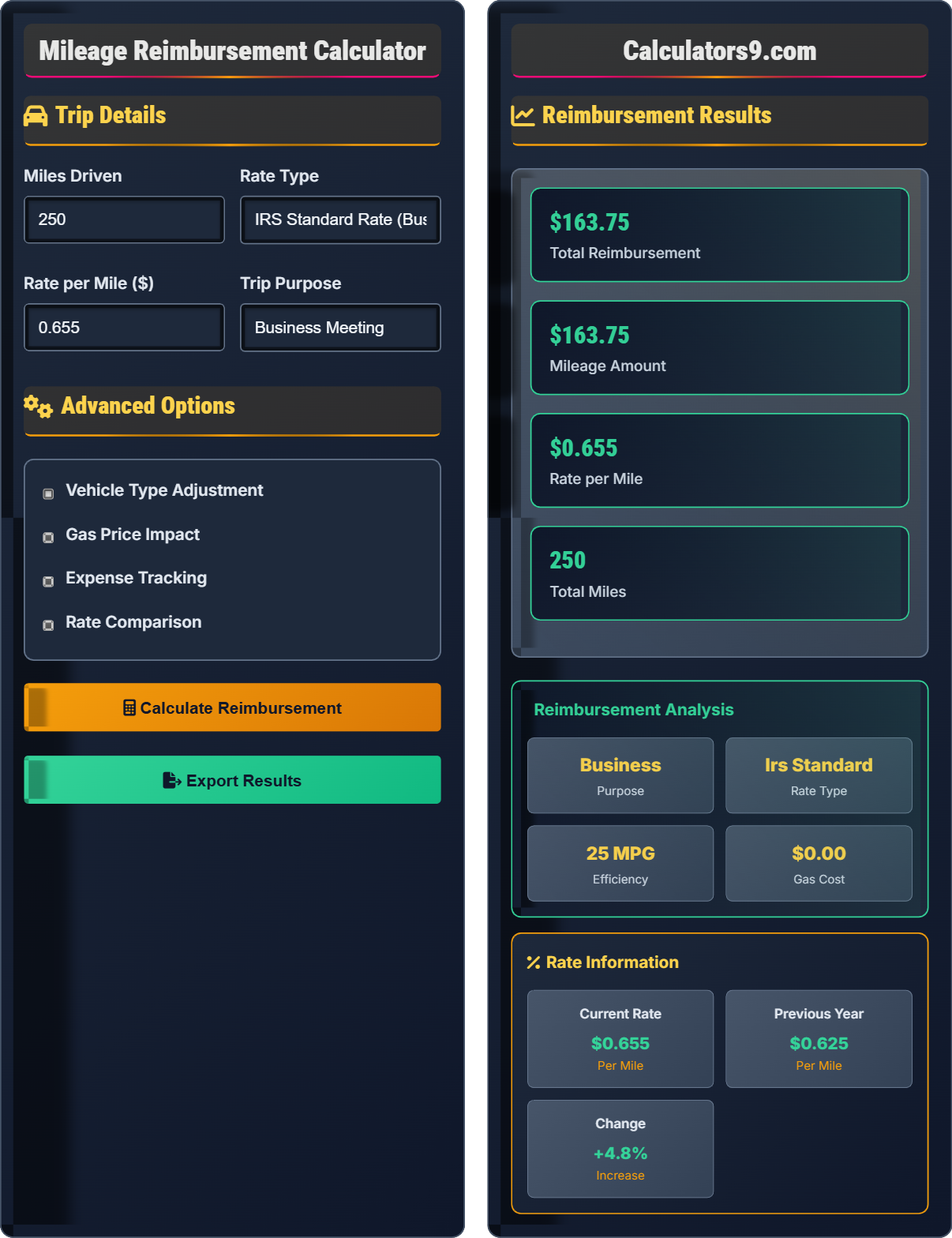
Example: For 250 business miles driven at the 2026 IRS standard mileage rate of $0.655 per mile:
Miles Driven = 250 miles
Reimbursement Rate = $0.655 per mile
Mileage Reimbursement = 250 × $0.655 = $163.75
Thus, the reimbursement amount would be approximately $163.75.
Trip Details
Advanced Options
Reimbursement Results
Mileage Reimbursement Guide
Mileage reimbursement compensates employees for business-related driving expenses using their personal vehicles. The IRS sets standard mileage rates annually that employers can use to calculate reimbursements. These rates account for gas, oil, maintenance, repairs, tires, insurance, and depreciation costs. Proper tracking and documentation are essential for tax compliance.
The standard mileage reimbursement calculation uses the following formula:
Where:
- \(MR\) = Mileage Reimbursement
- \(M\) = Miles Driven
- \(R\) = Reimbursement Rate per Mile
Eligible business mileage includes:
- Meetings at client offices
- Business trips between work locations
- Attending conferences or seminars
- Running business errands
- Visiting customers or suppliers
- Travel from home to temporary work location
- Record Immediately: Log miles right after each trip
- Include Details: Date, destination, purpose, and odometer readings
- Use Technology: Apps or GPS for accurate tracking
- Keep Receipts: Maintain supporting documentation
- Annual Reports: Summarize for tax purposes
Reimbursement Calculation
Compensation for business-related driving expenses using personal vehicle at standard rates.
\(MR = M \times R\)
Where MR=reimbursement, M=miles driven, R=rate per mile.
- IRS rates updated annually
- Must be for business purposes
- Proper documentation required
Expense Tracking
Vehicle miles driven for work-related purposes excluding regular commute.
- Date of travel
- Starting and ending locations
- Purpose of trip
- Odometer readings
- Total miles driven
- Regular commute not deductible
- Temporary work location is deductible
- Consistent record-keeping required
- Rate changes during year
Mileage Reimbursement Learning Quiz
An employee makes three business trips in one week: Trip 1: 45 miles to client meeting, Trip 2: 28 miles to training seminar, Trip 3: 37 miles to supplier visit. If the current IRS business mileage rate is $0.655 per mile, calculate the total weekly reimbursement. Then, calculate how much more the employee would earn if their employer offered $0.75 per mile. Show all calculations and explain the tax implications.
Step 1: Calculate Total Miles
Total Miles = Trip 1 + Trip 2 + Trip 3
Total Miles = 45 + 28 + 37 = 110 miles
Step 2: Calculate IRS Rate Reimbursement
IRS Reimbursement = Total Miles × IRS Rate
IRS Reimbursement = 110 × $0.655 = $72.05
Step 3: Calculate Employer Rate Reimbursement
Employer Reimbursement = Total Miles × Employer Rate
Employer Reimbursement = 110 × $0.75 = $82.50
Step 4: Calculate Difference
Difference = Employer Reimbursement - IRS Reimbursement
Difference = $82.50 - $72.05 = $10.45
The employee would earn $10.45 more with the higher employer rate. The total weekly reimbursement at IRS rate is $72.05.
Tax Implications: Under an accountable plan, both reimbursements would be tax-free to the employee. The employer would deduct the expenses as business costs. If the reimbursement exceeds actual expenses, the excess may be taxable income.
This problem demonstrates how mileage accumulation works across multiple trips in a period. The key concept is that miles from different business trips add together to form the total for reimbursement calculation. The comparison between IRS standard rate and employer rate shows how different reimbursement policies affect employee compensation. The tax implications section highlights the importance of understanding how reimbursements are treated differently than regular income.
Mileage Reimbursement: Compensation for business driving using personal vehicle
Accountable Plan: Tax-advantaged reimbursement arrangement with proper documentation
IRS Standard Rate: Per-mile rate set by IRS for business expense deductions
• Miles from multiple trips accumulate for total reimbursement
• Proper documentation is required for tax benefits
• Reimbursements under accountable plans are tax-free
• Track miles immediately after each trip
• Separate business and personal miles
• Including personal miles in business calculations
• Forgetting to document trips properly
• Confusing IRS rates with employer rates
A salesperson drives 1,200 business miles in a month with a vehicle that gets 22 MPG. Gas costs $3.65 per gallon, and they estimate $0.15 per mile for maintenance and wear. The company offers the standard IRS rate of $0.655 per mile. Should the salesperson use the standard mileage method or actual expense method for reimbursement? Calculate both options and explain which is more beneficial.
Standard Mileage Method:
Reimbursement = Miles × Rate
Reimbursement = 1,200 × $0.655 = $786.00
Actual Expense Method:
Gas Consumption = Miles ÷ MPG
Gas Consumption = 1,200 ÷ 22 = 54.55 gallons
Gas Cost = Gallons × Price per Gallon
Gas Cost = 54.55 × $3.65 = $199.11
Maintenance Cost = Miles × Maintenance Rate
Maintenance Cost = 1,200 × $0.15 = $180.00
Total Actual Expenses = Gas Cost + Maintenance Cost
Total Actual Expenses = $199.11 + $180.00 = $379.11
Comparison:
Standard Mileage Method: $786.00
Actual Expense Method: $379.11
Difference: $786.00 - $379.11 = $406.89
The standard mileage method provides $406.89 more in reimbursement than the actual expense method. For this driver, the standard method is more beneficial.
This problem illustrates the trade-off between the standard mileage method and actual expense method. The standard method often provides higher reimbursement because it includes not just fuel and maintenance, but also depreciation, insurance, and other vehicle costs. The actual expense method requires more detailed tracking but might be better for vehicles with exceptional fuel efficiency or low operating costs. In this case, the standard method is significantly more beneficial.
Standard Mileage Method: Fixed rate per mile for business driving
Actual Expense Method: Reimbursement based on actual vehicle costs
Miles Per Gallon (MPG): Fuel efficiency measurement
• Standard method is simpler to track
• Calculate both methods to determine the better option
• Consider your vehicle's efficiency and costs
• Keep detailed records if using actual expense method
• Not comparing both methods before choosing
• Forgetting to include all vehicle expenses in actual method
• Changing methods mid-year (not allowed)
FAQ
Q: What's the difference between the standard mileage method and actual expense method for business driving, and which should I choose?
A: The two methods for calculating vehicle expense deductions differ significantly:
Standard Mileage Method:
- How it works: Multiply business miles by the IRS standard rate ($0.655 for 2026 business use)
- Benefits: Simple to track, no need to document actual expenses, includes depreciation automatically
- Requirements: Just record miles driven, purpose, and dates
- Limitations: Cannot claim actual fuel, maintenance, or other vehicle expenses
Actual Expense Method:
- How it works: Calculate actual costs for gas, oil, repairs, insurance, registration, depreciation, etc.
- Benefits: Potentially higher deduction if vehicle costs are high
- Requirements: Detailed records of all vehicle expenses and percentage of business use
- Limitations: Complex tracking, must allocate expenses between business and personal use
Which to Choose:
- Standard Method is Better When: You drive frequently, have average vehicle costs, prefer simplicity
- Actual Method is Better When: You have a luxury vehicle with high depreciation, expensive maintenance, or drive infrequently
- Important: You must choose the method in the first year the car is used for business and cannot switch back to standard once you've used actual expenses
Recommendation: Calculate both methods for your situation. Most taxpayers benefit from the standard method due to its simplicity and inclusion of depreciation without tracking actual depreciation expenses.
Q: How should our company set up a mileage reimbursement policy, and what are the tax implications for both the company and employees?
A: Setting up a proper mileage reimbursement policy requires careful consideration of tax implications and compliance:
Policy Setup:
- Rate Selection: Use IRS standard rate ($0.655 for 2026) or establish your own rate
- Documentation Requirements: Specify required information (date, destination, purpose, miles)
- Eligible Trips: Define what constitutes reimbursable business travel
- Approval Process: Establish who can approve mileage claims
- Tracking Method: Require paper logs, mobile apps, or other approved methods
Tax Implications for Company:
- Deductible Expense: Mileage reimbursements are generally tax-deductible business expenses
- Accountable Plan: To avoid tax complications, maintain proper documentation requirements
- Wage Reporting: Improperly documented reimbursements may be taxable wages
Tax Implications for Employees:
- Tax-Free Reimbursement: Under accountable plan, reimbursements are not taxable income
- Accountable Plan Requirements: Business connection, timely reporting, return of excess amounts
- Documentation: Employees must substantiate expenses to avoid taxation
Best Practices:
- Written Policy: Document all requirements clearly
- Training: Educate employees on proper documentation
- Monitoring: Periodically audit mileage claims
- Updates: Adjust rates annually to match IRS guidelines
Accountable Plan Requirements: To qualify for tax-free treatment, the plan must require employees to substantiate business connection, report expenses within a reasonable time, and return any excess amounts. Meeting these requirements keeps reimbursements tax-free for employees and deductible for the company.