Trip Budget Calculator
Travel expense planner • 2026 destinations
Trip Budget Formula:
Show the calculator\( TB = (A \times N) + (F \times N) + (T \times N) + (E \times N) + O \)
Where:
- \( TB \) = Total Trip Budget
- \( A \) = Daily Accommodation Cost
- \( N \) = Number of Nights
- \( F \) = Daily Food Cost
- \( T \) = Daily Transportation Cost
- \( E \) = Daily Entertainment Cost
- \( O \) = Other Fixed Costs (Flights, Tours, etc.)
This formula calculates the total trip budget by summing daily expenses multiplied by the number of nights, plus other fixed costs. It provides a comprehensive estimate of all travel expenses.
Example: For a 7-night trip with $150/night accommodation, $60/day food, $30/day transportation, $40/day entertainment, and $800 in flights:
Daily Costs = $150 + $60 + $30 + $40 = $280
Accommodation Cost = $150 × 7 = $1,050
Food Cost = $60 × 7 = $420
Transportation Cost = $30 × 7 = $210
Entertainment Cost = $40 × 7 = $280
Total Daily = $280 × 7 = $1,960
Total Budget = $1,960 + $800 = $2,760
Thus, the total trip budget would be approximately $2,760.
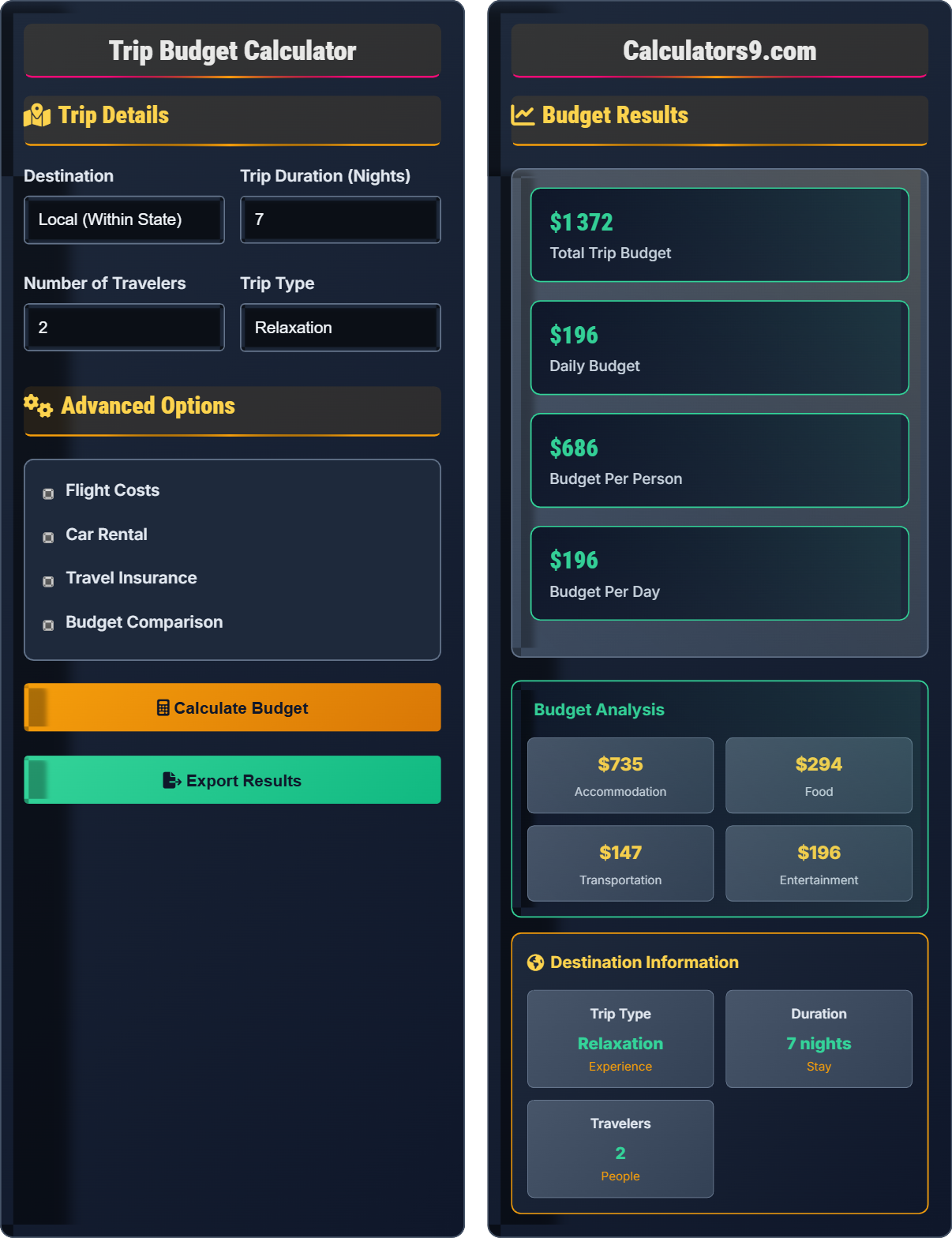
Trip Details
Advanced Options
Budget Results
Trip Budget Planning Guide
A trip budget is a financial plan that estimates all expenses for a journey, helping travelers manage their spending and avoid overspending. It includes accommodation, food, transportation, activities, and miscellaneous expenses. A well-planned budget considers both fixed costs (flights, hotels) and variable costs (meals, shopping) to ensure financial preparedness for the entire trip.
The standard trip budget calculation uses the following formula:
Where:
- \(TB\) = Total Trip Budget
- \(A\) = Daily Accommodation Cost
- \(N\) = Number of Nights
- \(F\) = Daily Food Cost
- \(T\) = Daily Transportation Cost
- \(E\) = Daily Entertainment Cost
- \(O\) = Other Fixed Costs (Flights, Tours, etc.)
Trip costs vary significantly based on destination:
- Local/National: $100-$300 per night
- European Cities: $150-$400 per night
- Asian Countries: $80-$250 per night
- North American Cities: $120-$350 per night
- Flight Costs: $200-$2,000+ depending on distance
- Research Ahead: Compare prices for accommodations and activities
- Book Early: Secure better rates for flights and hotels
- Travel Off-Season: Avoid peak pricing and crowds
- Use Apps: Track expenses in real-time during travel
- Buffer Funds: Include 10-20% contingency for unexpected expenses
Budget Calculation
A trip budget is a financial plan estimating all expenses for a journey, helping manage spending.
\(TB = (A \times N) + (F \times N) + (T \times N) + (E \times N) + O\)
Where TB=total budget, A=accommodation, F=food, T=transportation, E=entertainment, O=other costs.
- Include contingency buffer
- Research destination costs
- Track expenses during travel
Trip Planning
Extra funds reserved for unexpected expenses during travel (typically 10-20% of budget).
- Accommodation: 30-40% of budget
- Food: 20-30% of budget
- Transportation: 15-25% of budget
- Activities: 15-20% of budget
- Exchange rates for international travel
- Seasonal price variations
- Group discounts
- Prepaid vs. pay-as-you-go
Trip Budget Learning Quiz
A couple plans a 10-day trip to Paris. Their daily costs are: accommodation $180, food $80, transportation $35, and entertainment $45. They also have fixed costs: round-trip flights $1,200, travel insurance $150, and a guided tour $200. Calculate their total trip budget including a 15% contingency buffer. Show all calculations and explain how the contingency buffer protects against unexpected expenses.
Step 1: Calculate Daily Costs
Daily Total = Accommodation + Food + Transportation + Entertainment
Daily Total = $180 + $80 + $35 + $45 = $340
Step 2: Calculate Variable Costs
Variable Costs = Daily Total × Number of Nights
Variable Costs = $340 × 10 = $3,400
Step 3: Calculate Fixed Costs
Fixed Costs = Flights + Insurance + Tour
Fixed Costs = $1,200 + $150 + $200 = $1,550
Step 4: Calculate Base Total
Base Total = Variable Costs + Fixed Costs
Base Total = $3,400 + $1,550 = $4,950
Step 5: Add Contingency Buffer
Contingency = Base Total × 0.15
Contingency = $4,950 × 0.15 = $742.50
Step 6: Calculate Final Budget
Total Budget = Base Total + Contingency
Total Budget = $4,950 + $742.50 = $5,692.50
The total trip budget is $5,692.50. The 15% contingency buffer provides protection against unexpected expenses such as medical emergencies, flight delays, currency fluctuations, or unplanned activities.
This problem demonstrates the importance of categorizing trip expenses into variable costs (that scale with trip duration) and fixed costs (that remain constant regardless of trip length). The contingency buffer serves as a financial safety net for unpredictable expenses. In international travel, this buffer is especially important due to exchange rate fluctuations, unexpected transportation costs, and varying local prices that may not align with initial estimates.
Contingency Buffer: Extra funds reserved for unexpected expenses during travel
Variable Costs: Expenses that scale with trip duration (daily expenses)
Fixed Costs: Expenses that remain constant regardless of trip length
• International travel requires larger contingency buffers
• Variable costs multiply by trip duration
• Fixed costs remain constant regardless of trip length
• Research destination-specific costs before budgeting
• Check for seasonal price variations
• Consider group discounts for shared expenses
• Forgetting to include fixed costs in total budget
• Not accounting for exchange rate fluctuations
• Underestimating contingency buffer needs
A family of four is planning a 14-day trip visiting both New York City and Boston. They can choose between two options: Option A: Stay in NYC for 8 nights and Boston for 6 nights, or Option B: Split evenly with 7 nights in each city. Daily costs in NYC: accommodation $220, food $120, transportation $50, entertainment $60. Daily costs in Boston: accommodation $150, food $90, transportation $35, entertainment $45. Fixed costs: flights $1,600, car rental $400. Which option is more economical? Calculate both options and explain the difference.
Option A: NYC (8 nights) + Boston (6 nights)
NYC Variable Costs = ($220 + $120 + $50 + $60) × 8 = $3,600
Boston Variable Costs = ($150 + $90 + $35 + $45) × 6 = $1,920
Option A Total Variable = $3,600 + $1,920 = $5,520
Option B: 7 nights each city
NYC Variable Costs = ($220 + $120 + $50 + $60) × 7 = $3,150
Boston Variable Costs = ($150 + $90 + $35 + $45) × 7 = $2,240
Option B Total Variable = $3,150 + $2,240 = $5,390
Fixed Costs (Same for Both):
Fixed Costs = Flights + Car Rental = $1,600 + $400 = $2,000
Total Costs:
Option A Total = $5,520 + $2,000 = $7,520
Option B Total = $5,390 + $2,000 = $7,390
Option B is more economical by $130 ($7,520 - $7,390). This is because Boston has lower daily costs than NYC, so spending more time in the cheaper destination reduces the overall budget. The 7-night split minimizes time spent in the more expensive NYC.
This problem illustrates the importance of considering cost differences between destinations when planning multi-city trips. By allocating more time to the less expensive destination, travelers can optimize their overall budget. This strategy works because variable costs (daily expenses) accumulate over time, so spending more days in a lower-cost location reduces the total trip budget even if the trip duration remains the same.
Multi-City Trip: Journey visiting multiple destinations in sequence
Cost Optimization: Allocating resources to minimize total expenses
Destination Cost Differential: Price differences between locations
• Spend more time in less expensive destinations
• Fixed costs don't change with destination allocation
• Variable costs scale with time spent in each location
• Research cost differences between destinations before planning
• Consider transportation costs between cities
• Factor in travel time when allocating days
• Not considering cost differences between destinations
• Assuming equal time allocation is optimal
• Forgetting to account for intercity transportation
FAQ
Q: How do I adjust my budget for exchange rate fluctuations when traveling internationally, and what strategies can I use to minimize currency conversion costs?
A: Exchange rate fluctuations can significantly impact your international travel budget. Here are key strategies:
Budget Adjustments:
- Monitor Rates: Check exchange rates 2-3 months before travel and again closer to departure
- Use Historical Averages: Consider 6-month average rates rather than current rates
- Add Extra Buffer: Increase your budget by 10-15% if traveling to volatile currency regions
- Dynamic Tracking: Use apps that convert prices in real-time during travel
Minimizing Conversion Costs:
- ATM Withdrawals: Use ATMs affiliated with your bank to avoid surcharges
- No Foreign Transaction Fees: Use credit cards without foreign transaction fees
- Notify Banks: Inform banks of travel plans to prevent card blocks
- Compare Rates: Check rates at multiple exchange locations
- Local Currency: Avoid airport exchanges which typically offer poor rates
Best Practices:
- Prepaid Cards: Load cards with destination currency at favorable rates
- Credit Card Benefits: Use cards that offer travel insurance and rewards
- Emergency Cash: Carry some local currency for immediate needs
- Expense Tracking: Record purchases immediately to track spending
For long trips, consider hedging strategies like forward contracts for major expenses if currency volatility is expected to be high.
Q: What's the difference between per-person budgeting and group budgeting for family trips, and which approach is more effective?
A: The choice between per-person and group budgeting significantly affects trip planning:
Per-Person Budgeting:
- Definition: Each person has their own allocated budget for personal expenses
- Advantages: Personal autonomy, individual control over spending, clear accountability
- Disadvantages: May lead to unequal experiences, difficult for shared expenses
- Best For: Groups with varying spending habits or ages
Group Budgeting:
- Definition: Total budget divided among all participants for collective expenses
- Advantages: Shared costs for accommodation, transportation, group activities
- Disadvantages: Less personal spending flexibility, requires coordination
- Best For: Families or groups seeking unified experiences
Hybrid Approach (Recommended): Combine both methods by having a shared budget for major expenses (hotels, flights, car rentals) and individual budgets for personal expenses (souvenirs, personal dining, optional activities). This balances group cohesion with individual autonomy.
For Families:
- Shared Expenses: Accommodation, transportation, major activities
- Individual Allowances: Daily spending money for each family member
- Group Activities: Budget for everyone participating
- Personal Items: Individual responsibility
Effectiveness: Group budgeting is generally more cost-effective for families due to shared expenses and bulk discounts, while individual allowances ensure personal satisfaction.