Vacation Day Calculator
Leave planning tool • 2026 policies
Vacation Day Formula:
Show the calculator\( VD = (WD \times Y) + IB - U \)
Where:
- \( VD \) = Vacation Days Available
- \( WD \) = Weekly Vacation Days Earned
- \( Y \) = Years of Service
- \( IB \) = Initial Balance
- \( U \) = Used Days
This formula calculates the available vacation days based on accrual rate, years of service, initial balance, and previously used days. It helps employees plan their time off and understand their leave balance.
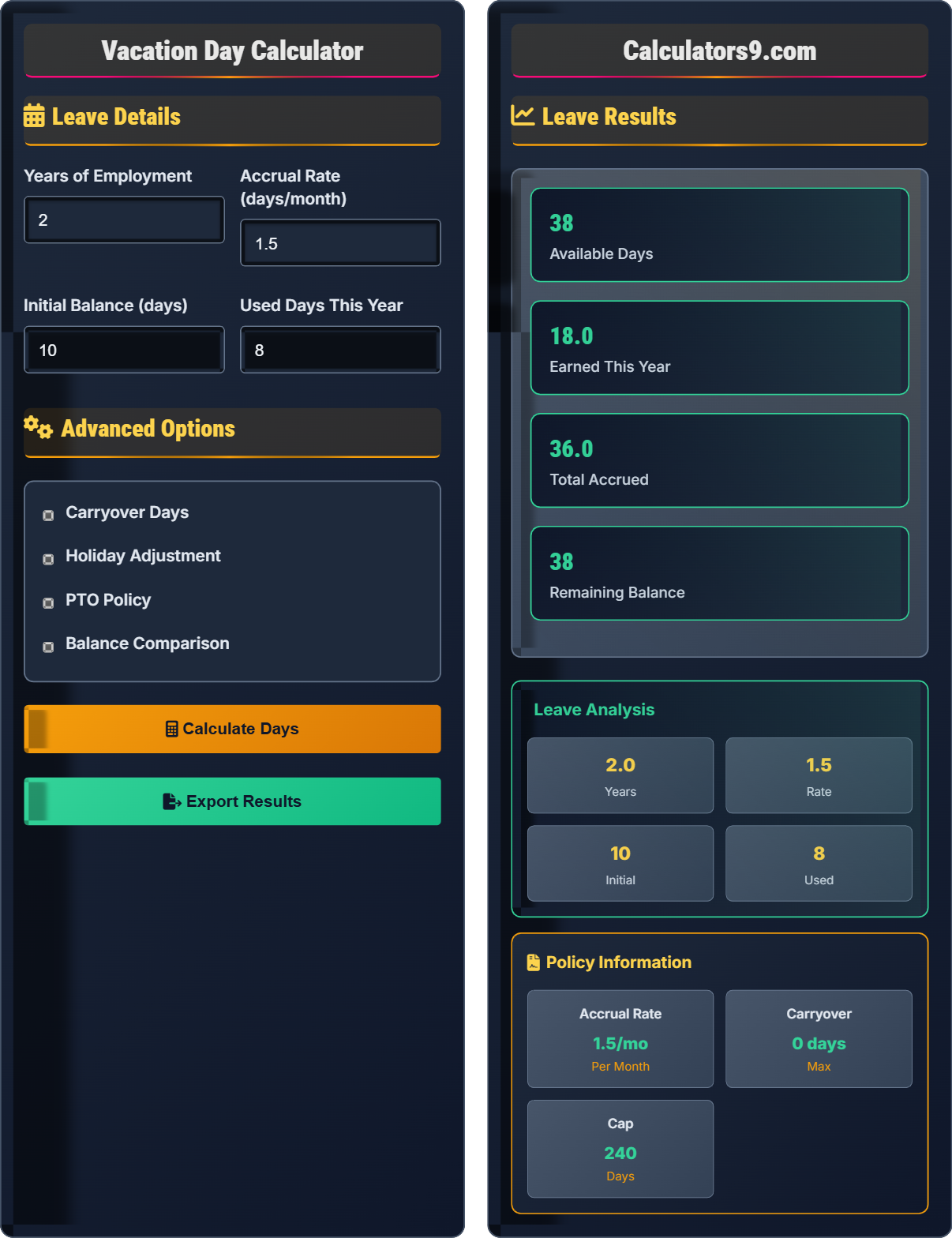
Example: For an employee who earns 1.5 days per month after 2 years of service, starting with 10 days initial balance, and having used 8 days:
Monthly Accrual = 1.5 days
Months of Service = 24 (2 years)
Earned Days = 1.5 × 24 = 36 days
Total Available = 36 + 10 = 46 days
Available After Usage = 46 - 8 = 38 days
Thus, the employee has 38 days available for vacation.
Leave Details
Advanced Options
Leave Results
Vacation Day Planning Guide
Vacation day planning involves managing and calculating available time off based on company policies. Understanding your leave accrual rate, carryover rules, and usage helps employees plan vacations effectively while maximizing their benefits. Proper planning ensures compliance with company policies and avoids running out of time off unexpectedly.
The standard vacation day calculation uses the following formula:
Where:
- \(VD\) = Vacation Days Available
- \(WD\) = Weekly Vacation Days Earned
- \(Y\) = Years of Service
- \(IB\) = Initial Balance
- \(U\) = Used Days
Common policy variations across companies:
- Carryover Limit: 5-10 days maximum
- Accrual Cap: 120-240 days maximum
- Waiting Period: 6-12 months before accruing
- Frontloading: All days available at start of year
- PTO vs Vacation: Combined vs separate policies
- Plan Ahead: Schedule vacations early in the year
- Maximize Balance: Use days before they expire
- Strategic Booking: Take advantage of holidays
- Carryover Planning: Understand company limits
- Balance Tracking: Monitor accruals monthly
Leave Calculation
Time off earned by employees for rest, recreation, and personal activities.
\(VD = (WD \times Y) + IB - U\)
Where VD=available days, WD=monthly accrual, Y=months of service, IB=initial balance, U=used days.
- Accrual rates vary by tenure
- Carryover may be limited
- Unused days may expire
Leave Planning
Paid Time Off combining vacation, sick, and personal days into single balance.
- Track monthly accruals
- Plan usage around holidays
- Consider carryover limits
- Monitor balance monthly
- Book early to secure dates
- Company approval required
- Blackout periods apply
- Notice requirements vary
- Accrual may pause during leave
Vacation Day Learning Quiz
An employee has been with the company for 3.5 years (42 months). Their accrual rate is 1.5 days per month for the first 2 years, then 2 days per month after 2 years of service. They started with an initial balance of 15 days and have used 22 days so far. Additionally, they can carry over up to 5 unused days from last year. Calculate their total available vacation days. Show all calculations and explain how the tiered accrual system works.
Step 1: Calculate Accrued Days in First 2 Years
Months in first 2 years = 24 months
Accrual rate for first 2 years = 1.5 days/month
Days earned in first 2 years = 24 × 1.5 = 36 days
Step 2: Calculate Accrued Days in Remaining 1.5 Years
Months in remaining 1.5 years = 18 months
Accrual rate after 2 years = 2 days/month
Days earned in remaining 1.5 years = 18 × 2 = 36 days
Step 3: Calculate Total Accrued Days
Total Accrued = Days in first 2 years + Days in remaining 1.5 years
Total Accrued = 36 + 36 = 72 days
Step 4: Calculate Total Available Before Usage
Total Available = Total Accrued + Initial Balance
Total Available = 72 + 15 = 87 days
Step 5: Calculate Remaining Balance After Usage
Remaining Balance = Total Available - Used Days
Remaining Balance = 87 - 22 = 65 days
Step 6: Add Carryover Days
Available for Vacation = Remaining Balance + Carryover Days
Available for Vacation = 65 + 5 = 70 days
The employee has 70 days available for vacation. The tiered accrual system rewards longevity by increasing the accrual rate after reaching service milestones.
This problem demonstrates a tiered accrual system where the rate of vacation day accumulation increases based on tenure. The employee earns 1.5 days per month for the first 2 years, then 2 days per month thereafter. This structure incentivizes employee retention by providing greater benefits to long-term employees. The calculation must account for different accrual rates applied to different periods of service, which requires segmenting the employment period and calculating separately.
Accrual Rate: Number of vacation days earned per unit of time
Tiered Accrual: System with different rates based on years of service
Carryover: Unused vacation days that transfer to next year
• Tiered systems apply different rates to different service periods
• Accrual may stop at maximum balance caps
• Carryover limits typically apply
• Calculate each tier separately for tiered systems
• Track accruals monthly to monitor balance
• Use carryover days before they expire
• Applying the same rate to all service years
• Forgetting to account for initial balances
• Not considering carryover limits
An employee has 2 years of service and must choose between two policies: Option A: Separate vacation (1.5 days/month) and sick time (0.5 days/month). Option B: Combined PTO (2.0 days/month). The employee typically uses 5 sick days per year and plans to take 15 vacation days this year. Which option provides more flexibility and better meets their needs? Calculate the total available days under each option and explain the advantages of each approach.
Option A: Separate Vacation and Sick Time
Months of service = 24 months
Vacation days earned = 24 × 1.5 = 36 days
Sick days earned = 24 × 0.5 = 12 days
Total available = 36 + 12 = 48 days
Usage this year: 15 vacation + 5 sick = 20 days
Remaining: 48 - 20 = 28 days
Option B: Combined PTO
PTO days earned = 24 × 2.0 = 48 days
Usage this year: 15 + 5 = 20 days
Remaining: 48 - 20 = 28 days
Comparison:
Both options provide the same total (48 days) and same remaining balance (28 days) in this scenario. However, the PTO approach offers greater flexibility since unused sick time can be used for vacation and vice versa.
Advantages of Option A: Ensures sick time is always available, prevents sick time from being used for vacation
Advantages of Option B: Greater flexibility, unused time can be applied to any need, simplifies tracking
For this employee, Option B (PTO) is more flexible since they have predictable sick day usage.
This problem compares two common leave structures: separate vacation/sick time versus combined PTO. While the mathematical totals may be the same, the policy structure significantly impacts flexibility. PTO offers more flexibility but requires careful planning to ensure sick time is available when needed. Separate policies provide certainty but less flexibility. The employee's typical usage patterns determine which option is more advantageous.
Separate Policy: Distinct balances for vacation, sick, and personal time
PTO Policy: Combined balance for all types of leave
Flexibility: Ability to use time off for different purposes
• PTO offers more flexibility than separate policies
• Consider your typical usage patterns when choosing policies
• PTO is better for predictable sick time users
• Separate policies suit those with unpredictable sick time needs
• Assuming equal mathematical outcomes mean equal value
• Not considering personal usage patterns
• Overlooking flexibility advantages
FAQ
Q: What's the difference between PTO and traditional vacation/sick time policies, and which is better?
A: The difference between PTO and traditional policies significantly impacts employee flexibility and benefits:
Traditional Separate Policy:
- Structure: Distinct balances for vacation, sick, and personal time
- Usage: Specific time off for specific purposes
- Accrual: Different rates for different types of leave
- Security: Guaranteed sick time availability
- Tracking: More complex to manage multiple balances
PTO Policy:
- Structure: Single combined balance for all leave types
- Usage: Flexible application to any need
- Accrual: Single rate for all time off
- Flexibility: Maximum adaptability for various needs
- Tracking: Simplified single balance management
Which is Better:
- PTO is Better For: Predictable sick time users, those wanting flexibility, simplified administration
- Separate Policy is Better For: Unpredictable sick time needs, those wanting guaranteed sick time, strict policy adherence
- Consider: Your typical usage patterns, health needs, and preference for flexibility vs. security
Decision Factors: If you typically use 3-5 sick days per year, PTO offers more flexibility. If you have chronic health conditions requiring unpredictable time off, separate sick time may be preferable.
Q: How should I manage team vacation schedules to ensure adequate coverage while respecting employee leave rights?
A: Managing team vacation schedules requires balancing business needs with employee rights:
Planning Strategies:
- Early Submission: Require vacation requests 30-60 days in advance
- Blackout Periods: Identify critical times when no one can take leave
- Overlap Requirements: Ensure minimum staff levels at all times
- First-Come-First-Served: Fair system for popular dates
- Seniority Considerations: Balance fairness with recognition
Coverage Planning:
- Cross-Training: Develop multiple employees in critical functions
- Temporary Support: Use contractors or overtime when needed
- Delegation: Assign responsibilities during absences
- Remote Coverage: Enable remote work for continuity
- Emergency Protocols: Plan for unexpected absences
Communication Protocols:
- Calendar Sharing: Maintain team visibility of schedules
- Backup Plans: Identify substitutes for each role
- Handover Procedures: Document responsibilities
- Return Protocols: Smooth transition back to duties
- Flexibility: Accommodate personal emergencies
Legal Considerations: Ensure compliance with local labor laws regarding leave, advance notice requirements, and anti-discrimination policies. Document all decisions consistently.