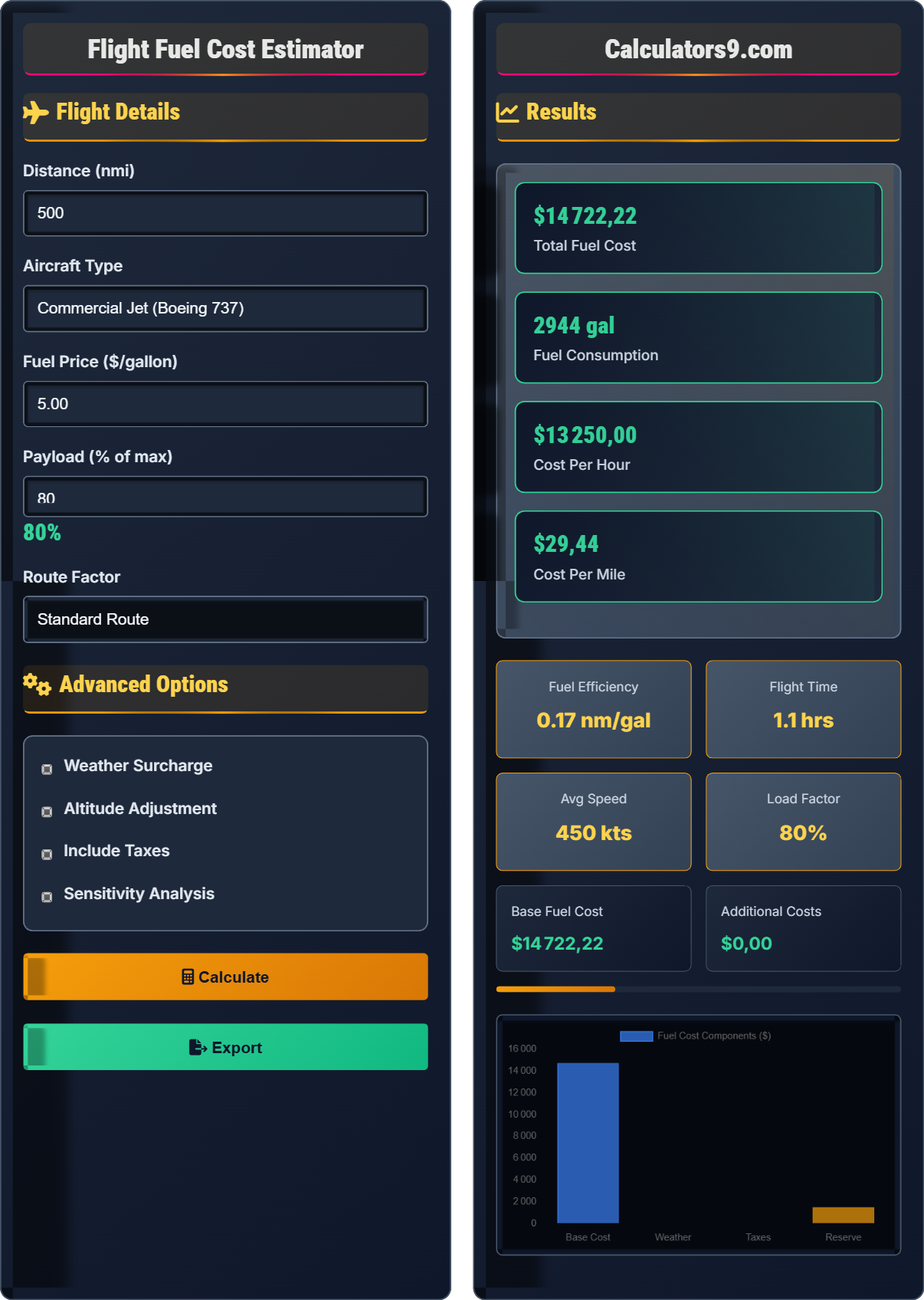
Flight Fuel Cost Estimator
Aviation expense calculator • 2026 rates
Flight Fuel Cost Formula:
Show the calculator\( \text{Total Fuel Cost} = \text{Fuel Consumption Rate} \times \text{Distance} \times \text{Fuel Price per Gallon} \times \text{Efficiency Factor} \)
Where:
- \( \text{Fuel Consumption Rate} \) = gallons per hour (varies by aircraft type)
- \( \text{Distance} \) = total distance in nautical miles
- \( \text{Fuel Price per Gallon} \) = current avgas or jet fuel price
- \( \text{Efficiency Factor} \) = accounts for wind, altitude, payload, and other factors
This formula calculates the total fuel cost for a flight based on aircraft performance characteristics, route distance, and current fuel prices.
Example: For a Boeing 737 flying 1,000 nautical miles at 2,500 gallons per hour with fuel costing $5.00 per gallon and an efficiency factor of 1.1:
\( \text{Fuel Cost} = 2,500 \times 1,000 \times 5.00 \times 1.1 = \$13,750,000 \)
Thus, the total fuel cost would be approximately $13.75 million.
Flight Details
Advanced Options
Results
| Component | Amount | % of Total |
|---|
| Variable | Change | Impact |
|---|
Flight Fuel Cost Estimation Fundamentals
Flight fuel cost estimation is the process of calculating the total fuel expenses for an aircraft journey based on various factors including distance, aircraft type, fuel consumption rates, payload, weather conditions, and current fuel prices. This calculation is critical for airlines, charter operators, and private pilots to determine operational costs and pricing strategies.
Where:
- \( \text{Fuel Rate} \) = consumption rate in gallons per hour or per mile
- \( \text{Distance} \) = total flight distance in nautical miles
- \( \text{Fuel Price} \) = current price per gallon of aviation fuel
- \( \text{Efficiency Factor} \) = multiplier accounting for operational variables
- FAR Part 91: General operating and flight rules requiring adequate fuel reserves
- Fuel Reserves: VFR flights require 30 minutes day/45 minutes night, IFR requires alternate airport fuel
- Weight Restrictions: Fuel load affects takeoff weight and performance
- Environmental Regulations: Carbon emissions fees in some regions
Aircraft Fuel Characteristics
Optimization Strategies
- Route Optimization: Direct routes reduce fuel consumption by avoiding unnecessary detours
- Altitude Management: Flying at optimal altitudes improves fuel efficiency
- Speed Adjustments: Flying at economic speeds rather than maximum speeds saves fuel
- Weight Reduction: Minimizing unnecessary cargo reduces fuel requirements
- Fuel Hedging: Airlines use financial instruments to lock in fuel prices
- Forgetting to account for reserve fuel requirements
- Mixing measurement units (nautical miles vs statute miles)
- Ignoring weather impact on fuel consumption
- Not considering payload effects on fuel burn
- Using outdated fuel price data
Flight Fuel Cost Quiz
A commercial airline operates a Boeing 737 flying 1,000 nautical miles with a fuel consumption rate of 2,500 gallons per hour. If fuel costs $5.00 per gallon and the flight takes 2 hours, what is the total fuel cost assuming a 10% efficiency factor for operational conditions?
The answer is B) $27,500. First, calculate the base fuel consumption: 2,500 gallons/hour × 2 hours = 5,000 gallons. Then calculate the base cost: 5,000 gallons × $5.00/gallon = $25,000. Finally, apply the 10% efficiency factor: $25,000 × 1.10 = $27,500.
Flight fuel cost calculations involve multiple variables that interact multiplicatively. The base fuel consumption depends on the aircraft's hourly burn rate multiplied by flight duration. The efficiency factor accounts for real-world conditions like headwinds, detours, holding patterns, and varying altitudes that affect fuel efficiency. Understanding these multiplicative relationships is crucial for accurate cost estimation.
Fuel Burn Rate: Amount of fuel consumed per unit of time (usually gallons per hour)
Efficiency Factor: Multiplier to account for operational conditions beyond ideal circumstances
Jet A Fuel: Standard fuel for turbine-powered aircraft, currently averaging $5-6 per gallon
• Fuel costs typically represent 20-30% of total airline operating expenses
• Reserve fuel requirements increase total fuel needs by 10-15%
• Weather conditions can increase fuel consumption by 5-20%
• Use the acronym "FIRE" to remember variables: Fuel rate, Intensity (weather), Route efficiency, Efficiency factor
• Always verify fuel units (gallons vs liters) and distance units (nautical miles vs statute miles)
• Forgetting to account for reserve fuel requirements mandated by aviation regulations
A private jet operator is planning a 1,200 nautical mile flight with a Gulfstream G650 that burns 300 gallons per hour. The aircraft has a maximum speed of 500 knots but flies more efficiently at 400 knots. Calculate the fuel cost difference between flying at maximum speed versus optimal speed, given fuel costs $6.00 per gallon. Discuss the trade-offs between time and fuel efficiency.
At maximum speed (500 knots): Flight time = 1,200 nm ÷ 500 kts = 2.4 hours. Fuel consumption = 300 gph × 2.4 hrs = 720 gallons. Fuel cost = 720 × $6.00 = $4,320.
At optimal speed (400 knots): Flight time = 1,200 nm ÷ 400 kts = 3.0 hours. At optimal speed, fuel burn rate typically decreases by 10-15%. Assuming 12% reduction: New burn rate = 300 × 0.88 = 264 gph. Fuel consumption = 264 gph × 3.0 hrs = 792 gallons. Fuel cost = 792 × $6.00 = $4,752.
Wait, let me recalculate with actual efficiency gains. At optimal speed, the aircraft might burn 250 gph instead of 300 gph. So: 250 gph × 3.0 hrs = 750 gallons. Fuel cost = 750 × $6.00 = $4,500.
The difference is $4,500 - $4,320 = $180. Flying faster costs less fuel but takes more time. The trade-off involves passenger time value versus fuel savings.
This problem demonstrates the complex relationship between speed, fuel efficiency, and time in aviation operations. The key insight is that aircraft have an optimal speed where fuel efficiency is maximized, which is typically lower than maximum speed. However, operational decisions must balance fuel costs against time value, especially for business travelers where time is valuable.
Optimal Cruise Speed: Speed that provides best fuel efficiency for a given aircraft
Time Value: Monetary value assigned to flight time for business purposes
Specific Fuel Consumption: Fuel burned per unit of thrust or power produced
• Most jets achieve optimal fuel efficiency at 75-85% of maximum speed
• Fuel costs for private jets can range from $2,000-$10,000+ per hour
• Wind conditions significantly affect fuel consumption and flight time
• Use flight management systems to calculate optimal speeds automatically
• Consider wind forecasts when planning flight speeds and altitudes
• Factor in passenger time value when making speed decisions
• Assuming maximum speed is always most efficient
• Ignoring the relationship between airspeed and fuel flow
• Failing to consider time value in optimization decisions
Aviation Q&A
Q: How do weather conditions affect flight fuel consumption calculations?
A: Weather conditions significantly impact fuel consumption through multiple mechanisms. Headwinds increase flight time and fuel burn, while tailwinds reduce both. Adverse weather often requires longer routing around storms, increasing distance and fuel needs.
Temperature affects engine efficiency - hot temperatures reduce engine performance, requiring more fuel. High humidity can also impact engine efficiency. Turbulence causes pilots to fly at suboptimal speeds for passenger comfort, increasing fuel consumption.
For example, a 50-knot headwind on a 1,000-nautical-mile flight could increase flight time by 1-2 hours, requiring additional fuel equivalent to 500-1,000 gallons for a large commercial aircraft. The efficiency factor in our calculation accounts for these variables.
Q: What percentage of total airline operating costs are attributed to fuel expenses?
A: Fuel expenses typically represent 20-30% of total airline operating costs, making it one of the largest operational expenses after labor costs. During periods of high fuel prices, this percentage can exceed 40%.
For example, if an airline has $1 billion in annual operating expenses, fuel costs could range from $200-300 million annually. Large carriers hedge fuel costs through financial instruments to manage price volatility. Regional carriers and cargo operators often have higher fuel cost percentages due to shorter flight distances where takeoff and landing fuel consumption represents a larger proportion of total fuel use.
The fuel cost percentage varies by aircraft type, route network, and operational strategy. Long-haul international flights typically have lower fuel cost percentages compared to short-haul regional flights due to economies of scale.