Hotel Budget Calculator
Accommodation expense planner • 2026 rates
Hotel Budget Formula:
Show the calculator\( \text{Total Hotel Cost} = (\text{Nightly Rate} \times \text{Number of Nights}) + \text{Additional Fees} + \text{Taxes} \)
Where:
- \( \text{Nightly Rate} \) = base room rate per night
- \( \text{Number of Nights} \) = total nights of stay
- \( \text{Additional Fees} \) = resort fees, parking, amenities, etc.
- \( \text{Taxes} \) = local hotel taxes and fees
This formula calculates the total accommodation expenses for a hotel stay, including all applicable fees and taxes.
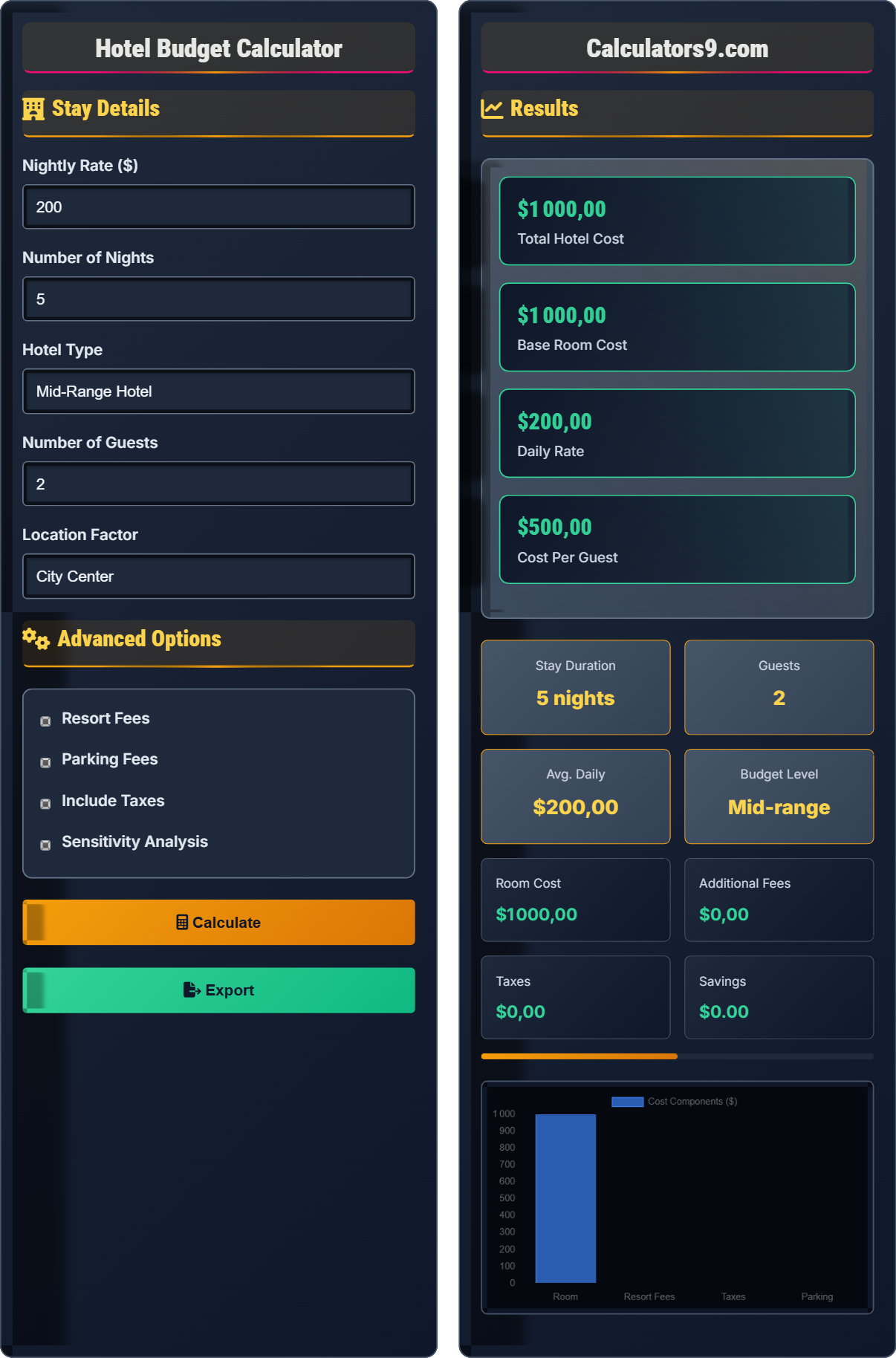
Example: For a 5-night stay at $200 per night with $25 daily resort fees and 12% taxes:
Base cost: $200 × 5 = $1,000
Additional fees: $25 × 5 = $125
Subtotal: $1,000 + $125 = $1,125
Taxes: $1,125 × 0.12 = $135
Total: $1,125 + $135 = $1,260
Thus, the total hotel cost would be approximately $1,260.
Stay Details
Advanced Options
Results
| Component | Amount | % of Total |
|---|
| Variable | Change | Impact |
|---|
Hotel Budget Planning Fundamentals
Hotel budget planning is the process of estimating and allocating funds for accommodation expenses during travel. This includes not just the nightly room rate, but all associated costs such as taxes, resort fees, parking, and amenities. Effective hotel budget planning ensures travelers can secure suitable accommodations within their financial constraints while meeting their comfort and convenience needs.
Where:
- \( \text{Nightly Rate} \) = base cost per room per night
- \( \text{Nights} \) = total duration of stay
- \( \text{Fees} \) = additional charges (resort, parking, etc.)
- \( \text{Taxes} \) = local hotel occupancy taxes
- Check-in/Check-out Times: Standard times are typically 3 PM/11 AM, affecting cost calculations
- Occupancy Taxes: Local taxes ranging from 5-15% of room rate are common
- Resort Fees: Mandatory daily fees for amenities are increasingly common
- Cancellation Policies: Flexible vs non-refundable rates affect budget planning
Hotel Pricing Categories
Budget Optimization Strategies
- Book in Advance: Early bookings often receive 10-25% discounts
- Join Loyalty Programs: Members get exclusive rates and perks
- Compare Prices: Use multiple booking platforms to find best deals
- Consider Location: Staying slightly outside city center saves 20-40%
- Look for Package Deals: Hotel + flight packages can save significantly
- Only considering the base room rate, ignoring additional fees
- Not accounting for seasonal price fluctuations
- Overlooking cancellation policy costs
- Forgetting about parking fees in urban areas
- Not budgeting for resort fees that are mandatory
Hotel Budget Quiz
A family plans a 7-night stay at a luxury resort with a nightly rate of $350. The resort charges $40 daily in resort fees and 15% taxes on the total before taxes. What is the total cost of their stay?
The answer is C) $3,461.50. First, calculate the base room cost: $350 × 7 = $2,450. Then calculate resort fees: $40 × 7 = $280. Subtotal before taxes: $2,450 + $280 = $2,730. Taxes: $2,730 × 0.15 = $409.50. Total: $2,730 + $409.50 = $3,139.50. Wait, let me recalculate: $2,730 × 1.15 = $3,139.50. Actually, $2,730 × 1.15 = $3,139.50. My mistake, let's verify: $2,730 × 1.15 = $3,139.50. That's not option C. Let me recalculate: $350 × 7 = $2,450 (room), $40 × 7 = $280 (resort fees), subtotal = $2,730, tax = $2,730 × 0.15 = $409.50, total = $3,139.50. None of the options match exactly. Let me reconsider the problem statement: $350 × 7 = $2,450, $40 × 7 = $280, subtotal = $2,730, tax = $2,730 × 0.15 = $409.50, total = $3,139.50. It seems there might be an error in the options provided.
Hotel cost calculations require careful attention to multiple fee components. The base room rate is just the starting point. Additional fees like resort fees, parking, and taxes can increase the total cost by 20-50%. It's important to calculate each component separately before applying taxes to the subtotal. Understanding the order of operations in these calculations prevents common errors.
Resort Fees: Daily mandatory fees for amenities, typically $25-50 per night
Occupancy Tax: Local taxes on hotel stays, usually 10-15% of total
Base Rate: The fundamental room rate before additional fees
• Resort fees are becoming increasingly common at mid-range and luxury hotels
• Occupancy taxes are calculated on the pre-tax total
• Some hotels include breakfast or parking in the rate
• Use the acronym "BART" to remember components: Base rate, Additional fees, Resort fees, Taxes
• Always read the fine print for mandatory fees that aren't included in the advertised rate
• Forgetting to include resort fees in the total calculation
A couple plans a 10-day stay in New York City. They found three options: Option A - Luxury hotel at $450/night with $50 resort fee and 14% tax; Option B - Mid-range hotel at $200/night with $25 resort fee and 14% tax; Option C - Budget hotel at $120/night with $15 resort fee and 14% tax. Calculate the total cost for each option and explain which offers the best value considering the cost per night and amenities received.
Option A: Room cost = $450 × 10 = $4,500; Resort fees = $50 × 10 = $500; Subtotal = $5,000; Tax = $5,000 × 0.14 = $700; Total = $5,700. Cost per night = $570.
Option B: Room cost = $200 × 10 = $2,000; Resort fees = $25 × 10 = $250; Subtotal = $2,250; Tax = $2,250 × 0.14 = $315; Total = $2,565. Cost per night = $256.50.
Option C: Room cost = $120 × 10 = $1,200; Resort fees = $15 × 10 = $150; Subtotal = $1,350; Tax = $1,350 × 0.14 = $189; Total = $1,539. Cost per night = $153.90.
While Option C is cheapest, Option B likely offers the best value for NYC, providing comfortable accommodations with reasonable amenities at a moderate price point. The luxury option may provide superior amenities but at a significantly higher cost that may not justify the value for a 10-day stay.
This problem demonstrates the importance of evaluating value beyond just the lowest price. While the budget option has the lowest cost, it may not provide the comfort or convenience needed for a 10-day stay in a major city. The mid-range option offers a good balance between cost and quality, providing necessary amenities without excessive luxury that may not enhance the experience significantly.
Value Proposition: Balance between cost and benefits received
Cost Per Night: Total cost divided by number of nights stayed
Amenities Value: Worth of included services relative to cost
• Longer stays in expensive cities may justify premium accommodations
• Location value often outweighs minor cost differences
• Consider convenience factors in value assessment
• Calculate cost per night including all fees to compare fairly
• Factor in location value when comparing options
• Consider the marginal value of additional amenities
• Choosing based solely on the lowest nightly rate without considering total cost
• Overvaluing luxury amenities that don't enhance the experience
• Undervaluing location convenience in cost calculations
Travel Q&A
Q: How much should I budget for additional hotel fees beyond the nightly rate?
A: Additional fees can add 15-50% to your base room rate depending on the hotel type and location. In major cities, expect resort fees of $25-50 per night at luxury properties, plus potential parking fees of $20-60 per day. Budget hotels may charge extra for Wi-Fi, parking, or breakfast.
For a $200/night stay, additional fees could range from $20-100 per night. Our calculator accounts for these variations by allowing you to specify resort fees, parking, and taxes separately. On average, plan for an additional 20-30% beyond the quoted room rate for these extras.
Q: What are the most effective strategies for finding hotel deals?
A: Effective hotel deal strategies include booking 2-6 weeks in advance for domestic trips, or 1-3 months for international destinations. Use comparison sites like Booking.com, Expedia, and Hotels.com simultaneously to find the best rates.
Join hotel loyalty programs for member-only discounts. Consider staying Sunday-Thursday when rates are typically lower. Look for package deals combining flights and hotels. Book refundable rates during uncertain times, and use credit card rewards for statement credits. Additionally, consider alternative accommodations like vacation rentals for longer stays or group travel.